
Choosing the Right EV Battery Cooling System for Your Application
Thermal management is one of the most critical design decisions in any electric vehicle or battery-powered system. Get it wrong, and you face accelerated cell degradation, reduced range, thermal runaway risk, and warranty claims that eat into margins. Get it right, and your battery pack delivers consistent performance across thousands of cycles.
The conversation around battery cooling typically defaults to liquid cooling loops — and for good reason. Liquid cooling dominates in passenger EVs and high-performance applications where energy density and C-rates push cells to their thermal limits. But liquid cooling is not always the right answer. For a growing number of applications — from small EV platforms and battery energy storage systems to charging infrastructure and fleet auxiliary power — DC-powered air conditioning offers a simpler, lighter, and more cost-effective thermal management path.
This article breaks down when a DC air conditioning approach makes more sense than liquid cooling for your EV battery cooling system, the scenarios where each technology excels, and how to evaluate the tradeoffs for your specific use case.
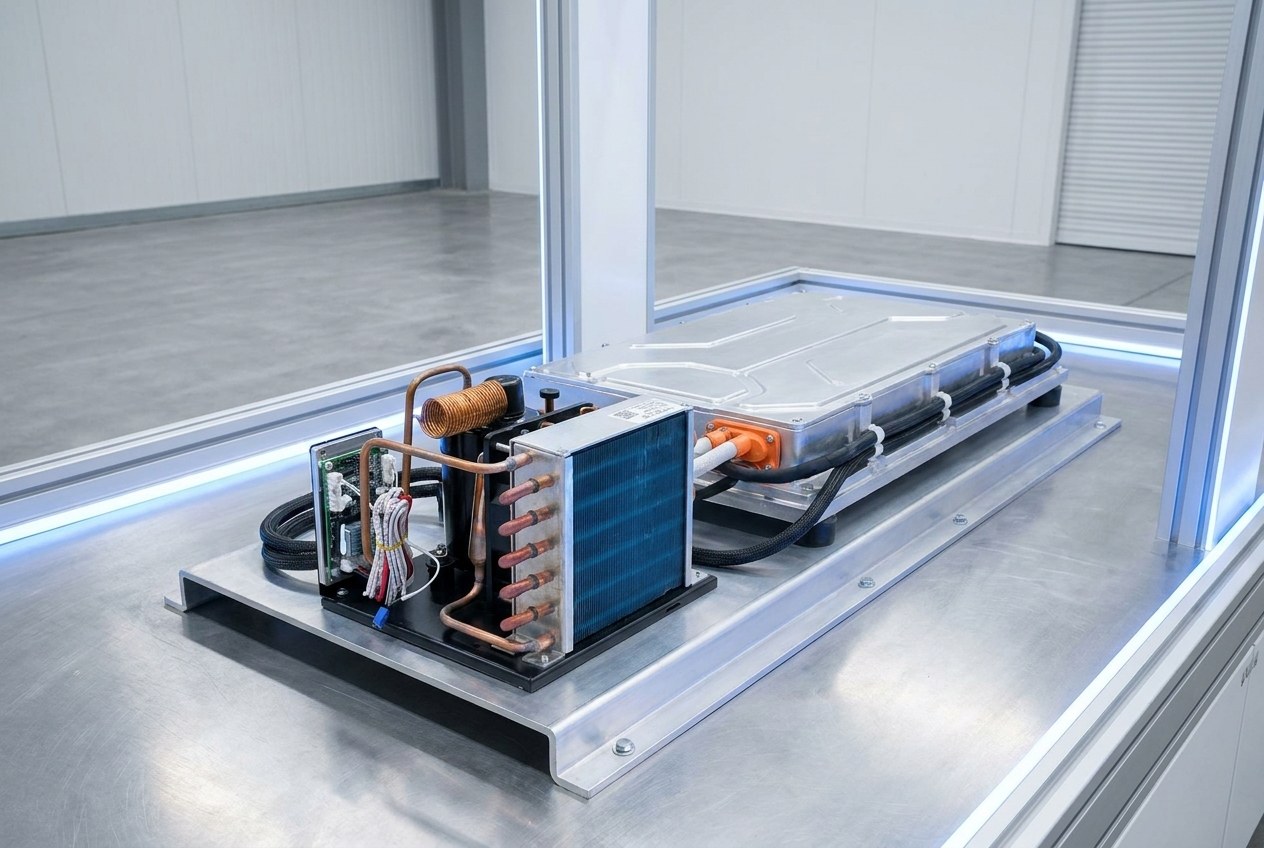
How Liquid Cooling Works for Battery Packs
Liquid cooling systems circulate a coolant (typically a water-glycol mixture) through channels or cold plates that make direct contact with battery cells or modules. A pump drives the coolant through the loop, and a chiller or radiator rejects heat to the ambient environment.
The advantages are clear: liquid has roughly 4x the heat capacity of air, enabling high heat flux removal from densely packed cells. This makes liquid cooling essential for large traction battery packs in passenger EVs, where cells operate at high C-rates during acceleration and fast charging.
However, liquid cooling comes with significant engineering overhead:
- Complexity: Pumps, reservoirs, hoses, fittings, cold plates, and a chiller unit all add components that can fail
- Leak risk: Coolant leaks in a battery enclosure can cause short circuits and catastrophic failure
- Weight: The complete loop — coolant, plumbing, pump, chiller — adds 15-30 kg depending on pack size
- Cost: Custom cold plates, leak-tested fittings, and redundant sensors drive up BOM cost significantly
- Maintenance: Coolant degrades over time, pumps wear out, and the system requires periodic inspection
- Design integration: Cold plates must be custom-designed for each cell geometry and module layout
For large-scale EV traction packs running at 2C-5C discharge rates, this complexity is justified. The thermal load simply cannot be managed any other way. But many battery applications operate well below these thresholds.
When DC Air Conditioning Makes More Sense
Air-based cooling using a vapor compression cycle (essentially a miniature air conditioner) takes a fundamentally different approach. Instead of circulating liquid through the pack, it circulates conditioned air through the battery enclosure, removing heat via convection.
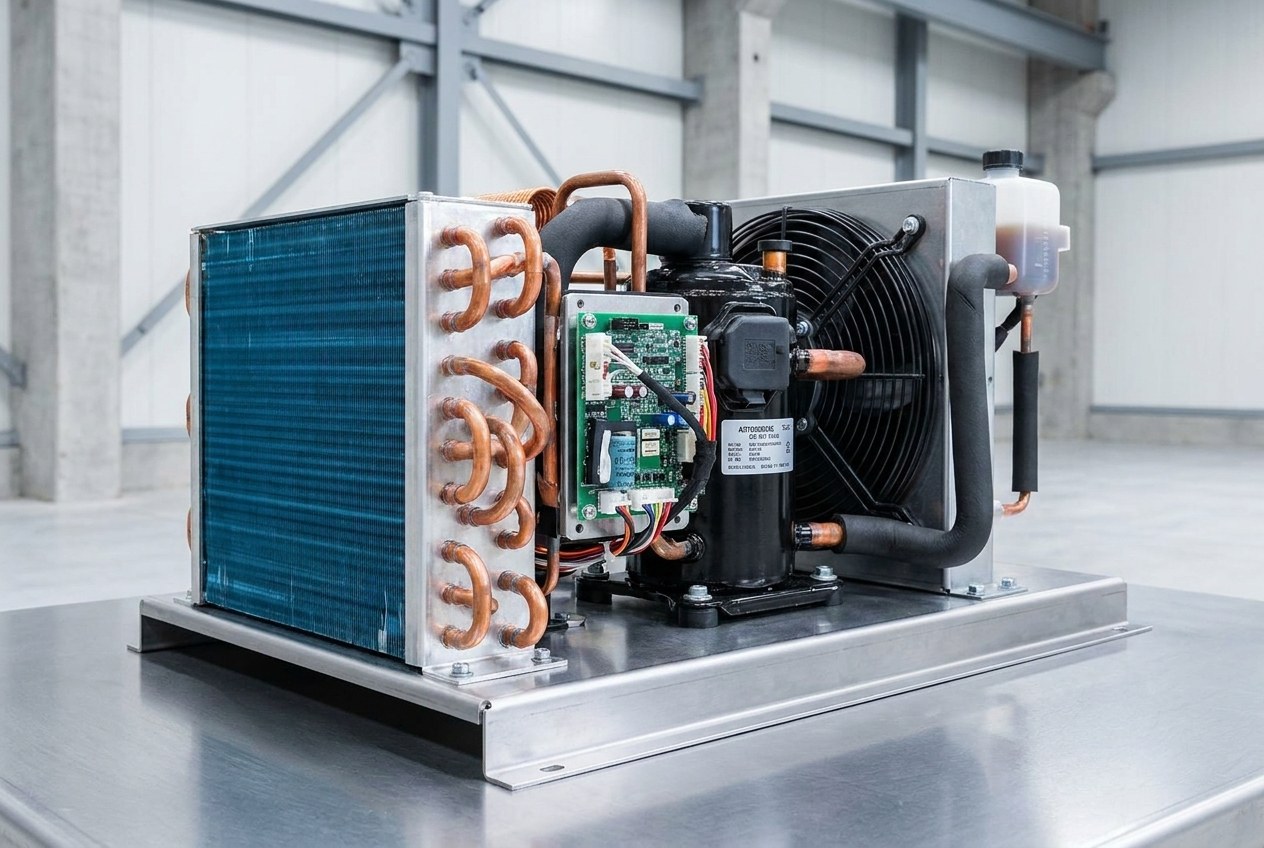
A DC-powered micro air conditioning unit uses a brushless DC compressor to run a standard refrigeration cycle with R134a refrigerant. The evaporator cools air inside the enclosure while the condenser rejects heat outside. The entire system is self-contained — no plumbing, no coolant, no leak risk inside the battery box.
This approach works well when:
- Heat loads are moderate: Battery packs operating at 0.5C to 1C discharge rates, or packs with lower energy density that generate less waste heat per cell
- The enclosure is sealed: Battery boxes, charging cabinets, and energy storage containers that need climate control without exposing cells to ambient air
- Simplicity matters: Applications where maintenance access is limited, or where the cost of a liquid cooling failure (leak) is unacceptable
- Weight is constrained: Small EV platforms, drones, or mobile applications where every kilogram counts
- DC power is available: Systems already running on 12V, 24V, or 48V DC where adding an inverter for AC-powered cooling adds unnecessary complexity and efficiency loss
Comparing the Two Approaches: A Practical Framework
Rather than declaring one approach universally better, the right choice depends on your specific thermal load, available space, power budget, and reliability requirements.
Thermal Load Capacity
Liquid cooling can handle heat fluxes above 10 W/cm² at the cell surface. Air-based systems are practical for enclosure-level cooling where the total heat load stays within the unit’s rated capacity — for example, 450W to 900W of cooling capacity for compact DC aircon units.
As a rough guideline (not a hard rule): if your pack generates less than approximately 1 kW of waste heat during normal operation, air-based cooling deserves serious consideration. Above 2-3 kW, liquid cooling becomes increasingly necessary.
Temperature Uniformity
Liquid cooling excels at maintaining tight temperature uniformity across cells (typically ±2°C) because the cold plate provides direct conductive contact. Air-based systems achieve wider uniformity ranges (approximately ±3-5°C) depending on airflow design within the enclosure. For applications where cell-to-cell temperature variation is less critical — such as LFP chemistry packs or lower C-rate applications — this wider range is entirely acceptable.
System Weight and Volume
A complete liquid cooling loop for a 10 kWh pack might weigh 15-25 kg including coolant, pump, chiller, and plumbing. A DC micro aircon unit weighs approximately 5 kg (11 lbs) and mounts directly to the enclosure wall. For small EV platforms, battery swap stations, or mobile energy storage, this weight difference is significant.
Installation Complexity
Liquid cooling requires custom cold plate design, leak-tested connections, a pump controller, coolant fill and bleed procedures, and ongoing maintenance. A DC aircon unit bolts to the enclosure with basic mounting hardware and connects to the DC bus — installation can be completed in hours rather than days.
Reliability and Maintenance
Every fitting in a liquid loop is a potential leak point. In vibration-heavy environments (vehicles, mobile equipment), these connections fatigue over time. Air-based systems eliminate this failure mode entirely. The BLDC compressor in modern DC aircon units is designed for long service life with minimal maintenance.
Real-World Application Scenarios
EV Charging Infrastructure
DC fast charging stations house battery buffers that absorb grid power during off-peak hours and deliver it during peak demand. These battery cabinets sit outdoors in all weather conditions and need reliable thermal management without complex maintenance schedules. A DC air conditioning unit maintains the enclosure temperature below the battery’s optimal operating range regardless of ambient conditions, with no coolant to leak and no pump to fail.
Small EV Platforms and Low-Speed Vehicles
Golf carts, warehouse AGVs, last-mile delivery vehicles, and small utility EVs typically use battery packs in the 5-20 kWh range operating at moderate C-rates. These applications rarely justify the cost and complexity of liquid cooling. A 450W or 700W DC aircon unit provides adequate cooling while running directly from the vehicle’s DC bus.
Battery Energy Storage Systems (BESS)
Container-based or cabinet-based energy storage systems need climate control to maintain battery temperature within operating limits. For smaller BESS installations (under 100 kWh), DC air conditioning provides a simpler alternative to liquid cooling with fewer failure points and lower installation cost.
Fleet Auxiliary Battery Packs
Trucks and commercial vehicles increasingly use auxiliary battery packs for hotel loads, liftgate power, and refrigeration unit backup. These packs operate independently from the traction battery and need their own thermal management. A compact DC aircon unit running on the vehicle’s 24V or 48V system provides dedicated cooling without tapping into the main vehicle’s thermal management loop.
The RIGID Micro DC Aircon: Purpose-Built for Battery Enclosures
RIGID’s Micro DC Aircon series is designed specifically for enclosed space cooling applications including battery boxes, charging cabinets, and electronic enclosures. The product line spans multiple voltage and capacity options to match different battery system architectures:
- DV1910E-AC: 450W (1,535 BTU) cooling capacity, 12V DC input, R134a refrigerant
- DV2820E-AC: 700W (2,387 BTU) cooling capacity, 24V DC input, R134a refrigerant
- DV3820E-AC: 900W (3,069 BTU) cooling capacity, 24V DC input, R134a refrigerant
- DV3830E-AC: 900W (3,069 BTU) cooling capacity, 48V DC input, R134a refrigerant
Key specifications relevant to battery cooling applications:
- Weight: Approximately 5 kg (11 lbs) — light enough for mobile and vehicle-mounted applications
- Cooling temperature: Can reach ≤20°C (68°F), well within optimal operating range for most lithium-ion chemistries
- COP: Approximately 2.5, meaning 2.5W of cooling for every 1W of electrical input
- Compressor: BLDC (brushless DC) variable-speed compressor for accurate temperature stability
- Refrigerant: R134a vapor compression cycle — proven, reliable, and widely serviceable
The variable-speed compressor is particularly relevant for battery applications. Rather than cycling on and off (which creates temperature swings), the compressor modulates its speed to maintain a stable enclosure temperature. This reduces thermal cycling stress on battery cells and improves overall pack longevity.
For more details on specifications and application guidance, visit the RIGID Micro DC Aircon product page.
Application Boundaries: When NOT to Use Air-Based Cooling
Honesty about limitations builds trust. DC air conditioning is not the right solution for every battery thermal management challenge:
- Large traction battery packs: Passenger EV packs (40-100+ kWh) operating at high C-rates during acceleration and regenerative braking generate heat loads that exceed what air-based systems can handle. These packs need liquid cooling loops with direct cell contact.
- High C-rate fast charging: Packs being charged above approximately 3C generate intense, concentrated heat that requires the high heat flux removal capability of liquid cooling with cold plates.
- Extreme temperature uniformity requirements: Applications requiring ±1°C cell-to-cell uniformity (such as high-performance racing or aerospace) need the direct conductive contact that only liquid cooling provides.
- Very large enclosures: If your battery enclosure volume exceeds what a 900W cooling unit can maintain at target temperature given your ambient conditions and insulation, you’ll need either multiple units or a different approach.
The sweet spot for DC air conditioning is moderate heat loads (under approximately 1 kW), sealed enclosures, DC power availability, and applications where simplicity and reliability outweigh the need for maximum thermal performance.
Cost and Complexity Comparison
For a typical small-to-medium battery pack application (5-20 kWh, moderate C-rate), here’s how the two approaches compare on total system cost:
Liquid Cooling System (Estimated)
- Custom cold plates: varies significantly by design
- Pump, reservoir, and plumbing: additional components and labor
- Chiller unit: separate cooling system required
- Sensors and controls: leak detection, flow monitoring, temperature sensors
- Installation labor: custom fitting, leak testing, coolant fill
- Ongoing maintenance: coolant replacement, pump inspection, leak checks
DC Air Conditioning System
- RIGID Micro DC Aircon unit: $580-$810 depending on model (based on published pricing)
- Mounting hardware and ducting: minimal additional cost
- Installation labor: bolt-on mounting, DC power connection
- Ongoing maintenance: minimal — no coolant, no pump, no leak risk
The total cost of ownership difference is substantial, particularly when you factor in maintenance over the system’s lifetime. For fleet applications with dozens or hundreds of battery packs to manage, the simplicity advantage compounds significantly.
Integration Considerations
If you’re evaluating DC air conditioning for your battery cooling application, consider these design factors:
Enclosure Design
The aircon unit needs adequate airflow across the battery cells. Design the enclosure with inlet and outlet paths that ensure air circulates past all cells, not just those nearest the evaporator. Baffles or directed airflow channels improve temperature uniformity.
Insulation
A well-insulated enclosure reduces the cooling load by minimizing heat gain from ambient conditions. This is especially important for outdoor installations in hot climates where solar radiation adds significant thermal load.
Controls Integration
The variable-speed compressor can be controlled via the battery management system (BMS) to modulate cooling based on actual cell temperatures rather than just enclosure air temperature. This provides tighter thermal control and reduces energy consumption during low-load periods.
Voltage Matching
Select the aircon model that matches your battery system voltage. Running a 12V unit from a 48V pack requires a DC-DC converter, adding cost and efficiency loss. The availability of 12V, 24V, and 48V models in the RIGID lineup means you can usually find a direct voltage match.
Redundancy
For critical applications, consider mounting two smaller units rather than one larger unit. If one fails, the other maintains partial cooling until service can be performed. This approach is common in telecom battery backup installations.
Making the Decision
The choice between liquid cooling and DC air conditioning for your EV battery cooling system comes down to matching the solution to the problem:
- Choose liquid cooling when you have large packs, high C-rates, tight uniformity requirements, and the engineering resources to design and maintain a complex thermal loop.
- Choose DC air conditioning when you have moderate heat loads, sealed enclosures, DC power available, and you value simplicity, reliability, and lower total cost of ownership.
Many successful battery thermal management designs use a combination — liquid cooling for the main traction pack and air-based cooling for auxiliary battery systems, charging infrastructure, or energy storage cabinets. The key is matching the thermal management approach to the actual requirements of each application rather than defaulting to the most complex solution available.
For battery pack designers and fleet managers working with moderate-scale applications, DC air conditioning represents a practical, proven approach that eliminates the most common failure modes of liquid cooling while delivering adequate thermal performance for the intended use case.