
Why Your EV Charger Cabinets Need a Micro DC Refrigeration System
If you manage EV charging stations, you already know the problem. Summer hits, ambient temperatures climb past 35°C, and your charging cabinets start throttling. Power modules derate. Screens flicker. Contactors trip on thermal protection. Revenue drops because chargers that should be pushing 150kW are limping along at 60kW — or shutting down entirely.
This isn’t a rare edge case. It’s the single most common failure mode in outdoor DC fast-charging infrastructure. And it’s getting worse as charger power densities increase and climate patterns push summer peaks higher year after year.
The root cause is straightforward: modern EV charger power electronics generate significant waste heat inside sealed NEMA 4/IP65 cabinets. These enclosures are designed to keep water and dust out — but they also trap heat in. Without active thermal management, internal cabinet temperatures can exceed 60°C on a 40°C day, pushing IGBTs, capacitors, and control boards well past their rated operating envelopes.
The Real Cost of Charger Cabinet Overheating
Let’s quantify what overheating actually costs a charging station operator. It’s not just about component replacement — though that’s expensive enough. The cascading effects hit your bottom line in multiple ways.
Power Derating and Revenue Loss
Most DC fast chargers implement thermal derating curves that begin reducing output power when internal temperatures exceed 45-50°C. A 150kW charger that derates to 80kW during peak afternoon hours — exactly when utilization is highest — represents a direct revenue loss. If your station charges $0.35/kWh and you lose 70kW of capacity for 6 hours daily during summer months, that’s roughly $147 per charger per day in lost potential revenue.
Component Degradation and Premature Failure
Electrolytic capacitors in power modules follow the Arrhenius equation for lifespan: every 10°C increase above rated temperature cuts expected life in half. A capacitor rated for 10,000 hours at 85°C will last only 2,500 hours if consistently operated at 105°C. At $3,000-$8,000 per power module replacement (plus downtime), this adds up fast across a network.
Warranty and Compliance Issues
Many charger OEMs specify operating ambient ranges of -20°C to +50°C for the cabinet interior. Operating consistently above this range can void warranties and create compliance issues with safety certifications. When a charger fails and the data logs show sustained over-temperature operation, you may be on your own for the repair bill.
Customer Experience and Network Reputation
EV drivers remember unreliable stations. A charger that’s frequently offline or delivering reduced power during hot afternoons gets poor ratings on PlugShare and similar platforms. Drivers route around unreliable stations, and that utilization never comes back easily.
Why Traditional Cooling Approaches Fall Short
Before we discuss the solution, let’s address why the obvious approaches often don’t work for EV charger cabinets specifically.
Ventilation Fans
Filtered fan ventilation is the cheapest option, but it fundamentally breaks the sealed enclosure concept. You’re introducing ambient air — along with dust, humidity, salt spray (coastal installations), and insects — directly into cabinets containing high-voltage power electronics. In many environments, this leads to creepage and clearance failures, corrosion on bus bars, and arc flash risks. For IP65-rated outdoor cabinets, ventilation fans are usually not an option without voiding the enclosure rating.
Heat Exchangers (Air-to-Air)
Sealed air-to-air heat exchangers maintain the enclosure seal but can only reduce internal temperature to slightly above ambient. On a 45°C day with 400W of internal heat generation, you might achieve 55°C internal — still well above the derating threshold for most power electronics. Heat exchangers work when the thermal challenge is modest, but they can’t provide cooling below ambient temperature.
Oversized Enclosures
Making the cabinet bigger increases surface area for passive dissipation, but it also increases cost, installation footprint, and shipping expense. For retrofit situations — which represent the majority of overheating problems — resizing the enclosure usually means a complete site redesign.
Traditional Split AC Systems
Conventional AC systems designed for buildings are oversized, require AC mains power (adding complexity to DC-native charging systems), and are not designed for the vibration, temperature cycling, and duty cycles that outdoor cabinets experience. They also typically require professional HVAC installation and refrigerant handling certifications.
The Micro DC Aircon Approach: Right-Sized Active Cooling
What EV charger cabinets actually need is a compact, self-contained cooling system that delivers genuine refrigeration (cooling below ambient), runs on DC power directly from the charger’s internal bus, fits within the existing cabinet footprint, and is designed for the specific thermal loads involved.
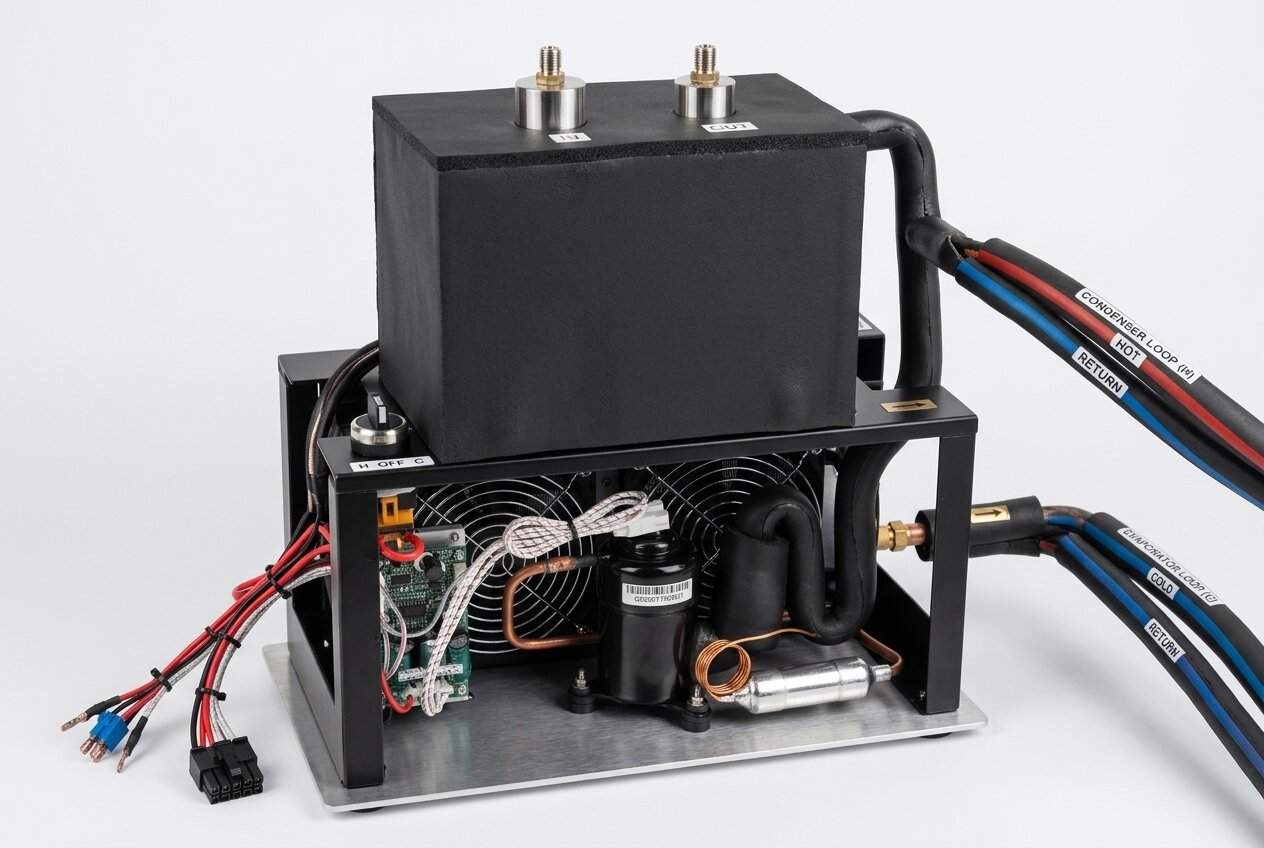
This is exactly what a micro DC aircon system provides. These units are purpose-built for sealed enclosure cooling in the 450W to 900W capacity range — which maps precisely to the thermal management needs of most 50kW to 350kW DC fast charging cabinets.
Key Technical Advantages for EV Charging Applications
True DC Operation (12V/24V/48V): The system runs directly from DC power without requiring an inverter. In a DC fast charger, you already have 24V or 48V auxiliary buses powering contactors, control boards, and communication modules. The micro DC aircon taps directly into this existing infrastructure. No additional AC circuit, no inverter losses, no added complexity.
BLDC Compressor with Variable Speed: Unlike fixed-speed compressors that cycle on/off (creating temperature swings and inrush current spikes), the BLDC compressor runs at variable speed. This enables precise temperature control — typically maintaining cabinet interior within ±2°C of setpoint. For power electronics that derate on thermal curves, this precision matters. You maintain maximum charging output without the thermal cycling that accelerates component fatigue.
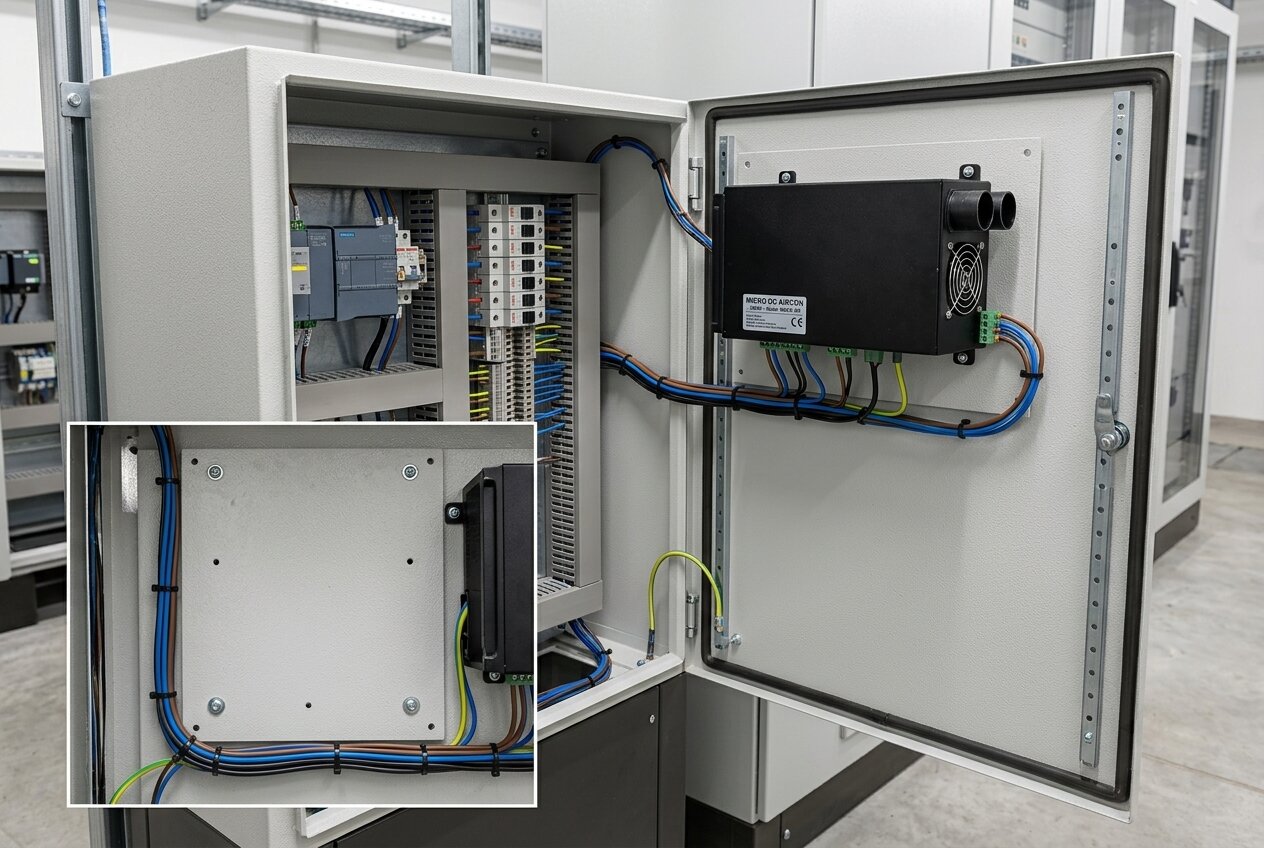
Compact Form Factor (~5kg): At approximately 5kg and with dimensions designed for panel or roof mounting on standard 19-inch and NEMA-sized enclosures, these units retrofit into existing installations without structural modifications. This is critical for addressing overheating problems in already-deployed charging networks.
R134a Vapor Compression: Real refrigeration using R134a refrigerant delivers genuine cooling capacity below ambient temperature. On a 45°C day, the system can maintain cabinet interiors at 30-35°C — well within the safe operating envelope for all power electronics components. This is fundamentally different from heat exchangers or fans that can only approach ambient temperature.
Cooling Capacity Matched to Real Thermal Loads
The 450W-900W cooling capacity range isn’t arbitrary. Let’s look at real thermal loads in DC fast charging cabinets:
A 150kW DC fast charger operating at 95% efficiency generates approximately 7.5kW of waste heat. However, this heat is distributed across multiple modules and the cabinet structure itself acts as a heat sink. The net heat load that accumulates inside the sealed cabinet — accounting for cabinet surface dissipation — typically ranges from 300W to 800W depending on cabinet design, ambient conditions, and power level.
For single-module 50kW chargers, internal heat accumulation runs 150-400W. For dual-module 150kW+ chargers, it’s 400-900W. The micro DC aircon system’s capacity range covers this spectrum, and variable speed operation means it’s not oversized for lighter loads — it simply runs slower, consuming less power and extending component life.
Installation Considerations for Charging Station Operators
Deploying micro DC aircon in EV charging cabinets is straightforward, but there are practical considerations worth noting.
Mounting Position
Top-mounted installations are preferred for EV charger cabinets because hot air naturally stratifies upward. The evaporator (cold side) faces into the cabinet interior while the condenser (hot side) rejects heat to ambient. Ensure the condenser has adequate airflow clearance — minimum 100mm from any obstruction.
Power Connection
Connect to the charger’s auxiliary DC bus. Most modern DC fast chargers provide 24V or 48V auxiliary outputs specifically for cabinet accessories. The micro DC aircon’s power draw (varying with compressor speed and thermal load) typically represents less than 2% of the charger’s total power capacity — a negligible overhead for the reliability benefit gained.
Thermostat Integration
The built-in controller supports configurable setpoints within the 5-30°C range. For EV charger applications, setting the target at 30°C provides adequate margin below the typical 45-50°C derating threshold while minimizing energy consumption. Lower setpoints increase cooling capacity utilization and energy draw without proportional reliability benefit.
Condensate Management
When cooling below dew point, condensation occurs on the evaporator. The system includes condensate drainage provisions. For outdoor installations, route the drain line away from the cabinet base and any cable entry points. In cold climates, consider a condensate heating element to prevent ice blockage during shoulder-season operation.
What This Solution Is — and Isn’t — Good For
Honesty about application boundaries is important. The micro DC aircon system is well-suited for specific scenarios and less appropriate for others.
Ideal Applications
- 50kW-350kW DC fast charger cabinets with sealed (IP54/IP65) enclosures experiencing thermal derating in summer operation
- Retrofit thermal management for existing charging networks where cabinet redesign isn’t practical
- Sites in hot climates (ambient >35°C regularly) where passive cooling and heat exchangers are insufficient
- Revenue-critical stations where derating directly impacts business performance
- Remote or unmanned installations where maintenance visits are expensive and reliability is paramount
Not Suitable For
- Large charging hub power rooms with aggregate heat loads exceeding 2kW — these need industrial HVAC or dedicated mechanical rooms
- Open-air or ventilated enclosures — if your cabinet is already ventilated, the cooling capacity will be lost to the environment
- Cabinets with major seal integrity issues — fix air leaks first, otherwise you’re cooling the outdoors
- Applications requiring cooling below 5°C — this is thermal management for electronics, not a freezer
Return on Investment: The Business Case
For station operators evaluating the investment, the ROI calculation is relatively straightforward.
Prevented derating revenue: If a charger loses an average of 50kW for 4 hours daily over 120 summer days at $0.30/kWh, that’s $7,200 per charger per season in lost revenue capacity.
Extended component life: Maintaining internal temperatures 15-20°C lower than unmanaged operation can extend power module life by 3-4x based on Arrhenius aging models. At $5,000+ per module replacement, avoiding even one premature failure pays for the cooling system several times over.
Reduced maintenance visits: Fewer thermal trips mean fewer service truck rolls. At $200-$500 per site visit (technician time plus travel), eliminating monthly thermal-related calls saves $2,400-$6,000 annually per problem site.
Most operators report payback periods under 6 months for stations in hot climates with demonstrated thermal issues.
Implementation: Getting Started
If your charging network is experiencing thermal derating or heat-related failures, here’s a practical path forward:
Step 1: Quantify the problem. Pull thermal data from your charger management system. Look for patterns: derating events correlated with ambient temperature, power module replacements concentrated in summer months, and stations with consistently lower utilization during hot periods.
Step 2: Identify priority sites. Focus first on your highest-revenue stations in the hottest locations. These deliver the fastest ROI on thermal management investment.
Step 3: Assess cabinet compatibility. Verify available mounting space (top or side panel), DC auxiliary power availability (24V or 48V), and condensate routing options.
Step 4: Deploy and monitor. Install the micro DC aircon system, set the thermostat to 30°C, and monitor for 30 days. Compare derating events and energy output against the same period pre-installation.
The data will speak for itself. Stations that were throttling at 60% capacity during peak hours typically return to full rated output — and stay there through the entire cooling season.
Ongoing Maintenance
One of the advantages of sealed vapor compression systems is minimal maintenance requirements. There are no filters to replace (the internal air loop is sealed), no refrigerant to top up (hermetic system), and no belts or bearings to service. Periodic visual inspection of the condenser fins for debris accumulation and verification of condensate drainage are the only routine tasks — easily incorporated into existing charger maintenance schedules.
Conclusion: Thermal Management as Infrastructure Investment
EV charging infrastructure is a long-term asset. The electronics inside those cabinets need to perform reliably for 10-15 years to deliver acceptable returns on the installation investment. Operating them consistently at temperatures 20-30°C above their optimal range is the thermal equivalent of running an engine without oil — it works for a while, then it doesn’t.
A micro DC refrigeration system sized correctly for the cabinet’s thermal load is one of the highest-ROI upgrades available to charging station operators. It protects the asset, maintains revenue, reduces maintenance, and extends the operational life of components that are expensive to replace.
The math isn’t complicated. The technology is proven. The question isn’t whether to manage cabinet thermals — it’s how quickly you can deploy the solution before another summer of derating and premature failures eats into your network’s performance.