
Evaporator Superheat Setting: What Changes When There Is No Valve
Superheat guidance in refrigeration is mature and specific. A target of roughly 8 to 12 °F is quoted for many systems; below about 10 °F the risk is liquid refrigerant reaching the compressor, above about 20 °F the refrigerant has boiled off too early in the evaporator and capacity is being wasted. The adjustment procedure is equally well documented: turn the expansion valve stem clockwise to raise superheat, half a turn at a time, and re-measure.
All of that assumes a thermostatic expansion valve. Most miniature DC refrigeration systems do not have one. They meter refrigerant through a capillary tube, which has no adjustment at all — and that single difference changes the entire evaporator superheat setting conversation from a field procedure into a design decision.
On a capillary system, superheat is not set. It is a result — of charge, of line and capillary geometry, and of the operating condition the system happens to be in. This guide covers what that means in practice, why variable speed complicates it further, and how to work the problem when the usual adjustment is unavailable.
What Superheat Is Doing For You
Before discussing how to set it, it helps to be precise about what is being set. Superheat is the temperature of the refrigerant vapor above its saturation temperature at the pressure it is at. Measured at the evaporator outlet, it answers one question: has all the liquid boiled off before the vapor reaches the compressor?
The evaporator superheat setting therefore balances two failures that sit on either side of it:
- Too little superheat means liquid refrigerant survives to the compressor suction. Liquid does not compress, and the consequences run from dilution of the oil to mechanical damage. This is the failure that destroys hardware.
- Too much superheat means the refrigerant finished evaporating partway along the coil, so the remaining length is transferring heat to vapor rather than boiling liquid. Vapor is a far worse heat transfer medium, so capacity falls and the compressor works harder for it. This is the failure that wastes energy.
The asymmetry matters when a system cannot be adjusted: a design that errs high loses efficiency, while one that errs low loses the compressor. Fixed-metering systems are therefore usually designed with more superheat than a valve system would run, deliberately trading efficiency for protection.
Capillary Metering: the Trade Being Made
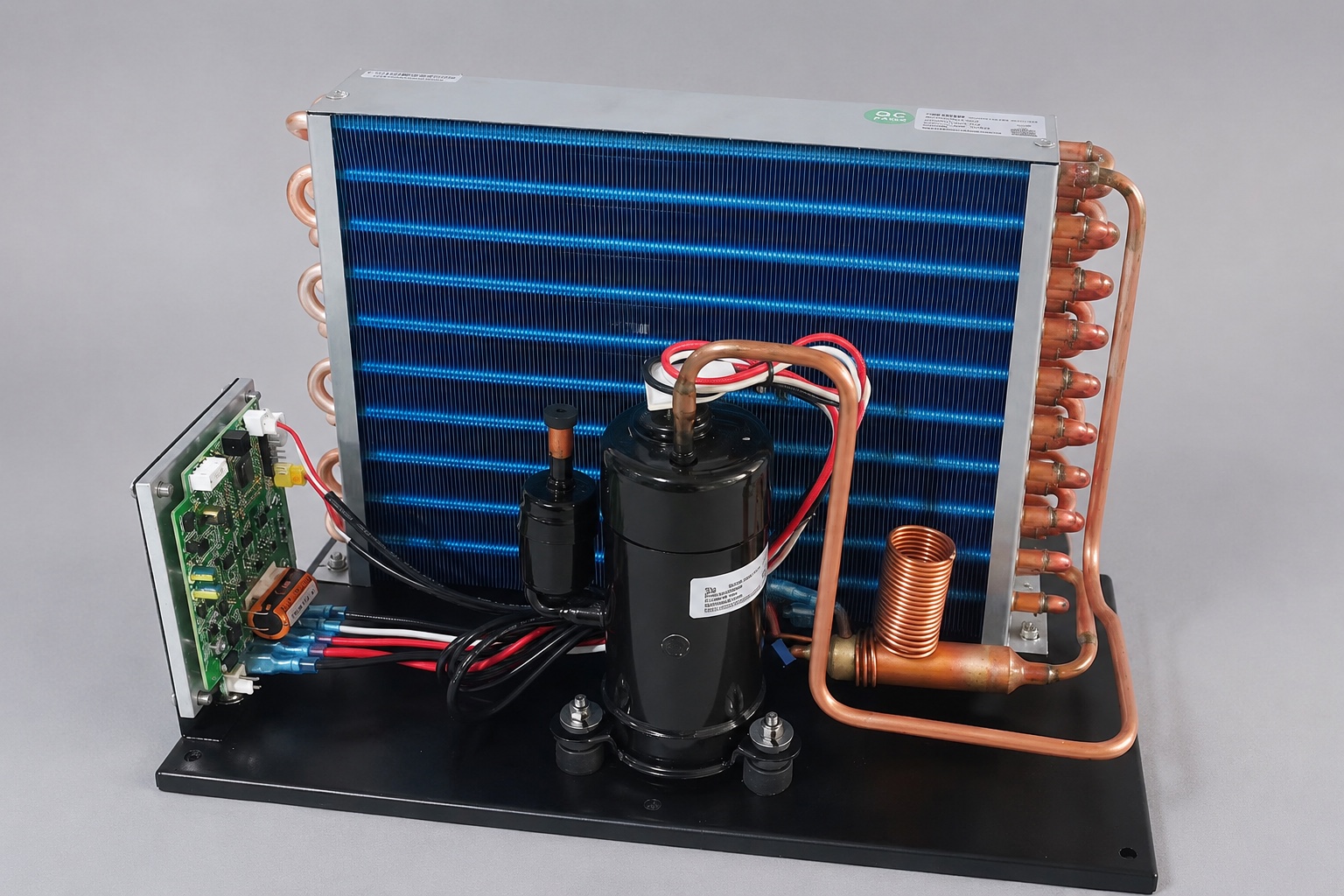 A capillary tube is a fixed restriction. Its flow depends on the pressure difference across it and on the state of the refrigerant entering it, and it has no feedback from the evaporator outlet whatsoever.
| Thermostatic expansion valve | Capillary tube | |
|---|---|---|
| Controls | Superheat directly, by feedback | Nothing; fixed restriction |
| Field adjustable | Yes, by stem | No |
| Behavior at varying load | Maintains superheat across a range | Superheat drifts with condition |
| Cost and complexity | Higher; a moving part | Minimal; a length of tube |
| Charge sensitivity | Tolerant | Very sensitive |
| Suits | Wide operating range | Narrow, predictable duty |
The last two rows are the important ones for a small DC system. Because a capillary has no feedback, the refrigerant charge becomes the primary means of setting where superheat lands — and because the total charge on a miniature system is small, a few grams changes it materially. The evaporator superheat setting is, in effect, chosen at the point the system is charged.
Why Variable Speed Makes It Harder
Variable speed complicates the evaporator superheat setting in a way fixed-speed systems never face. A capillary is sized for one operating point. A fixed-speed system spends its life at that point, which is why capillary metering works well in domestic refrigeration.
A variable-speed compressor moves the operating point continuously. As speed rises, mass flow demand rises, but the capillary’s flow does not rise proportionally — it responds only to the pressure difference across it. The result is that superheat is not constant across the speed range:
- At high speed the compressor pulls harder than the capillary can feed, so the evaporator runs starved and superheat rises. Capacity is lost at exactly the condition where it is most needed.
- At low speed the capillary can over-feed relative to demand, so superheat falls and the margin against liquid return shrinks.
- Both drifts are largest at the extremes of the range, which is why a wide speed span is harder to serve with fixed metering than a narrow one.
For a compressor family published across ranges such as 2,000~6,000 rpm for QX1901VDL(H) at 12 V, or 1,800~4,500 rpm for QX2802VDL at 24 V, that span is a real design consideration. The system has to be acceptable at both ends, not optimal at one.
Measuring Superheat on a System You Cannot Adjust
 Measuring the evaporator superheat setting is still worth doing, because it tells you whether the charge and geometry are right even when there is no stem to turn.
- Measure suction pressure at the compressor inlet and convert to saturation temperature for the refrigerant in use.
- Measure the actual refrigerant line temperature at the evaporator outlet, with the sensor in good thermal contact and insulated from ambient.
- Subtract: superheat is the difference between the two.
- Repeat at the extremes of the operating range — minimum and maximum speed, and at the highest and lowest realistic ambient.
- Record all of it as a commissioning baseline.
Step 4 is the one that separates a useful measurement from a misleading one. A single reading at one condition on a variable-speed capillary system says very little, because the number will be different at the other end of the range. What matters is whether it stays inside acceptable bounds everywhere the system operates.
Step 2 is where measurement errors originate. A probe in poor contact, or exposed to ambient air, reads warm and reports superheat that is not there — which is the dangerous direction, because it hides a flooding risk.
The Levers That Remain
Without a valve, four things still set where the evaporator superheat setting lands:
- Refrigerant charge. The dominant lever. More charge lowers superheat, less raises it. On a small system the sensitivity is high, which is both the problem and the means of control.
- Capillary length and bore. A design-time decision. Longer or narrower restricts more, raising superheat; shorter or wider does the opposite.
- Evaporator size relative to load. An oversized coil finishes boiling early and produces high superheat at part load; an undersized one struggles to complete evaporation at full load.
- Suction line heat gain. An uninsulated suction line adds superheat between the evaporator and the compressor, which protects against liquid return but does so by absorbing heat where it does no useful work.
That last item is worth understanding rather than dismissing. Some fixed-metering designs deliberately use a suction-line heat exchanger, bringing the suction line into contact with the liquid line so the two exchange heat. This subcools the liquid — improving capacity — while adding superheat to the suction vapor, improving protection. It is a way of buying both at once, and it is common in small sealed systems precisely because there is no valve to do the job.
Diagnosing Superheat Symptoms Without a Gauge Set
An evaporator superheat setting problem can be spotted without instruments. Not every installation can be gauged. Several symptoms point at superheat problems indirectly.
| Observation | Suggests | Direction |
|---|---|---|
| Frost on the suction line back to the compressor | Liquid carrying past the evaporator | Superheat too low |
| Evaporator frosted only at the inlet end | Refrigerant boiled off early | Superheat too high |
| Evaporator fully frosted, cabinet still warm | Airflow problem rather than superheat | Neither |
| Capacity falls at high ambient more than expected | Capillary starving at high demand | Superheat rising with load |
| Compressor noise changes on restart after a long off period | Migration of liquid to the compressor while stopped | Charge or off-cycle behavior |
| Running current lower than expected with poor cooling | Undercharge; too little refrigerant circulating | Superheat too high |
The second row is the most diagnostic of the set. A coil that frosts at the inlet and stays clear toward the outlet is showing you exactly where the refrigerant finished evaporating, which is a direct visual reading of excessive superheat.
Design Practices for Fixed-Metering DC Systems
- Charge to a measured superheat, not to a weight alone. Weight is the starting point; the confirmation is a superheat measurement at the design condition.
- Verify at both ends of the speed range before signing off, since one reading proves nothing on a variable-speed system.
- Keep the operating range as narrow as the application allows. A duty that genuinely needs a wide speed span is a case for evaluating a valve rather than a capillary.
- Insulate the suction line unless a suction-line heat exchanger is being used deliberately.
- Design the evaporator against the part-load condition as well as full load, because part load is where an oversized coil produces excessive superheat.
- Record charge, capillary geometry and measured superheat together. Changing any one without the others invalidates the design.
Evaporator and module matching at commissioning is covered in our guide to how a 12V compressor fridge works, and capacity behavior as ambient rises in our discussion of condensing unit derating in compact fridge production. Product data is on the DC condensing unit product page and the 12V compressor product page.
If you want a metering arrangement reviewed, send the following and our engineers will advise: compressor model and speed range, refrigerant, evaporating and condensing temperatures at design and at the extremes, evaporator geometry, capillary length and bore if already selected, expected duty pattern, and whether a suction-line heat exchanger is in the design. Send your system details to our engineering team.
Frequently Asked Questions
How do I adjust superheat on a capillary tube system?
You cannot, in the field. A capillary is a fixed restriction with no feedback and no adjustment. The evaporator superheat setting on such a system is determined by refrigerant charge, capillary geometry and evaporator sizing, all of which are design or charging decisions. Where superheat is wrong, the correction is charge or a different capillary, not an adjustment.
What superheat should a small DC system run?
Published targets for valve-controlled systems sit around 8 to 12 °F, with liquid return risk below roughly 10 °F and significant capacity loss above roughly 20 °F. A fixed-metering system is usually designed to sit higher than a valve system would, deliberately, because it cannot adapt — and erring high costs efficiency while erring low costs the compressor. Confirm your own figure at both ends of the operating range rather than adopting a single target.
Why does my superheat change with compressor speed?
Because a capillary is sized for one operating point and a variable-speed compressor moves continuously away from it. At high speed the compressor demands more mass flow than the capillary delivers, so the evaporator starves and superheat rises. At low speed the reverse happens and superheat falls. Both drifts are largest at the extremes, which is why a wide speed range is harder to serve with fixed metering.
What does frost on the suction line mean?
Frost extending along the suction line toward the compressor usually indicates liquid refrigerant carrying past the evaporator, which means superheat is too low. That is the dangerous direction, because liquid reaching the compressor dilutes oil and can cause mechanical damage. Check charge first, since overcharge is the common cause on a capillary system.
Can I measure superheat without gauges?
Not directly, but several symptoms are informative. An evaporator frosted at the inlet and clear toward the outlet shows where the refrigerant finished boiling and indicates high superheat. Frost running back along the suction line indicates the opposite. Running current lower than expected alongside poor cooling suggests undercharge and high superheat. None of these replaces a measurement, but all of them narrow it.
Is a suction-line heat exchanger worth including?
In fixed-metering systems it often is. Bringing the suction and liquid lines into thermal contact subcools the liquid, which improves capacity, while adding superheat to the suction vapor, which improves protection against liquid return. It buys both at once and needs no moving parts, which is why it appears frequently in small sealed systems that have no valve to do the job.