
Why Every Forklift Air Conditioner Conversation Starts with the Glass Cab Problem
Walk across any warehouse yard in July and watch the forklift operators. Some will have the cab door propped open. Others will be draping wet towels over their necks between pallet runs. A few will have clipped a personal fan to the roll cage — a gesture that moves hot air around without actually removing heat. The pattern is consistent across distribution centers, lumber yards, foundries, and container terminals: the forklift cab is one of the most thermally hostile enclosed workspaces in industrial operations, and most facilities have no engineered cooling solution in place.
The physics are straightforward. A typical sit-down counterbalance forklift has a cab volume between 1.5 and 2.5 cubic meters. Three or four sides are glass or polycarbonate panels — necessary for visibility during mast operations, but functioning as a greenhouse under solar load. The internal combustion engine or the electric drive motor sits directly beneath or behind the operator, radiating heat into the cabin structure. On a 35 °C ambient day, cab interior temperatures can climb past 55–60 °C within minutes of engine start when the unit is parked in direct sun. Even battery-electric forklifts generate significant waste heat from the drive controller and hydraulic systems, though less than their IC counterparts.
 This is not a comfort problem. It is an operational risk. Heat stress among forklift operators leads to slower reaction times, impaired judgment during load handling, and — in documented cases — loss of consciousness while operating a multi-ton vehicle in proximity to pedestrians and racking. OSHA does not currently enforce a specific maximum workplace temperature, but the agency’s Heat Illness Prevention Campaign and the proposed federal heat standard put employers on notice: if an operator suffers a heat-related incident inside a cab that has no engineered cooling, the liability exposure is significant.
Why Standard Cooling Approaches Fail in Forklift Cabs
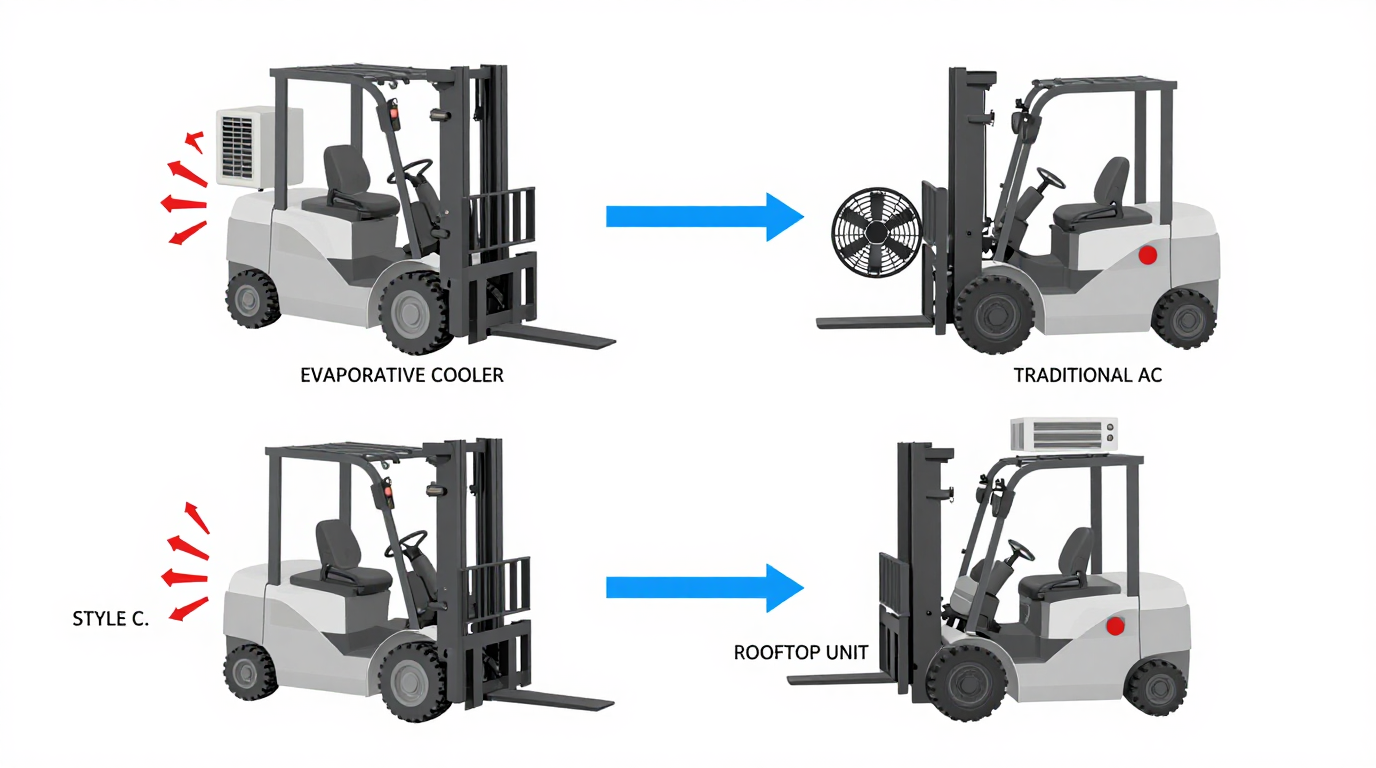
Before evaluating purpose-built solutions, it helps to understand why the obvious options tend to disappoint in this particular application. Fleet managers often cycle through two or three attempts before landing on something that works.
Portable Evaporative Coolers
Swamp coolers depend on low ambient humidity to produce a meaningful temperature drop. In a warehouse or outdoor yard — especially in the southeastern United States, the Gulf Coast, or most of Southeast Asia — relative humidity frequently exceeds 60%. At that point, evaporative cooling delivers perhaps 2–3 °C of reduction, which is imperceptible inside a glass-enclosed cab that is already 20+ degrees above ambient. Additionally, the water reservoir adds weight and requires daily refilling, and the evaporated moisture increases cab humidity further, making the perceived temperature worse.
Cab-Mounted Fans
Fans accelerate air across the operator’s skin, improving convective heat loss. This works when the air temperature is below skin temperature (roughly 33–35 °C). Inside a forklift cab at 55 °C, a fan simply blows hot air faster. The operator may feel a brief sensation of movement, but the core body temperature continues to climb. Fans also generate noise in an already loud environment and obstruct the operator’s sightline if mounted at head height.
Traditional Vehicle AC Compressors
Automotive-style belt-driven compressors require a running engine and are engineered for passenger car volumes of 3–5 cubic meters or more. Adapting one to a forklift typically requires custom bracketry, belt routing, and a condenser location — none of which are straightforward in the compressed engine compartment of a typical forklift. For electric forklifts, there is no engine belt to drive the compressor at all. Even when the mechanical integration succeeds, the system is often oversized for the small cab volume, cycling on and off aggressively and stressing the compressor bearings in a high-vibration environment.
Rooftop-Mounted Consumer Units
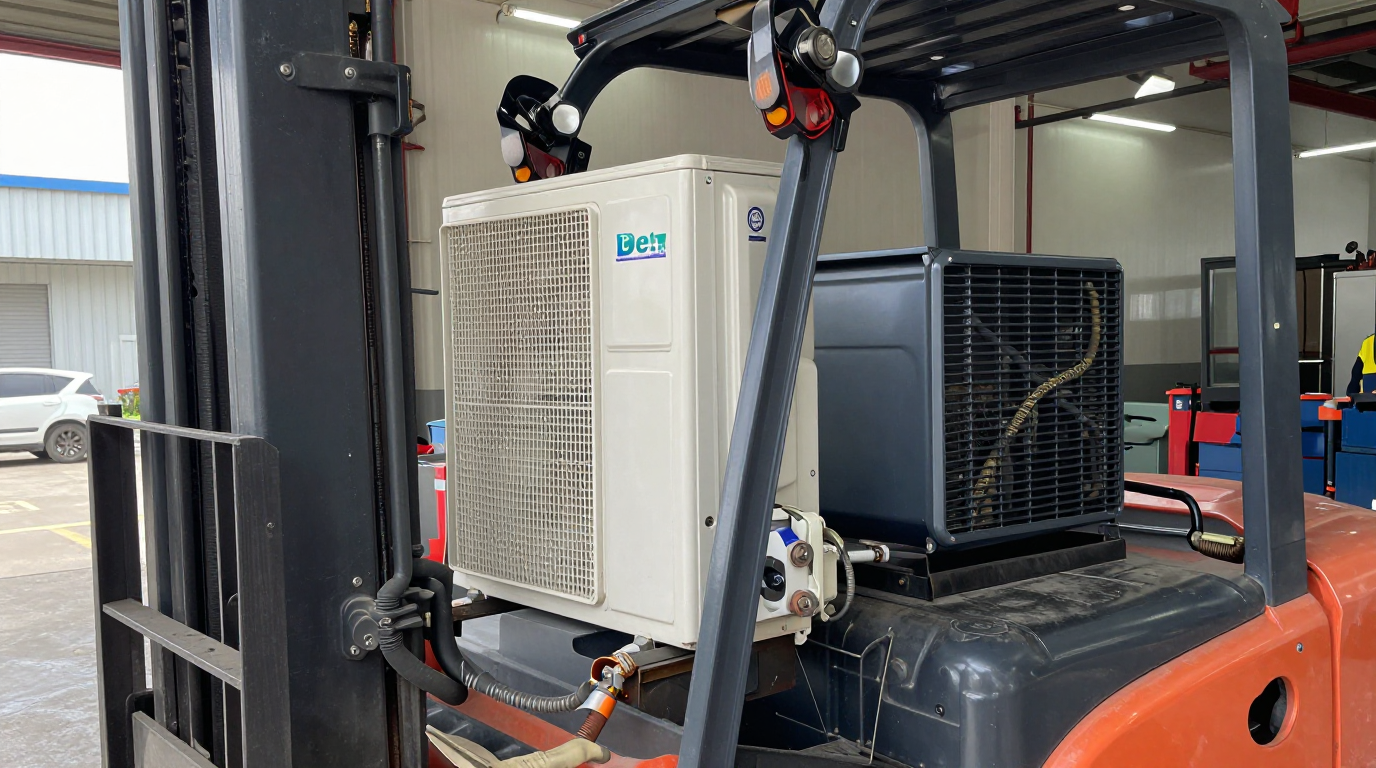
Some operators have attempted to mount residential or RV-style air conditioning units on the forklift’s overhead guard. Beyond the structural concerns — forklift overhead guards are rated for falling-object impact, not sustained static loads from an improperly secured appliance — these units are designed for gentle road vibration at most. The constant jarring of dock plates, uneven yard surfaces, and load engagement creates accelerations that residential compressors are not validated against. Refrigerant leaks, electrical failures, and premature compressor death typically follow within weeks to months.
Mapping the Constraints: What a Forklift Cab Actually Demands
A viable forklift air conditioner must satisfy a set of constraints that, taken together, eliminate most off-the-shelf options. Understanding these constraints is the first step toward a defensible specification.
Space Budget
The operator compartment of a sit-down counterbalance forklift leaves minimal room for additional equipment. The mast assembly, hydraulic lines, steering column, instrument cluster, and operator egress path all compete for space. Any indoor unit must fit within the cab roof lining or a narrow mounting zone behind or beside the operator’s head — typically a volume envelope of roughly 500 mm × 200 mm × 350 mm or less. A split-type system becomes nearly mandatory in this context, because it separates the evaporator (indoor) from the condenser (outdoor), allowing each component to occupy a different physical zone on the machine.
Vibration and Shock
Forklifts experience whole-body vibration levels that are considerably higher than on-road trucks. Traversing dock plates, driving over expansion joints, engaging loads on uneven surfaces, and the hydraulic impulses from mast operations all generate transient shocks. A forklift air conditioner’s compressor, refrigerant connections, and electrical harness must tolerate these accelerations without developing fatigue cracks or loosening fittings. Brazed refrigerant joints, locking electrical connectors, and vibration-isolating mounting brackets are baseline requirements, not optional upgrades.
Power Source Compatibility
Internal combustion forklifts may have a 12V or 24V electrical system, but drawing significant current for air conditioning from the alternator can stress the charging system and reduce available power for lights, horns, and control electronics. Battery-electric forklifts operate at 24V, 36V, 48V, or 80V depending on the platform. A DC-native air conditioning system that can accept a range of input voltages is significantly easier to integrate than one requiring an inverter to convert DC to AC. Each conversion stage introduces efficiency losses, additional wiring, and another potential failure point.
Cooling Capacity Versus Cab Volume
The small cab volume is deceptive. While less air mass needs to be cooled, the thermal load per unit volume is extremely high due to the glass area, engine proximity, and often-poor insulation. A rough rule of thumb for forklift cabs in direct sun is 1,500–2,500 W of cooling capacity, depending on glass area, insulation quality, and ambient temperature. Under-sizing leads to a unit that runs continuously without reaching a comfortable set point; over-sizing wastes energy and may cause excessive condensation due to rapid cycling.
How a Compact Split-Type DC System Addresses Forklift Constraints
The split-type DC air conditioning architecture — where a compact evaporator mounts inside the cab and a condenser unit mounts externally on the forklift frame or counterweight area — aligns well with the constraint profile described above. Here is how the decision logic maps:
| Constraint | How Split-Type DC System Responds |
|---|---|
| Limited cab space | Indoor unit sized for roof or side-panel mounting; condenser located externally |
| High vibration | DC compressor with fewer moving parts than belt-driven; vibration-isolated mounts |
| DC power source | Direct DC input (24V/48V/60V/72V) — no inverter required |
| High thermal load per volume | 2,300 W (7,843 BTU) capacity covers typical forklift cab heat loads |
| Pre-charged refrigerant | R134a factory-charged; no field evacuation or charging equipment needed |
| Weight distribution | 48 kg total split across two mounting points; does not concentrate load on overhead guard |
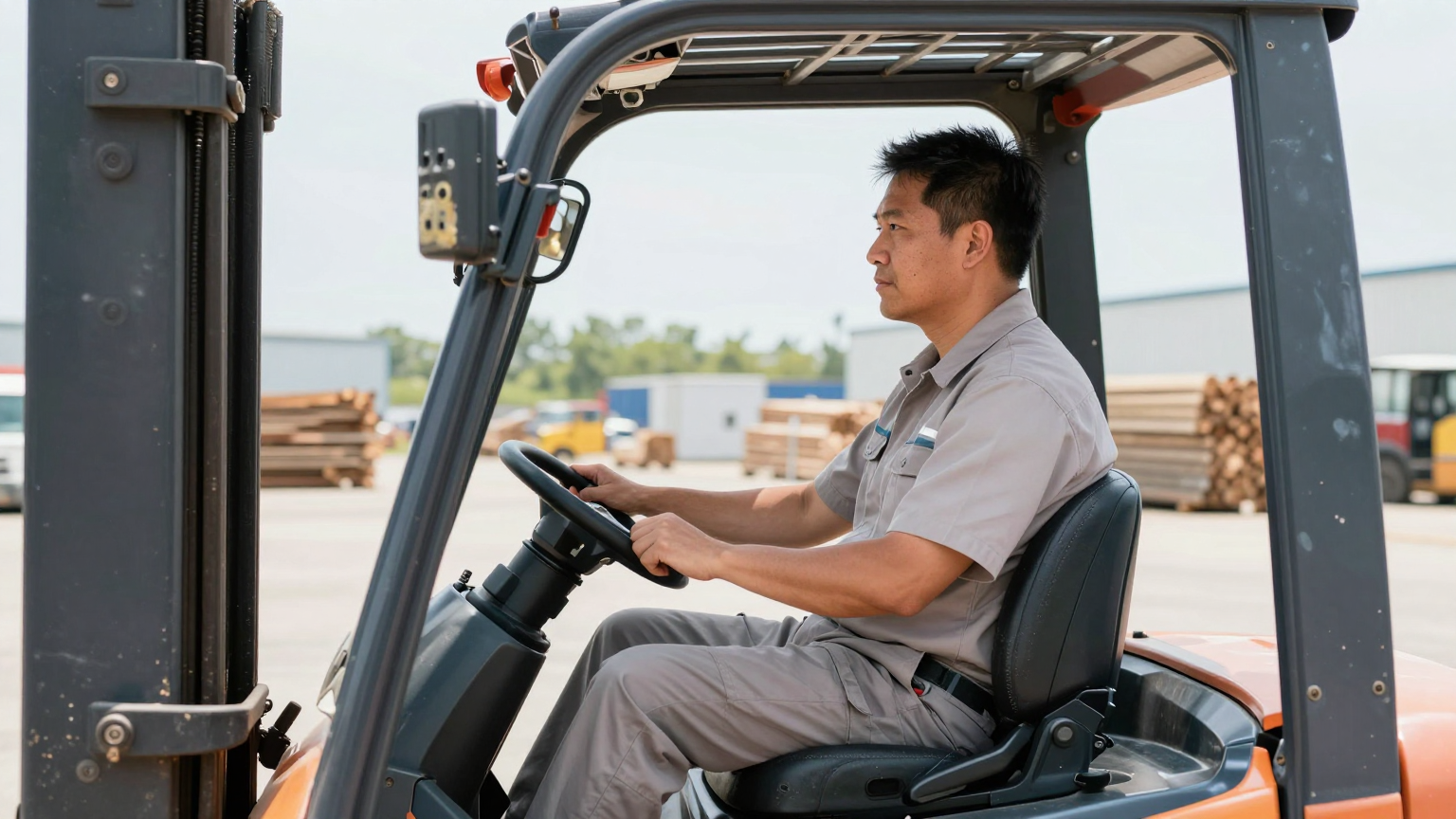 The indoor evaporator unit, at dimensions of 440 × 140 × 320 mm, is compact enough to fit within the headliner zone of most standard sit-down forklift cabs. The outdoor condenser (600 × 250 × 430 mm) typically mounts on the counterweight housing or behind the operator compartment, where airflow from the vehicle’s movement or the condenser fan provides adequate heat rejection. Because the refrigerant circuit is pre-charged with R134a and connected via quick-connect fittings in many configurations, installation does not require a certified HVAC technician to evacuate and charge the system — a meaningful cost and scheduling advantage for fleet operations that maintain dozens of units.
Installation Considerations for Fleet Operations
Getting the unit out of the box and onto the forklift is only part of the integration story. Several field decisions affect long-term reliability and operator satisfaction.
Electrical Integration
The first step is confirming the forklift’s nominal battery voltage and verifying it falls within the DC air conditioner’s input range. For battery-electric forklifts operating at 48V, a direct connection is typically straightforward. For IC forklifts with a 24V electrical system, the same applies. In cases where the forklift operates at a voltage outside the unit’s input range (for example, an 80V system), a DC-DC converter may be necessary, though this adds cost and a potential failure point. Wiring should include an inline fuse or circuit breaker rated for the system’s maximum draw, and the cable gauge must account for the full-load current at the lowest expected voltage.
Condenser Placement and Airflow
The condenser needs unobstructed airflow to reject heat effectively. Mounting it in a recessed pocket behind body panels — a tempting option for aesthetics — can create a dead-air zone that forces the compressor to work harder and reduces system life. In many forklift installations, the counterweight area or the rear pillar zone provides a natural mounting surface with good ambient air access. The condenser fan should draw air through the coil and exhaust it away from the cab, not recirculate warm exhaust air back into the condenser intake.
Drainage
The evaporator generates condensate during normal operation. In a forklift that tilts, accelerates, and traverses uneven surfaces, a poorly routed drain line will spill water inside the cab or onto electrical components. Routing the drain line through a grommet in the cab floor, with a loop or check valve to prevent backflow during tilt operations, is a detail that separates a reliable installation from a warranty headache.
Vibration Isolation
Even with a compressor designed for mobile applications, mounting the condenser unit with rigid steel brackets directly to the forklift frame transmits every shock directly into the refrigerant circuit. Rubber isolation mounts or spring-damper brackets — the kind used in marine compressor installations — absorb transient peaks and extend the life of brazed joints and compressor internals. This is especially critical on forklifts that routinely cross dock plates or operate on rough outdoor yards.
Operational Impact: Beyond Comfort
The business case for a forklift air conditioner extends well beyond operator preference. Several measurable outcomes typically follow a well-executed installation.
Reduced Heat-Related Incidents
OSHA’s heat illness data indicate that construction and warehousing are among the highest-risk sectors. While not every heat-related incident involves a forklift, the combination of physical exertion (steering, load engagement), an enclosed hot space, and the safety consequences of impaired judgment on a moving vehicle creates an outsized risk profile. A cooled cab directly reduces core body temperature rise during shift hours.
Operator Retention
In a tight labor market for warehouse and logistics operators, cab comfort is a tangible differentiator. Facilities that have retrofitted forklift fleets with air conditioning consistently report lower voluntary turnover among operators — a reduction that, even at modest scale, offsets the per-unit cost of the cooling system within one or two hiring cycles.
Productivity and Accuracy
Heat-stressed operators work slower, take more frequent breaks, and make more order-picking errors. While the exact productivity gain from cab cooling varies by facility and task profile, the directional effect is well-documented in occupational health literature. Maintaining the cab interior at a manageable temperature — typically 25–28 °C versus an unconditioned 50+ °C — keeps cognitive function and reaction time within normal ranges across the full shift.
Sizing and Selection Decision Framework
Not every forklift cab needs the same cooling solution. The following decision gates help fleet managers match the system to the application:
Gate 1: Cab Type and Enclosure Level
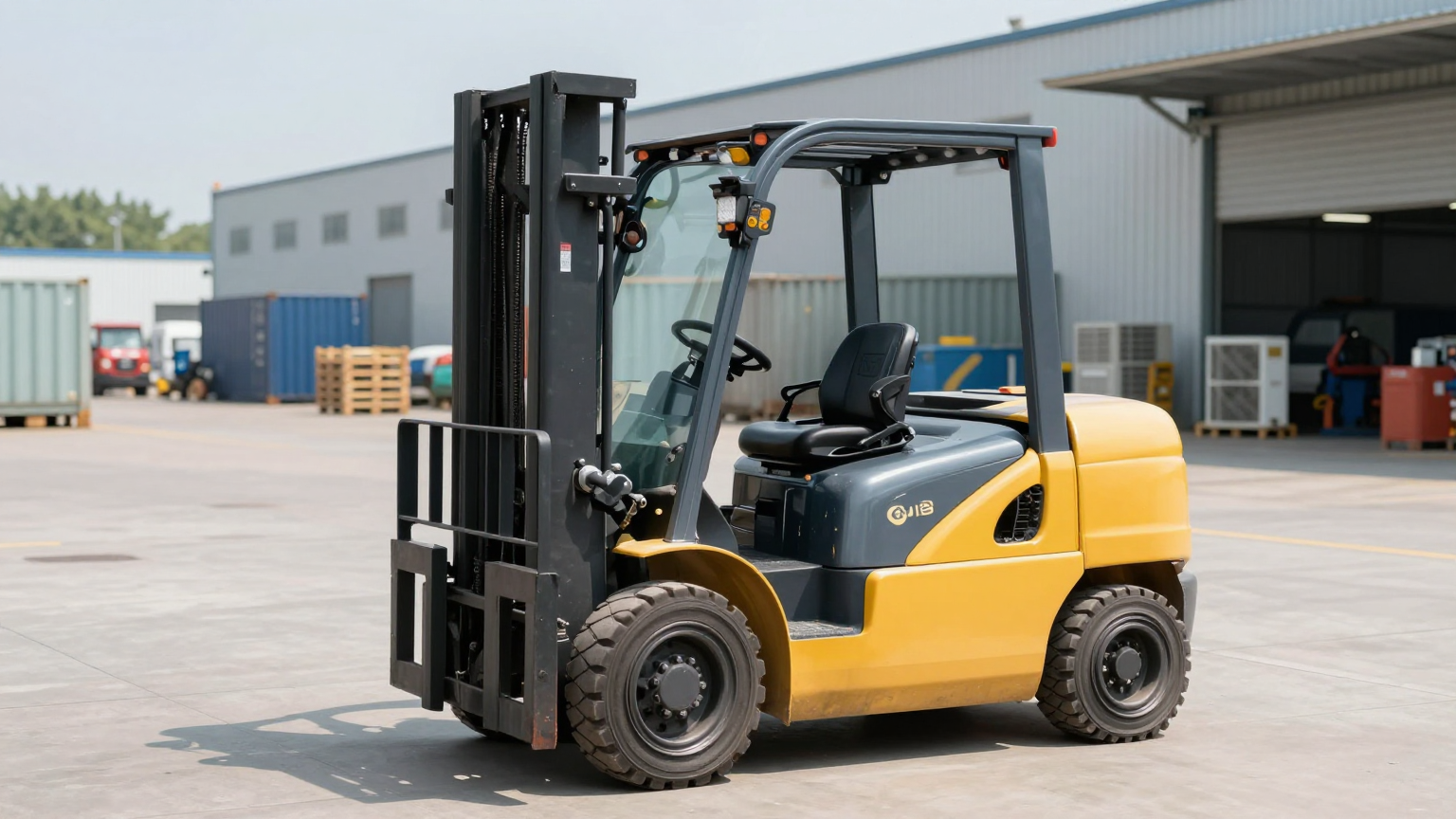
Open-platform forklifts (no cab enclosure) are not candidates for air conditioning — the cooled air escapes immediately. Full-cab forklifts with sealed doors and windows are the primary candidates. Semi-enclosed cabs (roof and partial side panels) can benefit if the openings are small enough to maintain a temperature differential, though cooling efficiency will be lower.
Gate 2: Power Source and Voltage
Identify the forklift’s electrical system voltage. Battery-electric units at 24V, 48V, or 72V align directly with common DC air conditioner input ranges. IC forklifts with 12V systems may require a step-up converter or a dedicated auxiliary battery. The key question: can the forklift’s electrical system sustain the additional load without affecting drive or hydraulic performance?
Gate 3: Operating Environment
A forklift that spends 80% of its shift inside a climate-controlled warehouse has a lower cooling load than one operating in a sun-exposed container yard. Ambient temperature, solar exposure, and the presence of radiant heat sources (furnaces, ovens, hot product) all influence the required cooling capacity. For high-ambient or high-solar applications, 2,300 W of cooling capacity provides meaningful margin for forklift-scale cab volumes.
Gate 4: Duty Cycle
Does the forklift run one eight-hour shift or three? Continuous operation increases the total energy draw from the battery and affects compressor duty cycle. For multi-shift electric forklifts, verify that the air conditioner’s energy consumption does not push the battery below its required state of charge before the scheduled swap or recharge.
Common Field Questions
Will a forklift air conditioner drain the battery too fast?
The energy draw depends on the system’s rated wattage and the duty cycle (how often the compressor runs versus idles). A 2,300 W system operating at roughly 60–70% duty cycle in a moderately hot environment consumes less energy per hour than most operators expect. On a 48V forklift with a standard industrial battery, the additional load typically represents a manageable fraction of total capacity — though the exact impact should be calculated against the specific battery’s amp-hour rating and the shift length.
Can it handle the vibration from dock plates and rough surfaces?
Purpose-built DC compressors designed for mobile and vehicular applications are validated against vibration profiles that include forklift-class accelerations. The SANYO DC compressor used in many split-type systems is a rotary design with fewer reciprocating parts, which inherently tolerates vibration better than piston-type compressors. Proper mounting with vibration-isolating hardware further mitigates risk.
Does installation require a certified HVAC technician?
Systems that ship pre-charged with R134a refrigerant and use quick-connect refrigerant fittings can often be installed by a qualified fleet mechanic. The electrical integration — wiring to the forklift’s battery or electrical system — follows standard low-voltage DC practices. However, any modification to the forklift should comply with the manufacturer’s guidelines and local regulations regarding vehicle modifications.
What about forklifts that operate in cold storage?
Cold storage forklifts face the opposite thermal challenge: the cab must be heated, not cooled. A cooling-only DC air conditioner is not the right solution for that application. Some facilities with forklifts that transition between cold storage and warm dock areas may benefit from a heat-pump variant, though this is a different product category and specification process.
How does the split-type design handle refrigerant lines during mast tilt?
The refrigerant lines between the indoor and outdoor units should be routed with sufficient slack and secured with padded clamps to accommodate the relative motion between the cab and frame during mast tilt operations. Rigid, taut lines will fatigue and crack at connection points. A service loop — similar to what marine refrigeration installations use — is the standard practice.
Is there a weight limit concern for the overhead guard?
Mounting the full system on the overhead guard is generally not recommended. The split-type architecture specifically avoids this by placing only the compact evaporator unit inside the cab (often mounted to the cab ceiling or a side panel) and locating the heavier condenser and compressor assembly externally on the frame or counterweight area. This distributes the 48 kg total weight across two separate mounting points rather than concentrating it overhead.
What maintenance does a forklift-mounted DC air conditioner require?
Routine maintenance typically includes cleaning or replacing the evaporator air filter (monthly in dusty environments), inspecting the condenser coil for debris accumulation, checking refrigerant line connections for tightness, and verifying that the drain line is clear. In forklift applications, the condenser coil tends to accumulate dust and debris faster than in on-road vehicles due to warehouse particulates, so a quarterly coil cleaning schedule is often appropriate.
Integration Support
Every forklift fleet has its own mix of models, voltages, operating environments, and shift patterns. If your constraints differ from the scenarios described here — unusual cab geometry, a voltage outside the standard 24–72V range, or an extreme ambient temperature profile — the Rigid engineering team can review your specific configuration and recommend an alignment path. Explore the HS23P split-type DC air conditioner as a starting reference point for compact cab cooling applications, and reach out with your fleet details for a configuration discussion.
The forklift cab heat problem is solvable. The solution starts with understanding the thermal constraints of the specific cab, matching the cooling capacity and power source to the application, and installing the system with attention to vibration, drainage, and airflow. The operators who spend eight or more hours a day in that glass box deserve an engineered answer — not a wet towel and a hope for cooler weather.