
Fridge Insulation Thickness Is an Optimization, Not a Maximization
Published work on domestic refrigerators and freezers puts the economic optimum insulation thickness somewhere in the range of 100 to 200 mm. Walk into any outdoor retailer and measure the wall of a portable 12 V fridge and you will find 25 to 50 mm. The gap is not an oversight by every manufacturer in the category. It is what happens when the thing being optimized changes.
A domestic fridge stands in a kitchen and optimizes energy cost against material cost. A portable or vehicle-mounted box optimizes energy against something far more expensive: every millimeter of fridge insulation thickness you add is internal volume you no longer have, in a product whose external dimensions are fixed by the space it has to fit into.
That changes the answer completely, and it means the useful question is not “how thick should it be” but “where does the next 25 mm stop paying for itself.” This guide works that curve with numbers.
The Conduction Term and Why It Halves
Steady-state conduction through a wall follows a simple relationship:
Q = (k × A × ΔT) ÷ L
where k is the thermal conductivity of the insulation, A the area, ΔT the temperature difference across the wall, and L the thickness. The important property is the L in the denominator: doubling thickness halves conduction, every time. There is no point at which the physics stops rewarding more insulation.
What does change is what each halving costs you. In a fixed external envelope, thickness comes directly out of the interior, and interior volume shrinks as a cube while surface area shrinks as a square. The first 25 mm is cheap in volume terms. The third is not.
Working the Curve on a Fixed External Envelope
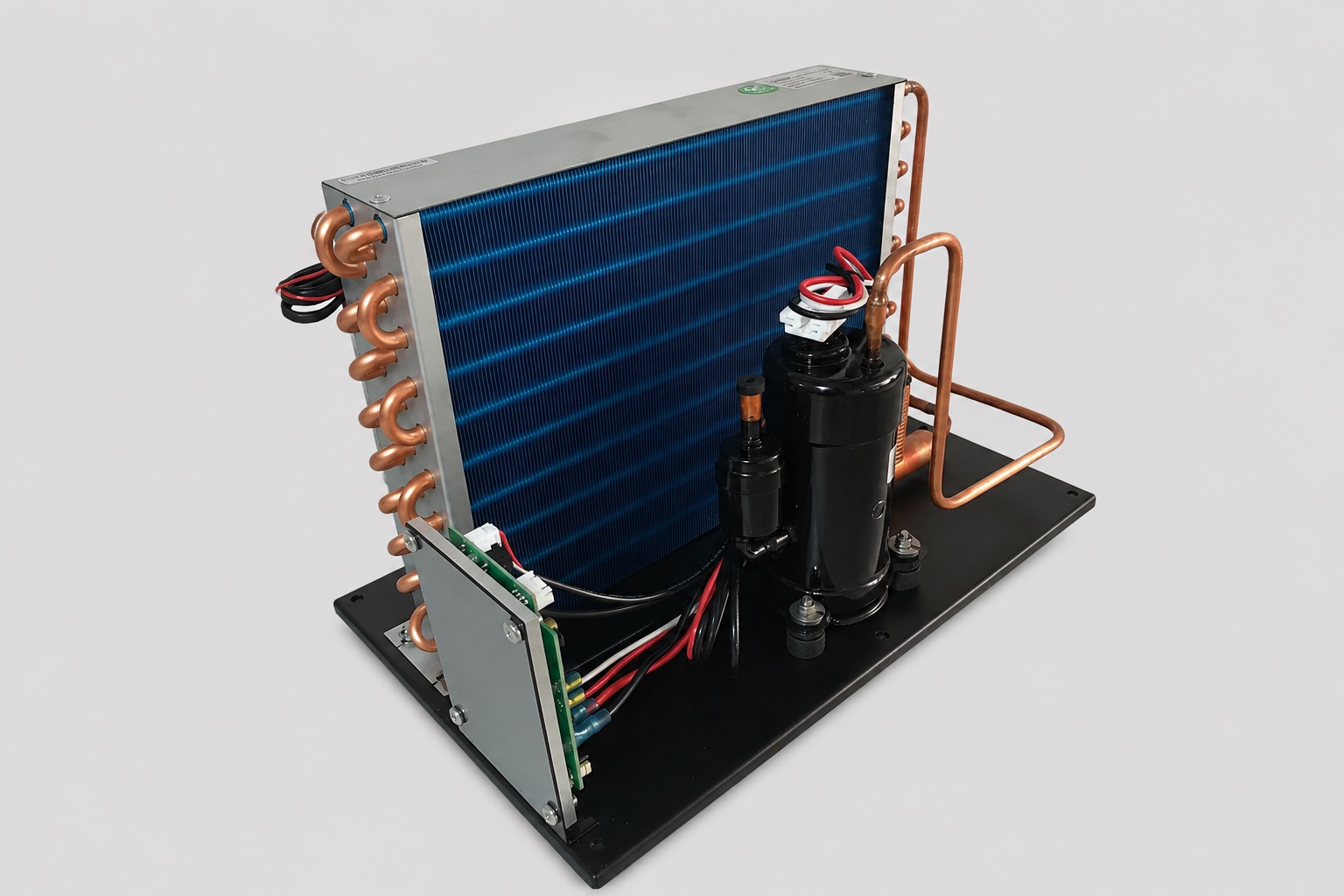 Take a box with fixed outside dimensions of 600 × 400 × 400 mm — a size that fits a typical vehicle cargo area — and vary only the wall thickness.
| Input | Value used | Basis |
|---|---|---|
| External dimensions | 600 × 400 × 400 mm | Assumed; fixed by the installation |
| External surface area | 1.28 m² | Calculated |
| Insulation conductivity | 0.022 W/m·K | Reference value for closed-cell polyurethane foam |
| Ambient | 35 °C | Assumed design-day condition |
| Box setpoint | 4 °C | Assumed refrigeration duty |
| Temperature difference | 31 K | Calculated |
Conduction load and remaining interior volume at three wall thicknesses:
| Wall thickness | Interior dimensions | Interior volume | Conduction load | Watts saved vs previous | Liters lost vs previous |
|---|---|---|---|---|---|
| 25 mm | 550 × 350 × 350 | 67.4 L | 34.9 W | — | — |
| 50 mm | 500 × 300 × 300 | 45.0 L | 17.5 W | 17.4 W | 22.4 L |
| 75 mm | 450 × 250 × 250 | 28.1 L | 11.6 W | 5.9 W | 16.9 L |
Reduce those to a single ratio and the shape of the decision appears:
- Going from 25 to 50 mm buys 0.78 W of load reduction per liter of interior sacrificed.
- Going from 50 to 75 mm buys 0.35 W per liter — less than half as efficient a trade.
Expressed another way: the first doubling removed 17.4 W at a cost of 22.4 L. To remove the next 17.4 W by thickness alone would require going far beyond 75 mm, by which point the interior has almost disappeared. The curve is not approaching a limit in physics — it is approaching a limit in what the box is for.
The second doubling costs three-quarters as much volume as the first and delivers one-third of the benefit. That is the entire argument for why portable boxes sit where they sit, and why 100 to 200 mm makes sense in a kitchen appliance whose interior is not competing with a vehicle’s cargo space.
Two caveats on the arithmetic. It uses external surface area, which slightly overstates conduction — the correct value is the mean between inner and outer surfaces, and the difference grows with thickness. And it ignores edges and corners, where heat paths are shorter than the flat-wall assumption. Treat the numbers as an order-of-magnitude comparison between thicknesses rather than as absolute loads.
What the Conduction Number Does Not Include
Conduction is the only term that responds to fridge insulation thickness. The other heat paths do not, and past a certain thickness they dominate — which is another reason the curve flattens.
- Infiltration. Warm humid air exchanged on every opening. Unaffected by wall thickness, and in a frequently opened box it can rival conduction. It is also the term that produces frost, which then degrades evaporator performance separately.
- Thermal bridging. Hinges, latches, the lid seal, and any fastener or drain fitting that penetrates the shell. Published estimates put poorly sealed door paths in the region of 15 to 20 percent of consumption. A 75 mm wall with a bad seal performs worse than a 50 mm wall with a good one.
- Product load. Warm contents being pulled down. Independent of the walls entirely, and in a box used for daily restocking it can exceed conduction for the first hour after each load.
- Internal load. The evaporator fan and controls.
Put numbers on that: if conduction at 50 mm is 17.5 W and a poor seal adds 15 percent to total consumption on a 45 W system, the seal is costing roughly 7 W — around 40 percent of what the entire wall is conducting. Closing that gap requires no interior volume at all, while buying the same 7 W through thickness would take the wall well past 75 mm.
The practical consequence is a sequencing rule: fix the seal and the bridges before adding thickness. Eliminating a bridging path is usually cheaper in volume terms than the insulation increase that would offset the same watts.
When Vacuum Panels Change the Trade
Vacuum insulated panels change the fridge insulation thickness equation because they deliver much lower conductivity per millimeter, which is precisely the constraint that binds in a fixed envelope. Reported comparisons suggest 40 to 60 mm of vacuum panel can cut compressor runtime by roughly 30 percent relative to 20 to 30 mm of foam.
They also bring constraints that matter in mobile use:
- A punctured panel loses most of its advantage permanently, and vehicle installations are exactly where things get punctured.
- Panels cannot be cut to fit on site, so the box has to be designed around standard sizes.
- Edges and joints between panels are thermal bridges, and the more panels a box uses the more joint length it has.
- Cost per unit area is substantially higher than foam.
The honest summary is that vacuum panels are the right answer when interior volume is worth more than cost and robustness — a medical transport box, a sampling cooler with a fixed footprint — and foam remains correct for most vehicle and recreational builds.
How Thickness Interacts With Compressor Selection
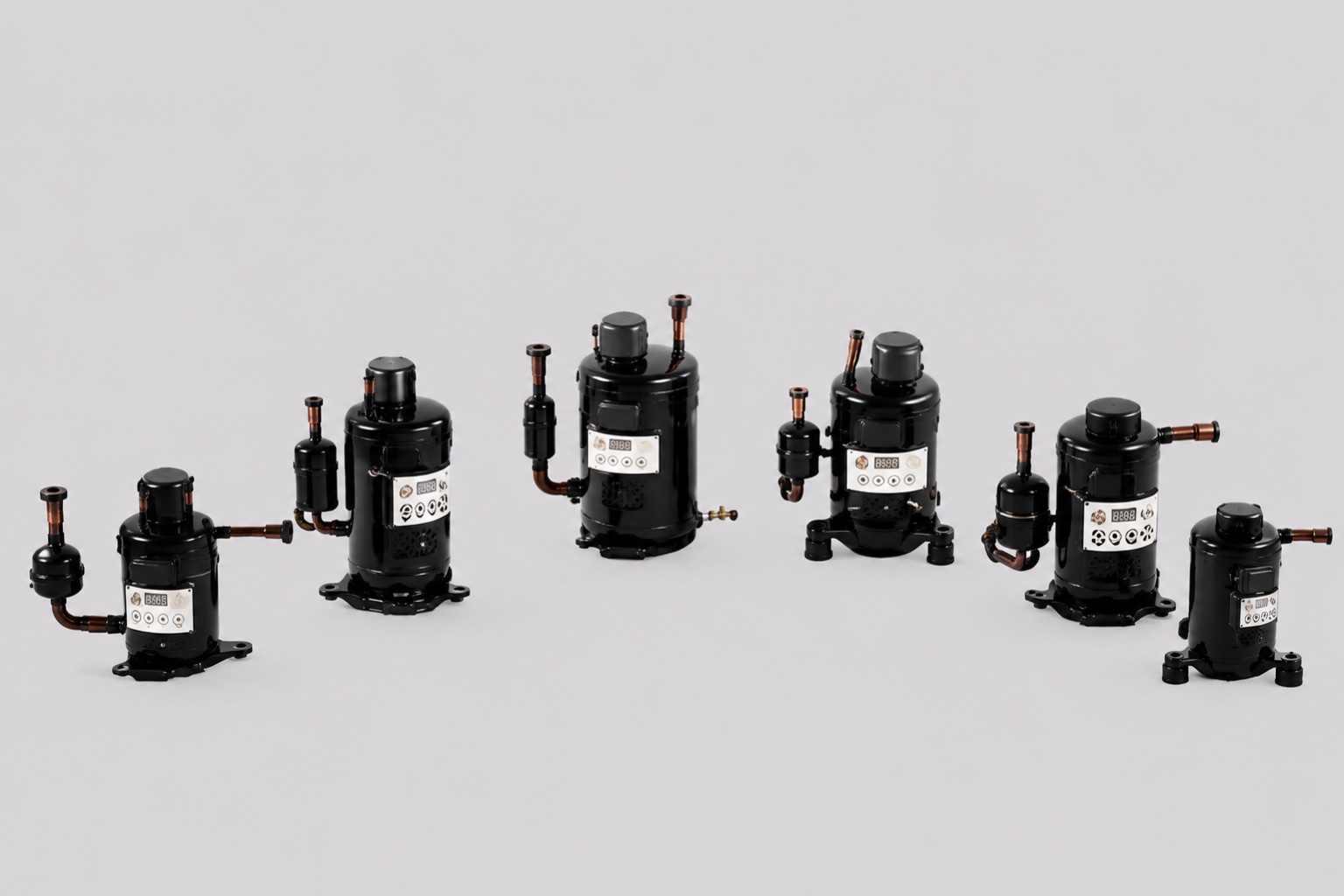 Fridge insulation thickness changes the compressor’s operating point more than its class. A thicker box has a lower and steadier load, which changes what you want from the compressor rather than simply letting you choose a smaller one.
With conduction cut from 35 W to 17 W, the total load might fall from roughly 60 W to 45 W once infiltration, product and internal terms are added. That is not a different compressor class — a variable-speed unit such as QX1901VDL(H), published at 100~455 W across 2,000~6,000 rpm at 12 V, spans both comfortably. What changes is where in its range it sits:
- The compressor spends more of its time near minimum speed, which is good for efficiency and noise.
- Duty cycle falls, so pull-down after a warm load takes proportionally longer relative to the steady state.
- Running permanently at minimum speed has its own consequences for a system with long refrigerant lines, since vapor velocity scales with speed.
In other words, better insulation moves the operating point rather than the model selection. The build-level implications of that are covered in our guide to 12V compressors in custom fridge builds, and measured consumption across duty cycles in our field data on real power consumption. Model-level data is on the 12V compressor product page.
A Practical Sequence for a Custom Build
- Fix the external envelope first, since it is usually dictated by the space available.
- Confirm the ambient the box will actually see. Fridge insulation thickness is being traded against a temperature difference, and a box specified for 25 °C ambient and used at 40 °C has a conduction load half again as large as designed.
- Decide the minimum interior volume the application actually requires. This is the real constraint, and it sets the ceiling on thickness.
- Calculate conduction at two or three candidate thicknesses within that ceiling and compare watts saved per liter lost, as in the table above.
- Design out thermal bridges — seal, hinges, fasteners, drain penetration — before spending volume on thickness.
- Add infiltration, product and internal loads to get the total, then size the compressor from that rather than from the conduction number alone.
- Verify with a measured pull-down and a steady-state duty cycle on the actual box. Assumed conductivity and real assembled performance are rarely the same.
If you are designing an OEM box and want the load and compressor operating point checked before tooling, send the following and our engineers will review it: external envelope, required interior volume, insulation material and thickness, seal and hinge arrangement, target box temperature, maximum ambient, expected opening frequency, and the mass and entry temperature of product loaded per day. Send your build parameters to our engineering team.
Frequently Asked Questions
How thick should the insulation on a 12V fridge be?
There is no universal answer because the correct fridge insulation thickness depends on how much interior volume you can afford to give up. On a fixed external envelope, going from 25 to 50 mm typically buys roughly twice as much load reduction per liter sacrificed as going from 50 to 75 mm. Most portable boxes land in the 25 to 50 mm range for that reason, while a domestic fridge with no volume pressure optimizes closer to 100 mm and above.
Does doubling insulation thickness halve the heat load?
It halves the conduction term, which is only part of the load. Infiltration from door openings, thermal bridging through seals and hinges, product load and internal fan power are all unaffected by wall thickness. Once conduction has been reduced to the point where those terms dominate, further thickness produces very little total improvement — which is the real reason the curve flattens.
Is it better to add insulation or improve the seal?
Improve the seal first, in almost every case. A poor lid seal is both a direct bridging path and a continuous infiltration source, and published estimates put that contribution in the region of 15 to 20 percent of consumption. Fixing it costs no interior volume, whereas the equivalent watts bought through thickness cost several liters.
Are vacuum insulated panels worth it?
They are worth it where interior volume is more valuable than cost and robustness — a fixed-footprint medical or sampling box, for instance. They deliver much lower conductivity per millimeter, which is exactly the constraint that binds in a fixed envelope. Against that, they cannot be cut on site, their edges are thermal bridges, and a puncture permanently removes most of the benefit. For general vehicle and recreational builds, foam remains the practical choice.
Does better insulation mean I can use a smaller compressor?
Usually it changes the operating point rather than the model. A variable-speed compressor spanning 100~455 W covers both a well-insulated and a moderately insulated box of this size; the better-insulated one simply spends more time near minimum speed. That is good for efficiency and noise, but a system running permanently at low speed has its own design considerations, particularly around refrigerant line sizing.
Why do commercial portable fridges use so little insulation?
Because they are optimizing interior volume within a fixed external size that has to fit a vehicle, not optimizing energy cost in isolation. The thickness that minimizes lifetime energy cost in a kitchen appliance would make a portable box unusable — a 75 mm wall on a 600 × 400 × 400 mm envelope leaves only about 28 liters of usable interior, against 67 liters at 25 mm.