
Glycol vs Water in Your Lab Chiller: When You Need Glycol and How Much to Add
Every recirculating chiller needs a coolant flowing through its loop. Water is the default — it is cheap, non-toxic, has excellent heat transfer properties, and is available from any tap. But water freezes at 0°C, and many laboratory applications demand coolant temperatures well below that threshold. This is where glycol enters the picture.
Adding glycol (ethylene glycol or propylene glycol) to your chiller’s coolant loop lowers the freezing point, allowing the system to operate at sub-zero temperatures without ice forming in the lines, pump, or heat exchanger. However, glycol is not a free upgrade — it changes the coolant’s viscosity, heat transfer efficiency, and pump requirements. Adding too much glycol degrades performance; adding too little provides inadequate freeze protection.
This guide covers when you actually need glycol, which type to use, how much to add for your target temperature, and the common mistakes that waste money or damage equipment.
When You Need Glycol (and When You Don’t)
The decision to add glycol depends entirely on your chiller’s operating temperature setpoint:
- Setpoint above +5°C: Pure water is fine. There is no risk of freezing, and water provides the best heat transfer performance. Adding glycol at these temperatures only reduces cooling efficiency for no benefit.
- Setpoint between 0°C and +5°C: A gray zone. The chiller’s internal evaporator may reach temperatures below 0°C even when the coolant setpoint is slightly above freezing. Most chiller manufacturers recommend at least 10–15% glycol concentration if you regularly operate near 0°C, as a safety margin against localized freezing at the evaporator surface.
- Setpoint below 0°C: Glycol is mandatory. Without it, the coolant will freeze in the coldest part of the system (typically the evaporator plate or coil), blocking flow and potentially cracking components. The glycol concentration must be matched to the lowest temperature the system will reach — not just the setpoint, but the evaporator temperature, which can be 5–10°C colder than the coolant output.
A common mistake is adding glycol “just in case” to a chiller that only operates at 15–20°C. This reduces heat transfer efficiency by 10–20% and increases pump load — all for protection against a freezing condition that will never occur.
Ethylene Glycol vs Propylene Glycol: Which One?
Two types of glycol are used in laboratory chillers. Both lower the freezing point and raise the boiling point of the coolant mixture, but they differ in toxicity, viscosity, and cost:
| Property | Ethylene Glycol (EG) | Propylene Glycol (PG) |
|---|---|---|
| Toxicity | Toxic if ingested (sweet taste makes accidental ingestion a risk) | Generally recognized as safe (GRAS) by FDA; low toxicity |
| Heat transfer | Better — lower viscosity at the same concentration | Worse — higher viscosity reduces heat transfer coefficient |
| Freeze protection | More effective per percent concentration | Requires higher concentration for the same freeze point |
| Viscosity at -20°C | Moderate increase (~5× vs water at 20°C) | High increase (~8× vs water at 20°C) |
| Cost | Lower | Slightly higher |
| Best for | Closed systems with no food/pharma contact | Labs with food, pharmaceutical, or biosafety requirements |
For most laboratory chillers, ethylene glycol is the standard choice. It provides better heat transfer and freeze protection at lower concentrations. Use propylene glycol only when toxicity is a concern — for example, in pharmaceutical labs where a coolant leak could contaminate product, or in food science applications where incidental contact is possible.
Always use inhibited (pre-mixed with corrosion inhibitors) laboratory-grade or industrial-grade glycol. Automotive antifreeze contains silicates, phosphates, and other additives that can clog small-diameter chiller passages and damage seals. Never use automotive antifreeze in a laboratory chiller.
Glycol Concentration Guide: How Much to Add
The correct glycol concentration depends on the lowest temperature your chiller will reach internally. This is typically 5–10°C below the coolant setpoint, because the evaporator must be colder than the coolant to drive heat transfer. For example, if your setpoint is -20°C, the evaporator surface may reach -25°C to -30°C.
Use the following table to determine the minimum glycol concentration for your application:
| Coolant Setpoint | Estimated Evaporator Temp | Min EG Concentration | Min PG Concentration |
|---|---|---|---|
| 0°C to -5°C | -5°C to -15°C | 20–25% | 25–30% |
| -5°C to -10°C | -10°C to -20°C | 25–30% | 30–35% |
| -10°C to -20°C | -20°C to -30°C | 35–40% | 40–45% |
| -20°C to -30°C | -30°C to -40°C | 45–50% | 50–55% |
| -30°C to -40°C | -40°C to -50°C | 55–60% | 60% (near practical limit) |
 Important: Do not exceed 60% glycol concentration. Above 60%, the coolant becomes so viscous that pump performance drops severely, heat transfer degrades by 30–40% compared to pure water, and the system may not achieve its rated cooling capacity. More glycol is not better — it is a balance between freeze protection and thermal performance.
Mixing Instructions: Getting the Ratio Right
Glycol concentration is measured by volume percentage. To prepare a 40% ethylene glycol mixture for a chiller with a 5-liter coolant reservoir:
- Calculate volumes: 40% of 5 liters = 2.0 liters glycol + 3.0 liters distilled water
- Use distilled or deionized water — tap water contains minerals that cause scale buildup in the heat exchanger over time
- Pre-mix the glycol and water in a clean container before filling the chiller. Do not pour glycol into the reservoir and then add water — incomplete mixing can leave glycol-rich zones near the pump inlet
- Fill the chiller, run the pump for 5 minutes, then check the level and top off as needed (air bubbles will purge during initial circulation)
To verify your concentration after mixing, use a refractometer (laboratory supply, under $30) or glycol test strips. Many chiller manufacturers also offer built-in concentration monitoring on their digital displays.
Performance Impact: What Glycol Costs You
Adding glycol to your coolant is a necessary compromise at sub-zero temperatures, but it does reduce system performance. Understanding these trade-offs helps you use the minimum concentration needed rather than over-dosing:
Heat Transfer Reduction
Glycol has lower thermal conductivity and higher viscosity than water. At 30% EG concentration, heat transfer efficiency drops approximately 10–15% compared to pure water. At 50% EG, the reduction reaches 20–25%. This means your chiller delivers less effective cooling at the instrument — a unit rated at 1,000W with water may deliver only 750–800W at 50% glycol, all else being equal.
Increased Pump Load
Higher viscosity means the pump works harder to maintain flow rate. At -20°C with 40% EG, the coolant viscosity is roughly 5 times higher than water at 20°C. Flow rate may drop 15–30% if the pump is not sized for viscous fluids. Reduced flow compounds the heat transfer penalty — the coolant spends less time in the heat exchanger, and the boundary layer at the tube wall becomes thicker.
Slower Temperature Response
Glycol mixtures have higher specific heat capacity volume for volume, but the viscosity-driven flow reduction often outweighs this advantage. The net result is that the system takes longer to reach setpoint from a warm start. Allow 10–20% more cooldown time when operating with high glycol concentrations.
Maintenance: Glycol Does Not Last Forever
Unlike water, which can be replaced cheaply at any time, glycol degrades over time and requires periodic monitoring:
- Check concentration every 6 months — glycol concentration can change due to evaporation (water evaporates faster than glycol, increasing concentration) or dilution from condensation ingress. Either direction is problematic.
- Test pH annually — fresh inhibited glycol has a pH of 8–10. As corrosion inhibitors deplete, pH drops below 7, and the mixture becomes acidic and corrosive to aluminum components. Replace the coolant if pH falls below 7.0.
- Replace completely every 1–2 years — even with stable concentration and pH, glycol degradation products accumulate and can form deposits. Full replacement is inexpensive insurance against long-term damage.
- Never mix glycol types — ethylene glycol and propylene glycol are chemically compatible, but mixing them makes concentration measurement unreliable (refractometer scales are calibrated for one type). Pick one and stick with it.
Common Mistakes That Damage Equipment
These errors are seen frequently in laboratory settings and are entirely preventable:
- Using automotive antifreeze — contains silicates that deposit on heat exchanger surfaces, reducing efficiency by 20–50% within months. Use only laboratory-grade or industrial inhibited glycol.
- Adding glycol to a system already showing signs of freezing — if ice has formed in the lines, adding glycol will not melt it. Warm the system to room temperature first, drain completely, prepare the correct mixture, and refill.
- Ignoring the evaporator-setpoint gap — sizing glycol concentration for the coolant setpoint rather than the evaporator temperature. The evaporator is always colder. A -20°C setpoint needs glycol protection to at least -30°C.
- Exceeding 60% concentration — makes the coolant so thick that the pump cavitates, flow drops to near zero, and the system overheats or shuts down on a flow alarm.
- Using tap water for dilution — mineral content causes scale buildup. Always use distilled or deionized water.
A properly maintained glycol/water coolant system will provide years of reliable sub-zero operation with no consumable costs beyond the periodic glycol replacement itself — a fraction of the cost of alternative cooling methods like dry ice or expendable cold packs.
Matching Your Chiller to Glycol Operation
Not all chillers handle glycol equally well. When selecting a chiller for sub-zero applications that require glycol coolant, verify these specifications:
- Pump rated for viscous fluids — the pump must maintain adequate flow at the viscosity corresponding to your glycol concentration and operating temperature. Check the pump curve at your conditions, not just at water/20°C.
- Cooling capacity derated for glycol — ask the manufacturer for cooling capacity specs at your specific glycol concentration and setpoint. Reputable manufacturers publish performance curves for different coolant mixtures.
- Wetted materials compatible with glycol — most stainless steel, brass, and EPDM rubber seals are glycol-compatible. Avoid galvanized steel components, which corrode rapidly in glycol.
- Temperature range extending below your target — ensure the chiller can reach at least 5°C below your required coolant temperature, to account for the evaporator offset discussed above.
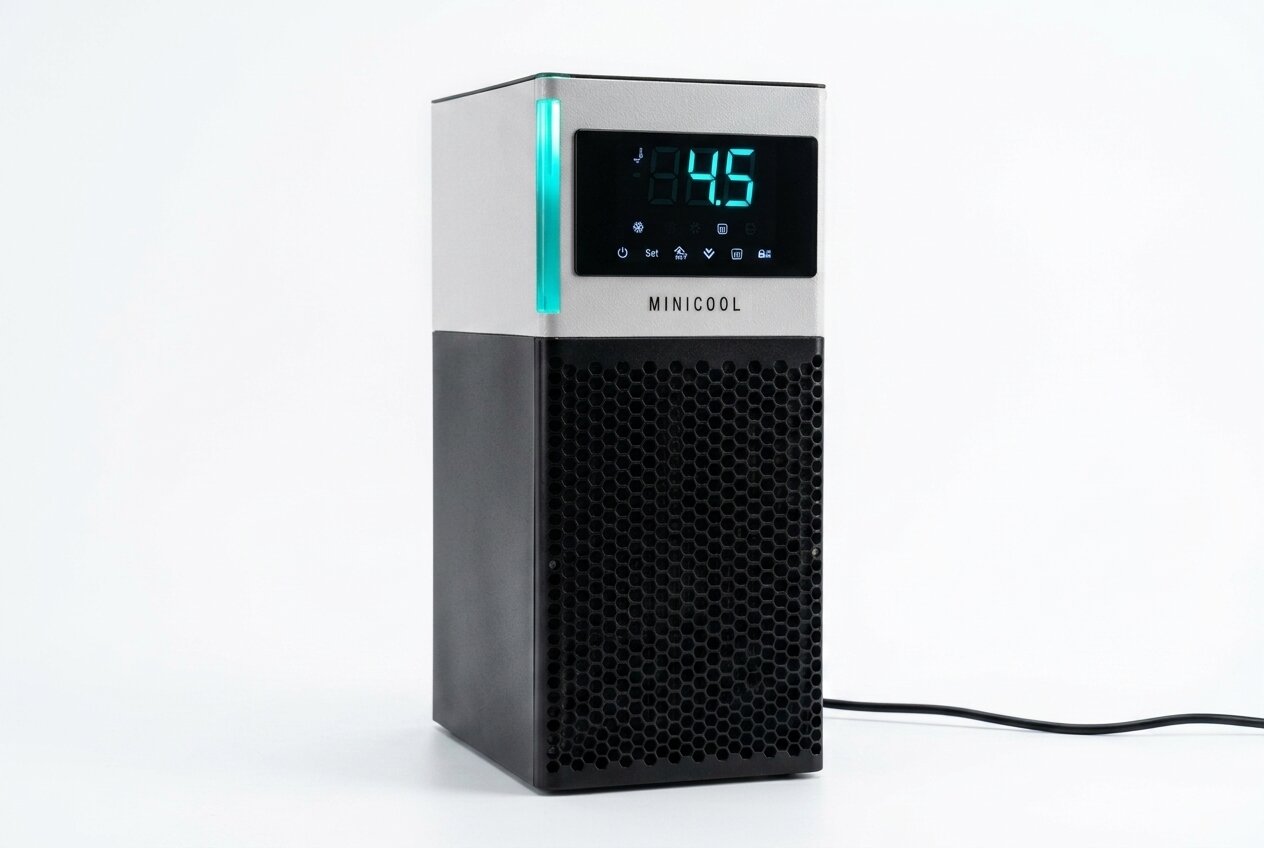
The RIGID MiniCool™ series is designed for glycol-compatible operation across its full 0°C to -40°C range, with pump specifications rated for water/glycol mixtures up to 50% concentration. The closed-loop design minimizes evaporation losses and contamination ingress, reducing the frequency of coolant replacement. For applications requiring higher cooling capacity at deep sub-zero temperatures with viscous glycol mixtures, the MidiCool™ series provides 1,300W–4.6kW with pumps sized for the increased flow resistance.
Quick Decision Flowchart
Use this step-by-step process to determine your coolant setup:
- What is your chiller setpoint? If above +5°C → use pure distilled water. Stop here.
- Setpoint between 0°C and +5°C? → Add 15–20% ethylene glycol as a safety margin against evaporator freezing.
- Setpoint below 0°C? → Glycol is mandatory. Proceed to step 4.
- Are there toxicity restrictions? (Food lab, pharmaceutical, biosafety) → Use propylene glycol. Otherwise → ethylene glycol.
- Determine minimum freeze protection temperature: Take your setpoint, subtract 10°C for evaporator offset. Example: setpoint -20°C → protect to -30°C minimum.
- Look up concentration in the table above. For -30°C protection with EG: 45–50%. For PG: 50–55%.
- Mix with distilled water, verify with refractometer, fill chiller.
- Schedule maintenance: Check concentration every 6 months. Test pH annually. Full replacement every 1–2 years.
Following this process takes less than 15 minutes and prevents the most common glycol-related chiller problems — under-protection leading to freezing, over-concentration reducing performance, and wrong glycol type complicating measurements.
Frequently Asked Questions
Can I use pure glycol (100%) instead of a water mixture?
No. Pure glycol has surprisingly poor freeze protection compared to a properly diluted mixture — 100% ethylene glycol freezes at approximately -13°C, which is worse than a 60% mixture (freezes at approximately -52°C). Pure glycol also has terrible heat transfer properties and extreme viscosity. The optimal working range is 20–60% glycol by volume, depending on your target temperature.
How do I know if my chiller already has glycol in it?
Check with a refractometer — place a few drops of coolant on the prism and read the glycol concentration directly from the scale. If the previous user did not document the coolant type, drain and refill with a fresh, known mixture. The cost of new glycol ($10–$30 for 5 liters of pre-mixed coolant) is trivial compared to the risk of running with an unknown or degraded mixture.
Does glycol affect the chiller warranty?
Most chiller manufacturers explicitly support glycol use within their recommended concentration ranges. However, using non-approved coolant additives (automotive antifreeze, ethanol, methanol, salt solutions) typically voids the warranty. Always follow the manufacturer’s coolant specifications.