
Why a Golf Cart Air Conditioner Is No Longer a Novelty
Five years ago, the phrase “golf cart air conditioner” sounded like a punchline. Today it is a serious engineering requirement — and the reason has less to do with golf and more to do with the rapid evolution of what a “golf cart” actually is.
The vehicle category that began as an open-sided, low-speed utility for 18 holes has expanded into a fully enclosed, street-legal transportation platform used in gated retirement communities, luxury resorts, university campuses, airport operations, theme parks, and private estates. These are no longer golf carts in any meaningful sense — they are low-speed electric vehicles (LSEVs) with enclosed cabins, doors, windshields, and in many cases, heating and sound systems. What they lack, overwhelmingly, is climate control that matches the rest of the vehicle’s fit and finish.
The enclosed cab is what changes the thermal equation entirely. An open golf cart with a canopy top has natural airflow — hot, perhaps, but not a sealed greenhouse. An enclosed golf cart with doors, windows, and a fixed roof traps solar heat exactly like a parked car. On a 33 °C day in Florida, Arizona, or Southeast Asia, the interior of an enclosed golf cart sitting in a parking area can exceed 55 °C within 20 minutes. Passengers who step into this vehicle — often elderly residents in retirement communities or high-value resort guests — experience immediate discomfort and, in extreme cases, heat-related health risk.
The Problem with Current “Cooling” Options
The aftermarket has responded to the golf cart cooling demand with a range of products that fall into three broad categories — only one of which actually provides air conditioning.
Clip-On Fans and USB Blowers
These move air but do not cool it. When the interior air temperature is 50+ °C, a fan blowing that air at the passenger is not a solution — it is a convection oven with better circulation. Fans provide comfort only when ambient air temperature is below skin temperature (approximately 33–35 °C), which eliminates them as a primary cooling solution in any climate where enclosed golf cart AC is needed in the first place.
Evaporative Coolers
Several products marketed as “golf cart air conditioners” are actually evaporative coolers — they pass air over a wet filter to achieve cooling through water evaporation. In dry climates (the American Southwest, for example), these can reduce air temperature by 8–12 °C and provide meaningful relief. In humid climates — Florida, the Gulf Coast, most of Southeast Asia — where relative humidity exceeds 60%, evaporative cooling delivers perhaps 2–4 °C of reduction. In the very markets where enclosed golf carts are most popular (humid subtropical regions), evaporative coolers are the least effective.
True Vapor-Compression AC
Only a vapor-compression system — a compressor, condenser, evaporator, and refrigerant circuit — provides genuine air conditioning that works regardless of ambient humidity. The system removes heat and moisture from the cabin air and rejects it to the outside environment. This is what buildings, cars, and trucks use, and it is the only technology that reliably maintains a comfortable cab temperature in all climates.
The challenge for golf carts and LSEVs is that traditional vehicle AC systems (belt-driven compressors sized for cars and trucks) are far too large, heavy, loud, and power-hungry for a small electric vehicle with a limited battery budget. The golf cart air conditioner that actually works must be purpose-designed for the constraints of this platform.
What Makes Golf Cart AC Different from Truck or Car AC
Specifying cooling for an enclosed golf cart or LSEV requires understanding how these vehicles differ from the applications where mobile AC is well-established.
Battery Budget Is the Primary Constraint
A typical golf cart runs on a 36V, 48V, or 72V battery pack with a total capacity of 3–10 kWh depending on chemistry (lead-acid vs. lithium) and configuration. The vehicle’s drive motor, controller, lights, and accessories all draw from this same pack. Unlike a truck with a diesel engine and alternator continuously replenishing the electrical system, the golf cart’s battery is a finite energy reservoir for the entire day’s use. Every watt consumed by the AC system is a watt not available for driving range.
This makes compressor efficiency and variable-speed operation critical. A system that runs at full capacity continuously (like a fixed-speed belt-driven compressor) will drain the battery unacceptably fast. A variable-speed DC compressor that throttles down once the cab reaches setpoint — consuming perhaps 40–60% of rated power during steady-state operation — extends the vehicle’s effective range while maintaining comfort.
Noise Is a Deal-Breaker
Golf carts and LSEVs operate in environments where noise matters. Resort guests do not want to hear a compressor cycling. Retirement community residents expect a quiet ride. University campus vehicles must not disturb outdoor classes. The background noise level of an electric golf cart at cruising speed is remarkably low — often below 50 dB — which means any AC system that generates significant compressor or fan noise will be immediately and unpleasantly noticeable.
DC rotary compressors operating at variable speed are inherently quieter than fixed-speed reciprocating designs because they generate less vibration and can run at lower RPM when full cooling capacity is not needed. The difference between a 65 dB AC system and a 50 dB system is the difference between a constant distraction and an unnoticeable background hum.
Aesthetics and Integration
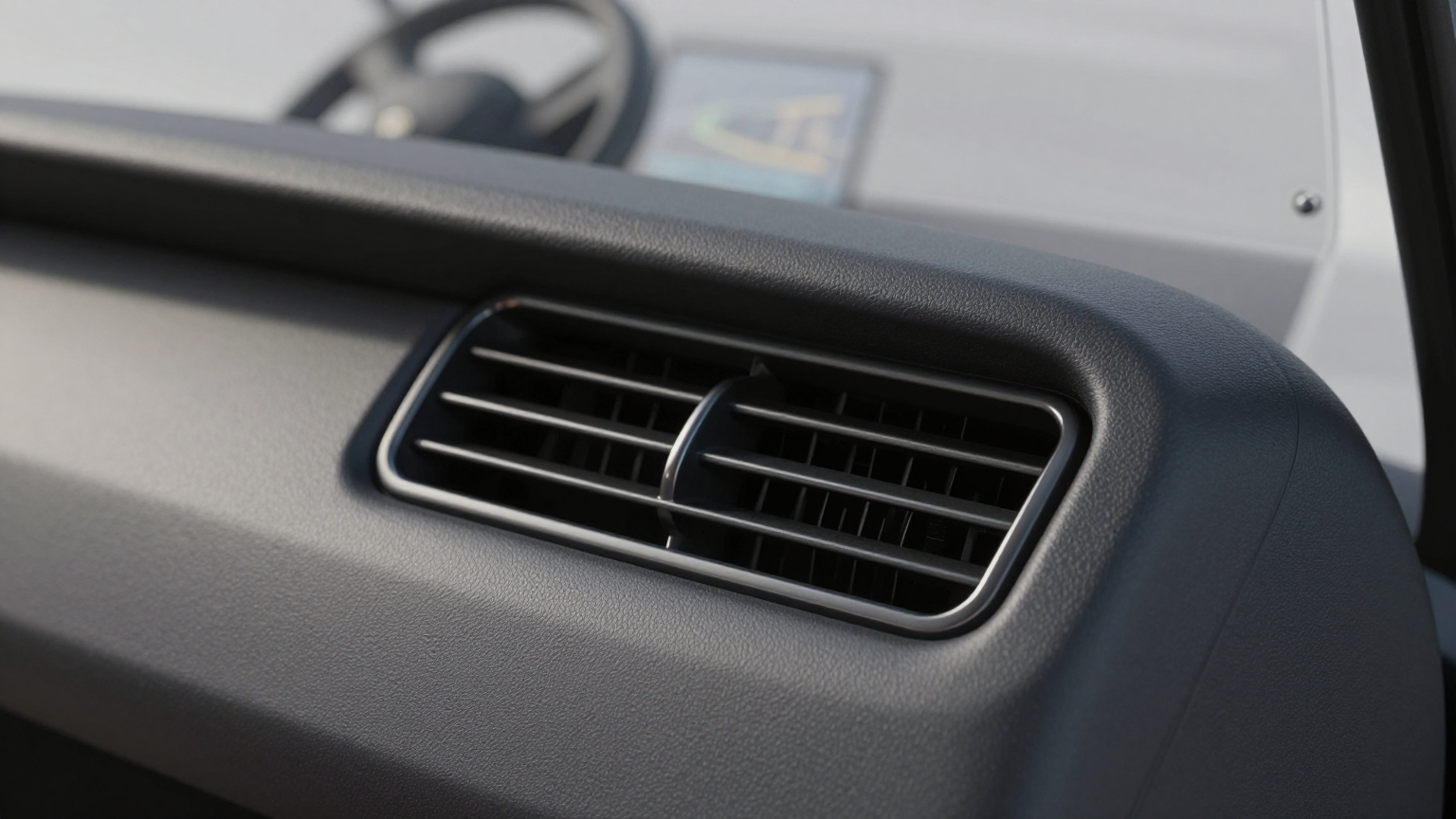
A luxury enclosed golf cart costing $15,000–$40,000 is, for its owner, a personal vehicle — not a piece of industrial equipment. Bolting an industrial-looking AC unit to the roof with exposed refrigerant lines and a condenser hanging off the back is functionally effective but aesthetically unacceptable for this market. The AC system must integrate cleanly with the vehicle’s interior and exterior design. This favors compact components that can be concealed within existing body panels and dashboard structures.
Sizing AC for the Golf Cart Cab Volume
Enclosed golf cart cabins are small — typically 1.0 to 2.5 cubic meters depending on whether the vehicle is a two-seater, four-seater, or six-seater configuration. The thermal load, however, is disproportionately high relative to volume because of extensive glass area and minimal insulation in most golf cart body designs.
For a two-seater enclosed golf cart in direct sun at 35 °C ambient, the cooling load is typically 1,200–1,800 W. For a four-to-six-seater with more glass area and body heat from additional passengers, the load rises to 1,800–2,500 W. A system rated at 2,300 W (7,843 BTU) covers the full range of enclosed golf cart and LSEV configurations with margin for high-ambient conditions.
Over-sizing is less of a concern on golf carts than on larger vehicles, because a variable-speed DC compressor will simply throttle down when the small cabin reaches setpoint. The compressor runs at low speed, drawing minimal power, and cycles gently rather than short-cycling aggressively. This behavior actually extends compressor life and reduces noise — both desirable outcomes in this application.
Voltage Matching Across the Golf Cart Fleet
Golf carts and LSEVs operate at a wider range of system voltages than most vehicle categories:
- Older lead-acid golf carts: 36V or 48V
- Modern lithium golf carts: 48V or 72V
- LSEVs and enclosed utility vehicles: 48V, 60V, or 72V
A DC air conditioning system with multi-voltage input capability — accepting 24V through 72V — eliminates the need to stock different AC units for different vehicle models in a fleet. For resort and community operations managing 20, 50, or 100+ vehicles across multiple generations and manufacturers, this voltage flexibility is a significant procurement and inventory advantage.
Split-Type Architecture for Clean Integration
The split-type AC architecture — compact evaporator inside the cab, condenser and compressor mounted externally — is particularly well-suited to golf cart integration for several reasons:
- The evaporator unit (440 × 140 × 320 mm in a typical configuration) is small enough to mount within the golf cart’s dashboard structure, overhead console, or rear cargo area partition — out of sight and out of the passenger’s space.
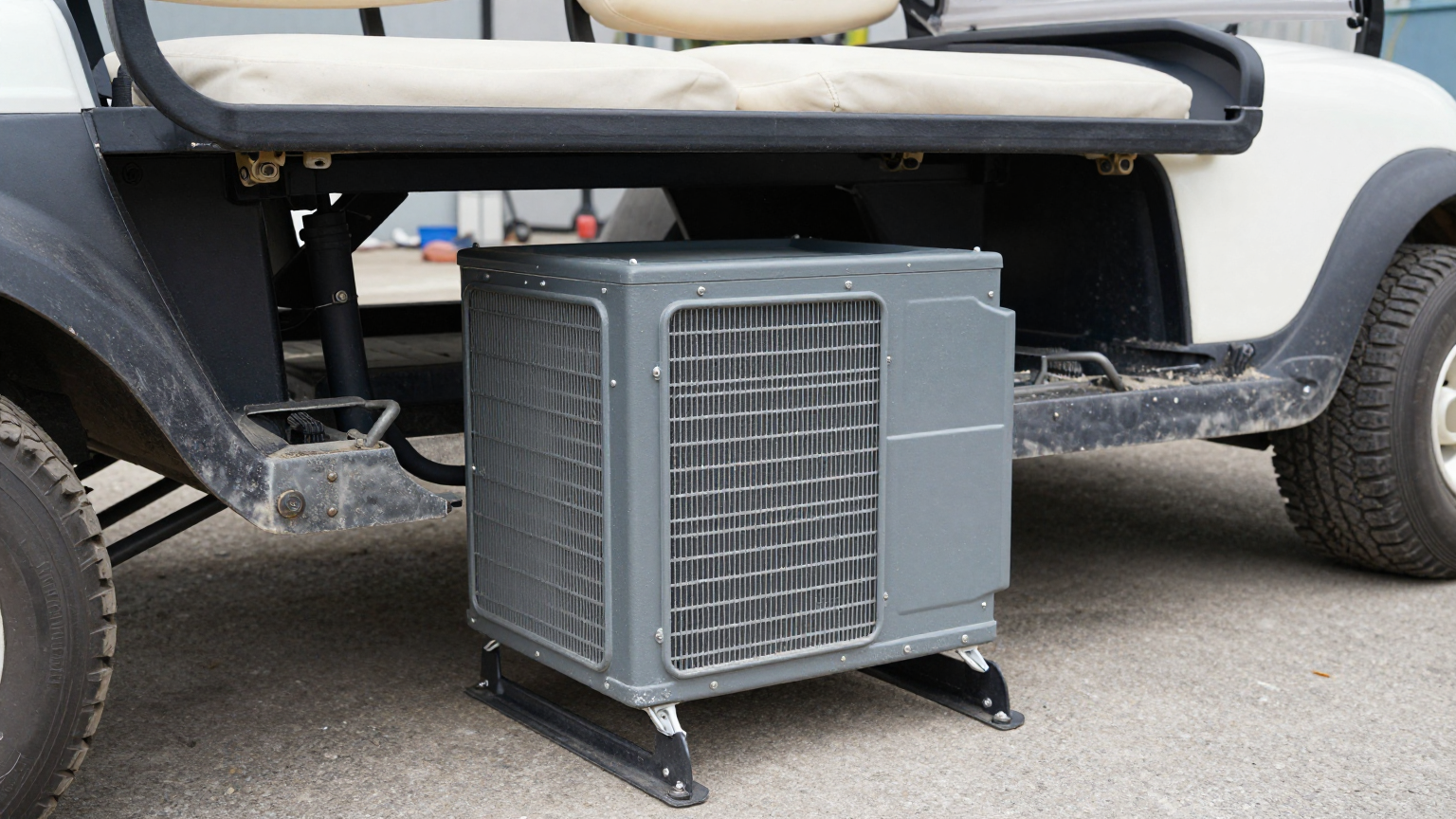
- The condenser (600 × 250 × 430 mm) mounts under the vehicle, behind the rear body panel, or in the utility compartment, where it has access to ambient airflow without being visible to passengers or passersby.
- The total system weight of approximately 48 kg, distributed between two mounting locations, has minimal impact on the vehicle’s handling and range — less than the weight of one additional adult passenger.
- Pre-charged R134a refrigerant and factory-sealed connections mean the system can be installed by the fleet’s maintenance staff without specialized HVAC tools or certification.
Fleet Operations: Maintenance and Lifecycle Planning
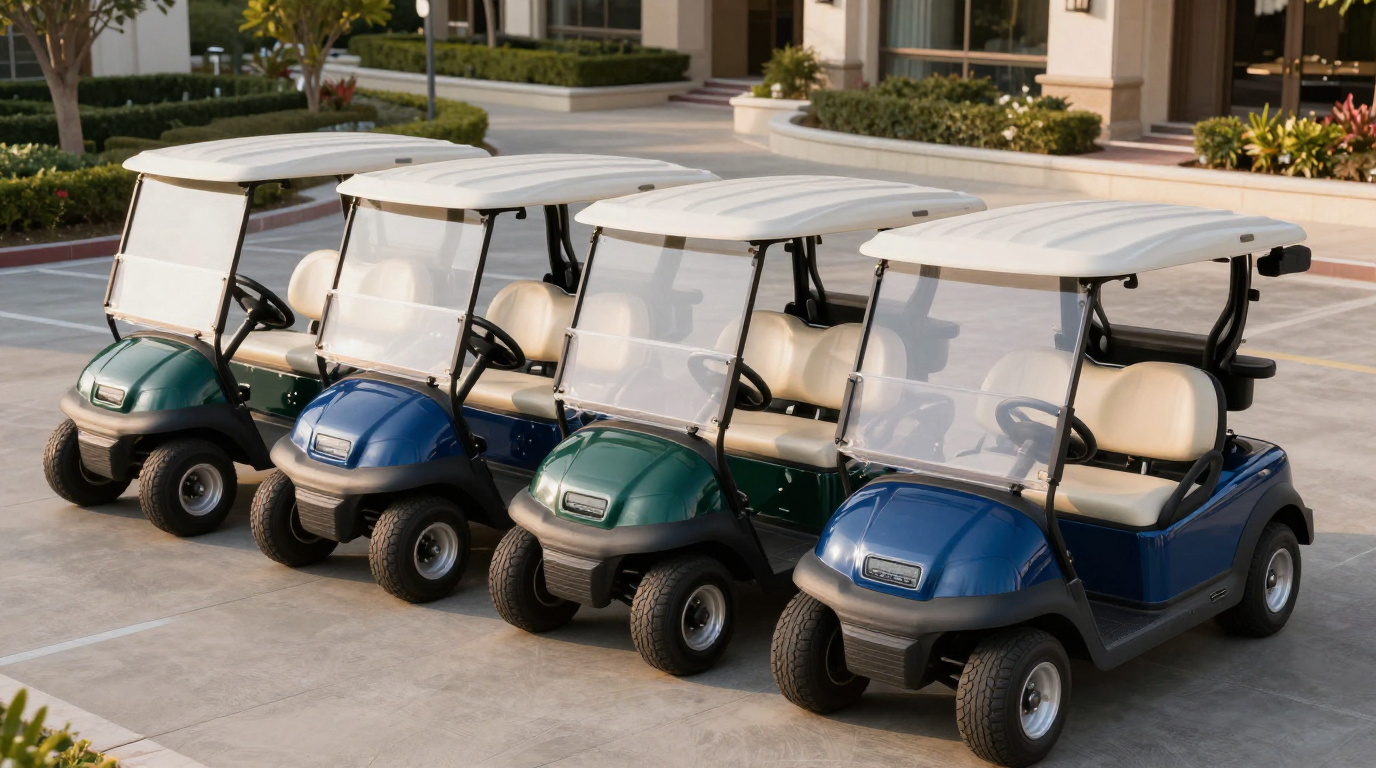
For resort and community fleets, the AC system’s maintenance burden is as important as its cooling performance. A system that cools well but requires monthly service calls is not viable for a fleet of 50 vehicles.
Maintenance Schedule
| Task | Interval | Complexity |
|---|---|---|
| Evaporator air filter cleaning/replacement | Monthly (or per manufacturer schedule) | Low — operator or fleet technician |
| Condenser coil inspection and blowdown | Quarterly (more often in dusty/sandy environments) | Low — compressed air or garden hose |
| Electrical connection inspection | Semi-annually | Low — visual check for corrosion or looseness |
| Refrigerant system check | Annually | Medium — pressure check, look for oil stains at fittings |
| Drain line clearance | Quarterly | Low — verify clear flow |
For fleet operations in sandy or coastal environments (where salt air accelerates corrosion and sand clogs condenser fins faster), the condenser cleaning interval should be shortened. Coating the condenser coil with a corrosion-resistant treatment can extend service life in salt-air environments — a relevant consideration for beachfront resorts and island communities.
Seasonal Considerations
In markets with distinct seasons (the U.S. Sun Belt, for example), golf cart fleets may see heavy AC demand from April through October and minimal use through winter. During the off-season, running the AC system briefly every few weeks maintains compressor seal lubrication and prevents refrigerant migration. For year-round tropical operations, the system runs continuously during operating hours, and the maintenance schedule should account for the higher cumulative duty cycle.
Common Field Questions
How much driving range will the AC system cost me?
The impact depends on the vehicle’s battery capacity and the AC system’s average power draw. A 2,300 W system operating at 60% average duty cycle on a 48V lithium battery pack with 5 kWh capacity draws approximately 1.4 kWh over a full hour of operation. On a vehicle with a 30–40 km range, this translates to roughly 8–15% range reduction — noticeable but manageable for most community and resort driving patterns where daily distances are short.
Is evaporative cooling good enough for golf carts?
In dry climates with relative humidity consistently below 40% (parts of Arizona, Nevada, inland California), evaporative cooling provides meaningful temperature reduction at much lower power consumption than vapor-compression AC. In humid climates (Florida, Texas Gulf Coast, Southeast Asia, coastal resorts), evaporative cooling provides negligible benefit and adds moisture to an already humid cabin. For fleets operating in humid regions, true vapor-compression AC is the only effective option.
Can I install AC on an open golf cart?
Air conditioning requires an enclosed space to be effective. On an open golf cart, the cooled air immediately escapes into the ambient environment. The AC system would run at full capacity continuously without producing a noticeable temperature difference for the occupants. Enclosed or semi-enclosed configurations with doors and windows are the minimum requirement for effective air conditioning.
What noise level should I expect?
Variable-speed DC compressor systems designed for quiet applications typically operate at 45–55 dB at the indoor unit — comparable to a quiet conversation or a residential refrigerator. The condenser fan (outdoor unit) adds some noise, but when mounted under the vehicle or behind a body panel, it is largely shielded from the passenger compartment. Confirm the manufacturer’s rated noise level at the compressor speeds relevant to your typical operating conditions, not just the minimum-speed rating.
Is it worth adding AC to an older 36V lead-acid golf cart?
It depends on the battery bank’s capacity and condition. A 36V lead-acid system with aging batteries may not sustain the AC draw without significantly reducing driving range and accelerating battery degradation. If the vehicle is due for a battery upgrade, converting to 48V lithium simultaneously with AC installation provides both the electrical capacity for cooling and improved overall vehicle performance. Adding AC to an end-of-life 36V battery bank is generally not cost-effective.
How does the AC system handle the stop-and-go pattern of golf cart use?
Variable-speed DC compressors handle intermittent load gracefully. When the vehicle stops and passengers exit briefly (at a golf hole, a resort activity station, or a community mailbox), the compressor throttles down as the cab temperature stabilizes. When passengers return and door openings introduce warm air, the compressor ramps up to recover setpoint. This modulating behavior avoids the hard on-off cycling that stresses fixed-speed compressors and produces noticeable noise spikes.
Integration Support
Every golf cart and LSEV fleet has its own mix of vehicle models, battery voltages, body configurations, and operational environments. If your fleet includes non-standard cab dimensions, a voltage outside the 24–72V range, or specific noise or integration requirements, the Rigid engineering team can review the details and recommend a configuration path. The HS23P split-type DC air conditioner provides the compact form factor, multi-voltage input, quiet variable-speed operation, and pre-charged refrigerant circuit that align with the core demands of enclosed golf cart and LSEV cooling.
The enclosed golf cart is no longer just a golf course vehicle — it is a personal transportation platform for communities, resorts, and campuses where passenger comfort is a baseline expectation. Meeting that expectation requires real air conditioning, not a fan and a wet filter. The technology exists. The engineering challenge is matching it to the vehicle’s battery budget, noise requirements, and integration constraints — and that is a solvable problem.