
Why Every Grow Tent Air Conditioner Decision Starts with a Failed Exhaust Fan
The standard approach to managing heat in grow tents and indoor cultivation environments is exhaust ventilation — pull hot air out of the tent with an inline fan, replace it with cooler air from the room. This works as a basic temperature control strategy, but it creates a cascade of problems that serious growers eventually cannot ignore.
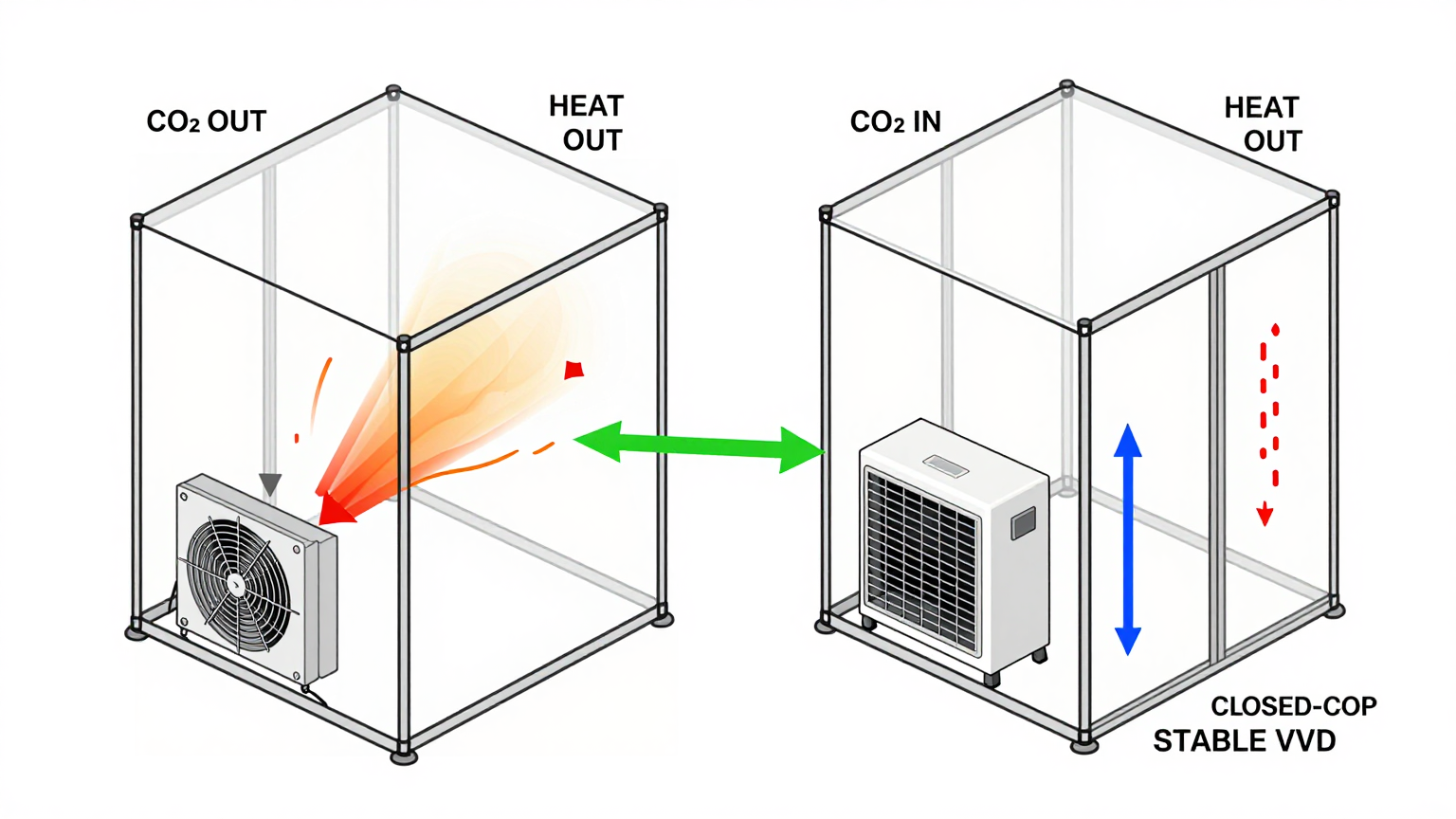
When you exhaust air from a sealed grow tent, you are not just removing heat. You are removing CO2-enriched air that was deliberately and expensively added to accelerate plant growth. You are removing humidity that the plants transpired and that the environment needs to maintain proper vapor pressure deficit (VPD). You are pulling in unfiltered room air that may carry pests, pathogens, or inconsistent temperature and humidity conditions. Every exhaust cycle is a disruption to the carefully controlled environment that indoor growing is supposed to provide.
A grow tent air conditioner — a self-contained cooling module that removes heat from the tent without exchanging air — keeps the growing environment sealed. The CO2 stays inside. The humidity stays controlled. The temperature drops. This is not a luxury upgrade. For any serious indoor cultivation operation — commercial vertical farms, research facilities, or high-value home grows — it is the thermodynamically correct approach to heat management.
The Heat Problem: LEDs Are Efficient But Not Cool
Modern LED grow lights are far more efficient than the HPS (high-pressure sodium) lights they replaced — converting 40 to 60 percent of electrical input into photosynthetically active radiation (PAR) versus 30 to 35 percent for HPS. But that still means 40 to 60 percent of the electrical input becomes waste heat. A 600 W LED panel generates 240 to 360 W of waste heat. A 4-by-8-foot grow tent with two 600 W panels generates 480 to 720 W of heat from the lights alone, plus additional heat from drivers, fans, pumps, and dehumidifiers.
In a sealed tent with typical insulation (thin mylar-lined fabric walls), this heat accumulates rapidly. Without cooling, a sealed 4-by-8 tent can reach 40 degrees Celsius within 60 to 90 minutes of lights-on — well above the optimal growing range of 24 to 28 degrees for most cultivated species during the light period.
The higher the light intensity (and therefore the higher the photosynthetic potential), the more waste heat the tent must manage. This creates a direct tension between light intensity and temperature control that only active cooling can resolve. Growers who want to push PPFD (photosynthetic photon flux density) above 800 to 1,000 micromoles per square meter per second in sealed environments need active cooling — period.
Why Exhaust Ventilation Undermines the Grow Environment
Exhaust ventilation removes heat, but the collateral damage is significant:
CO2 Loss
Plants in a sealed, CO2-enriched environment can photosynthesize 30 to 50 percent faster than at ambient CO2 levels (400 ppm versus 1,200 to 1,500 ppm enriched). Growers invest in CO2 tanks, regulators, and monitoring systems to maintain elevated levels. Every exhaust cycle dumps enriched air and replaces it with 400 ppm ambient air. The CO2 system must then replenish the lost gas — a continuous waste of CO2 that adds directly to operating costs. In a commercial vertical farm running dozens of tents, this waste compounds into a substantial operational expense.
Humidity Disruption
Vapor pressure deficit (VPD) — the relationship between temperature and humidity — is one of the most critical environmental parameters for plant health and yield. Exhaust ventilation replaces humid tent air with room air at whatever humidity the room happens to be, creating VPD swings that stress plants and invite pathogen issues like powdery mildew and botrytis. Maintaining precise VPD requires controlling both temperature and humidity independently — which is impossible when your cooling strategy involves dumping the entire air volume every few minutes.
Pest and Pathogen Introduction
Sealed growing environments exist partly to keep biological contaminants out. Exhaust ventilation creates a negative-pressure pathway that pulls room air through every gap, seam, and imperfect seal — along with whatever fungal spores, spider mites, thrips, or other organisms are present in the room. Carbon filters address odor but do not stop microscopic pests and pathogens.
How a Grow Tent Air Conditioner Works in a Sealed Environment
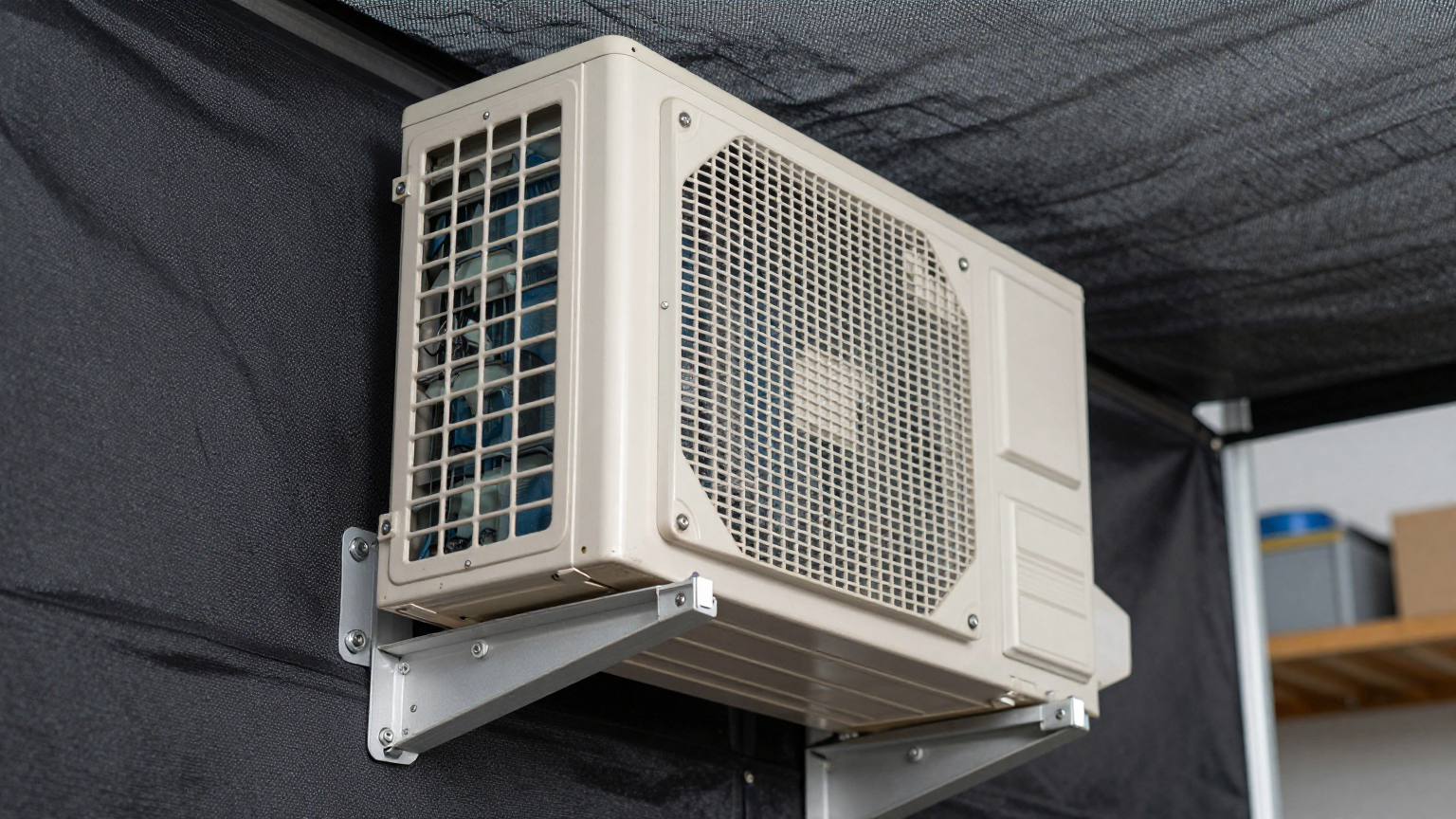
A self-contained DC air conditioner module installed in or on the grow tent operates as a closed-loop system. The evaporator coil absorbs heat from the tent’s internal air and transfers it via refrigerant to the condenser coil, which rejects the heat to the room outside the tent. No air is exchanged between the tent and the room — only heat is transferred.
This means:
- CO2-enriched air stays inside the tent at the target concentration
- Humidity is managed independently (the evaporator also dehumidifies, which can be an advantage or require supplemental humidification depending on the growth stage)
- The tent remains sealed against pests, pathogens, and environmental inconsistency
- Temperature control is decoupled from air exchange — the cooling module modulates to hold the setpoint regardless of room conditions
Sizing the Cooling Module for a Grow Tent
The cooling capacity must match the total heat load inside the tent:
- LED waste heat: total LED wattage multiplied by 0.4 to 0.6 (the fraction that becomes heat rather than light)
- LED driver heat: if drivers are inside the tent, add their waste heat (typically 5 to 15 percent of LED power)
- Dehumidifier heat: if a dehumidifier runs inside the tent, its motor and compressor heat adds to the load
- Pump and fan heat: recirculating fans and hydroponic pumps add 20 to 100 W depending on the system
| Tent Size | Typical LED Power | Estimated Heat Load | Recommended Cooling Capacity |
|---|---|---|---|
| 4×4 ft (1.2×1.2 m) | 400-600 W | 250-450 W | 500-700 W cooling |
| 4×8 ft (1.2×2.4 m) | 800-1200 W | 500-900 W | 800-1200 W cooling |
| 5×10 ft (1.5×3.0 m) | 1200-2000 W | 750-1400 W | 1200-1800 W cooling |
Always size the cooling module for the worst case — all lights on, all equipment running, warmest room temperature. A module that is barely adequate at 22 degrees room temperature will be overwhelmed when the room reaches 28 degrees in summer.

Day/Night Temperature Differential (DIF)
Many cultivation protocols call for a temperature differential between the light period (day) and the dark period (night) — typically 24 to 28 degrees during the day and 18 to 22 degrees at night. This DIF (difference between day and night temperature) influences stem elongation, flower development, and essential oil production depending on the species.
Active cooling enables precise DIF control by actively cooling the tent to the night setpoint when lights turn off, rather than waiting for the tent to passively cool down over 2 to 3 hours. This is particularly important in facilities where the room temperature is warm year-round — without active cooling, the night temperature may never drop to the target, and the DIF protocol cannot be executed.
Dehumidification as a Dual-Purpose Feature
The evaporator coil of a vapor-compression cooling module operates below the dew point of the tent air, causing moisture to condense on the coil surface and drain out of the system. This dehumidification is an inherent byproduct of cooling — not a separate function requiring additional equipment. For indoor growing, this dual-purpose operation can simplify the environmental control stack significantly.
During the flowering stage of most cultivated species, growers actively reduce humidity to 40 to 55 percent RH to prevent mold, botrytis, and bud rot. A separate dehumidifier — which generates its own waste heat that must then be removed by the cooling system — is the conventional approach. A cooling module that simultaneously removes heat and moisture eliminates the dehumidifier and its associated heat load, reducing both equipment cost and total energy consumption.
During the vegetative stage, where higher humidity is desired (60 to 75 percent RH), the cooling module’s dehumidification effect may over-dry the air. In this case, a small humidifier supplements the moisture. The overall energy balance is still favorable because the cooling module’s dehumidification is far more energy-efficient than a standalone dehumidifier — which is essentially a refrigeration system that reheats the air after removing moisture, consuming energy for cooling and then again for reheating.
Energy Economics: Cooling Module vs Exhaust Fan
An exhaust fan consumes 50 to 150 W and costs very little to operate. A cooling module consumes 200 to 500 W and costs more. At first glance, the exhaust fan wins on energy. But the comparison is incomplete without accounting for the CO2 that the exhaust fan wastes.
A sealed tent enriched to 1,200 ppm CO2 using bottled CO2 costs approximately 0.10 to 0.30 USD per hour in CO2 replenishment when ventilating at typical exhaust rates. Over a 12-hour light period, that is 1.20 to 3.60 USD per day — 36 to 108 USD per month. The electricity cost of the cooling module at 300 W average draw is approximately 0.04 USD per hour at typical US rates (0.12 USD/kWh), or 0.48 USD per 12-hour period — 14.40 USD per month. The cooling module saves 20 to 90 USD per month in CO2 alone, before accounting for the yield improvement from maintaining stable CO2 levels and VPD. The payback period for the cooling module investment is typically 3 to 6 months.
Common Field Questions
Does the air conditioner dehumidify too much?
Vapor-compression cooling inherently dehumidifies because the evaporator coil operates below the dew point, condensing moisture from the air. In early vegetative growth stages where high humidity is desired (65 to 75 percent RH), this dehumidification effect may require supplemental humidification. In flowering stages where lower humidity is desired (40 to 55 percent RH), the dehumidification is beneficial and may reduce or eliminate the need for a separate dehumidifier.
Can I use a portable room air conditioner instead of a dedicated module?
Portable ACs require an exhaust hose — which must vent somewhere outside the tent, defeating the sealed environment. Mini-split systems can work but are oversized, expensive, and require professional installation for the refrigerant lines. A dedicated DC micro air conditioner module is purpose-built for the power range, form factor, and sealed-environment requirements of grow tents.
How much power does the cooling module add to my electricity bill?
A cooling module with a COP of 2.5 to 3.0 removes 2.5 to 3.0 watts of heat per watt of electricity consumed. To remove 600 W of LED heat, the module consumes approximately 200 to 240 W. Over an 18-hour light period, that is 3.6 to 4.3 kWh per day — roughly 10 to 15 percent of the LED energy consumption. This is significantly less than the CO2 waste and yield loss from exhaust ventilation.
What about noise in a home grow setup?
A DC compressor module operating at partial load produces 35 to 45 dB at 1 meter — comparable to a quiet inline fan. Variable-speed operation keeps the compressor at the minimum speed needed to maintain temperature, reducing noise during periods of lower heat load (such as when only some lights are on or during the dark period).
Integration Support
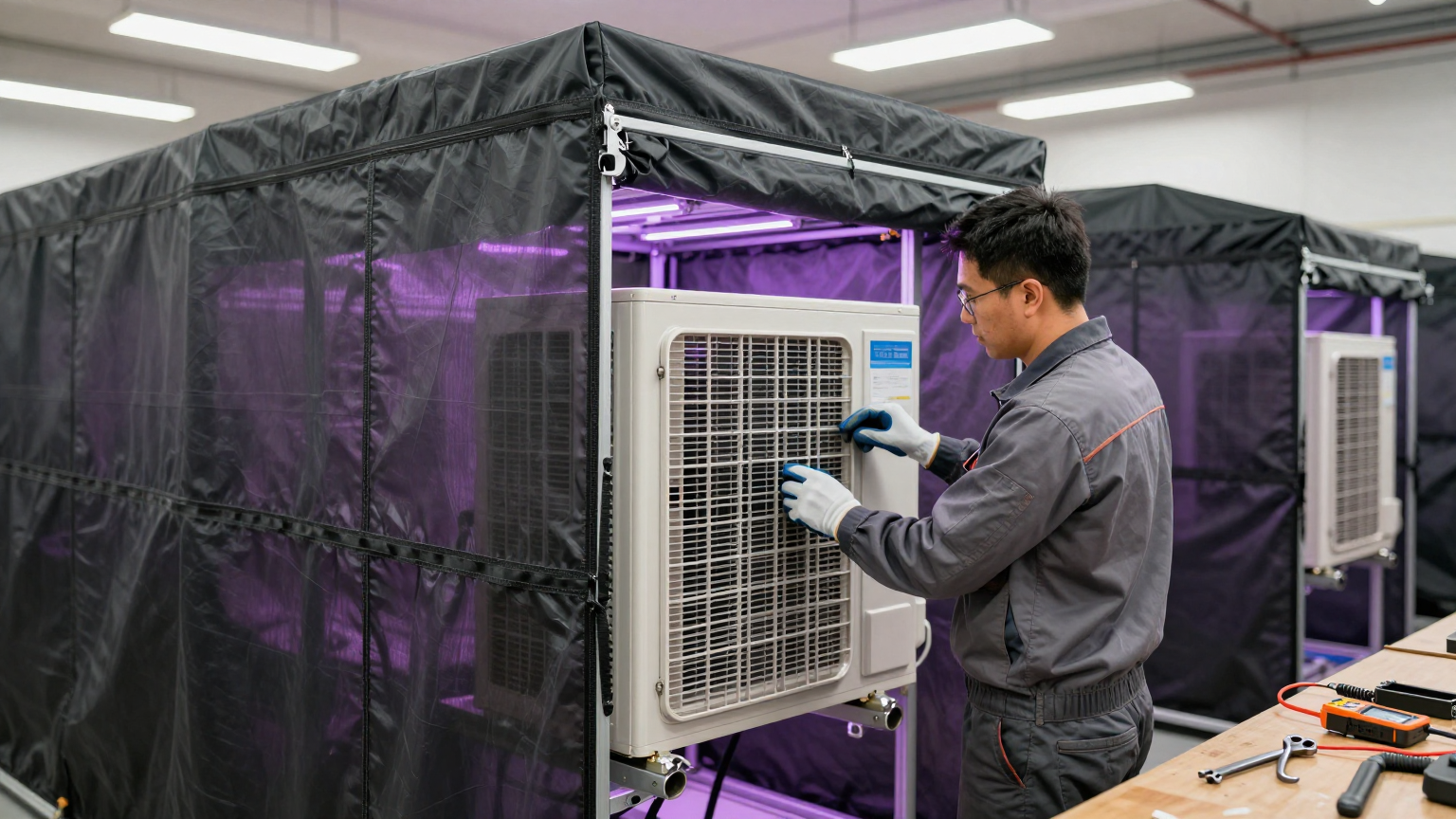
Indoor cultivation thermal management varies with tent size, light intensity, CO2 enrichment strategy, and climate control precision requirements. If your growing environment struggles with temperature control, CO2 waste from exhaust ventilation, or inconsistent VPD, the Rigid engineering team can evaluate the application. The Rigid Micro DC Aircon module is a compact, DC-powered, sealed cooling sub-system that maintains temperature without air exchange — keeping your CO2, humidity, and pest control strategies intact while removing the heat that your lights inevitably produce.
The exhaust fan was the first solution because it was the simplest solution. The air conditioner is the better solution because it solves the temperature problem without creating three new ones. In a sealed growing environment, every molecule of air you exhaust is a molecule of controlled atmosphere you paid to create and now have to recreate. Stop venting your investment.