
The Symptom: Guard Booth AC Runs Hard, But The Sweat Don’t Stop
We recently received a support ticket from a logistics center in Arizona. Their gate guards were complaining that the guard booth AC in the 4×6 security booth was useless. It was 105°F (40°C) outside, and the interior thermometer read 95°F.
The unit was a standard RV rooftop cooler. It was technically rated for the square footage. So why was it failing?
The culprit was the door. In a busy logistics yard, trucks arrive every 3 minutes. The guard opens the door/window to check paperwork. Every time that happens, the entire volume of cool air is exchanged for 105°F desert air. The AC never reaches a steady state.

Why Standard Sizing Fails for Guard Shack ACs
Most sizing calculators assume a “sealed box.” They calculate heat gain through walls and windows (insulation value). They do NOT account for Air Exchange Rate.
- Static Load: Heat entering through walls (e.g., 2,000 BTU/hr).
- Dynamic Load: Heat entering via open door (e.g., 5,000 BTU/hr spikes).
If you size your security booth cooling system based only on the square footage (Static Load), you will be undersized by 300% during rush hour. You need a unit with high Recovery Speed—the ability to blast cold air immediately after the door closes.
Material Matters: Metal vs. Fiberglass Guard Shacks
Not all guard shacks are created equal. The material of your booth drastically affects the cooling requirements.
- Metal (Steel/Aluminum) Booths: These are heat magnets. Without R-13+ insulation, the metal skin conducts solar heat directly into the cabin. A metal roof can reach 140°F, turning the ceiling into a radiant heater. For these, you need 30% more BTU capacity than standard calculations.
- Fiberglass/Composite: Better natural insulation, but often have large single-pane windows that create a “greenhouse effect.”
- Concrete/Brick: High thermal mass. They stay cool in the morning but retain heat late into the night.
Pro Tip: If you have a metal guard shack AC, painting the roof white with elastomeric paint can drop the internal temperature by 10°F before you even turn on the air conditioner.
The Physics of Heat Infiltration
When a door opens, two things happen simultaneously: thermal conduction (hot air mixing with cold air) and latent heat gain (humidity entering the space). In a small 4×6 booth, opening the door for just 30 seconds can replace 80% of the interior air volume. This means your AC has to re-cool the entire space from scratch every 3 minutes.
Standard residential window units are designed to run for long cycles and slowly lower the temperature. They are not designed for “shock cooling.” This constant short-cycling leads to compressor overheating and premature failure.
The Hidden Power Problem: Voltage Drop
Guard booths are often located hundreds of feet away from the main building. If the power cable running to the booth is too thin (high gauge) for the distance, you get Voltage Drop.
- Scenario: You send 110V from the main breaker. By the time it travels 500ft to the booth, it might drop to 95V under load.
- Result: The compressor struggles to start (“hard start”), draws massive amps, and trips the breaker or overheats.
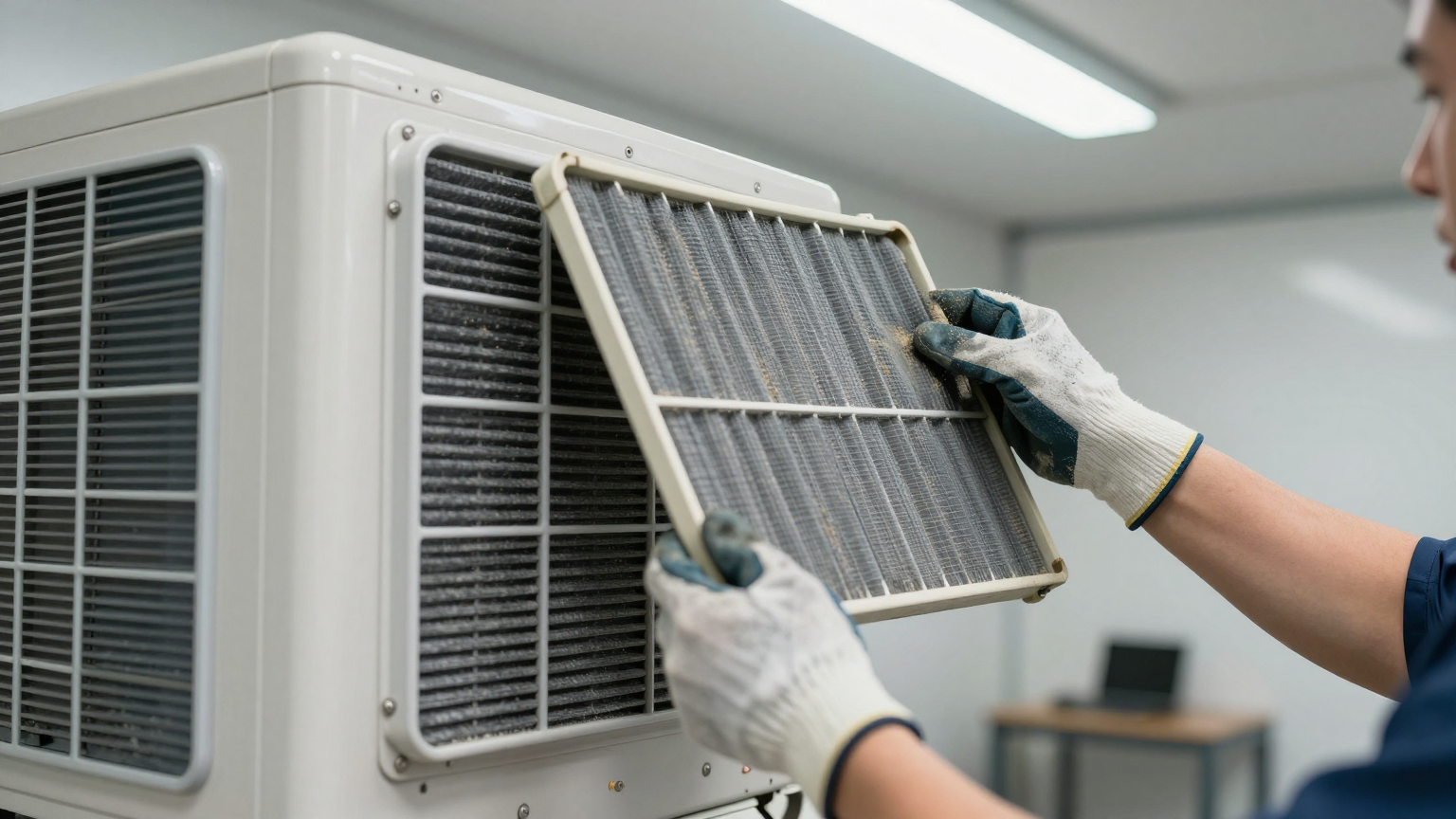
The DC Solution: By using a Rigid Portable DC A/C with a local battery bank, you eliminate the voltage drop issue. The batteries act as a local power reservoir, providing the high current needed for compressor bursts, while the grid (or solar) slowly recharges them.
The DC Advantage: Battery Buffer & Surge Cooling
This is where the Rigid Portable DC A/C shines. Unlike grid-tied units that might trip breakers during hard starts, our DC units run directly off a battery bank.
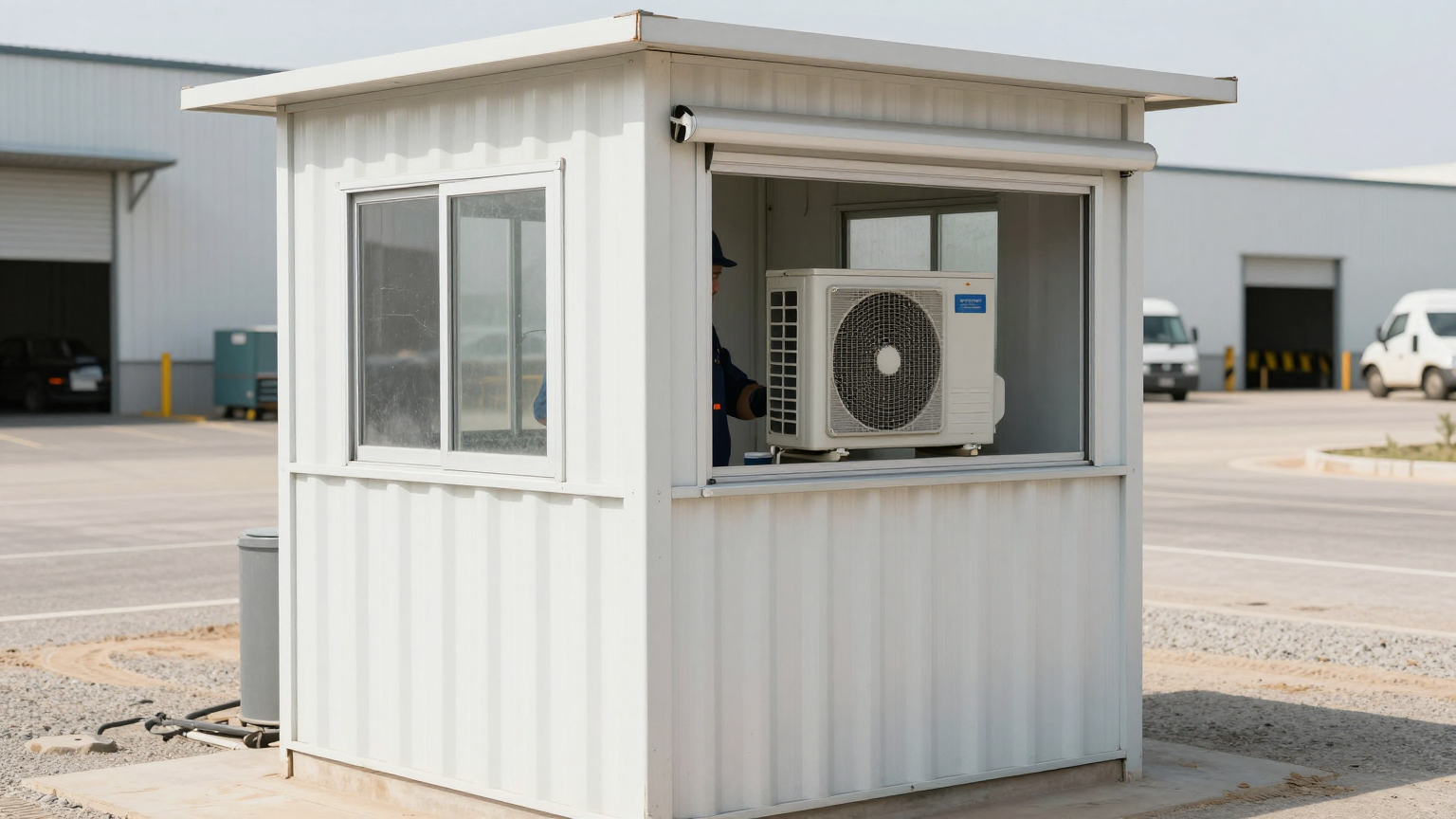
In this Arizona deployment, we swapped the rooftop unit for a Rigid LC2810E portable unit. We positioned the vent to blow directly on the guard’s seating position (spot cooling) rather than trying to cool the entire leaky box.
Installation Tip: Positive Pressure
Another trick is to create slightly positive pressure. By setting the Rigid unit to intake a small amount of fresh air (if configured), you push air out when the window cracks open, preventing dust and hot air from rushing in as aggressively.
Decision Checklist
| Scenario | Recommended Strategy |
|---|---|
| Door closed 90% of time | Standard wall/roof sizing is usually fine. |
| Door opens every 5-10 mins | Oversize by 50% or switch to Spot Cooling focus. |
| Off-grid / Solar powered | Rigid DC Aircon (Direct 12V/24V connection, no inverter loss). |
Detailed Troubleshooting: Why Your Current Unit is Dying
If you are experiencing compressor failures, it is likely due to short-cycling. When the door opens, the thermostat senses a massive heat spike and slams the compressor on. When the door closes, the tiny volume cools rapidly, and it shuts off. This ON/OFF cycle happens 20 times an hour.
Rigid’s Inverter Compressors solve this by running continuously at variable speeds. Instead of shutting off, they ramp down to 2000 RPM when cool, and ramp up to 6500 RPM when the door opens. This eliminates the “hard start” current spike and extends compressor life by 300%.
Case Study: 24/7 Gate Operations in Mining
At a mining site in Western Australia, guards work 12-hour shifts. The ambient temp hits 48°C. Their diesel generator was consuming 20L of fuel per shift just to run the AC.
The Fix: We installed a Rigid 24V DC Aircon powered by a 400Ah LiFePO4 battery bank and 600W of solar on the booth roof.
The Result:
- Fuel Savings: The generator now runs only 2 hours a day to top up batteries.
- Noise: The DC unit is whisper quiet (45dB) compared to the generator’s roar.
- Comfort: The variable speed compressor maintains a steady 24°C inside, even during shift changes.
FAQ: Guard Booth Cooling
1. How many BTU for a 4×6 guard booth with frequent door opening?
Static calculations suggest 2,000 BTU, but real-world “door opening” loads require at least 5,000 BTU. We recommend sizing up or using spot cooling to target the guard, not the empty air.
2. How to stop short cycling in a small security cabin?
Short cycling kills compressors. In small cabins, the temperature drops too fast when the door is closed. Use an Inverter DC Air Conditioner like the Rigid LC2810E. It doesn’t shut off; it simply slows down to 2000 RPM, maintaining a steady temp without the hard ON/OFF stress.
3. Do I need a condensate drain in a guard shack?
Yes. Even in dry climates, an AC removes moisture (latent heat). If you don’t route a drain hose outside, you’ll have water pooling on your floor or rotting your booth’s floorboards.
4. How do I maintain the unit in a dusty yard?
Logistics yards are dusty. A clogged condenser coil will kill your efficiency. We recommend checking the intake filter every week. Rigid units have accessible washable filters exactly for this reason.
Integration Support
If you are outfitting a fleet of mobile security trailers or guard shacks, power budget is everything. We can help you calculate the exact battery bank size needed to handle the compressor’s duty cycle in your specific climate.
Check out the specs of the Rigid Portable DC Air Conditioner to see if it fits your cabin constraints.