
Heat Transfer Fluid Aging: the Failure Nobody Logs
A chiller that loses capacity over two years has usually not worn out. In a sealed, low-maintenance recirculating loop, the component most likely to have degraded is the one nobody inspects because it is not a component: the fluid itself.
Heat transfer fluid aging is gradual, invisible from the outside, and produces symptoms that look exactly like machine faults — longer pull-down, unstable temperature, a pump that sounds labored, a setpoint that can no longer be reached. Each of those has a mechanical explanation that gets investigated first, and the fluid gets changed last, after the service visit that finds nothing wrong.
This article walks through a constructed two-year timeline showing how aging progresses and what it mimics along the way. All operating values are assumed for illustration; the degradation chemistry is general. Our coolant selection guide covers choosing a fluid in the first place, and the glycol ratio guide covers mixing it — this one is about what happens to that fluid afterward, and when to take it out.
The Scenario
| Parameter | Value used | Basis |
|---|---|---|
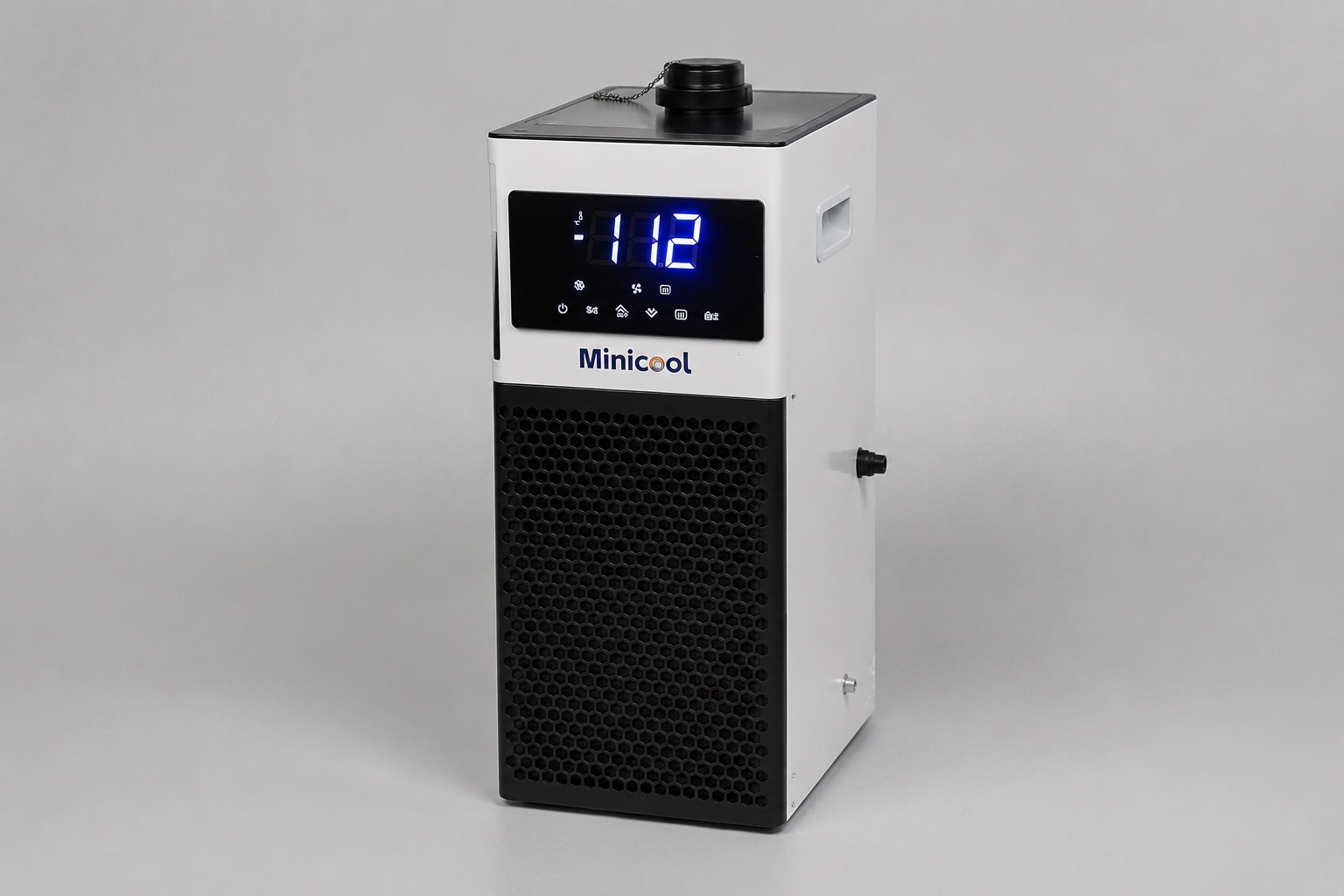
| Machine | MiniCool-class recirculating chiller, 450 W at the working point | Published range 450–850 W, 0 to −40 °C |
| Setpoint | −20 °C | Assumed |
| Coolant | Ethylene glycol / water, 40/60 by volume | Assumed; gives roughly −25 °C freeze protection |
| Duty | 8 hours/day, 5 days/week | Assumed |
| Loop | Closed, vented reservoir, mixed metals (copper, brass, stainless) | Assumed, typical |
| Maintenance | None on the fluid | The point of the scenario |
Nothing in that setup is abusive. It is an ordinary installation doing ordinary work, which is exactly why the outcome is worth walking through: heat transfer fluid aging does not need a fault to start. It starts on day one.
What Is Actually Degrading
 The chemistry is worth naming, because each mechanism produces a different symptom later.
- Glycol oxidation. In contact with air — and a vented reservoir guarantees contact — ethylene glycol slowly oxidizes into organic acids, including glycolic and formic acid. Heat accelerates it; so does every pass through the pump.
- Inhibitor depletion. Formulated coolants carry corrosion inhibitors that sacrifice themselves protecting metal surfaces. They deplete by doing their job, and once consumed, the acids from oxidation meet bare metal.
- Falling pH. As acids accumulate and inhibitors deplete, the fluid drifts from mildly alkaline toward acidic — the single most useful number in tracking heat transfer fluid aging.
- Biological growth. Below roughly 30 percent glycol this becomes likely in warm reservoirs; at 40 percent it is slower but not impossible, particularly in a loop that sits warm and idle between runs.
- Particulate load. Corrosion products and biofilm fragments circulate as fine solids that abrade pump seals and settle in low-flow passages.
The reservoir design sets the pace of the first mechanism. A vented reservoir renews the air above the fluid every time the level breathes with temperature, feeding oxidation continuously; a sealed or bladder-type reservoir starves it, and the same fluid can last considerably longer. Idle time is not neutral either — a loop that sits warm and still between runs gives biology its best conditions, which is one reason intermittent-duty machines sometimes present worse fluid than continuously running ones with more hours.
Two Years, Step by Step
- Months 0–6. Nothing observable. Inhibitors are working, pH is stable, the loop performs to specification. The only change is invisible: the inhibitor reserve is being consumed.
- Months 6–12. The fluid darkens slightly. pH has drifted down but is still in the safe band. Pull-down to −20 °C takes marginally longer — within the noise of ambient variation, so nobody notices.
- Months 12–18. Inhibitor reserve is substantially depleted. Copper and brass begin contributing ions; the fluid takes on a green-brown cast. Viscosity at −20 °C is rising as degradation products accumulate, and low-temperature flow drops a few percent.
- Months 18–24. pH is now clearly acidic. Corrosion is active on the warmest metal surfaces, particulates circulate, and a soft deposit builds in the evaporator’s coldest passages where viscosity is highest. The machine reaches −20 °C but holds it unsteadily under load, and the pump runs louder than it used to.
At no point in that sequence did anything fail. Every stage is chemistry doing what chemistry does, at rates set by temperature, air exposure, and metallurgy — which is why a fixed calendar interval borrowed from another installation is unreliable in both directions.
What Aging Mimics
The reason heat transfer fluid aging goes undiagnosed is that its symptoms all have more famous explanations.
| Symptom at month ~20 | What gets blamed | What the fluid was doing |
|---|---|---|
| Longer pull-down | Refrigerant charge, condenser fouling | Higher viscosity cutting low-temperature flow |
| Unstable temperature under load | Controller tuning, sensor drift | Reduced heat transfer through fouled surfaces |
| Noisy, hot pump | Pump bearings wearing out | Abrasive particulates and thicker fluid raising pump work |
| Setpoint unreachable in winter room | “Machine is undersized” | Viscosity climbing steeply at the cold end |
| Smell from reservoir | — | Biological growth or acid formation, correctly attributed for once |
A service technician checking refrigerant pressures will find them normal, because the refrigeration circuit is sealed and genuinely is normal. The degraded circuit is the one the customer owns the contents of — and the fluid is the only wetted component with no service indicator, no alarm, and no fault code.
Condition Checks That Take Ten Minutes
 Four checks cover the condition of the fluid, and none needs laboratory equipment.
- pH strip or meter. Fresh inhibited glycol is mildly alkaline. A reading drifting toward neutral means inhibitors are depleting; clearly acidic means replacement is due regardless of appearance. This is the highest-value single number.
- Refractometer. Confirms the glycol fraction — and therefore the freeze point — has not drifted from topping up with plain water. A loop topped up twice with water can quietly lose ten degrees of freeze protection.
- Visual and smell, against a reference sample kept from the original fill in a sealed jar. Darkening, haze, sediment, or a sour smell all mean chemistry has moved.
- A note of pull-down time to setpoint under a repeatable condition, recorded at commissioning and rechecked at each service. A lengthening trend with normal refrigerant behavior points at the fluid side.
The reference sample and the commissioning pull-down number are the two items that cost nothing at installation and are unobtainable afterward. Both belong in the commissioning routine of any sub-zero loop.
A Defensible Replacement Logic
Condition-based replacement beats calendar-based, but a calendar backstop is still worth having, because the failure mode of condition-based maintenance is that nobody does the checks.
- Check pH and glycol fraction every 6 months, against the reference sample. Ten minutes.
- Replace on condition: pH clearly fallen, visible sediment or haze, sour smell, or freeze point drifted more than a few degrees from target.
- Replace on the backstop regardless of appearance after 2 years for a vented loop worked at sub-zero setpoints — sooner in hot rooms or continuous duty, later only if condition data justifies it.
- After any corrosion event or biological contamination, flush before refilling; new fluid poured onto old chemistry inherits it.
The backstop number is an assumption, not a specification — vented reservoirs, duty, metallurgy, and temperature all move it. What makes the logic defensible is the condition data: an interval you can defend is one anchored to a measured pH trend and a commissioning baseline, not one copied from a different installation.
Sub-Zero Loops Age Differently
Two things distinguish heat transfer fluid aging at −20 °C from the same chemistry in a room-temperature loop.
First, viscosity punishes degradation harder. A 40/60 glycol mix is already several times more viscous at −20 °C than at room temperature; degradation products push it further, and flow in the coldest passages — precisely where the work is done — falls first. The same fluid condition that would be cosmetic at +15 °C measurably cuts capacity at −20 °C.
Second, the freeze point margin is a safety figure, not a preference. Fluid that has been diluted by water top-ups is not just less protective in the abstract — in a machine capable of −40 °C setpoints, it can freeze inside the evaporator, and that is a hardware event, not a fluid event. The refractometer check exists for this reason, and the published 0 to −40 °C envelope of the MiniCool range is only available to a fluid whose freeze point still matches its label.
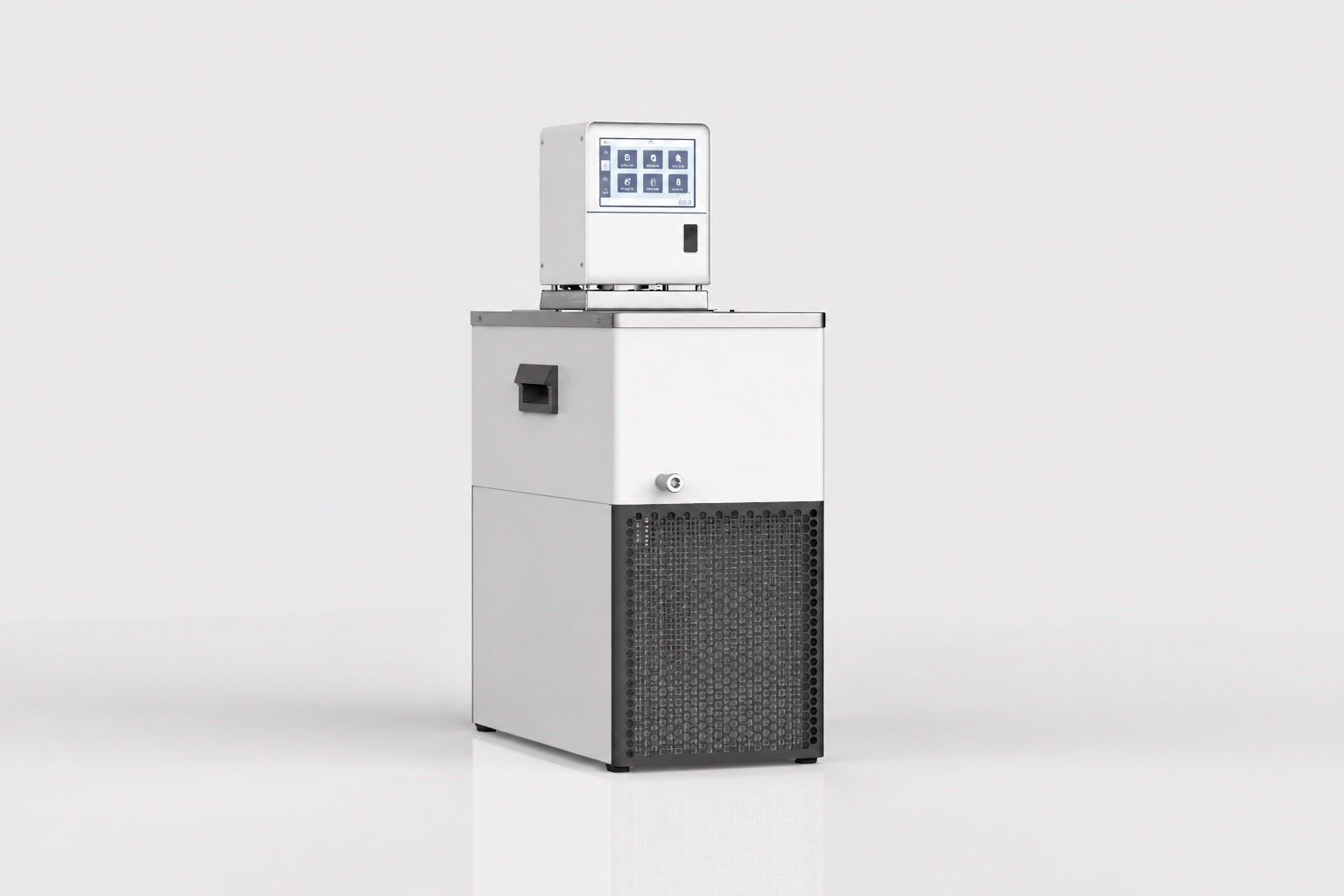
For positive-temperature loops the same chemistry applies with gentler consequences; the DV compact liquid chiller family (100–550 W, −20 to +20 °C) tolerates a degraded fluid longer before performance moves — which is convenient, and also exactly why aging in those loops goes unnoticed longest.
What Replacement Actually Involves
Draining and refilling is the visible part. The parts that determine whether the new fill lasts:
- Flush with clean water (or a flush product after contamination) until it runs clear, then displace the flush water fully — residual water dilutes the new mix and shifts its freeze point.
- Mix to the target ratio before filling, and verify with the refractometer after circulation, not by trusting the bucket arithmetic.
- Refill the reference jar and re-record the commissioning pull-down time. The new fluid’s baseline is the next cycle’s diagnostic.
- Log the date. The calendar backstop only works if the calendar knows when the clock started.
If you want a fluid regime matched to a specific installation, send the following and our engineers will advise: machine model and setpoint, coolant type and ratio if known, reservoir type (vented or sealed), duty pattern, room temperature range, and how long the current fill has been in service. Send your loop details to our engineering team.
Frequently Asked Questions
How often should chiller coolant be replaced?
On condition, with a calendar backstop. Check pH and glycol fraction every six months against a reference sample; replace when pH has clearly fallen, sediment or smell appears, or freeze point has drifted. For a vented sub-zero loop, an assumed backstop of around two years is a reasonable default — but heat transfer fluid aging runs faster in hot rooms and continuous duty, and the condition checks outrank the calendar in both directions.
What does aged glycol coolant look like?
Darkened, sometimes green-brown from dissolved copper, possibly hazy or carrying fine sediment, and in later stages sour-smelling. But appearance lags chemistry: fluid can be acidic while still looking acceptable, which is why the pH check matters more than the visual one. A sealed reference jar from the original fill turns the visual check from a guess into a comparison.
Can I just top up instead of replacing?
Topping up with plain water replaces evaporated water correctly, but repeated top-ups dilute the glycol and raise the freeze point — dangerous in a sub-zero machine. Topping up with fresh mixed coolant maintains the ratio but does not restore depleted inhibitors or remove acids. Once the chemistry has moved, only a drain, flush and refill resets it.
Why is my chiller slower to pull down than it used to be?
If refrigerant-side checks are normal, suspect the fluid: degradation products raise viscosity, viscosity cuts flow at the cold end hardest, and reduced flow shows up first as longer pull-down and unstable temperature under load. Comparing today’s pull-down time with the commissioning value, under similar conditions, separates fluid-side drift from machine faults better than any single measurement.
Does fluid aging damage the chiller itself?
It can. Depleted inhibitors expose mixed metals to acidic fluid, corrosion particulates abrade pump seals, and deposits foul the evaporator’s coldest passages. A freeze-point drift from water top-ups can go as far as freezing the evaporator. The fluid is the cheapest wetted component in the loop, and replacing it on time is the cheapest way to protect the ones that are not.
Is heat transfer fluid aging faster at sub-zero setpoints?
The chemistry itself is driven mostly by heat, air exposure and metallurgy rather than by the cold end. What changes at sub-zero setpoints is sensitivity: viscosity is already high at −20 °C, so the same degradation costs more flow and more capacity than it would in a warm loop, and freeze-point margin becomes a hardware-protection figure. Cold loops do not age faster — they forgive aging less.