
Why a Heavy Duty Cooling Vest for Industrial Heat Is a Safety Decision, Not a Comfort Purchase
There is a conversation that happens in every smelter control room, every mining dispatch office, and every steel plant safety meeting. Someone brings up the heat. Someone else says workers are “used to it.” And then, quietly, the incident reports pile up — not catastrophic explosions or structural failures, but the slow, grinding accumulation of errors that nobody connects back to core body temperature.
A forklift operator misjudges clearance by six inches. A furnace tender hesitates two seconds too long on a valve sequence. A haul truck driver drifts a lane on a bench road because his reaction time has degraded by 15% and he doesn’t even know it. These aren’t dramatic. They’re statistical. And they’re the real cost of industrial heat exposure that never shows up on a thermometer.
If you’re a safety manager or operations lead searching for a heavy duty cooling vest for industrial heat, you’ve probably already moved past the “is heat a problem” stage. You’re in the “what actually works at scale” stage. This article is written for that conversation — the practical, field-level reality of deploying active cooling in environments where passive solutions have already failed.
The Real Problem: Heat Stress Doesn’t Announce Itself
The dangerous thing about heat stress in industrial settings isn’t the dramatic heat stroke case that triggers an emergency response. It’s the subclinical impairment that degrades performance across an entire shift without anyone raising a flag.
Research from occupational health literature consistently shows that cognitive function begins to decline well before a worker feels “dangerously hot.” Core body temperature elevations of just 1-2°F above baseline are associated with measurable drops in working memory, attention, and decision-making speed. In a furnace-front environment where ambient temperatures routinely exceed 120°F, that threshold can be crossed within the first 30-45 minutes of a shift.
Here’s what that looks like in practice:
- Slower hazard recognition. A worker who would normally spot a leaking hydraulic line in two seconds now takes five. In a smelter environment, those three seconds can be the difference between a controlled shutdown and a spill.
- Increased procedural errors. Multi-step lockout/tagout sequences, valve operations, and equipment checks become error-prone. Not because workers are careless — because their cognitive bandwidth has been physically narrowed by thermal load.
- Degraded communication. Radio calls get shorter, less precise. Critical information gets dropped or garbled. In mining operations where clear communication between surface and underground crews is a safety lifeline, this is not a minor issue.
- Cumulative fatigue across shifts. A worker who finishes a 12-hour shift with elevated core temperature doesn’t fully recover overnight. Day two starts with a deficit. Day three compounds it. By the end of a rotation, the entire crew is operating at reduced capacity — and the incident rate reflects it.
The financial math is straightforward but rarely calculated honestly. Most operations track direct heat-related incidents (heat exhaustion cases, OSHA recordables) but miss the vastly larger pool of near-misses, quality defects, and productivity losses driven by subclinical heat impairment. Field experience from heavy industry sites suggests the ratio of hidden losses to visible incidents can run 10:1 or higher, though this varies significantly by operation and measurement methodology.
Why Ice Vests and Evaporative Gear Hit a Wall in Heavy Industry
Before we talk about active cooling, it’s worth understanding why the most common “cooling vest” solutions underperform in serious industrial heat environments. This isn’t about any product being bad — it’s about physics and operational constraints.
Ice pack vests
Phase-change and ice pack vests provide genuine cooling, but with hard time limits. In a 130°F furnace-front environment, ice packs typically provide meaningful cooling for 60-90 minutes before they need to be swapped. For a 12-hour shift, that means managing 8-12 ice pack changes per worker — each requiring the worker to leave the hot zone, swap packs, and return. In practice, the logistics of ice supply, freezer space, and swap timing break down quickly at scale. Workers start skipping changes. Cooling becomes intermittent. The protection gap grows.
Evaporative cooling
Evaporative vests rely on ambient air movement and low humidity to function. In many industrial heat environments — particularly smelters, foundries, and enclosed mining operations — humidity levels are high enough and air circulation restricted enough that evaporative cooling delivers minimal benefit. When ambient temperature exceeds skin temperature (roughly 95°F), evaporative vests in humid conditions can actually impede the body’s own cooling mechanisms by adding an insulating wet layer.
Misting systems and spot coolers
Area cooling solutions work well for fixed workstations but don’t follow workers through complex environments. A furnace tender who moves between the tap floor, the control room, and the casting bay needs cooling that travels with them. Fixed infrastructure can’t provide that.
The pattern is consistent: passive and semi-active cooling solutions provide partial protection in moderate conditions but fail to maintain adequate core temperature management during extended exposure to extreme industrial heat. The gap between what these solutions deliver and what the thermal environment demands is where heat-related performance degradation lives.
Active Compression Cooling: How It Works and Where It Fits
Active cooling — meaning a system that uses a mechanical refrigeration cycle to actively pump heat away from the body — addresses the fundamental limitation of passive approaches. Instead of relying on phase change materials that deplete or evaporation that depends on environmental conditions, an active system provides continuous, adjustable cooling regardless of ambient temperature or humidity.
The RIGID Micro Cooler is a compressor-driven cooling unit that uses sealed Freon refrigerant in a rotary micro-compressor system to deliver sustained cooling. Some key specifications from the manufacturer:
- Weight: Under 7 kg (15 lbs) — light enough for a wearable vest configuration, though you’ll want to evaluate mounting options for your specific application
- Temperature capability: Can cool below 35°F, with adjustable output via remote control
- Power draw: 18-22 amps maximum, depending on installation and ambient conditions
- Maintenance: Sealed refrigerant system requires no recharging or consumable replacement
- Operation: Plug-and-play setup with remote control for temperature adjustment
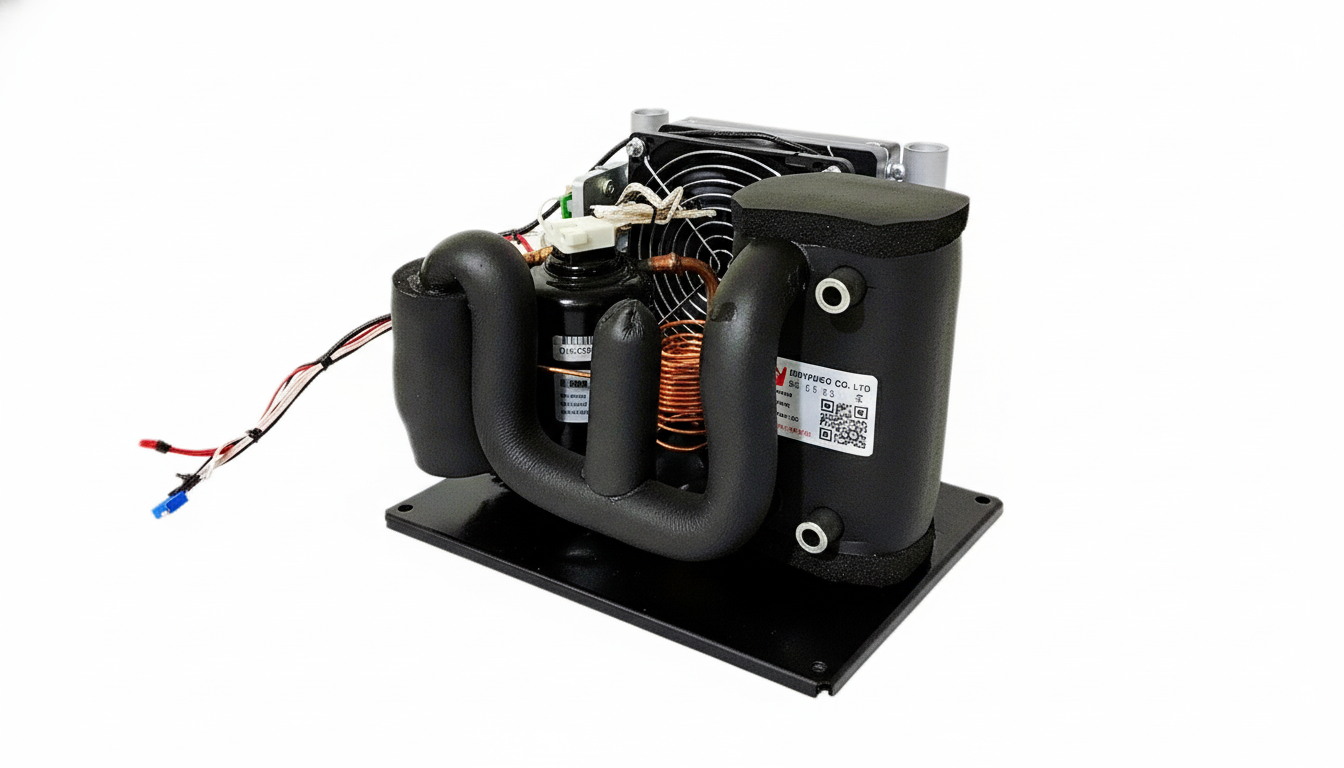 The practical significance of compressor-driven cooling versus ice or evaporative approaches comes down to three things: continuous operation without consumable resupply, independence from ambient humidity and airflow conditions, and adjustable cooling output that can be tuned to the thermal load rather than delivering a fixed, declining cooling curve.
Field Notes: Deploying Active Cooling in Furnace-Front and Mining Operations
The following observations are drawn from field experience with active cooling deployments in heavy industrial settings. These are practical notes, not laboratory data — treat them as experienced guidance rather than guaranteed specifications.
Power planning is the first conversation
At 18-22 amps draw, power supply is the first integration question for any deployment. In most furnace-front and mining applications, workers are already operating near mobile power infrastructure (vehicles, generator sets, or distributed power panels). The key planning question is whether existing power circuits have capacity for additional cooling loads, or whether dedicated circuits need to be run.
In vehicle-mounted applications (haul trucks, loaders, mobile equipment), the vehicle’s electrical system typically provides adequate power. For foot-mobile workers, power routing options depend heavily on the specific site layout. This is worth a site-specific engineering conversation rather than a generic answer.
Weight distribution matters more than total weight
At under 15 lbs, the Micro Cooler is manageable weight, but placement affects comfort and mobility over a full shift. Field experience suggests that back-mounted configurations work well for workers in relatively stationary positions (control stations, monitoring posts), while belt-mounted or vehicle-tethered configurations are preferred for workers who need full range of motion for physical tasks.
The important thing is to involve workers in the mounting decision. A cooling system that workers find uncomfortable or awkward will see declining usage rates regardless of how well it performs thermally. Compliance is a human problem, not an engineering problem.
Don’t overcool
This sounds counterintuitive, but it’s a real operational consideration. The system can cool below 35°F, which is far colder than what’s needed for core temperature management in most industrial applications. Overcooling can cause localized skin discomfort, vasoconstriction (which actually impairs the body’s heat dissipation from uncooled areas), and worker complaints that lead to system rejection.
Experienced operators typically find that maintaining cooling vest output at a level that keeps core body temperature stable — not cold, stable — produces the best combination of comfort, cognitive performance, and worker acceptance. The remote control feature is useful here, as it allows workers to adjust cooling output as thermal conditions change through a shift. Start moderate and let workers dial in their preference.
Shift change logistics
In continuous operations running 24/7 with rotating crews, cooling equipment becomes shared assets. Plan for a 15-20 minute turnover between shifts to allow equipment inspection, basic wipe-down, and fit adjustment for the incoming worker. Sealed compressor systems have an advantage here — there’s no ice to restock, no water reservoir to refill, no consumable to replace between shifts.
Integration with existing PPE
In most heavy industrial environments, cooling vests must coexist with flame-resistant clothing, fall protection harnesses, respiratory equipment, and other PPE layers. The cooling distribution tubing and vest component need to fit under or integrate with existing PPE without creating snag points, restricting movement, or interfering with harness attachment points.
This is a site-specific fitting exercise. What works in a smelter (FR coveralls, minimal fall protection) may not work directly in a mining operation (full harness, self-rescuer, cap lamp battery). Budget time for fitting sessions with representative workers wearing their full PPE loadout before committing to a deployment configuration.
Application Boundaries: Where This Works and Where It Doesn’t
Honest assessment of fit is more useful than overselling. Here’s how active compressor cooling maps to common industrial heat scenarios:
Strong fit
- Furnace-front operations (smelters, foundries, glass plants): High radiant heat, extended exposure, workers in relatively defined zones near power infrastructure. This is the core use case for active cooling.
- Mining equipment operators: Enclosed or semi-enclosed cabs with high ambient temperatures, vehicle power available, extended shift durations. Vehicle-mounted cooling is a natural integration.
- Boiler and maintenance operations in power plants: Workers performing extended maintenance in high-temperature enclosures where area cooling is impractical.
- Steel and aluminum processing: Continuous casting, rolling, and finishing operations where workers are stationed near high-temperature materials for extended periods.
Conditional fit — requires careful evaluation
- Underground mining (non-vehicle): Heat conditions are often severe, but power routing to foot-mobile workers in active headings can be challenging. Evaluate power infrastructure on a case-by-case basis.
- Confined space entry: Cooling is often desperately needed, but additional equipment bulk and tethering may conflict with confined space entry/exit requirements. Coordinate with your confined space rescue plan.
- Explosive atmospheres (Class I/II environments): Any electrical equipment in hazardous classified areas requires appropriate ratings. Verify compliance with your site’s area classification before deployment.
Not the right fit
- Short-duration, high-mobility tasks: If workers are in the hot zone for less than 30-45 minutes at a time with adequate cool-down periods between exposures, the deployment overhead of active cooling may not be justified. Simpler solutions (ice vests, work-rest cycling) may be more practical.
- Outdoor construction with no power access: Active cooling requires electrical power. Remote outdoor sites without vehicle or generator power nearby are not a good match unless battery solutions are separately evaluated.
- Moderate heat environments (below 100°F): If your thermal challenge is moderate, passive solutions may be entirely adequate and simpler to deploy. Active cooling provides the most value where passive solutions have already been tried and found insufficient.
Measuring What Matters: How to Evaluate Cooling Effectiveness
If you’re going to invest in active cooling, you need a framework for evaluating whether it’s actually working. “Workers feel cooler” is a starting point but not sufficient for a safety-critical investment.
Leading indicators
- Core body temperature monitoring: Ingestible temperature sensors or continuous tympanic monitoring can provide objective data on core temperature trends across shifts. You’re looking for stable core temperatures in the 99-100°F range rather than the progressive rise seen without cooling intervention.
- Cognitive performance baselines: Simple reaction time tests administered at the start and end of shifts can quantify cognitive degradation. Several commercial systems exist for this, and some operations use simple custom protocols. The key is consistent measurement before and after cooling deployment.
- Heart rate variability: Wearable HR monitors can track cardiovascular strain as a proxy for thermal stress. Lower sustained heart rates during equivalent work indicate reduced thermal load.
Lagging indicators
- Near-miss and incident rates: Track these with enough granularity to isolate heat-related factors. This requires honest reporting culture and analytical rigor — most operations undercount heat-related near-misses because the connection between thermal stress and a procedural error isn’t obvious.
- Productivity metrics: Tons processed, tasks completed, cycle times — whatever your operation measures. Compare equivalent periods with and without cooling intervention, controlling for other variables as best you can.
- Absenteeism and crew turnover: Chronic heat exposure drives both. If your operation struggles to retain experienced workers in high-heat positions, cooling may affect retention rates over time.
A reasonable evaluation period is 60-90 days of consistent deployment. Heat-related performance effects are cumulative and statistical — you won’t see a clear signal in a one-week trial.
The Cost Conversation: Reframing Cooling as Loss Prevention
The purchase cost of active cooling equipment is visible and easy to quantify. The cost of not deploying it is diffuse and easy to ignore. This is why cooling is perpetually underfunded relative to its impact.
Consider a practical framing. A single lost-time incident in a heavy industrial operation — a strained back from a heat-fatigued worker making an awkward lift, a vehicle contact from degraded reaction time, a procedural error that damages equipment — typically costs $30,000-$150,000 in direct costs (medical, investigation, repair) and multiples of that in indirect costs (production disruption, overtime, regulatory attention, insurance impact).
If active cooling prevents even one such incident per year across a deployed crew, the equipment cost is recovered. Field experience in high-heat operations suggests the actual incident prevention rate is meaningfully higher than that, though quantifying the precise number requires operation-specific data and honest attribution analysis.
The more compelling economic argument, though, is productivity. A crew operating at full cognitive capacity produces more, makes fewer errors requiring rework, and maintains higher quality output than the same crew operating under thermal impairment. In continuous process operations where throughput is measured in tons per hour, even single-digit percentage improvements in effective working time have significant financial impact.
Implementation Checklist for Safety Managers
If you’re moving toward a pilot deployment, here’s a practical sequence based on field experience:
- Identify your highest-impact positions first. Don’t try to cool everyone at once. Start with the roles that combine the highest thermal exposure, the longest continuous exposure duration, and the most safety-critical tasks. Furnace operators, heavy equipment operators in enclosed cabs, and workers performing precision tasks in radiant heat zones are typical starting points.
- Conduct a power audit. Map available power at each target work position. Identify what’s available, what capacity exists, and what modifications (if any) are needed. This is the most common bottleneck in deployment planning.
- Involve workers early. The people who will wear the equipment need to be part of the selection, fitting, and configuration process. Top-down mandates without worker input produce compliance problems. Frame it as a tool they’re being given, not a requirement being imposed.
- Establish baseline measurements. Before deploying cooling, collect at least two weeks of baseline data on whatever metrics you plan to track (core temperature, incident rates, productivity, or all three). Without a baseline, you can’t demonstrate impact.
- Plan for a 90-day pilot. Deploy to your highest-impact group, collect data, iterate on mounting and configuration, and build the operational case for broader deployment based on measured results.
- Document everything. Your pilot data becomes the business case for scaling. Capture setup configurations, worker feedback, maintenance requirements, and performance data in a format that supports a capital expenditure request.
Closing Perspective
The question isn’t whether heat affects worker performance in industrial environments — the physiology is unambiguous on that point. The question is whether your operation is measuring that impact and making informed decisions about managing it.
A heavy duty cooling vest for industrial heat, backed by active compressor technology, doesn’t eliminate heat as a workplace factor. It manages it — continuously, measurably, and in a way that scales across shifts and seasons. For operations where heat-related performance degradation is a known but poorly managed risk, that’s a meaningful capability gap to close.
The RIGID team supports integration planning for industrial deployments, including site-specific power assessment, PPE compatibility evaluation, and pilot program design. If you’re evaluating active cooling for your operation, the most productive next step is a technical conversation about your specific environment and requirements. Reach out to discuss your deployment scenario — the engineering details matter, and generic solutions rarely survive contact with real industrial conditions.