
Heavy Duty Electric AC: What the Label Actually Has to Mean
Search for a DC air conditioner for any piece of heavy equipment — a forklift, an excavator, a crane, a tractor, a street sweeper — and you will find dozens of products described as “heavy duty.” The phrase appears on Amazon listings for $350 units and on industrial catalogs for $3,500 systems. It appears on products with consumer-grade compressors and on systems built around validated mobile-application components. It has become so overused that it communicates almost nothing to the person actually trying to cool an equipment cab.
This is a problem, because the gap between a DC air conditioning system that works on heavy equipment and one that fails is real, measurable, and expensive. The failures do not happen on the bench or in the showroom — they happen three months into field deployment, when vibration has loosened a fitting, dust has choked the condenser, or thermal cycling has cracked a seal. By that point, the fleet has spent money on the unit, money on installation, and money on the downtime to diagnose and replace it.
This article is a review of what “compact” and “rugged” must actually mean in a heavy duty electric ac system for equipment cabs — not as marketing language, but as engineering specifications that predict field survival. It draws on the common failure modes and deployment challenges across the full range of heavy equipment applications: forklifts, excavators, agricultural tractors, cranes, golf carts and LSEVs, and street sweepers.
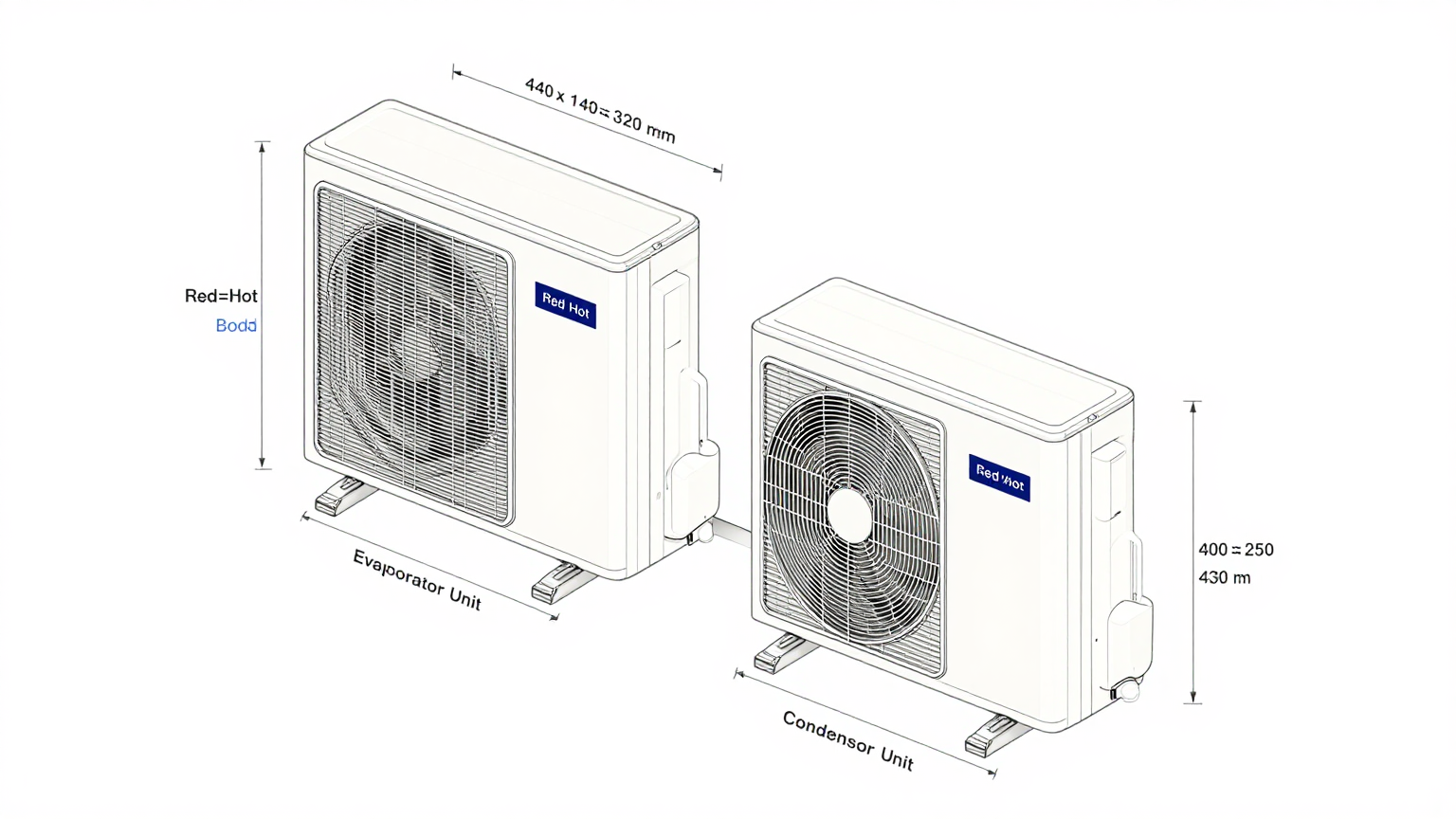
What “Compact” Means When Every Centimeter Is Contested
Equipment cabs are not designed with aftermarket air conditioning in mind. The operator’s compartment is engineered around sightlines, control ergonomics, egress paths, and structural rollover protection. There is no vacant bay labeled “install AC here.” Every component of the cooling system must fit into space that was allocated for something else — or into the margins between things.
Indoor Unit: The Headliner Zone
The evaporator unit sits inside the cab, where it must deliver cooled air to the operator without obstructing visibility, controls, or head clearance. On a forklift, the available zone is typically behind or above the operator’s head, within the cab ceiling structure. On an excavator, the headliner or a side panel offers mounting space. On a crane, the cab may be so small that the evaporator must integrate into the dashboard or a custom overhead console.
A compact evaporator — 440 × 140 × 320 mm in a representative split-type system — fits within these zones on most equipment cab types. An evaporator that is 20% larger in any dimension may not. The difference between a system that integrates cleanly and one that requires cutting into structural panels or blocking a vent is often measured in millimeters.
Outdoor Unit: Condenser Placement Is an Engineering Decision
The condenser and compressor assembly — 600 × 250 × 430 mm in a typical split-type configuration — mounts externally. On a forklift, this might be the counterweight area. On an excavator, the superstructure behind the cab. On a tractor, the rear frame or fender zone. On a crane, a bracket on the cab exterior or the turntable structure. On a golf cart, under the vehicle or behind a body panel. On a street sweeper, the chassis frame.
In every case, the condenser location is a compromise between airflow access, cleaning accessibility, protection from impact, and available mounting structure. A compact condenser gives the installer more options. A bulky one reduces the viable locations to one or two — and sometimes to zero.
Total System Weight
Weight matters differently on different platforms. On a 20-ton excavator, 48 kg of AC equipment is negligible. On a battery-electric golf cart where every kilogram affects driving range, or on a crane cab where the structure has a defined load rating, 48 kg is a meaningful number. A split-type system distributes this weight across two mounting points rather than concentrating it in one location (as a rooftop monoblock does), which generally produces better load distribution and lower center of gravity — relevant on equipment that works on slopes or experiences dynamic load shifts.
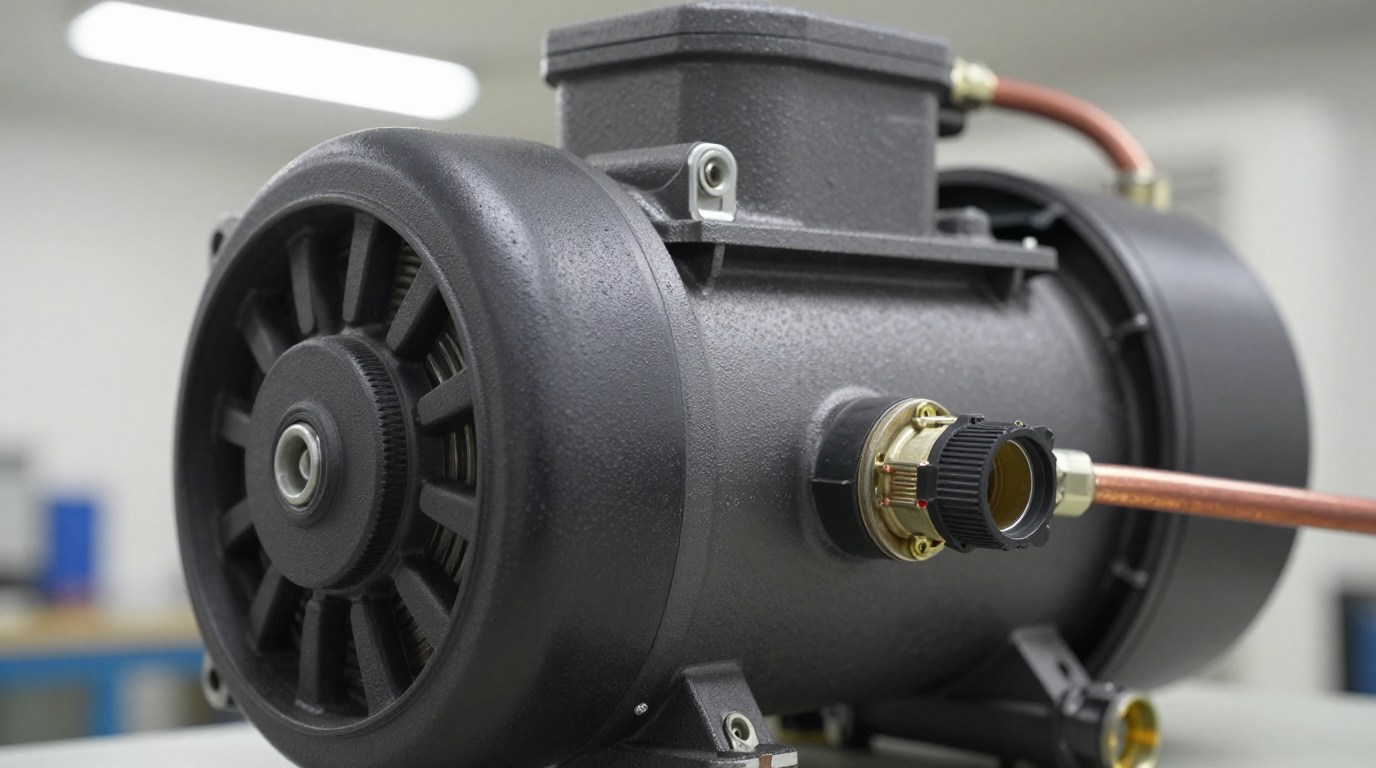
What “Rugged” Means When the Environment Tries to Kill the System
The word “rugged” on a product listing might mean “we used thicker sheet metal on the housing.” In actual field deployment on heavy equipment, ruggedness is tested by three specific environmental forces that act continuously and compound each other.
Vibration: The Silent Compressor Killer
Every piece of heavy equipment vibrates, but the vibration profile varies dramatically by machine type. Forklifts generate high-frequency transient shocks from dock plates and load engagement. Excavators produce multi-axis vibration from bucket strikes and boom cycling. Cranes impose low-frequency oscillations from load dynamics. Tractors transmit PTO-driven vibration through the frame. Sweepers generate brush and vacuum-induced vibration at varying frequencies.
A rugged AC system must tolerate all of these profiles, because the same product is often deployed across a mixed equipment fleet. This means:
- A rotary or scroll compressor rather than a reciprocating piston design — fewer parts subject to impact-induced fatigue
- Vibration-isolating mounts at every attachment point — rubber or spring-damper hardware that absorbs transient peaks
- Brazed rather than flared refrigerant connections — more resistant to loosening under vibration
- Locking electrical connectors (Deutsch-style or equivalent) — standard spade connectors vibrate loose within weeks on heavy equipment
Dust and Particulates: The Condenser’s Enemy
Construction dust, agricultural chaff, road debris from sweeping operations, sand in coastal environments — all of it ends up in the condenser fins. The condenser is the system’s heat rejector; when its fins clog, the system loses cooling capacity, the compressor works harder, energy consumption rises, and component life drops.
Ruggedness in this context means:
- Condenser fin spacing that balances heat transfer efficiency against fouling resistance
- Condenser mounting that allows quick access for cleaning — weekly on some applications
- Corrosion-resistant condenser coil materials and coatings for salt-air, chemical, and high-humidity environments
- Sealed or potted electrical connections that prevent dust and moisture ingress into the control electronics
Thermal Cycling: Stress on Every Joint
Equipment operates in cycles — hot days, cold nights, engine-on to engine-off, idle to full load. Each cycle expands and contracts every material in the system — metal fittings, rubber seals, copper tubing, electrical insulation. Over hundreds of cycles, weak joints develop leaks, seals harden and crack, and electrical connections develop high-resistance points that cause intermittent faults.
A rugged system uses materials and connection methods validated for the thermal cycling range of the deployment environment. Pre-charged refrigerant circuits with factory-sealed connections (R134a, for example) reduce the number of field-made joints that are vulnerable to cycling-induced degradation.
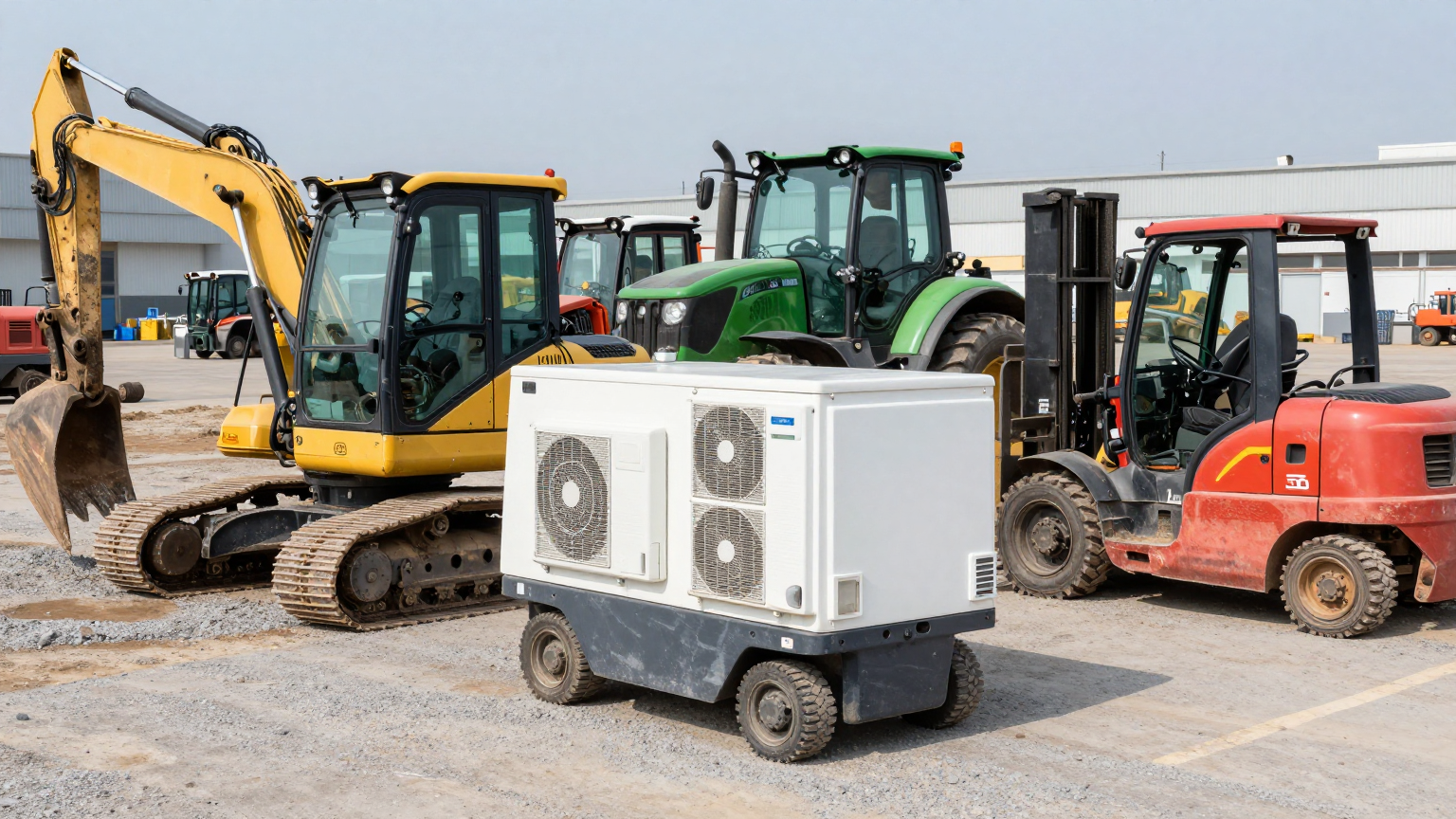
The DC-Native Advantage Across Equipment Types
One engineering choice cuts across all heavy equipment applications: whether the air conditioning system is DC-native or AC-converted.
Heavy equipment electrical systems are DC — 12V, 24V, 48V, or higher. A DC-native AC system connects directly to this power source. An AC-dependent system requires an inverter to convert DC battery power to AC before driving the compressor motor. The inverter adds cost, weight, heat (wasted energy), and a failure point. On battery-electric machines (electric forklifts, electric sweepers, electric golf carts), the inverter loss is especially costly because the battery budget is finite.
A DC air conditioning system with multi-voltage input (24V through 72V) deploys across the full range of equipment electrical systems — diesel machines with 24V systems, electric forklifts at 48V, lithium golf carts at 72V — without modification, voltage conversion, or model-specific variants. For fleets that operate diverse equipment, this is a procurement and inventory simplification that compounds over time.
Field Performance Summary Across Applications
The following table summarizes how the core attributes of a compact, rugged DC AC system address the specific challenges of each equipment type covered in this series.
| Equipment Type | Primary Challenge | Critical AC Attribute |
|---|---|---|
| Forklift | Extreme space constraint; glass-box heat trap | Ultra-compact evaporator; split-type to avoid overhead guard loading |
| Excavator | Multi-axis vibration; extreme dust | Rotary compressor; serviceable condenser; sealed connectors |
| Tractor | Engine HP loss from belt-driven AC | DC-native compressor; zero mechanical parasitic load |
| Crane | Suspended cab; no ambient airflow; height access | Low-maintenance design; pre-charged refrigerant; compact form |
| Golf Cart / LSEV | Battery range impact; noise sensitivity | Variable-speed quiet operation; high energy efficiency |
| Street Sweeper | Battery budget competition; self-generated dust | Maximum energy efficiency; easy-clean condenser access |
The common thread is that the same core system architecture — compact split-type, DC-native, variable-speed rotary compressor, pre-charged refrigerant, multi-voltage input — addresses the dominant challenge on each platform. The specific installation (condenser location, wiring, mounting hardware) varies by equipment type, but the system itself is consistent. This is the practical meaning of a platform approach to heavy equipment cab cooling.
Common Field Questions
Is one AC system really suitable for all these equipment types?
The core system — compressor, evaporator, condenser, refrigerant circuit, and controller — is the same. What changes between applications is the mounting hardware, wiring harness length, and condenser placement. A system with 2,300 W (7,843 BTU) cooling capacity, multi-voltage DC input, and a compact split-type form factor covers the cab volume and thermal load range of all the equipment types discussed. The installation engineering is application-specific; the cooling hardware is common.
How do I evaluate whether a product is truly heavy-duty?
Ask three questions: (1) What type of compressor is it — rotary/scroll or reciprocating piston? Rotary and scroll types tolerate vibration better. (2) Is the refrigerant circuit pre-charged and factory-sealed, or does it require field charging? Pre-charged systems have fewer field-made connections that can leak. (3) What is the compressor’s drive method — DC-native or inverter-fed? DC-native eliminates the inverter as a failure point and efficiency loss. Products that answer favorably on all three are more likely to survive heavy equipment deployment.
What is the typical lifespan of a DC AC system on heavy equipment?
It depends heavily on maintenance — specifically condenser cleaning and electrical connection inspection. A well-maintained system with a quality DC rotary compressor can operate for 5,000–10,000+ hours in demanding environments. The most common life-limiting factor is not the compressor itself but the condenser fouling (which overstresses the compressor) and vibration-induced refrigerant leaks (which starve the compressor of lubrication). Regular maintenance directly extends system life.
Should I standardize on one AC system across my entire fleet?
If your fleet spans multiple equipment types and voltage ranges, a multi-voltage DC system with a common core design simplifies procurement (one part number), spare parts inventory (one set of filters, one condenser specification), and technician training (one installation and maintenance procedure). The per-unit cost may be slightly higher than the cheapest application-specific option, but the total cost of ownership across a diverse fleet is typically lower.
What is the single most important maintenance task?
Condenser cleaning. On every equipment type, in every operating environment, condenser fouling is the primary driver of system underperformance and premature failure. A clean condenser lets the compressor run at lower load, draw less energy, generate less heat, and last longer. Everything else — filter changes, electrical checks, drain line clearance — matters, but condenser maintenance is the foundation.
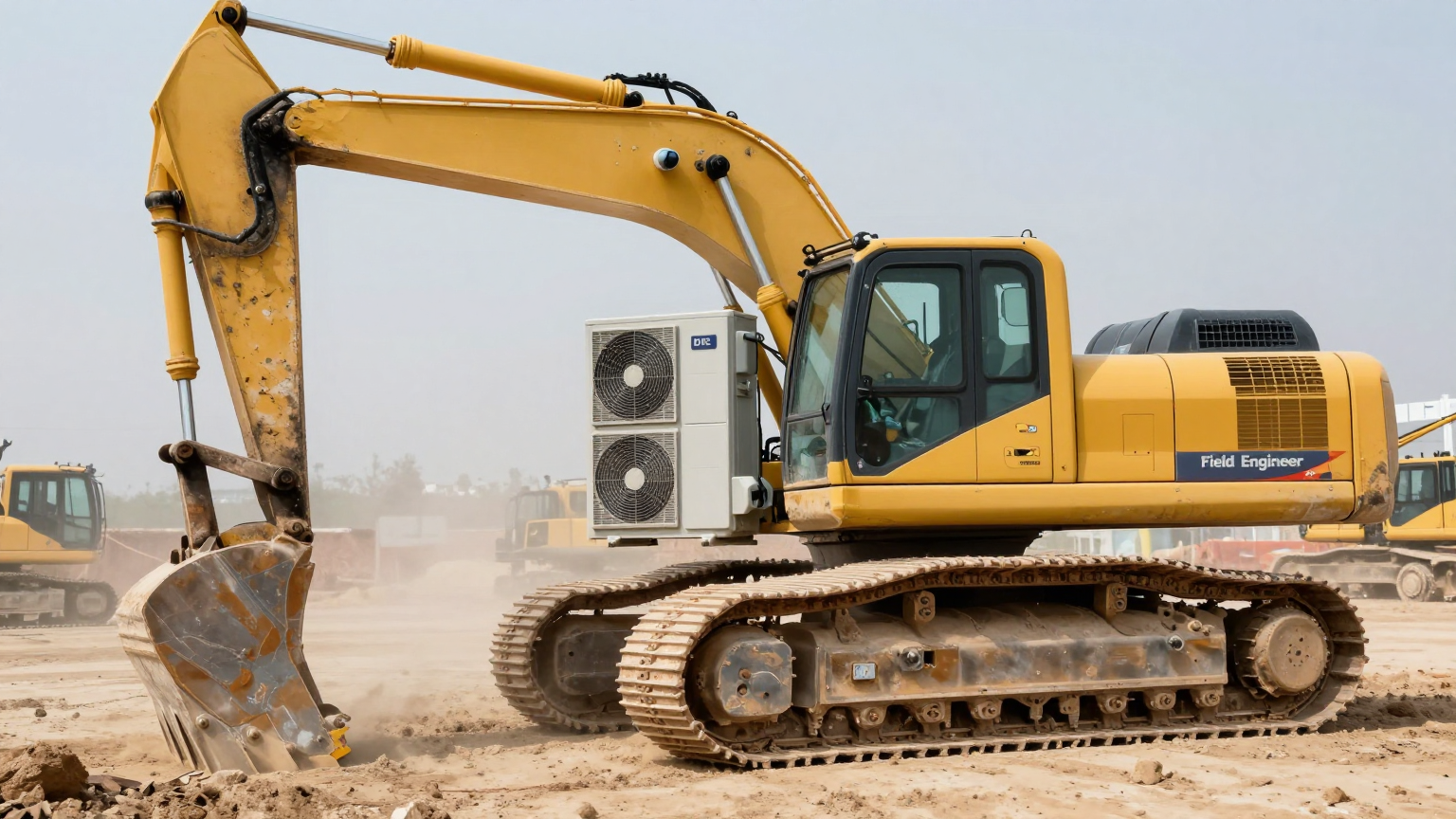
Integration Support
Heavy equipment fleets are diverse by nature — different machines, different manufacturers, different voltages, different operating environments. If your fleet includes equipment types or operating conditions not covered in this series, the Rigid engineering team can evaluate the specifics and recommend a configuration path. The HS23P split-type DC air conditioner embodies the compact, rugged, DC-native architecture reviewed in this guide — 2,300 W cooling capacity, SANYO DC rotary compressor, multi-voltage input (24V/48V/60V/72V), pre-charged R134a refrigerant, and a split-type form factor designed for the space constraints and environmental demands of heavy equipment cabs.
“Heavy duty” should not be a marketing label. It should be a verifiable set of engineering attributes — vibration tolerance, dust resistance, thermal cycling endurance, DC-native efficiency, and compact dimensions that fit real equipment cabs. The system that meets these criteria across a diverse fleet is not the most expensive option or the cheapest. It is the one that is still running at the end of the season, on every machine, without a warranty claim or a mid-shift failure. That is what compact and rugged actually mean.