
How Loud Is a Lab Chiller? Noise Levels, Decibels, and What Quiet Really Means
You are comparing laboratory chillers. Two units have similar cooling capacity, similar temperature range, similar price. One specification line says “45 dB.” The other says “55 dB.” You move on to the next specification because those numbers do not mean anything to you — yet.
They should. A 10 dB difference represents a perceived doubling of loudness. The 55 dB chiller will sound twice as loud as the 45 dB unit. In a shared laboratory where researchers concentrate for hours, that difference is the gap between “I forget the chiller is running” and “I need noise-cancelling headphones.”
This article explains what chiller noise specifications actually mean, how to interpret them for your laboratory environment, and why acoustic performance deserves more attention than it typically receives in purchasing decisions.
Understanding Decibels: A Quick Reference
The decibel (dB) scale is logarithmic, which makes it unintuitive. A small number change represents a large perceptual change. Here is how common laboratory chiller noise levels compare to everyday sounds:
| dB Level | Equivalent Sound | Perception in Lab |
|---|---|---|
| 30 dB | Quiet library, whisper | Inaudible from 2 meters |
| 35 dB | Quiet home at night | Barely noticeable |
| 40 dB | Quiet office, refrigerator hum | Noticeable only in silence |
| 45 dB | Moderate rainfall, quiet conversation | Present but not intrusive |
| 50 dB | Normal conversation at 1 meter | Clearly audible, manageable |
| 55 dB | Dishwasher, background music | Requires raised voice nearby |
| 60 dB | Normal conversation at close range | Distracting for concentration work |
| 65+ dB | Vacuum cleaner, loud office | Unacceptable for most labs |
Key relationships to remember:
- +3 dB = double the sound energy (barely perceptible change)
- +6 dB = four times the sound energy (noticeable increase)
- +10 dB = ten times the sound energy (perceived as twice as loud)
- +20 dB = one hundred times the sound energy (perceived as four times louder)
Why Chiller Noise Specifications Are Misleading
When a manufacturer states “noise level: 48 dB,” several critical questions are left unanswered:
At What Distance?
Sound level decreases with distance from the source. A chiller measured at 1 meter will read approximately 6 dB lower at 2 meters. Some manufacturers measure at 1 meter (ISO standard), others at 1.5 meters or “typical operating distance.” Without knowing the measurement distance, the number is meaningless for comparison.
At What Operating Condition?
Chiller noise varies dramatically with operating condition:
- Standby/idle (setpoint reached, minimal load): Only the pump and controller fans run. Noise may be 35–40 dB.
- Partial load (moderate cooling demand): Compressor runs at reduced speed (for variable-speed units). Noise is typically 40–48 dB.
- Full load (maximum cooling, compressor at full speed): This is the loudest operating condition, typically 45–55 dB for compact chillers.
- Deep sub-zero operation (-30°C to -40°C): Compressor runs at maximum speed with higher pressure differential. This is the worst-case noise scenario, often 5–10 dB louder than moderate-temperature operation.
A specification stating “48 dB” without noting the operating condition likely represents a favorable measurement point — perhaps partial load at a moderate setpoint. The chiller may reach 55+ dB when working hard at sub-zero temperatures.
Continuous vs Cycling Noise
Fixed-speed compressors cycle on and off to maintain temperature. This creates a distinctive noise pattern: silence → startup surge → full-speed running → shutdown. The startup transient is typically 5–10 dB louder than steady-state running, creating periodic noise spikes that are more disruptive than continuous sound at the same average level.
Variable-speed (BLDC) compressors modulate continuously, producing a steady background hum that is psychologically less intrusive even at the same measured dB level. The human brain adapts to constant sounds far more readily than to intermittent ones.

What Makes a Lab Chiller Quiet (or Loud)?
Several design factors determine a chiller’s acoustic performance:
Compressor Type and Speed Control
The compressor is the primary noise source in any chiller. Two factors dominate:
- BLDC variable-speed compressors can reduce speed to 30–50% of maximum when the cooling demand is low, reducing noise proportionally. At 50% speed, a BLDC compressor is typically 8–12 dB quieter than at full speed — a dramatic perceptual difference.
- Fixed-speed compressors operate at one speed only. When less cooling is needed, they cycle off entirely, creating the on-off noise pattern described above.
Vibration Isolation
Compressor vibration transmitted to the chiller chassis and then to the bench surface creates structure-borne noise — a low-frequency hum that travels through solid materials. Effective vibration isolation (rubber mounts, spring dampeners, decoupled compressor cradles) can reduce structure-borne noise by 10–15 dB.
Fan Design
Condenser fans are the second-largest noise source. Larger fans running at lower speed move the same airflow with significantly less noise than smaller fans at high speed. Well-designed fan shrouds and airflow paths reduce turbulence noise.
Enclosure Design
The chiller’s housing can either amplify or dampen internal noise. Features that reduce noise include acoustic insulation panels (closed-cell foam or mass-loaded vinyl), sealed panel joints that prevent sound leakage, and strategic placement of air inlets and outlets to direct noise away from the operator.
How Chiller Noise Affects Laboratory Work
Noise is not merely a comfort issue — it has measurable impacts on laboratory operations:
Researcher Productivity and Concentration
Research on open-plan office environments consistently shows that background noise above 50 dB reduces cognitive performance on complex tasks by 5–15%. Laboratory work — requiring sustained attention to procedures, calculations, and observations — is similarly affected. A quiet chiller pays for its acoustic premium through reduced error rates and faster task completion.
Communication
In shared laboratories, equipment noise accumulates. Three chillers at 55 dB each produce a combined noise floor of approximately 60 dB — the point where normal-volume conversation becomes difficult. Researchers either raise their voices (increasing their own noise contribution) or avoid verbal communication (reducing collaboration and safety call-outs).
Sensitive Measurements
Some analytical instruments are vibration-sensitive:
- Analytical balances: Vibration from a nearby chiller can cause weight readings to fluctuate, requiring longer settling times or dedicated vibration isolation tables.
- Optical microscopy: Vibration can blur images at high magnification, particularly for time-lapse or fluorescence imaging.
- NMR spectroscopy: Sensitive to magnetic field disturbances from compressor motors, though modern shielded compressors have largely addressed this concern.
Practical Noise Reduction Strategies
If your current chiller is too loud, or if laboratory layout constraints place the chiller close to work areas, several strategies can reduce the perceived noise:
| Strategy | Noise Reduction | Cost | Difficulty |
|---|---|---|---|
| Place chiller on vibration-dampening mat | 3–5 dB | $20–$50 | Easy |
| Move chiller to under-bench position | 3–8 dB (distance + shielding) | $0 | Easy |
| Add acoustic enclosure (ventilated) | 10–15 dB | $100–$300 | Moderate |
| Extend coolant lines to remote location | 15–25 dB (distance) | $50–$200 | Moderate |
| Replace with quieter chiller model | 5–15 dB | $1,500–$3,600 | Capital expense |
Important note about acoustic enclosures: Any enclosure must provide adequate ventilation for the chiller’s condenser. A sealed enclosure will overheat the chiller within minutes. Effective acoustic enclosures use baffled air paths — allowing airflow while forcing sound waves through absorptive materials.
Multi-Chiller Labs: Cumulative Noise Is the Real Problem
A single chiller at 48 dB may be perfectly acceptable. But laboratories rarely have just one piece of equipment running. Consider a typical analytical chemistry lab:
| Equipment | Noise Level | Quantity |
|---|---|---|
| Recirculating chiller | 48 dB | 2 |
| Fume hood | 55 dB | 3 |
| Vacuum pump | 60 dB | 1 |
| Centrifuge (running) | 65 dB | 1 |
| HVAC system | 45 dB | Continuous |
The combined noise from all these sources creates a background level of approximately 67–68 dB — well into the “difficult to concentrate” range. In this context, choosing a chiller at 42 dB instead of 55 dB provides meaningful cumulative relief. Each quiet equipment choice lowers the aggregate noise floor, creating a compounding benefit.
When specifying equipment for new laboratory construction or major renovations, consider the total acoustic environment rather than evaluating each piece of equipment in isolation. An acoustic consultant can model the expected noise levels from all equipment combined and recommend specifications for each category to achieve target background levels.
The Hidden Cost of Loud Chillers
Noisy equipment rarely appears in cost analyses, but its impact is real:
- Personal protective equipment: Laboratories where aggregate noise exceeds 85 dB (rare with chillers alone, but possible with cumulative equipment) must provide hearing protection under OSHA standards. Even below 85 dB, many institutions provide earplugs or noise-cancelling headphones when complaints arise — an ongoing supply cost.
- Researcher retention: In competitive academic and industry environments, laboratory working conditions affect recruitment and retention. Researchers given the choice between a quiet, well-equipped lab and a noisy one will choose the quiet lab every time. Graduate students and postdocs, who spend the most hours in the lab, are particularly sensitive to chronic noise exposure.
- Error rates: Research consistently demonstrates that background noise above 50 dB increases error rates in precision tasks. In a laboratory setting, errors mean wasted reagents, repeated experiments, and delayed results. A single wasted synthesis or failed analytical run can cost more than the price difference between a quiet and a loud chiller.
- Relocation costs: When a chiller proves too noisy after installation, labs often resort to relocating it — extending coolant lines, building enclosures, or moving it to a service corridor. These after-the-fact modifications cost $200–$1,000 and could have been avoided by specifying acoustic performance at the purchase stage.
What to Look for When Buying a Quiet Lab Chiller
When evaluating chillers with noise as a priority, ask these specific questions:
- What is the noise level at full load, measured at 1 meter? This is the worst-case number you will actually experience. If the manufacturer cannot provide this, their published number is likely a best-case measurement.
- Is the compressor variable-speed (BLDC) or fixed-speed? Variable-speed units are quieter at partial load and eliminate cycling noise.
- What vibration isolation is built in? Internal rubber mounts or spring dampeners indicate attention to acoustic design.
- Can the unit operate under a bench? A compact form factor that fits beneath the work surface provides natural noise shielding.
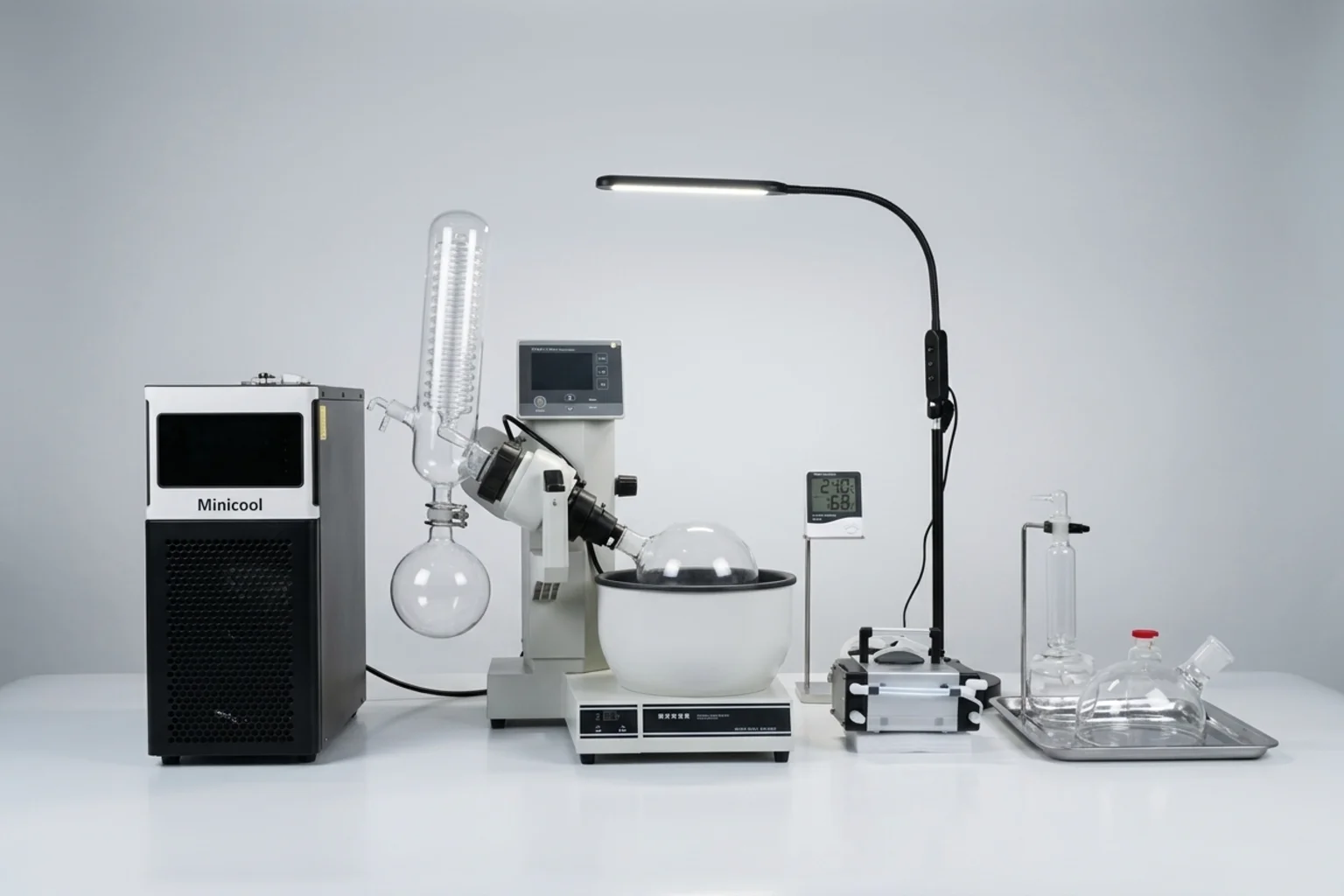
The RIGID MiniCool™ series uses BLDC variable-speed compressor technology that operates at reduced speed during partial load — the condition where most laboratory chillers spend the majority of their operating time. The compact form factor fits comfortably under a standard laboratory bench, combining distance-based noise reduction with the inherent quiet operation of variable-speed compression.
Noise Comparison: Chiller Types Side by Side
To put the noise discussion in concrete terms, here is how different chiller categories compare acoustically:
| Chiller Type | Typical Noise (1m, full load) | Typical Noise (1m, partial load) | Key Acoustic Feature |
|---|---|---|---|
| Budget fixed-speed (imported) | 55–65 dB | 55–65 dB (cycling) | No modulation, on-off cycling |
| Mid-range fixed-speed | 50–58 dB | 50–58 dB (cycling) | Better enclosure, same cycling pattern |
| BLDC variable-speed (compact) | 45–52 dB | 35–45 dB | Speed modulation, continuous operation |
| Premium BLDC with acoustic optimization | 40–48 dB | 30–40 dB | Optimized enclosure + isolation + modulation |
The key takeaway: the quietest variable-speed chillers at partial load (35–40 dB) are quieter than the loudest fixed-speed chillers at any operating condition by 20–30 dB — which represents a 4–8× reduction in perceived loudness.
Frequently Asked Questions
Is 45 dB quiet enough for a laboratory?
For most laboratory environments, 45 dB at 1 meter is acceptable — comparable to a quiet office or moderate rainfall. At typical working distance (1.5–2 meters), the perceived level drops to approximately 39–42 dB, which most researchers find unobtrusive. For noise-sensitive environments (recording studios within research facilities, sleep study labs, or spaces adjacent to patient areas), 40 dB or below may be required.
Does cooling capacity affect noise?
Generally, yes — larger compressors producing more cooling capacity generate more noise. However, the relationship is not linear. A well-designed 1kW chiller can be quieter than a poorly designed 500W unit. Compressor technology (BLDC vs fixed-speed) and enclosure design matter more than raw capacity.
Can I use longer tubing to move the chiller farther away?
Yes, with limitations. Extending coolant lines by 2–3 meters is straightforward and can reduce perceived noise by 6–10 dB. Beyond 5 meters, you may experience reduced flow rate (increased pressure drop in the tubing) and delayed temperature response. Use the largest practical tubing diameter (typically 10–12mm ID) to minimize flow resistance for longer runs. Insulate the tubing to prevent condensation and reduce thermal losses.
Why do some chillers get louder over time?
Several factors cause chillers to become noisier with age: worn compressor bearings (gradual increase over years), loose panel fasteners (vibration rattle), dirty condenser coils (fan runs at higher speed to compensate), and degraded vibration mounts (rubber hardens with age). Annual maintenance — tightening fasteners, cleaning coils, inspecting mounts — prevents most age-related noise increases.