
Why Jacketed Glass Reactor Insulation Decides −40 °C Performance
A jacketed glass reactor is a good heat exchanger in both directions. The same thin borosilicate wall that lets coolant in the jacket pull heat out of the reaction also lets the laboratory push heat back in through the outer jacket wall. At room temperature that hardly matters. At −40 °C it can decide whether the reaction reaches its set point at all.
The reason is scale. A compact recirculating chiller has a few hundred watts of cooling at deep sub-zero temperatures, and a bare reactor, its lid, its bottom valve and its hoses can take a large share of that before the chemistry adds any heat. Jacketed glass reactor insulation is how that capacity gets returned to the process.
This guide shows where heat enters a jacketed reactor, works through a bare-versus-insulated comparison, and covers the insulation, frost, hose and glass-stress details that matter when the target is −40 °C.
Jacketed glass reactor insulation is also one of the cheapest upgrades available. A fitted jacket costs a small fraction of a larger chiller, fits an existing vessel and pays back on every sub-zero run, which is why it is usually the first thing to check before replacing cooling equipment.
Where the Heat Gets In
Heat gain on a jacketed reactor comes from more places than the obvious outer wall.
| Heat path | What happens | Typical fix |
|---|---|---|
| Outer jacket wall | Room air warms the jacket’s outer glass, which sits close to coolant temperature | Fitted insulation jacket with a viewing window |
| Frost and condensation | Moisture freezing on cold glass releases latent heat and blocks the view | Insulation, dry-gas purge at the window |
| Lid, joints and stirrer gland | Uninsulated metal and glass above the jacket conduct heat in | Insulating covers; avoid bare metal clamps |
| Bottom outlet valve | A thick glass or PTFE valve body below the jacket stays warm and frosts | Insulated valve boot |
| Hoses and fittings | Every meter of coolant hose gains heat on the way to and from the chiller | Short runs, closed-cell insulation, insulated couplings |
| Stirrer and additions | Mechanical work and warm reagents add heat | Part of the process load; plan for it |
Two of these are easy to underestimate. Frost is not just a visibility problem; every gram of ice deposited from room air releases heat into the jacket. Hoses are not just plumbing; on a bench layout they can be several meters long and at nearly the same temperature as the coolant.
Worked Example: Bare vs Insulated 10 L Reactor
The example below uses assumed values for illustration: a 10 L jacketed glass reactor with about 0.30 m² of outer jacket surface, jacket coolant at −38 °C, a 22 °C laboratory, and 2 m of 12 mm coolant hose. The reaction’s own heat is not included.
| Heat source | Bare | Insulated | Assumption |
|---|---|---|---|
| Outer jacket wall | About 145 W | About 35 W | Bare: combined film coefficient about 8 W/m²·K over a 60 K difference; insulated: 25 mm closed-cell foam plus a small uninsulated window |
| Frost deposition | About 25 W | Near zero | Moderate room humidity on bare cold glass |
| Lid, joints, bottom valve | About 25 W | About 10 W | Covers and valve boot |
| Hoses, 2 m | About 48 W | About 10 W | Bare hose about 24 W per meter; 13 mm foam sleeve |
| Stirrer | About 10 W | About 10 W | Unchanged by insulation |
| Total before any process heat | Roughly 250 W | Roughly 65 W |
 The worked example makes the point more clearly than any rule of thumb. Insulation cuts the parasitic load by roughly a factor of four. On a compact chiller whose capacity at −40 °C is a fraction of its nominal rating, that difference can be the whole margin available for the reaction itself.
It helps to separate where that heat goes. Heat entering through the outer jacket wall, the hoses and the fittings is absorbed by the coolant before it reaches the reaction: it uses up chiller capacity and warms the coolant supply, but it does not flow through the inner wall. Heat entering through the lid, joints and exposed upper glass reaches the contents directly. Insulation therefore helps the reaction in two ways: it leaves more chiller capacity to hold a cold coolant supply, and it cuts the heat that would otherwise warm the contents through uncovered surfaces. The gap between contents and coolant is then set mainly by process heat flowing through the inner wall.
The comparison also shows where to start. The outer jacket wall and the hoses account for most of the bare load, so jacketed glass reactor insulation should begin with those two before smaller items such as the lid or valve. Insulating the hoses is often the quickest single win, because it needs no change to the vessel at all.
Insulation Options for Glass Reactors
Several approaches are used for jacketed glass reactor insulation, and they can be combined.
| Option | Strengths | Limits |
|---|---|---|
| Fitted foam insulation jacket with viewing window | Made for the vessel shape, removable, lets you see the contents | Window area stays a weak spot; must suit the vessel size |
| Closed-cell elastomeric wrap | Low cost, adaptable, good at sub-zero temperatures | Hides the contents; seams must be sealed against moisture |
| Vacuum-insulated (triple-wall) vessel | Very low heat gain, clear view, no frost on the outer wall | Higher cost; chosen at purchase, not retrofitted |
| Hose and fitting insulation | Removes a large, often ignored load | Couplings need their own boots or sleeves |
Whatever material is used, it must be closed to moisture. Open-cell foam or a gap at a seam lets humid air reach the cold glass, where water condenses inside the insulation and freezes. Wet insulation insulates poorly and can hide a leak.
Check the chosen jacketed glass reactor insulation at the working temperature, not just at room temperature. Some foams stiffen and crack when repeatedly cycled to −40 °C, and fasteners or hook-and-loop closures can lose grip when cold. A quick look after the first few cold runs catches gaps before they fill with ice.
Frost, Condensation and Keeping the Contents Visible
Being able to see inside a glass reactor is much of the reason to use one. At −40 °C, frost can hide the contents within minutes.
- Keep the uninsulated window small and place it where you actually need to look, such as at the liquid level or the stirrer.
- A gentle flow of dry nitrogen or dry air across the window keeps frost off the outer glass during critical observation.
- Cover the lid and upper joints, where frost builds and then drips into the insulation as it melts.
- Boot the bottom outlet valve. It is often the coldest exposed part and the first to ice.
- Plan for meltwater at the end of a run: the insulation and bench will see water as everything warms.
Hoses, Valves and the Parts People Forget
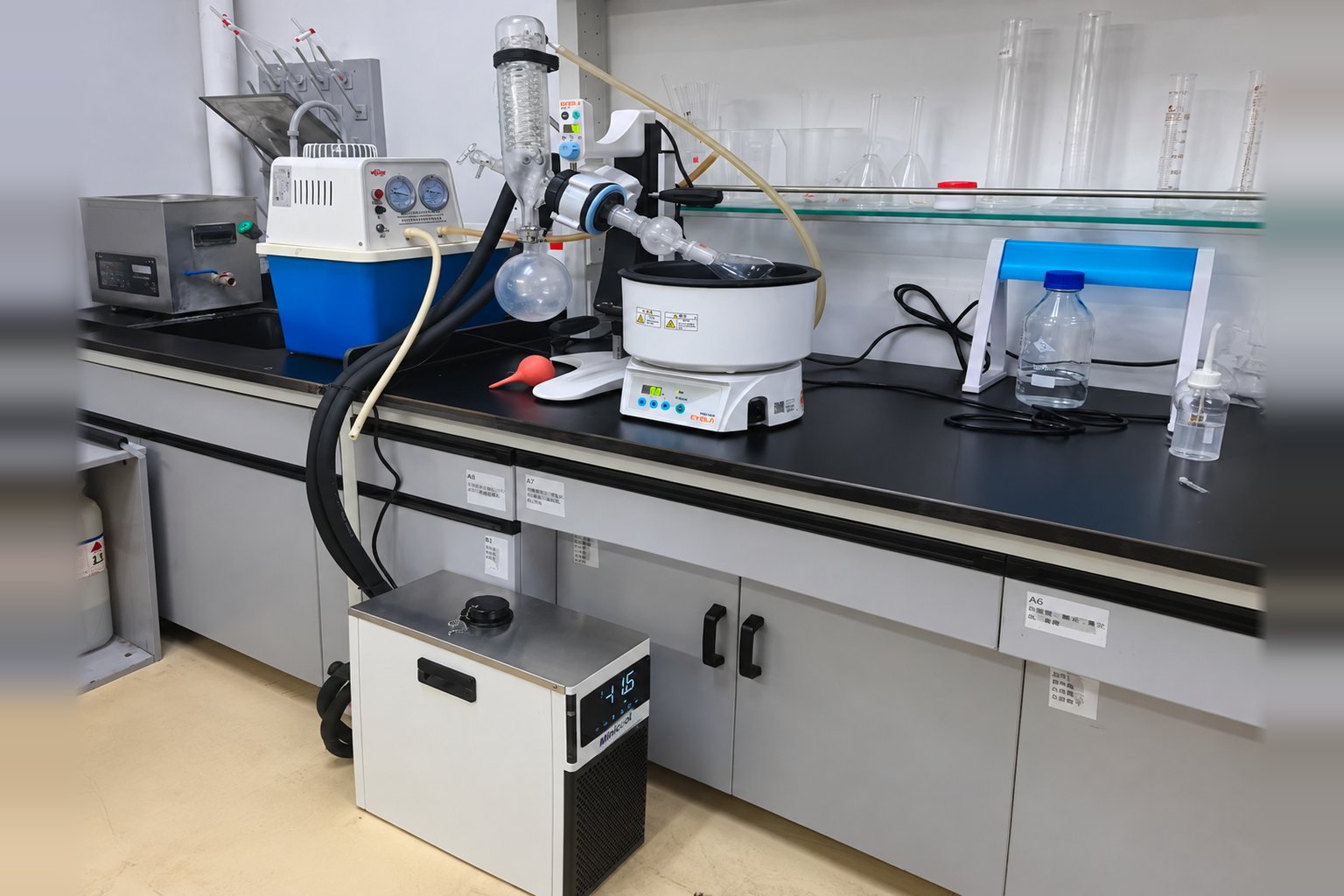 Hoses, valves and fittings between the chiller and the jacket often gain as much heat as the reactor itself. On a crowded bench they also tend to be longer than they need to be.
- Place the chiller as close to the reactor as ventilation allows, and route hoses directly.
- Insulate both supply and return hoses along their full length, including the last short sections at the jacket nozzles.
- Use couplings rated for the coolant and the lowest temperature, and add insulating boots over them.
- Avoid bare metal manifolds or valve blocks in the coolant path; each is a small heat sink.
- Check that flow direction suits the jacket: coolant entering at the bottom and leaving at the top helps purge air and keeps the jacket full.
For the sizing side of reactor cooling, including how to estimate the process load itself, see our guide to sizing a chiller for a lab reactor.
Coolant and Flow at −40 °C
Insulation reduces the heat to be moved; the coolant still has to move it. At −40 °C coolant choice and flow deserve as much attention as the insulation.
- Choose a coolant with clear margin below the lowest jacket temperature. Near its own limit, a coolant thickens, flow falls and heat transfer through the jacket drops sharply. Our lab chiller coolant selection guide compares the common options.
- Check that flow is still adequate at the coldest temperature, not just at room temperature during commissioning.
- Keep the coolant dry. Moisture drawn into the loop over time can change its low-temperature behavior.
Glass Stress and Temperature Ramps
Borosilicate glass handles large temperature ranges, but jacketed vessels are sensitive to large differences between the jacket and the contents, and to sudden changes.
- Follow the reactor manufacturer’s maximum allowed temperature difference between jacket and contents, and its maximum rate of change.
- Ramp the jacket down in stages rather than switching a warm, full reactor straight to its coldest set point.
- Avoid introducing warm coolant into a very cold jacket at the end of a run; warm up gradually.
- Insulation helps here too: with less heat flowing through the wall, the difference between jacket and contents stays smaller.
Choosing and Checking the Chiller
With insulation in place, the chiller has to cover the remaining parasitic load plus the process load, at the coolant temperature the jacket really needs.
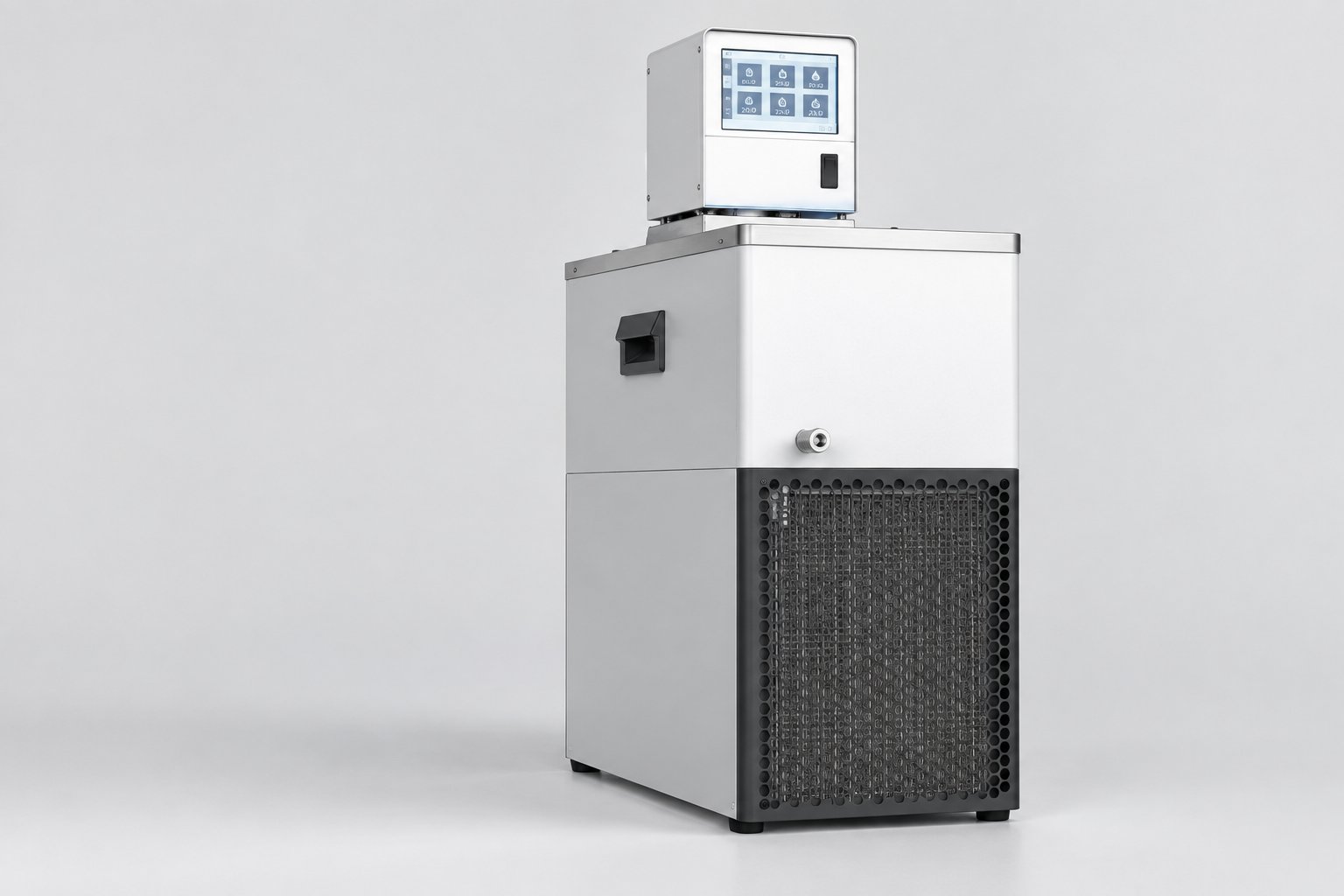
RIGID’s MiniCool countertop recirculating chiller is listed at 450, 800 and 850 W of cooling capacity, with a temperature range of 0 to −40 °C, temperature stability of ±0.1 °C (test conditions not stated), quick-connect or threaded ports, and a 200 × 430 × 450 mm footprint. Capacity at −40 °C is not listed, so confirm it against your insulated load before choosing a model. Because the contents always run warmer than the jacket coolant, a reaction that must be held at −40 °C needs coolant colder than a chiller whose range stops at −40 °C can supply.
For a wider look at what work fits a −40 °C circulator and where a colder system is needed, see our overview of low-temperature circulator applications.
Common Mistakes
- Sizing the chiller for the reaction and forgetting the bare reactor, lid, valve and hoses.
- Using open-cell foam or leaving seams open, so the insulation fills with ice.
- Insulating the vessel but leaving long hoses and couplings bare.
- Expecting contents to reach the jacket temperature under load.
- Dropping a warm, full reactor straight to its coldest set point.
- Choosing a coolant with little margin below the jacket temperature.
If you are planning sub-zero work in a jacketed glass reactor, send us the vessel size, target contents temperature, insulation you plan to use, hose length and expected process heat, and our engineers will help check the cooling side. Send your jacketed reactor details to our engineering team.
Frequently Asked Questions
Does a jacketed glass reactor need insulation at −40 °C?
In most cases, yes. A bare jacket, lid, bottom valve and hoses can take a large share of a compact chiller’s sub-zero capacity before any process heat is added. Insulation returns that capacity to the reaction and keeps frost off the glass.
How much heat does a bare jacketed reactor gain?
It depends on size, room conditions and hose length. In the worked example, a bare 10 L reactor with 2 m of hose gained roughly 250 W at a −38 °C jacket temperature, compared with about 65 W when insulated.
What is the best insulation for a glass reactor?
A fitted closed-cell insulation jacket with a small viewing window is a practical choice for most existing reactors. Vacuum-insulated vessels give the lowest heat gain but are chosen at purchase. Whatever the material, it must be sealed against moisture.
How do I stop frost covering the reactor window?
Keep the window small, insulate everything around it, and blow a gentle flow of dry nitrogen or dry air across the glass when you need to observe the contents.
Why are my reactor contents warmer than the jacket set point?
Heat has to flow from the contents through the glass into the coolant, so the contents always run warmer than the jacket. The gap grows with the heat flowing through the inner wall: process heat plus heat entering the contents through an uninsulated lid, joints and upper glass. Heat gained by the outer jacket and hoses instead warms the coolant and uses up chiller capacity.
Can a −40 °C chiller hold reactor contents at −40 °C?
Not under load. The contents will settle somewhat warmer than the coolant, so a chiller whose range stops at −40 °C will hold the contents above that. Good insulation narrows the gap, but reactions that must run at −40 °C need colder coolant.