
Where Chiller Derating Comes From
The same recirculating chiller that held −30 °C comfortably in February starts losing ground in August. Nothing inside it changed. What changed is the air it has to reject heat into.
Chiller derating in a warm room is a condenser problem. An air-cooled machine pushes its heat into room air, and the warmer that air is, the higher the condensing pressure the compressor has to work against. Capacity falls, the pull-down takes longer, and at some point the machine can no longer reach the set point at all.
Heat and humidity do different things, and confusing them leads to the wrong fix. Room temperature costs you capacity. Humidity costs you coolant quality, frost and water where you did not want it.
The Heat Balance Nobody Draws
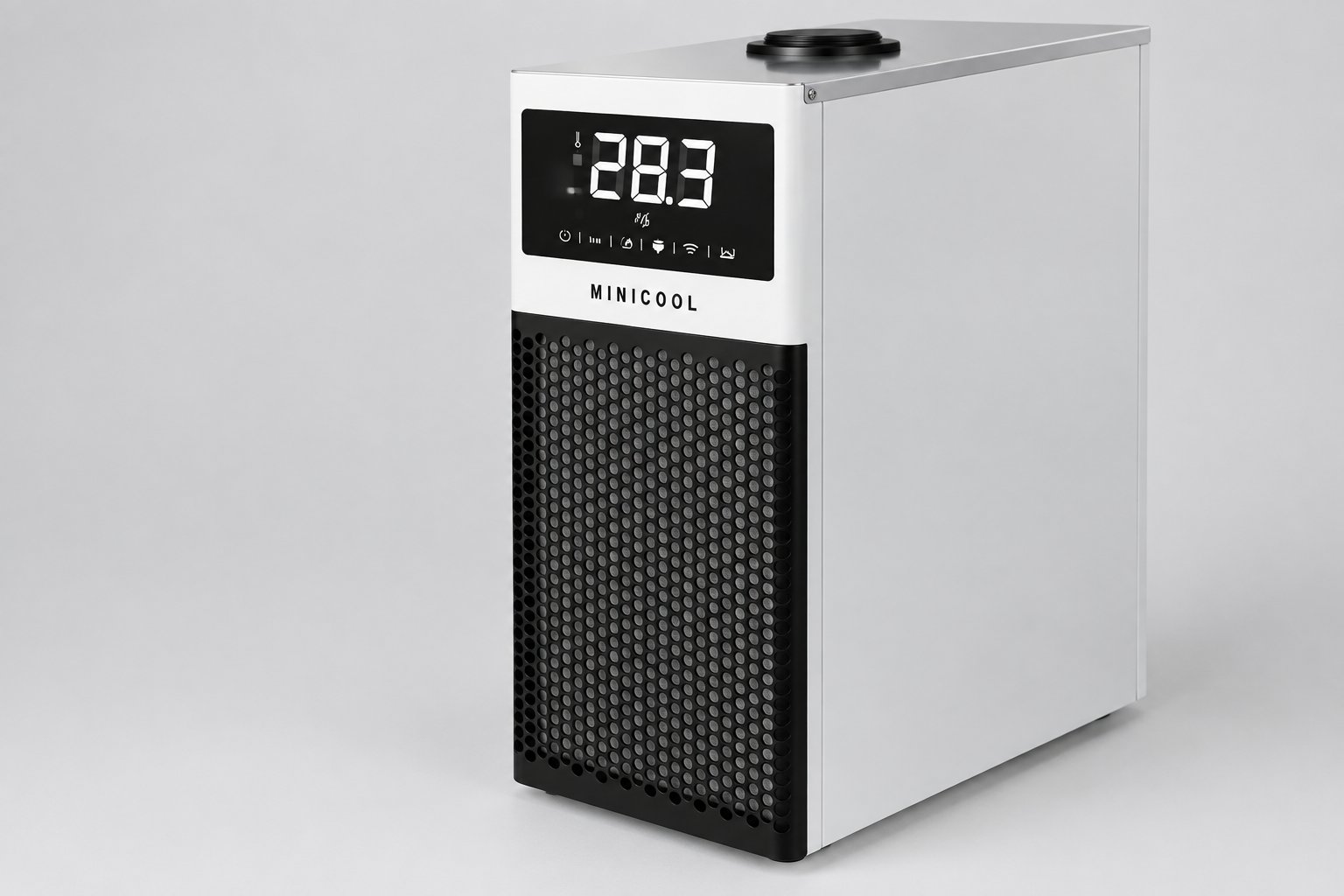 The heat balance is simple and it surprises people the first time they write it down: an air-cooled chiller puts more heat into the room than it takes out of the process.
| Term | Where it goes |
|---|---|
| Heat removed from the loop | Into the refrigerant, then into room air at the condenser |
| Compressor electrical input | Also into room air at the condenser |
| Pump and fan power | Into the fluid and the room |
| Total rejected to the room | Cooling load plus all electrical input |
That last row is where chiller derating starts. As an illustration with assumed numbers: a unit removing 400 W from a sub-zero loop, with an assumed coefficient of performance of 1.5 at that set point, draws around 270 W of compressor input and rejects roughly 670 W at its condenser. State whether pump and fan power sit inside that input figure. Note too that if the 400 W came from equipment in the same room, the room’s net gain is the electrical input rather than the full 670 W, even though the condenser still has to reject all of it. Put two of those in a small room with limited ventilation and the room warms, which derates both machines further. The assumption here is a placeholder: ask the supplier for input power and capacity at your set point rather than reusing this figure.
What Humidity Actually Changes
Humidity is often blamed for lost capacity. For an air-cooled condenser, the dominant variable is the dry-bulb temperature of the air entering it; moisture content has little direct effect on how much heat that air can carry away. Humidity does add load, and some of it is immediate rather than gradual: water condensing or frosting on a cold open surface releases latent heat into the fluid, and ice on an evaporator degrades heat transfer while it sits there.
Published guidance from laboratory equipment makers treats high humidity as an aggravating factor alongside high ambient, and there is a practical truth behind it: humid days in most laboratories are also hot days, and the humidity brings its own set of failures.
- Condensation on cold surfaces, fittings and hoses, and water dripping onto benches and electronics.
- Frost on evaporator surfaces in open baths, which insulates them and reduces heat transfer.
- Moisture absorbed into the bath fluid, which changes its freeze point and viscosity.
- Corrosion and biological growth in wetted parts over longer periods.
- Moisture reaching electrical enclosures and connectors, where the damage appears months later as an intermittent fault rather than as an obvious leak.
Treat capacity problems and moisture problems as two separate investigations, even when they show up in the same week.
Moisture Pickup in an Open Bath
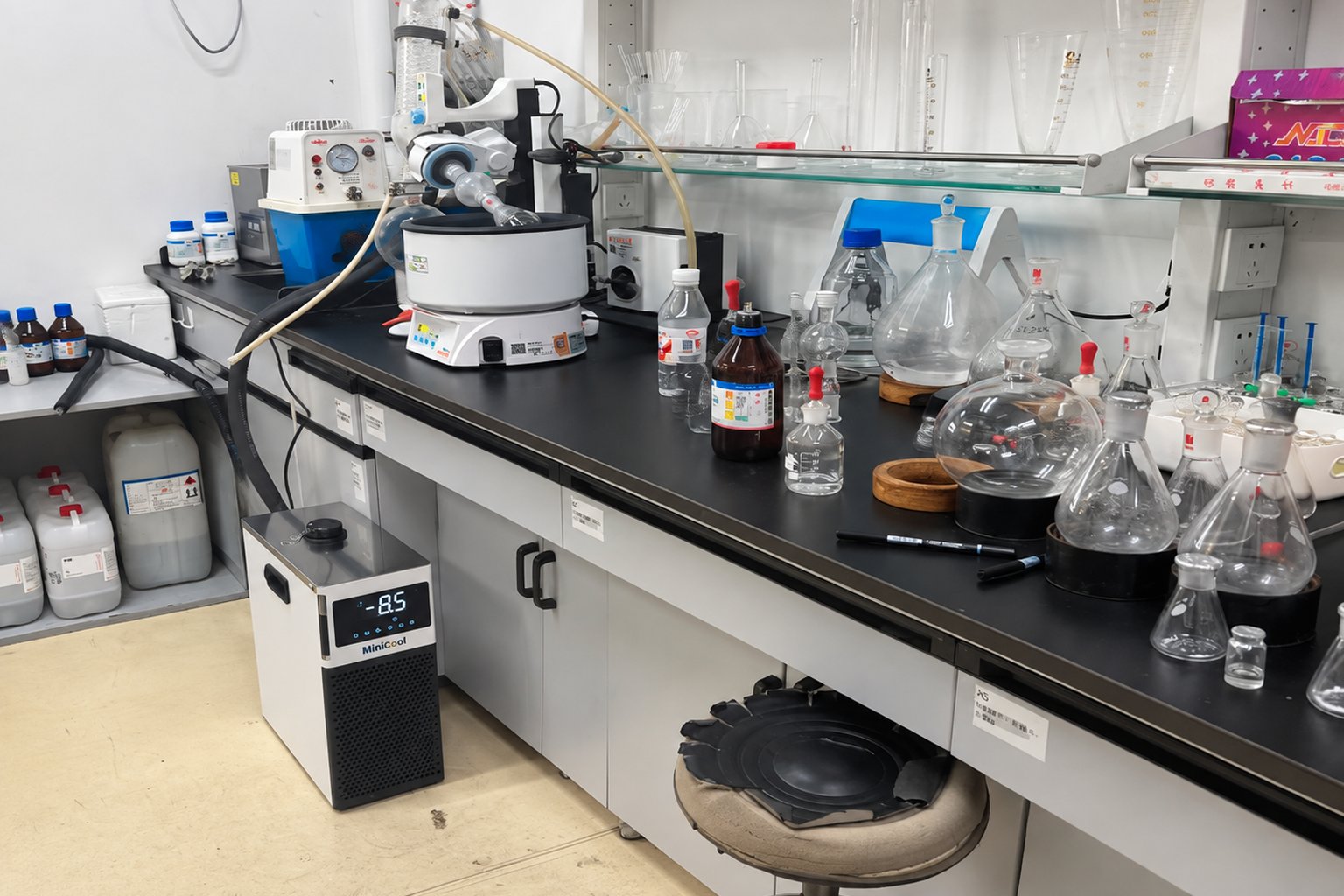 Moisture is the slower failure, and it is the one that catches laboratories out because the machine looks fine while it happens.
An open bath running below 0 °C is a moisture pump. Room air contacts a cold surface, water condenses or frosts, and it ends up in the fluid. Alcohols and glycols take water readily; silicone oils do not mix with it, which sounds better until the water collects as a separate layer and freezes on the coil.
| Symptom | Likely cause | What to do |
|---|---|---|
| Set point slowly becomes unreachable over weeks | Water in the fluid raising its freeze point, and ice forming on the evaporator | Check fluid condition and freeze point; warm and drain if needed |
| Fluid looks cloudy or has a separate layer | Water contamination | Replace fluid; review the cover and purge arrangement |
| Pump noise and reduced flow when cold | Ice crystals or a separated water layer restricting the loop, or fluid that has aged | Check freeze point and appearance first: adding water to a single-phase glycol mixture usually lowers viscosity rather than raising it, so thickening points at icing, contamination or fluid age |
| Frost ring around the bath opening | Normal for an open bath in humid air | Fit a cover; consider a closed loop instead |
The pickup rate depends on how much cold surface is exposed and how humid the room is, so the same bath that runs for a year in a dry climate may need attention after a single humid summer. Check the fluid on a schedule rather than waiting for the set point to slip.
Fluid does not last forever even without water. Our notes on heat transfer fluid aging and replacement intervals cover when to change it. Fluid choice matters here too: alcohols and glycols absorb water readily, while silicone oils reject it into a separate layer that can freeze on the coil.
Reading Ambient Specifications Honestly
Ambient limits belong to the machine, not to the physics, so they have to come from the manufacturer.
- RIGID’s MiniCool countertop recirculating chiller is listed with a range of 0 to −40 °C, capacities of 450, 800 and 850 W and stability of ±0.1 °C (test conditions not stated). The product page does not state an ambient temperature or humidity limit, so confirm both with the supplier for the room you have.
- RIGID’s compact liquid chiller modules are described on their product page as intended for indoor use with a minimum ambient of +5 °C.
- A capacity figure without a stated ambient is a laboratory number. Ask what ambient and what set point it refers to before comparing two machines.
This article is about the room around the chiller. Derating that comes from the set point itself, where capacity falls as the coolant gets colder, is a separate effect covered in small water chiller sizing and set point derating; in a hot, humid lab the two stack.
Installation Details That Decide the Outcome
Most chiller derating complaints resolve into air path problems, and they are cheap to fix.
- Clearance. Leave the manufacturer’s stated space around intake and discharge. A chiller pushed against a wall recirculates its own hot air.
- Do not place the unit under a bench where discharge air is trapped, unless the enclosure is ducted.
- Keep the condenser filter or grille clean; dust is a derating mechanism that grows quietly.
- Do not install next to an oven, a furnace or another chiller’s discharge.
- In a small room, count the total heat rejected by all equipment, and check that the room’s own ventilation or air conditioning can carry it.
A Diagnostic Sequence for a Hot Room
Work from the room inward. Each step separates a cause rather than guessing at one, and the order matters: the cheapest measurements come first, and each one either clears a suspect or points at the next test.
- Measure the air temperature at the chiller intake, not in the middle of the room. Recirculation shows up here first.
- Compare intake temperature with the manufacturer’s stated ambient limit, once you have it in writing.
- Clean the condenser surface and repeat the measurement.
- Check the loop: flow restriction and fouling look exactly like lost capacity.
- Check fluid condition and freeze point before concluding the machine is at fault.
- If capacity is still short at a confirmed acceptable ambient, ask the supplier for capacity at that set point and ambient, and compare the numbers.
When the Room Is the Problem
Sometimes the honest answer is that the laboratory cannot support the equipment in it.
- Several chillers, ovens and pumps in a small room can exceed the room’s cooling capacity in summer.
- Rooms with sealed windows and minimal ventilation drift upward through the day and never recover.
- A chiller moved into a corridor or plant room, with the loop extended, sometimes solves what no amount of tuning will.
- Equipment that only runs in campaigns can be scheduled for cooler hours, which is free and often enough to get through a heatwave without new hardware.
- Ducting condenser discharge outside the room is an option worth discussing with the manufacturer before improvising it.
- Where the room has building air conditioning, check whether it is actually running in the hours the equipment needs it. Systems set back overnight or at weekends leave long-running experiments in a room that behaves nothing like the one the equipment was commissioned in.
Extending the loop has its own costs in pressure drop and heat gain, so it is a trade rather than a free move.
Measuring Chiller Derating Instead of Arguing About It
Two afternoons of measurement settle most disputes about whether a machine has lost capacity or the room has changed.
- Pick a repeatable load. Use a test load arrangement approved for the fluid, the temperature and the electrical environment, or the manufacturer’s own heat load procedure; a real process is acceptable if its load is steady.
- Log supply temperature, return temperature and intake air temperature together, at one-minute intervals.
- Run the same test on a cool morning and on a hot afternoon.
- Compare the temperature rise across the loop at the same set point, with flow, fluid temperature and the controller’s output recorded at the same time. An unchanged rise while the set point is missed points toward derating; a larger rise points toward flow or fouling. Neither conclusion holds without the flow measurement, because Q = ρ·V̇·cp·ΔT needs a defined steady state.
Keep the raw logs. Chiller derating arguments with a supplier go much faster when both sides are looking at intake air temperature rather than at a recollection of how the room felt.
What good records look like
- Intake air temperature, because that is what the machine experiences.
- Set point, supply and return, so the load is visible.
- Fluid type, concentration and date of last change.
- Filter or condenser cleaning date, which is the variable that drifts silently.
Common Mistakes
- Blaming humidity for lost capacity when intake air temperature is the variable that changed.
- Comparing two machines on capacity figures quoted at different, or unstated, ambient conditions.
- Running an open bath below zero in a humid room without a cover and then replacing the chiller.
- Installing against a wall or under a bench and creating a recirculation loop.
- Assuming an ambient limit that the product page never stated.
- Ignoring the room heat balance when adding a second machine.
If a loop that used to hold set point is struggling this summer, send us the intake air temperature, the set point, the fluid and its age, and the room layout. Our engineers can help separate chiller derating from a fluid or airflow problem. Ask our team about a chiller that is losing capacity.
Frequently Asked Questions
Does humidity reduce a chiller’s cooling capacity?
For an air-cooled condenser the dry-bulb temperature of the intake air is the dominant factor; moisture content has little direct effect on capacity. Humidity causes condensation, frost and fluid contamination instead, which can look like lost capacity after a few weeks.
How much capacity does chiller derating cost in a warm room?
It depends on the machine, which is why the question has to be answered with the manufacturer’s data at your set point and ambient. A capacity figure quoted without those conditions cannot be derated reliably by rule of thumb.
What ambient temperature can a MiniCool work in?
The product page does not state an ambient temperature or humidity limit, so ask the supplier for the figures that apply to the model you are considering rather than assuming a typical laboratory value.
Why is my bath fluid cloudy?
Usually water, absorbed from room air by an open bath running below zero. Water changes the freeze point and viscosity and can form ice on the evaporator, so the fluid should be checked and replaced rather than topped up.
Can I duct the hot air out of the room?
Sometimes, but not by improvisation. Restricting or extending condenser discharge changes the airflow the machine was designed around, so agree the arrangement with the manufacturer first.
Is a water-cooled machine the answer in a hot lab?
It moves the heat rejection problem to a cooling water supply, which some buildings have and others do not. Where facility water exists, it removes room heat rejection from the equation; where it does not, the answer is usually better airflow or a different room.
References
- JULABO USA, Is There a Lab Chiller That Performs Well in a Hot and Humid Environment? — operating envelope guidance for hot, humid laboratories.
- JULABO USA, The Effect of Ambient Temperature and Humidity on Refrigerated Temperature Control Units — moisture entering open bath fluids and ice forming on evaporator coils.