
Lab Chiller Reservoir Low Level Detection Depends on the Vessel
Lab chiller reservoir low level detection should be selected for the actual coolant vessel, liquid, and operating environment. Decide first whether the proposed device senses through a nonmetal wall, contacts the liquid, or uses a moving float. Then verify its behavior at the intended low temperature and mounting position. An external monitor does not become a built-in chiller protection function simply because its alarm is visible beside the machine.
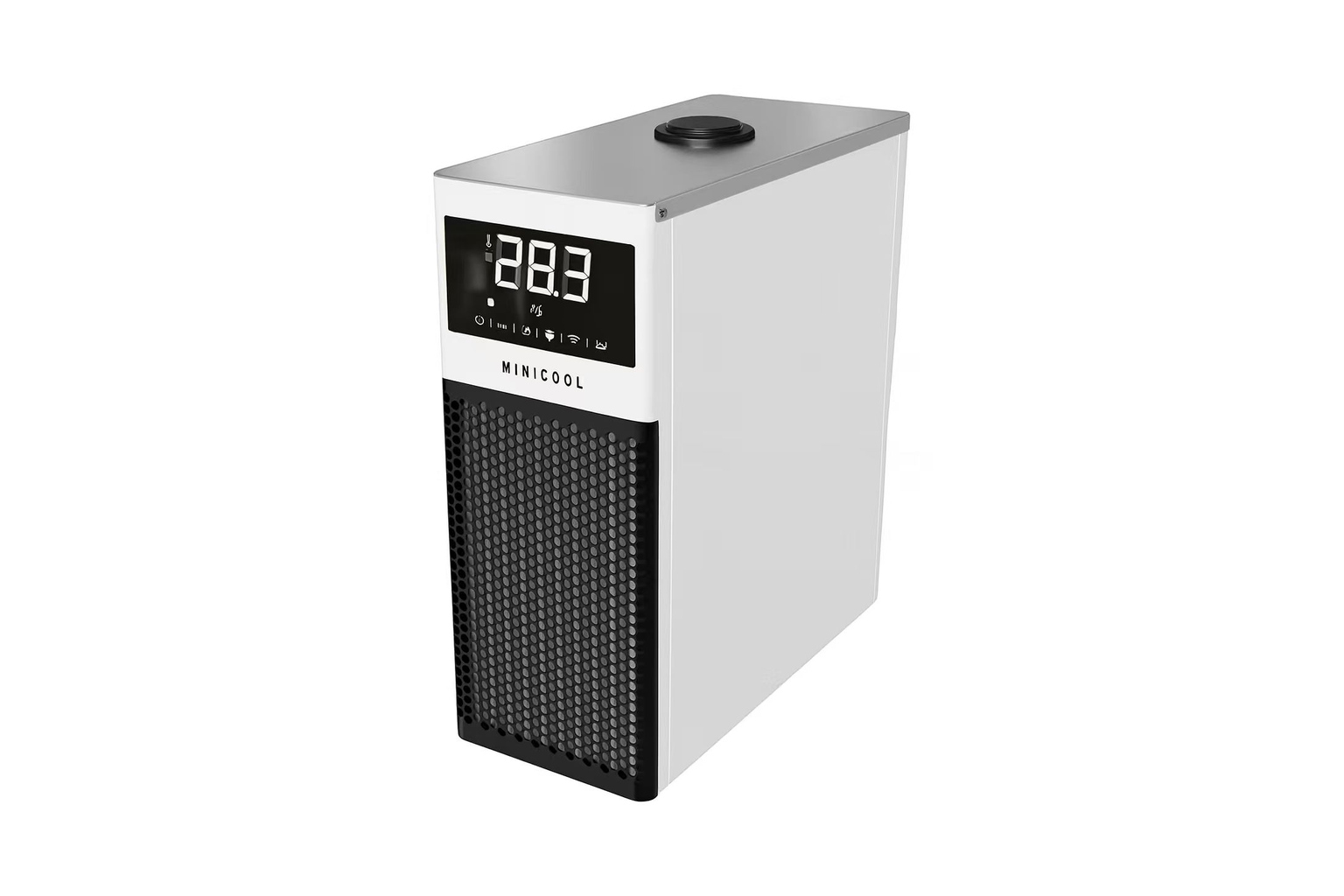 The purpose here is to choose and accept an additional detector for a coolant reservoir. Coolant level and refrigerant level are separate tasks. Neither the device selection nor its wiring should be transferred from one circuit to the other. Reservoir volume changes and coolant foam already have their own diagnostic questions; this guide addresses how a new detector distinguishes an acceptable liquid condition from a low-level condition.
Define the Vessel You Are Actually Monitoring
Identify whether the target is an accessible external reservoir, a remote vessel supplied with the laboratory equipment, or a chiller’s internal tank. Record material, wall thickness, usable access, insulation, and any pressure rating. A stainless enclosure does not establish the material of the tank inside it. Obtain the reservoir drawing or manufacturer confirmation before buying a sensor on the assumption that it can see through the visible cabinet wall.
For an internal vessel, ask the chiller supplier about approved monitoring provisions. Do not drill an enclosure or tank, add a wetted penetration, or reposition existing devices based on a generic sensor illustration. An external detector may be practical on a separate customer reservoir while being unsuitable as a retrofit inside a supplied machine. Define the installation scope clearly so the quote does not conceal a mechanical modification that the equipment supplier has never approved.
Distinguish Warning Level From a Protective Limit
Determine what low level means for this vessel and operating state. It might be an early refill warning, a condition that interrupts a laboratory sequence, or part of an approved protective response. These are different requirements. Specify the needed action and responsible controller before choosing an output type. A discrete point detector answers whether liquid is present at its sensing zone; it does not necessarily provide usable reservoir volume or continuous level.
Have the equipment supplier establish the minimum usable level and the relevant startup and running conditions. Do not position a detector from a guessed tank capacity or an assumed pump inlet height. A warning is not automatically an interlock. Keep existing protective functions in service and treat the proposed sensor as an additional requirement until its role, integration, and failure response are confirmed by the responsible equipment and controls providers.
Consider External Capacitive Detection on Suitable Walls
An externally mounted capacitive point sensor can be a candidate for an appropriate nonmetal vessel. ifm’s technology guidance identifies vessel material, wall construction, nearby metal, and mounting as relevant conditions for through-wall sensing. This supports checking the physical installation, not declaring every plastic reservoir compatible. Obtain the selected sensor’s wall-thickness and mounting requirements rather than importing a figure from a different device family.
Record the wall material at the sensing point, any double wall, coating, air gap, insulation, bracket, and adjacent metal. Ask the supplier whether the actual coolant and proposed cold conditions are within its supported application. The device’s sensitivity setup must distinguish liquid from the empty vessel under the specified conditions. An accessible flat wall may simplify mounting, but convenient access alone does not establish a reliable sensing zone.
Evaluate Wetted Probes as a Different Installation
A wetted detector introduces material compatibility, sealing, process temperature, and reservoir-access questions. Obtain the supplier’s approval for the complete inhibited coolant product, not just water or glycol as isolated ingredients. Confirm whether the proposed probe senses a point or a continuous level and which part of the probe is active. The connector’s ambient rating and the sensing element’s process rating may have different limits.
Capacitive and other electronic wetted devices may offer application-specific adjustment for residue or foam. ifm’s LI technology description, for example, discusses tuning to a particular medium. That feature belongs to the described product and configuration; it is not evidence that every electronic sensor ignores foam. Verify the selected device’s discrimination. Obtain the supported settings and acceptance method for the actual vessel and coolant rather than treating a technology name as a performance guarantee.
Review Float Movement and Mounting Clearance
A float-based option needs sufficient free movement and a compatible wetted construction. Ask the supplier which liquid density range, mounting orientation, temperature, and clearances apply to the exact assembly. Check that the float cannot strike a wall, hose, internal fitting, or baffle throughout its intended travel. A nominal switch position drawn on a schematic does not show those physical constraints.
Consider inspection and maintenance access before deciding that a float is the simplest route. The laboratory must be able to verify that it moves and switches as intended using the supplier’s procedure. Do not infer that moving parts will necessarily fail or that an electronic replacement will necessarily be more reliable. Lab chiller reservoir low level detection is an installation choice supported by evidence, including how each option will be checked after installation.
Test Liquid, Foam, Residue, and Exterior Moisture Separately
Define the conditions the detector must distinguish: adequate liquid, the intended low-level condition, representative residue, and any credible foam condition. Ask the sensor supplier how those conditions should be represented in an acceptance test. Use the actual approved coolant formulation and record its temperature. A demonstration with clean room-temperature water does not resolve detection in a different mixture on a cold laboratory vessel.
Also examine condensation or frost on the outside of a through-wall installation. Keep that observation separate from liquid inside the tank. Foam diagnosis addresses whether foam indicates air or contamination; a detector acceptance test addresses whether the chosen device recognizes the required state. Do not create foam by introducing an unapproved additive merely to test the sensor, and do not conceal a persistent wet indication by progressively reducing sensitivity.
Choose a Position That Represents the Required Level
Document the sensing height relative to a physical reservoir datum and the equipment supplier’s minimum-level requirement. Identify return jets, local turbulence, fittings, and potential pockets that could give an unrepresentative indication. Check the cold and warm states for the proposed position without turning the exercise into an assumed contraction calculation. The existing sub-zero reservoir level guide addresses liquid-volume changes; this review uses the supplier’s level requirement to decide where detection should occur.
Specify any allowed delay or hysteresis through the controls review, rather than selecting values to suppress every observed alarm. Filtering must not hide an unacceptable state. If normal circulation repeatedly crosses the proposed sensing threshold, first examine whether the location and requirement are appropriate. Keep the response requirement visible in the acceptance record, including how startup, steady operation, shutdown, and refill are distinguished when the equipment design calls for different behavior.
Treat Cold-Liquid and Ambient Ratings Independently
Lab chiller reservoir low level detection in a sub-zero installation requires review of both process exposure and surrounding conditions. A detector may have electronics in room air while its probe contacts cold liquid. Alternatively, an external sensor can be cooled by a vessel wall even when the laboratory is warm. Document the expected temperatures at the sensing zone, body, connector, and cable installation.
Request confirmation for the selected construction, including seals and mounting accessories. Do not extend a warm-water catalog example to a negative-temperature vessel or read an ingress-protection marking as a temperature approval. Record the coldest intended operating condition and any planned warmup. When a rating is unavailable, identify the missing confirmation explicitly. An application can remain under review without being described as universally suitable or unsuitable for low-temperature monitoring.
Define the Electrical Response With the Controls Provider
Ask what the proposed sensor output means in adequate liquid, low liquid, loss of sensor power, disconnected wiring, and any device-reported fault. The answers depend on the selected sensor and receiving controller. Confirm voltage, signal type, connector, and electrical interface from their respective documentation. Do not assume that a relay, open collector, or communication output can connect directly to an unidentified chiller input.
Agree on the approved action for each state and on how an operator will recognize a failed monitoring channel. Detection and shutdown need separate verification. A successful sensor test establishes one input condition; the complete response test establishes that the intended equipment sequence follows it. Neither permits bypassing existing chiller protection. Restore normal configuration after testing and record the responsible controls provider’s acceptance rather than treating an observed alarm lamp as proof of a complete protective function.
Keep MiniCool Product Claims Within Their Evidence
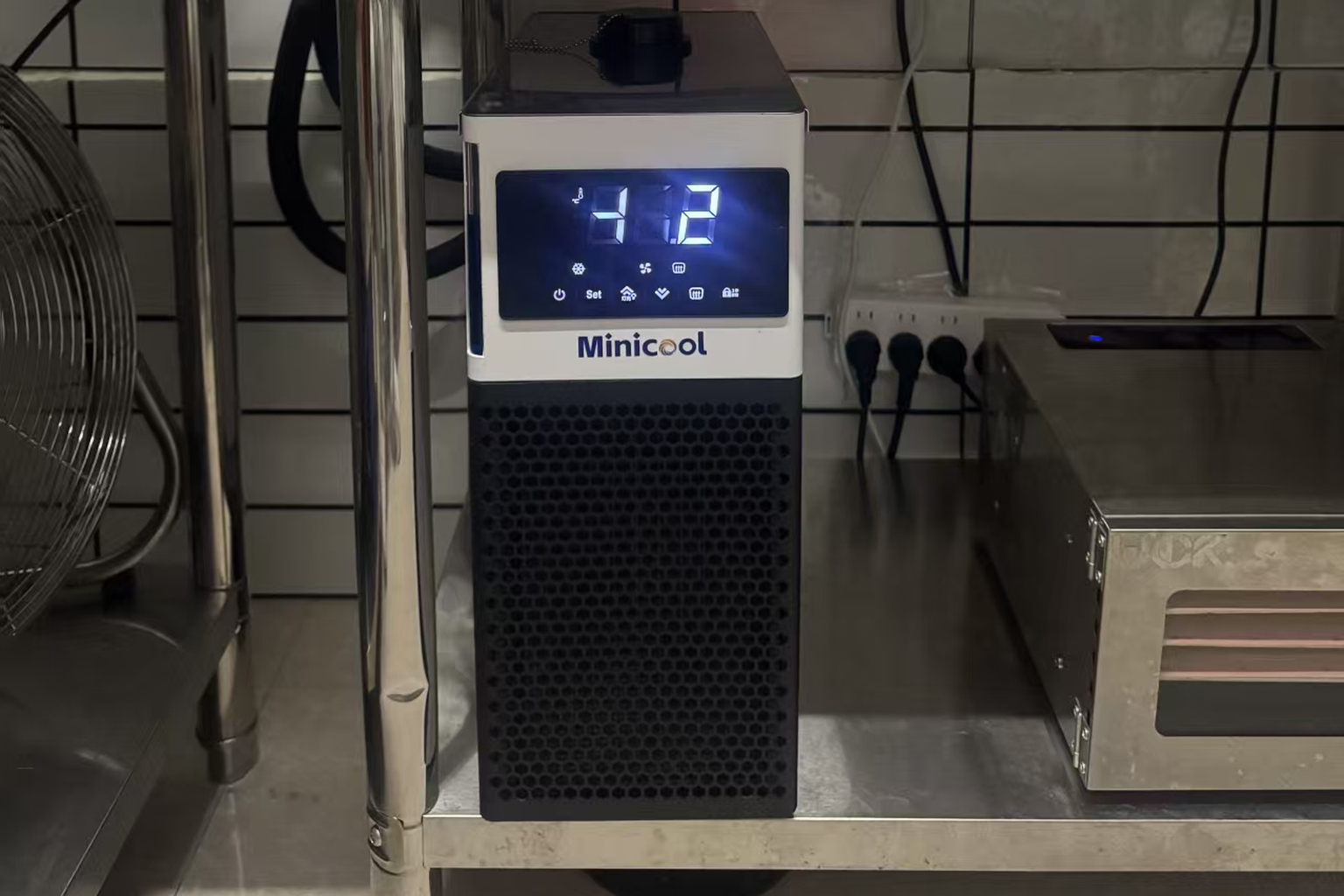
The RIGID MiniCool laboratory chiller series is published for −40°C to 0°C operation. Its public series information reviewed here does not establish an external low-level sensor accessory, a particular alarm input, a tank drawing, or reservoir volume. A proposed external monitor therefore requires configuration-specific confirmation. Do not describe the sensors in this guide as supplied MiniCool features or infer that a pictured cabinet contains the proposed detector.
If an external customer reservoir is being considered with MiniCool, submit its arrangement and coolant requirements for engineering review. Establish which supplier owns the reservoir and monitoring equipment. The public temperature range does not approve a retrofit, and published temperature stability does not quantify level-sensor behavior; the stability test conditions are not stated. Lab chiller reservoir low level detection should remain an identifiable external monitoring task until the final supply and integration scope are agreed.
Compare the Routes in an Acceptance Record
Keep the selected device, vessel, coolant, mounting, output logic, and required response in one document. The comparison below identifies the questions that separate the three routes. It is a purchasing and commissioning worksheet, not a list of preapproved accessories. Obtain model-specific limits before marking a route acceptable, and retain supplier correspondence where the application differs from standard catalog conditions.
| Detection route | Physical requirement | Evidence to obtain |
|---|---|---|
| External capacitive point sensor | Suitable nonmetal wall and mounting | Wall and coolant approval; cold empty/full discrimination |
| Wetted electronic detector | Approved penetration and compatible sensing zone | Materials, seals, process limits, residue behavior |
| Float-based assembly | Compatible liquid and unrestricted movement | Density range, orientation, clearance, switch response |
| All routes | Approved output and response sequence | Low state, power loss, wiring fault, restoration behavior |
Record the actual observations for adequate liquid, the agreed low condition, and relevant nuisance conditions. Include the mounted device position and settings so a replacement can be checked against the same arrangement. If an output changes correctly but the receiving controller does not act as required, the complete monitoring function remains unaccepted. Record that distinction instead of signing off the installation on the basis of the sensor alone.
Prepare the Monitoring Scope for Review
For lab chiller reservoir low level detection, send RIGID the vessel and monitoring scope together with intended coolant temperatures, the selected sensor documentation, and the required equipment response. Indicate whether this is a customer-owned external reservoir or a request involving an internal vessel. A clear scope allows the cooling supplier to address the relevant configuration without implicitly accepting responsibility for an unrelated controller or sensor.
Frequently Asked Questions
Can a capacitive sensor detect coolant through any tank wall?
No. Through-wall suitability depends on the selected device, wall material and construction, mounting, nearby metal, and liquid. Obtain model-specific approval and verify empty and adequate-liquid behavior in the actual installation, including its intended cold conditions.
Is a float always better than an electronic detector?
Neither route is universally better. A float needs compatible liquid properties and free movement; an electronic device needs suitable sensing conditions and adjustment. Compare installation, cold operation, nuisance states, and the laboratory’s ability to verify the selected device.
Does low-level detection replace a flow switch?
No. Reservoir level and circulation are different conditions. A sufficient level does not prove branch flow, and an accepted flow reading does not establish adequate stored liquid. Keep the equipment supplier’s approved protection requirements separate from an additional monitoring proposal.
Can I connect an external detector directly to MiniCool?
Direct connection is not established by the public series information reviewed. Request the selected MiniCool configuration’s approved interface and response details. The sensor and receiving controls must also have compatible electrical specifications before integration is accepted.
What should an acceptance test demonstrate?
It should show the required detection state and the approved equipment response with the actual coolant and installation. Include relevant nuisance conditions and device or wiring failures using supplier-approved methods. Record settings, position, observations, and unresolved limitations.