
What Is a Liquid Chiller and Why Does the Heat Exchanger Type Matter?
A liquid chiller removes heat from a process by circulating cooled fluid—typically water or a water-glycol mixture—through a closed or open loop. The refrigeration cycle compresses and expands a refrigerant, transferring thermal energy away from the process fluid and rejecting it to ambient air or a secondary water supply.
Within every liquid chiller, the heat exchanger is the component where the actual thermal transfer takes place between the refrigerant and the process fluid. Choosing the right heat exchanger type directly affects cooling efficiency, footprint, maintenance frequency, and compatibility with your specific process. Three designs dominate the market: brazed-plate, coil (shell-and-coil or immersion coil), and coaxial (tube-in-tube). Each has distinct strengths, and matching the correct type to your application can mean the difference between stable, long-term operation and chronic thermal drift.
This guide walks through each liquid chiller heat exchanger type, maps them to common applications, and explains where a compact closed-loop recirculating chiller fits into the picture.
Brazed-Plate Heat Exchangers: High Efficiency in a Small Package
Brazed-plate heat exchangers consist of multiple thin, corrugated stainless-steel plates bonded together. Refrigerant and process fluid flow through alternating channels, creating a large surface area for heat transfer within a remarkably compact volume.
How They Work
The corrugated plate pattern forces turbulent flow on both the refrigerant and fluid sides, which increases the heat transfer coefficient significantly compared to smooth-walled designs. Because the channels are narrow, brazed-plate exchangers achieve high thermal efficiency per unit of volume, making them a popular choice when space is limited.
Where Brazed-Plate Exchangers Excel
Brazed-plate designs are well suited to applications that require precise temperature control with clean, filtered process fluids. Common uses include:
- Laboratory analytical instruments where temperature stability is critical
- Laser diode cooling systems that demand tight thermal tolerances
- Medical diagnostic equipment with limited chassis space
- Semiconductor test benches where consistent fluid temperature prevents measurement drift
Limitations to Consider
The narrow channels that give brazed-plate exchangers their efficiency also make them susceptible to fouling. If the process fluid carries particles, scale, or biological growth, flow restriction can develop over time. Filtration on the fluid inlet is strongly recommended, and periodic chemical flushing may be necessary in hard-water environments. Brazed-plate units are also generally not serviceable—once fouled beyond chemical cleaning, the entire exchanger typically requires replacement.
Coil-Type Heat Exchangers: Rugged and Tolerant
Coil-type heat exchangers—including shell-and-coil and immersion-coil designs—use a length of tubing wound into a spiral or helix. The refrigerant typically flows inside the coil, while the process fluid circulates around it (shell-and-coil) or the coil is submerged directly in a fluid reservoir (immersion coil).
How They Work
The coiled geometry creates a longer flow path than a straight tube of the same physical length, providing more contact area between the refrigerant and the process fluid. Shell-and-coil units enclose the coil inside a cylindrical shell; immersion coils simply sit inside an open tank or reservoir. Coil exchangers generally tolerate dirtier fluids and wider flow-rate variations than brazed-plate designs because their channels are larger and less prone to clogging.
Where Coil-Type Exchangers Excel
These exchangers work well in situations where the process fluid may not be perfectly clean or where the system design benefits from a built-in fluid reservoir:
- Open-bath temperature control in chemistry and life-science labs
- Food and beverage process cooling where fluids may contain sugars or particulates
- Industrial wash-down or rinse-water cooling
- Applications with variable thermal loads that benefit from the thermal mass of a reservoir
Limitations to Consider
Coil-type exchangers are typically larger than plate exchangers for the same cooling capacity. Their heat transfer efficiency per unit volume is lower, which means a coil-based liquid chiller system will generally have a bigger physical footprint. Temperature response can also be slower when a reservoir is involved, because the thermal mass of the stored fluid dampens rapid setpoint changes.
Coaxial (Tube-in-Tube) Heat Exchangers: Simple and Versatile
A coaxial heat exchanger consists of two concentric tubes—one inside the other. Refrigerant flows through one passage while process fluid flows counter-currently through the other. The design is mechanically simple and has been used in refrigeration systems for decades.
How They Work
Counter-current flow ensures that the coldest refrigerant meets the coldest process fluid and the warmest refrigerant meets the warmest fluid, maximizing the average temperature difference across the exchanger length. This counter-flow arrangement makes coaxial exchangers thermodynamically efficient relative to their simplicity. The smooth, wide flow paths are easy to clean and resist fouling better than plate designs.
Where Coaxial Exchangers Excel
Coaxial heat exchangers are often found in applications that value reliability and low maintenance:
- HVAC and process cooling where long service life matters more than extreme compactness
- Water-cooled condenser applications paired with building chilled-water loops
- Systems that need to handle moderate particulate loads without frequent cleaning
- Equipment where the exchanger must withstand pressure cycling or vibration
Limitations to Consider
For a given cooling capacity, coaxial exchangers occupy more linear space than brazed-plate units. They can be coiled to save footprint, but the trade-off is increased refrigerant charge. In applications where every cubic centimeter matters—benchtop instruments, portable medical devices, or compact electronics enclosures—a coaxial exchanger may simply be too large to integrate cleanly.
Matching Heat Exchanger Type to Your Application
Selecting a liquid chiller system starts with understanding your application requirements. The following decision framework can serve as a starting estimate—actual selection should be confirmed with thermal calculations and engineering review.
Start with These Questions
What is your heat load? Determine the watts of thermal energy your process generates. This sets the minimum cooling capacity. As a rule of thumb, add a 20% safety margin above the calculated heat load to account for ambient temperature variation and system aging. Note that cooling capacity is not the same as input power—a liquid chiller rated at 500W cooling capacity may draw a different amount of electrical power depending on its coefficient of performance.
What are your temperature requirements? Some applications need fluid delivered at a stable 20°C; others require sub-zero temperatures down to -40°C. The target temperature and the allowable deviation (±0.5°C vs. ±0.1°C) narrow the field of suitable chillers considerably.
How clean is your process fluid? Clean, deionized water or pre-mixed coolant works with any exchanger type. Fluids carrying particles, oils, or biological matter push the selection toward coil or coaxial designs that resist fouling.
How much space do you have? Benchtop applications and equipment with limited internal volume favor brazed-plate exchangers. Floor-standing industrial installations can accommodate the larger profile of coil or coaxial units.
Quick-Reference Decision Framework
For laboratory and precision applications with clean fluids and tight space—consider a chiller with a brazed-plate exchanger. For open-bath or reservoir-based cooling with moderate fluid cleanliness—a coil-type exchanger handles the job. For general-purpose process cooling where reliability and easy maintenance are priorities—coaxial exchangers are a dependable choice.
Closed-Loop vs. Open-Loop: Which Architecture Fits?
Beyond the heat exchanger type, liquid chiller systems divide into two fundamental architectures: closed-loop and open-loop.
Closed-Loop Recirculating Chillers
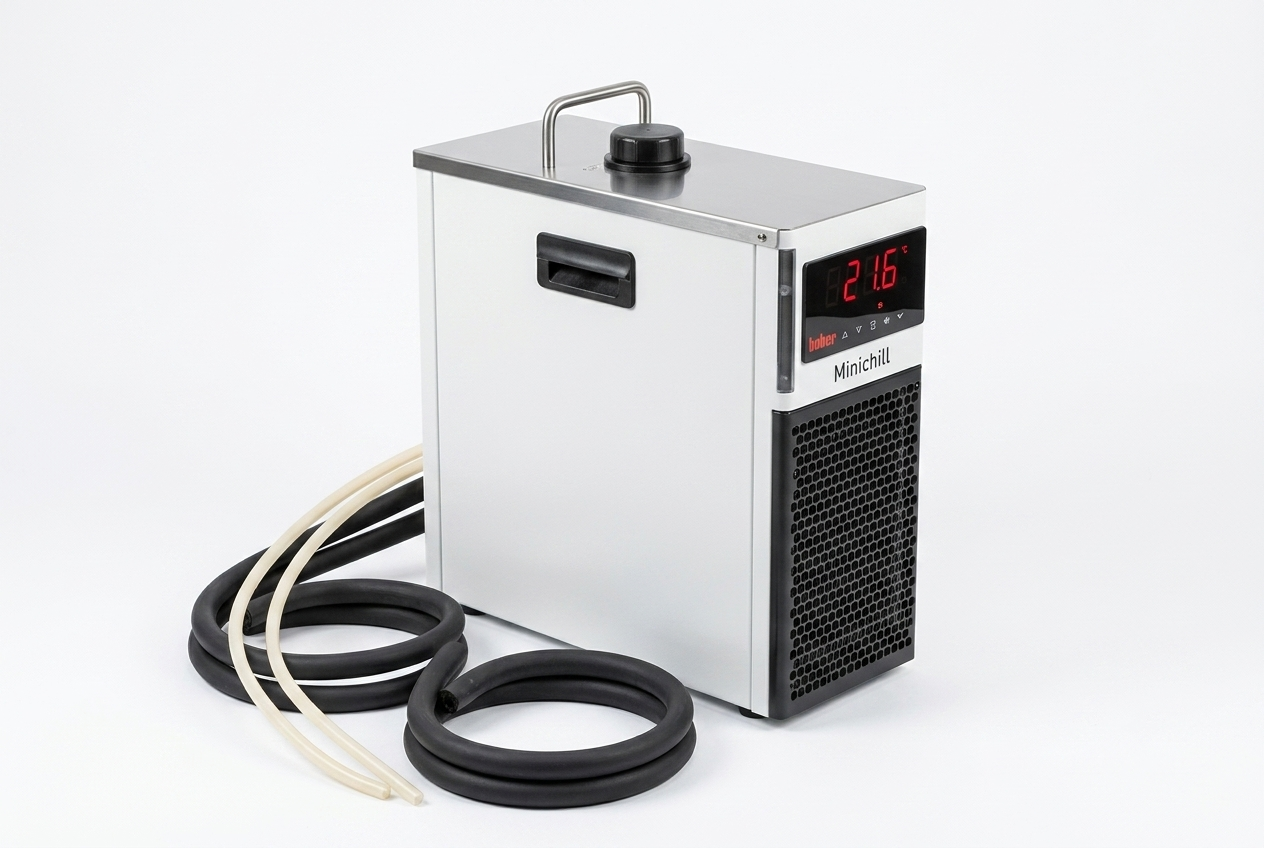
In a closed-loop system, the same volume of process fluid circulates continuously between the chiller and the heat source. The fluid never contacts the atmosphere, which reduces contamination, minimizes evaporative losses, and allows the use of specialized coolants (such as inhibited glycol mixtures) without ongoing top-ups. Closed-loop chillers typically include an integrated pump and reservoir, making them self-contained units that require minimal external plumbing.
Closed-loop systems are the standard choice for laser cooling, electronics thermal management, medical device cooling, and laboratory instruments where fluid purity and temperature precision are non-negotiable.
Open-Loop Systems
Open-loop systems draw fluid from an external source—often a municipal water supply or a large holding tank—pass it through the process, and discharge it. While simple, open-loop designs waste water, introduce variable inlet temperatures, and can carry contaminants into sensitive equipment. They remain common in large industrial settings where water cost is low and precise temperature control is less critical.
When Closed-Loop Is the Clear Winner
If your application involves any of the following, a closed-loop recirculating liquid chiller is strongly preferred:
- Processes sensitive to fluid contamination or dissolved solids
- Setpoint temperatures below ambient (sub-cooling)
- Requirements for ±0.1°C to ±0.5°C stability
- Installations in labs, cleanrooms, or enclosed equipment where water discharge is impractical
Sizing a Liquid Chiller: Key Parameters to Define
Before requesting quotes or comparing models, document these parameters for your application:
Heat load (watts). Measure or calculate the thermal energy generated by your process. For laser systems, this is often published as waste heat in the laser datasheet. For electronics cooling, sum the power dissipation of all components on the liquid loop. Remember: this is the heat to be removed, not the electrical input power of the chiller itself.
Fluid temperature setpoint and tolerance. Define the target supply temperature and the acceptable deviation. A ±0.1°C requirement calls for a chiller with PID-controlled variable-speed compressors or electronic expansion valves; a ±1°C tolerance opens up simpler, less costly options.
Ambient temperature range. The chiller must reject heat to the surrounding air (or to a secondary water loop). Higher ambient temperatures reduce available cooling capacity. As a starting estimate, derate the chiller capacity by roughly 2–3% for every degree Celsius the ambient exceeds the rated condition—though actual derating curves vary by manufacturer.
Flow rate and pressure drop. Your process has a required flow rate (liters per minute) and a pressure drop across its internal passages. The chiller pump must deliver adequate flow at the required head pressure. Undersizing the pump leads to insufficient cooling even when the chiller has spare refrigeration capacity.
Fluid type and volume. Water, deionized water, water-glycol mixtures, and dielectric fluids all have different thermal properties. Glycol mixtures, for example, reduce heat transfer efficiency compared to pure water—a factor that must be accounted for in capacity calculations.
Where Compact Closed-Loop Chillers Fit: The MiniCool Approach
Many of the applications described above—laser cooling, semiconductor test, laboratory instruments, medical devices—share a common set of requirements: moderate heat loads (roughly 450W to 1kW), tight temperature control, clean closed-loop fluid circuits, and severely limited installation space.
Traditional liquid chiller systems designed for these heat loads often come in floor-standing enclosures that occupy significant lab real estate. For teams working in crowded labs, fume hoods, or integrated equipment enclosures, a countertop-format chiller changes the equation.
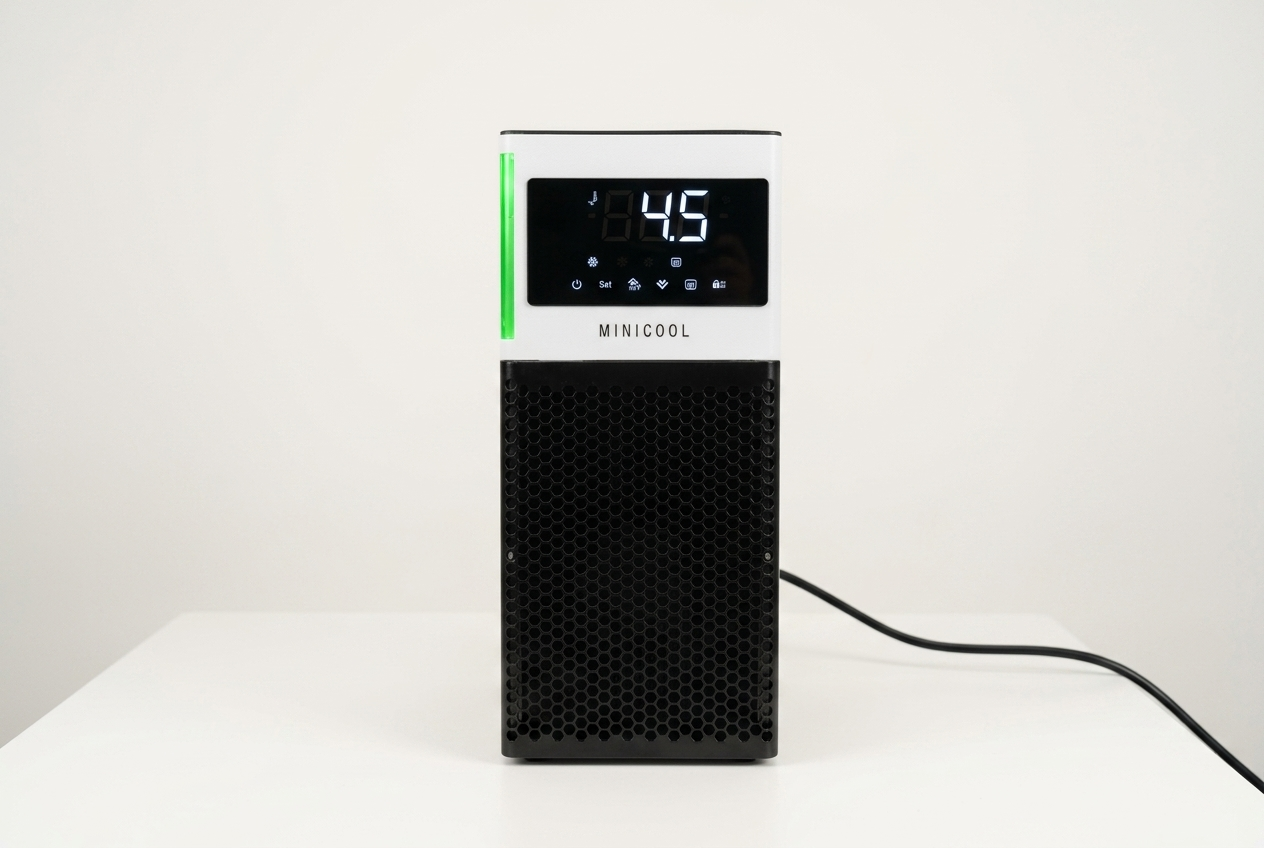
The RIGID MiniCool series is a closed-loop recirculating liquid chiller built specifically for these constrained environments. Key specifications include:
- Cooling capacity from 450W to over 1kW, covering the thermal loads common in benchtop laser systems, small analytical instruments, and electronics test fixtures
- Temperature range from 0°C down to -40°C, supporting both ambient-tracking and deep sub-zero applications
- Temperature stability of ±0.1°C, suitable for processes where thermal drift directly affects measurement accuracy or product quality
- Refrigerant options including R134a, R290, and R1234yf to align with regional regulations and environmental requirements
- Both AC (120V–240V) and DC power input, accommodating laboratory power as well as mobile, battery-powered, or off-grid installations
The MiniCool uses a compact vertical form factor designed to sit on a bench, under a fume hood, or inside an equipment cabinet. Its integrated pump and reservoir eliminate the need for external fluid-handling components, reducing plumbing complexity and potential leak points.
Applications Where MiniCool Fits Well
The MiniCool series is designed for heat loads in the 450W to 1kW range. Within that envelope, it serves applications including:
- Fiber and diode laser cooling for engraving, marking, and small-format cutting systems
- Semiconductor device testing where consistent junction temperature is required during characterization
- Laboratory rotary evaporators, refractometers, and viscometers that need chilled circulating fluid
- Medical diagnostic instruments—such as PCR thermal cyclers and blood analyzers—where temperature precision affects test reliability
- Electronics thermal cycling chambers used in reliability and qualification testing
Where MiniCool May Not Be the Right Fit
For heat loads significantly above 1kW, larger chiller platforms are more appropriate. Industrial CNC spindle cooling, large-format laser cutting systems, and high-throughput process cooling applications typically require capacities of several kilowatts or more, which falls outside the MiniCool design envelope. Similarly, applications using highly viscous fluids or aggressive chemical coolants may require specialized wetted materials not covered by the standard MiniCool configuration. In those cases, exploring higher-capacity models or custom-engineered solutions is the recommended path.
Maintenance and Longevity Tips for Any Liquid Chiller
Regardless of which liquid chiller type you select, a few maintenance practices extend equipment life and maintain performance:
Monitor fluid quality. Check coolant concentration, pH, and clarity on a regular schedule. Degraded fluid reduces heat transfer and can corrode internal passages. Replace or refresh the fluid according to the chiller manufacturer’s recommendations.
Keep condenser surfaces clean. Air-cooled condensers collect dust, which insulates the coil and raises condensing pressure. A quarterly cleaning with compressed air or a soft brush prevents gradual capacity loss.
Inspect pump and flow rates. A drop in flow rate may indicate a clogged filter, air in the loop, or pump wear. Catching flow issues early prevents the cascade failure where reduced flow leads to overheating, which leads to compressor shutdowns.
Track temperature trends. If the chiller takes longer to reach setpoint or shows wider temperature swings than when new, the refrigerant charge may be low (indicating a leak) or the heat exchanger may need cleaning. Trend data is more useful than spot checks.
Verify electrical connections. Vibration can loosen terminal connections over time, leading to intermittent faults. An annual inspection of wiring and contactors is a low-effort step with high reliability payoff.
Making the Right Liquid Chiller Decision
Selecting a liquid chiller is ultimately about matching three variables: the heat exchanger type that suits your fluid and cleanliness requirements, the system architecture (closed-loop vs. open-loop) that fits your process constraints, and the physical format that works within your available space.
For many precision applications in the 450W to 1kW range—particularly in laboratories, medical devices, laser systems, and electronics testing—a compact closed-loop recirculating chiller with a brazed-plate or optimized coaxial exchanger delivers the right balance of performance, footprint, and reliability. Defining your heat load, temperature requirements, and space constraints upfront streamlines the selection process and avoids costly mismatches down the line.