
Reaching -40°C in the Lab: What a Low Temperature Circulator Actually Does
When a laboratory application requires cooling below -20°C, the stakes change. Standard recirculating chillers that handle routine condenser cooling or jacketed reactor temperature control may not reach deep sub-zero temperatures — or if they do, their performance degrades so significantly that the cooling capacity becomes insufficient for the application. Understanding what a low temperature circulator can realistically achieve at -30°C or -40°C helps you select the right equipment and set realistic expectations for your process.
This guide covers the practical applications that require -40°C cooling, what actually happens to chiller performance at these temperatures, and how to determine whether a single-stage recirculating chiller can meet your needs or whether you need a different approach.
Applications That Require -40°C Cooling
Several common laboratory workflows demand coolant temperatures in the -20°C to -40°C range. These are not exotic requirements — they arise regularly in chemistry, pharmaceutical, and analytical laboratories:
Cold Traps for Vacuum Systems
Cold traps protect vacuum pumps by condensing solvent vapors before they reach the pump oil. For effective trapping of common solvents like dichloromethane (boiling point 40°C at atmospheric pressure, lower under vacuum), the trap must operate at least 20°C below the vapor’s condensation point. This pushes the required trap temperature to -20°C or colder. For highly volatile solvents like diethyl ether (BP 35°C), effective trapping demands -30°C to -40°C.
Without adequate cold trap performance, solvent vapors contaminate pump oil, reducing pump efficiency, increasing maintenance frequency, and shortening pump life. A cold trap running at -40°C versus -10°C can improve solvent capture from 70–80% to over 95%.
Low-Temperature Reactions
Many organic chemistry reactions require precise temperature control at sub-zero temperatures. Lithiation reactions using n-butyllithium are typically performed at -40°C to -78°C. Grignard reaction selectivity improves at low temperatures. Certain enzymatic assays require incubation at controlled sub-zero temperatures in cryoprotectant solutions.
Traditionally, these reactions use dry ice/acetone baths (-78°C) or dry ice/isopropanol baths (-78°C). A recirculating chiller reaching -40°C cannot replace dry ice baths for reactions that truly need -78°C, but it can replace them for the many reactions that only need -20°C to -40°C — with far better temperature stability, reproducibility, and convenience.
Rotary Evaporator Condenser Cooling
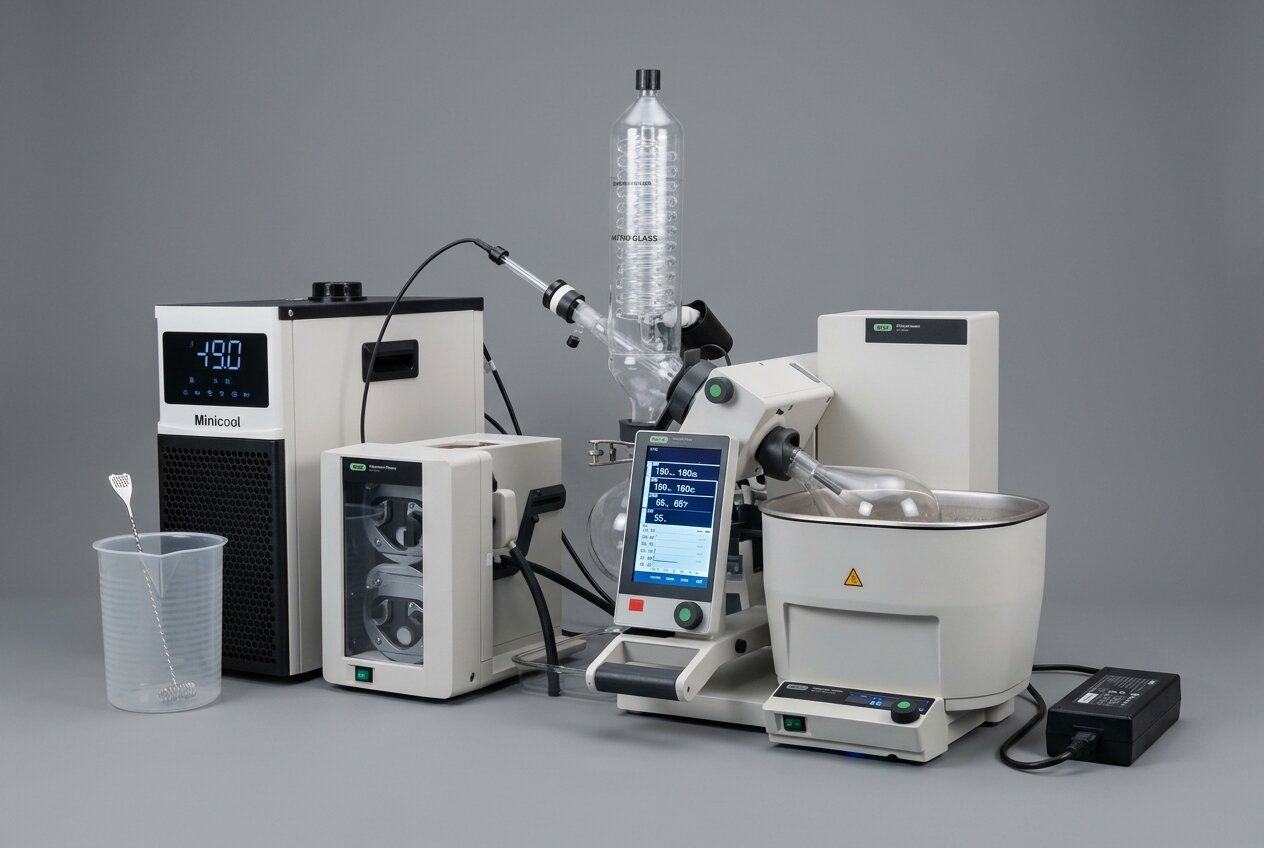
As discussed in our rotary evaporator sizing guides, volatile solvents with low boiling points under vacuum require condenser temperatures well below 0°C for efficient recovery. Following the Rule of 20 (condenser temperature 20°C below solvent boiling point at operating vacuum), solvents like pentane, diethyl ether, and dichloromethane push condenser requirements into the -20°C to -40°C range.
Sample Cooling and Cryopreservation Preparation
Some biological sample preparation protocols require controlled cooling to specific sub-zero temperatures before transfer to liquid nitrogen or ultra-low freezers. Controlled-rate freezing at -1°C per minute to -40°C is a standard protocol for cell cryopreservation. A programmable circulator with precise temperature ramping simplifies this process compared to manually monitoring cooling rates in a freezer.
Analytical Instrument Cooling
Certain analytical instruments — including some NMR probes, mass spectrometer ion sources, and detector arrays — require cooling to sub-zero temperatures for optimal performance or reduced thermal noise. A compact recirculating chiller providing -30°C to -40°C coolant can serve these instruments directly, eliminating the need for dedicated instrument cooling modules.
What Happens to Chiller Performance at -40°C
A chiller rated at 2,000W of cooling capacity does not deliver 2,000W at every temperature. Cooling capacity decreases as the setpoint temperature drops — this is a fundamental characteristic of vapor compression refrigeration, not a deficiency of any particular manufacturer’s equipment.
The reason is thermodynamic: as the evaporating temperature decreases, the pressure ratio across the compressor increases, the refrigerant mass flow rate drops, and the compressor must work harder to move each unit of refrigerant through the cycle. The net result is that available cooling capacity at -40°C is typically 30–50% of the rated capacity at 20°C.
For practical planning, expect the following approximate capacity retention at different setpoints (relative to rated capacity at 20°C with water):
| Setpoint Temperature | Approximate Capacity Retention | Example: 2,000W Rated Chiller |
|---|---|---|
| +20°C (rated condition) | 100% | 2,000W |
| 0°C | 75–85% | 1,500–1,700W |
| -10°C | 60–70% | 1,200–1,400W |
| -20°C | 45–55% | 900–1,100W |
| -30°C | 35–45% | 700–900W |
| -40°C | 25–35% | 500–700W |
This means that if your application requires 800W of cooling at -30°C, you need a chiller rated at approximately 1,800–2,300W at 20°C — not an 800W chiller. This is the single most common sizing mistake for low-temperature applications.
Coolant Considerations at -40°C
At -40°C, coolant selection becomes critical. Water freezes at 0°C. Even standard glycol/water mixtures may not provide adequate protection or pumpability at -40°C without careful attention to concentration and viscosity.
For -40°C operation, you need ethylene glycol concentration of approximately 55–60% to prevent freezing at the evaporator (which may reach -45°C to -50°C internally). At this concentration and temperature, the coolant viscosity is extremely high — roughly 80–100 times the viscosity of water at room temperature. This has direct consequences:
- Pump flow rate drops significantly — sometimes by 50% or more compared to water at 20°C
- Heat transfer at the load becomes less efficient due to laminar flow conditions
- Cooldown time from ambient to -40°C may take 30–60 minutes depending on system volume and insulation
These effects compound the capacity derating discussed above. The chiller’s compressor produces less cooling at -40°C, and the fluid circuit delivers a smaller fraction of that cooling to the load. Selecting a chiller with adequate margin — both in refrigeration capacity and pump performance — is essential for reliable -40°C operation.
Single-Stage vs Cascade: When -40°C Is the Limit
Most laboratory recirculating chillers use single-stage vapor compression with a single compressor and one refrigeration circuit. This architecture can reach -40°C, but that represents the practical lower limit for most single-stage systems. Below -40°C, the pressure ratio becomes too extreme for a single compressor to handle efficiently, and cooling capacity drops to impractical levels.
For temperatures below -40°C (typically -60°C to -80°C), cascade refrigeration systems use two separate compressors and refrigeration circuits in series — the “low stage” cools the process, and the “high stage” removes heat from the low stage’s condenser. Cascade systems are significantly larger, heavier, more expensive, and less energy-efficient than single-stage units.
The key insight: if your application truly requires temperatures below -40°C, you need a cascade system or dry ice. If your application can work within the 0°C to -40°C range, a single-stage recirculating chiller is the most practical, cost-effective, and space-efficient solution.
Insulation and Heat Gain: Protecting Sub-Zero Performance
At -40°C, the temperature differential between the coolant and the surrounding laboratory environment (typically 20–25°C) is 60–65°C. This enormous delta-T drives significant heat gain through any uninsulated surface — tubing, fittings, the chiller reservoir, and the instrument being cooled.
Practical steps to minimize parasitic heat gain:
- Insulate all coolant lines — use closed-cell foam insulation rated for sub-zero temperatures. Standard pipe insulation becomes brittle below -20°C; specify elastomeric foam (Armaflex or equivalent) rated to -50°C minimum.
- Keep line lengths short — every meter of uninsulated tubing at -40°C can absorb 15–30W from the surrounding air. A 3-meter uninsulated line run could consume 50–100W of your chiller’s limited capacity at -40°C.
- Manage condensation — surfaces below the dew point (typically around 10–15°C in a laboratory) will accumulate condensation. Below 0°C, this condensation freezes into ice that grows over time, adding thermal mass and potentially blocking airflow around the chiller’s condenser. A vapor barrier over insulation prevents moisture ingress.
- Position the chiller close to the instrument — the shortest coolant path minimizes both heat gain and pump pressure requirements.
Choosing a Chiller for -40°C Applications
When selecting a recirculating chiller for applications requiring -30°C to -40°C, prioritize these factors:
- Published cooling capacity at your target temperature — not just the rated capacity at 20°C. A 4.6kW-rated chiller that delivers 1,500W at -30°C may be more appropriate than a 2kW-rated unit that delivers only 500W at the same temperature.
- Temperature stability at setpoint — ±0.1°C stability at 20°C does not automatically mean ±0.1°C at -40°C. Verify the stability specification at the lowest operating temperature.
- Cooldown time — how long does the chiller take to reach -40°C from ambient? For batch processes where the instrument must be cold before starting, this matters for scheduling.
- Pump performance with viscous coolant — the pump must maintain adequate flow with high-concentration glycol at -40°C. Check the pump curve at operating conditions.
- Refrigerant type — R404A provides better low-temperature performance than R134a for reaching -40°C. R290 (propane) offers a lower global warming potential alternative with good low-temperature characteristics.
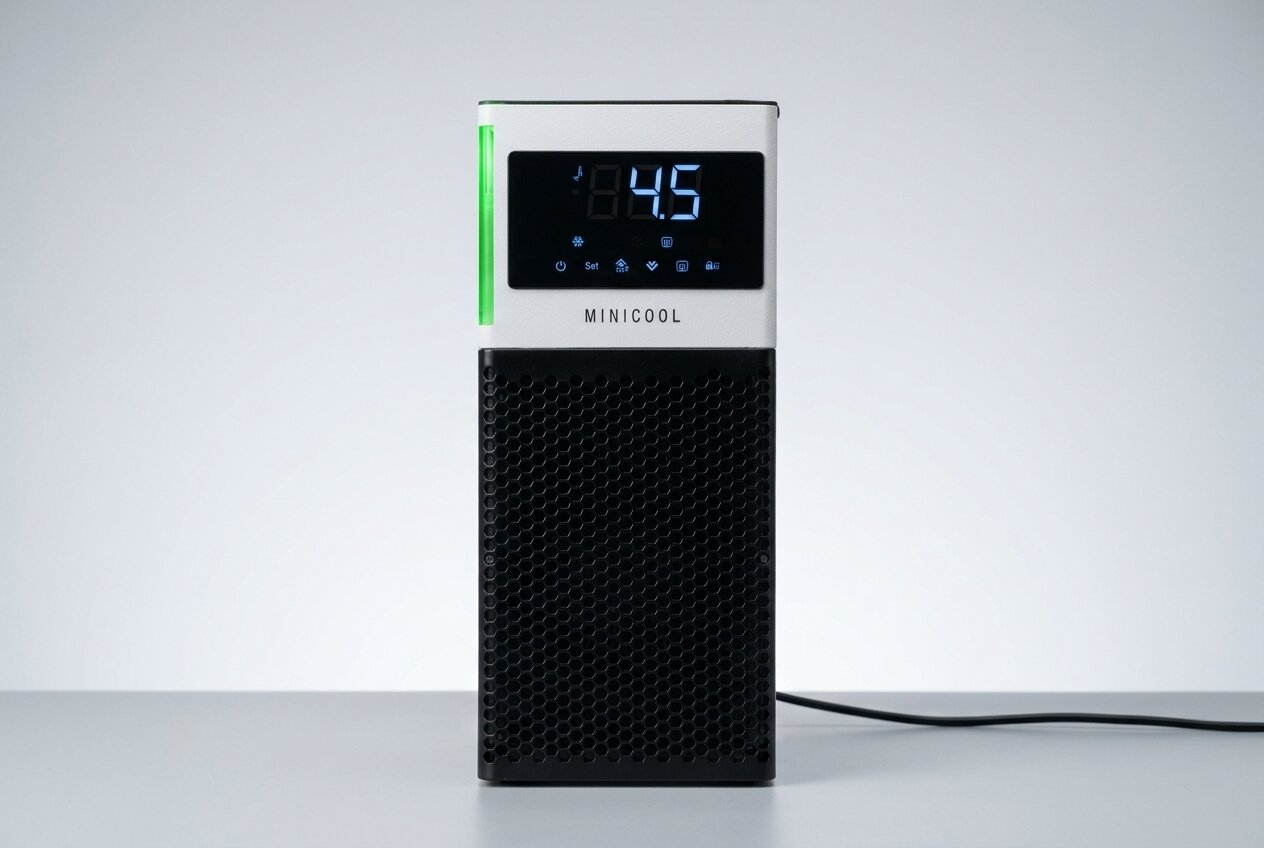
The RIGID MidiCool™ series delivers 1,300W to 4.6kW of cooling capacity with a temperature range extending to -40°C and ±0.1°C stability. Available with R290 or R404A refrigerant options, the MidiCool is designed for the demanding sub-zero applications described in this article — from cold traps and low-temperature reactions to analytical instrument cooling. The pump system is rated for glycol operation at the full temperature range, ensuring reliable coolant delivery even at -40°C.
Real-World Expectations: What -40°C Cooling Looks Like in Practice
Engineers and lab managers sometimes expect a -40°C chiller to behave like a standard chiller that happens to go colder. In reality, operating at -40°C involves several practical differences from routine cooling:
- Startup takes time: Unlike a 10°C chiller that reaches setpoint in 5–10 minutes, a -40°C system requires 30–60 minutes to cool from ambient. Plan experiments accordingly — set the chiller running before other preparations begin, or leave it at setpoint overnight.
- Energy consumption is higher: The compressor runs continuously at or near full capacity. Expect 50–100% higher electricity consumption per watt of delivered cooling compared to operation at 0°C.
- Noise increases: The compressor runs at higher speed and higher pressure ratio, and the condenser fan operates continuously at full speed. Typical sound levels at -40°C operation are 5–10 dBA higher than at moderate setpoints.
- Condensation and frost are constant: Every exposed cold surface collects condensation. Insulation is not optional — it is a functional requirement. Budget for proper insulation materials and installation time.
- Coolant maintenance is more critical: At these concentrations and temperatures, glycol degradation progresses faster than at moderate temperatures. Plan for more frequent coolant monitoring and replacement.
None of these factors should discourage the use of a -40°C chiller — they simply require appropriate planning. A well-designed system installed with proper insulation and maintained on schedule will deliver reliable -40°C cooling for years.
Comparing Cooling Methods for Sub-Zero Applications
| Method | Temperature Range | Cost Model | Precision | Best For |
|---|---|---|---|---|
| Ice bath | 0°C only | Low consumable | ±5–10°C drift | Simple tasks above 0°C |
| Dry ice bath | -78°C fixed | Recurring consumable | ±3–5°C | Deep cold traps, cryogenic work |
| Recirculating chiller | 0°C to -40°C adjustable | One-time equipment | ±0.1°C | Daily sub-zero cooling with precision |
| Cascade chiller | -40°C to -80°C | High equipment | ±0.5–1°C | Ultra-cold applications |
For the -20°C to -40°C range that covers the majority of laboratory sub-zero applications, a single-stage recirculating chiller offers the best combination of precision, convenience, and total cost of ownership.
Frequently Asked Questions
Can a -40°C chiller replace dry ice for all laboratory applications?
No. A -40°C chiller replaces dry ice only for applications that operate within the 0°C to -40°C range. Cold traps at -78°C, reactions requiring -78°C (such as lithiation with n-BuLi), and sample transport at dry ice temperatures still require dry ice or a cascade chiller system capable of reaching -60°C to -80°C. However, many applications traditionally done with dry ice out of convenience — not necessity — actually only need -20°C to -40°C and benefit from switching to a chiller.
How much electricity does a chiller consume when operating at -40°C?
Power consumption at -40°C is typically higher than at moderate setpoints because the compressor runs continuously at or near full speed. A MidiCool unit rated at 1.5–2.5kW electrical input at 20°C may draw the same or slightly higher power at -40°C, while delivering less cooling. The COP (coefficient of performance) at -40°C is typically 0.5–1.0, compared to 2.0–3.0 at 20°C — meaning the energy cost per watt of cooling is 2–6 times higher at -40°C.
How long does it take a chiller to cool down from room temperature to -40°C?
Cooldown time depends on the coolant volume, insulation quality, and chiller capacity. As a rough guide, a system with 5 liters of 55% ethylene glycol takes approximately 30–45 minutes to reach -40°C from 20°C with a well-matched chiller. Larger systems with 10–20 liters of coolant take proportionally longer. Pre-cooling the coolant overnight (setting the chiller to -40°C before leaving the lab) ensures the system is ready at the start of the next workday.