
Low Temperature Viscosity Bath Work Lives at the Bottom of the Envelope
Room-temperature kinematic viscosity is a solved cooling problem — a bath at 40 °C mostly needs heating, and the standards’ tight tolerances are a controller question. The character of the work changes entirely when the method book opens to the low-temperature pages. Standards for low-temperature viscosity of transmission fluids, hydraulic fluids and lubricants run their test points at −12, −26 and −40 °C, and gel-point and cold-flow work pushes the same direction: the measurement now lives at the bottom of a refrigeration machine’s envelope, where capacity is scarcest and every design shortcut collects its fee.
A low temperature viscosity bath is therefore two problems wearing one jacket: a stability problem the standard dictates, and a cold-sink problem the laboratory must engineer. This guide takes the second problem seriously — capacity at depth, bath fluid selection, the stability budget, and a worked example around the −26 and −40 °C points — because the first problem is unwinnable without it.
It is also a different article from bath cooling in general: the mid-range points forgive approximate engineering, and the deep points do not. What follows assumes the deep points are the requirement.
Why −40 °C Is Not Just Colder −12 °C
Three things change qualitatively on the way down, and each moves the selection:
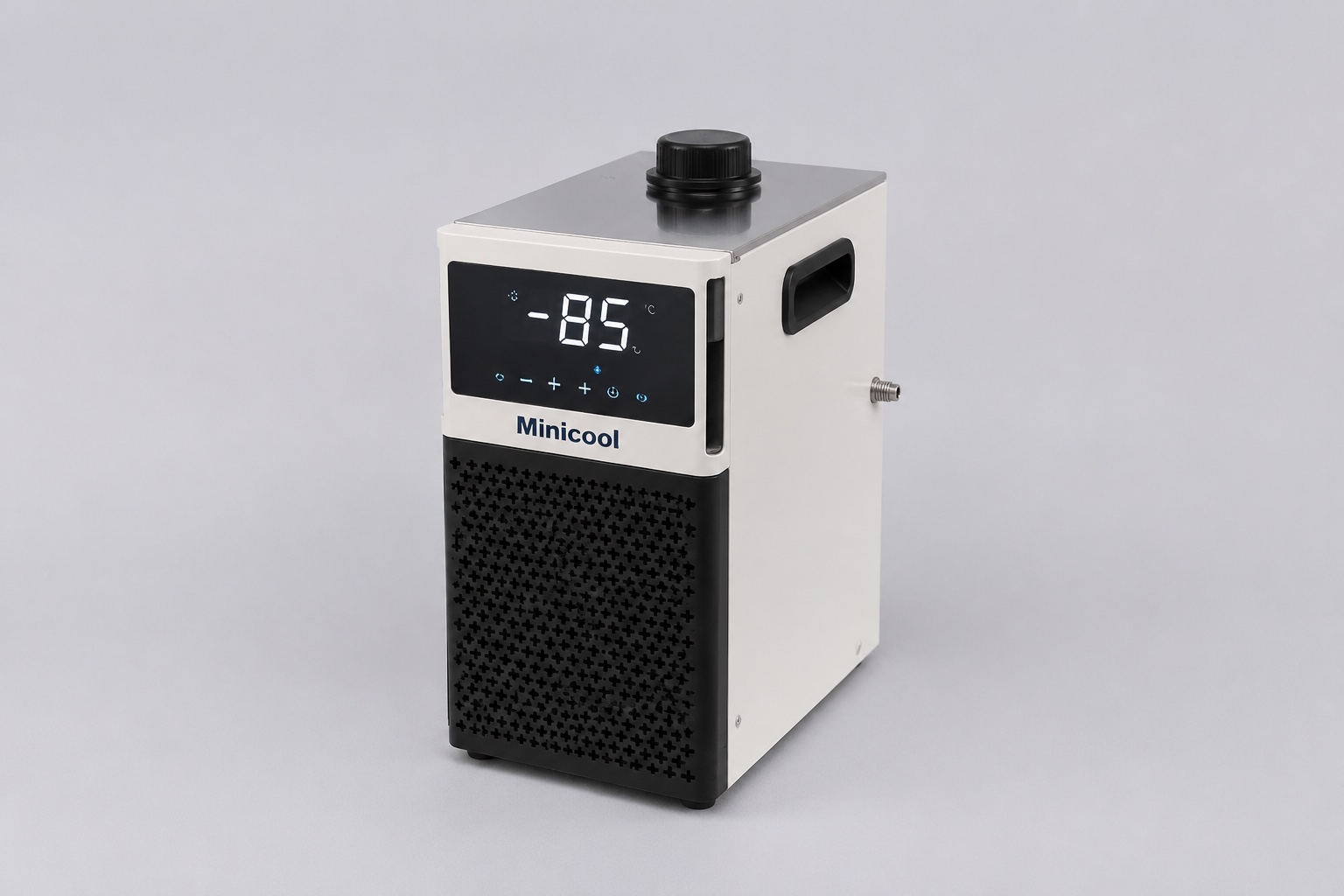
- Machine capacity falls as the setpoint falls. A chiller rated in the hundreds of watts near 0 °C delivers a fraction of that at −40 °C — the published capacity figure at the test point, not the nominal, is the only number that matters. The MiniCool range spans 450–850 W across a 0 to −40 °C envelope, model-dependent, with the applicable figure falling toward the cold end.
- The bath fluid thickens. The same physics being measured in the sample is happening in the bath: viscosity climbing steeply with falling temperature. Circulation weakens, film coefficients drop, and stirring power — which is heat input — rises exactly when capacity is scarcest.
- Every parasitic load grows. Heat leak through insulation, bath surface losses, conduction down viscometer stems and stirrer shafts — all scale with the temperature difference to the room, which at −40 °C in a 22 °C lab is 62 degrees working against you continuously.
The combination explains the field experience: a setup that holds −12 °C with composure struggles at −26 °C and fails theatrically at −40 °C, not because anything broke but because three curves crossed it on the way down. It also explains why the deepest test point should be the one the selection is built around — a system engineered for −40 °C inherits the shallower points for free, while the reverse inheritance never happens.
The Worked Budget
 The worked budget makes it concrete. All values are assumed for illustration; the method transfers, the numbers do not.
| Load at a −40 °C bath | Value used | Basis |
|---|---|---|
| Heat leak through bath insulation | 60 W | Assumed for a well-insulated 6 L bath at ΔT 62 °C |
| Bath surface and lid losses | 30 W | Assumed, lid mostly closed |
| Stirrer input | 25 W | Assumed; rises in thick fluid |
| Conduction via stems, racks, sensors | 15 W | Assumed |
| Sample and glassware changes | Transient | Recovery load between runs |
| Steady total | 130 W | |
| Margin for recovery and control authority | 50 % | Assumed practice for tight-stability work |
| Requirement at −40 °C sink | ~195 W | At the sink temperature, not nominal |
Two readings of the low temperature viscosity bath budget. First, the requirement is modest in absolute terms — the difficulty is not the number but where it must be delivered: the candidate machine’s published capacity at −40 °C must clear it, and the sink typically runs a few degrees below the bath to drive the heat exchange, pushing the working point deeper still. Second, the 50 percent margin is not luxury: it is the control authority that turns a bath that merely reaches temperature into one that holds it through sample changes and stirrer load swings.
Bath Fluid at Depth
 Bath fluid is the second selection, and at −40 °C it eliminates most of the familiar candidates. Water is long gone; common glycol-water mixes are marginal or frozen; what remains is a short list with real trade-offs:
- Silicone oils graded for low temperature: wide liquid range, stable, low toxicity — the default for deep bath work. Grade selection matters: viscosity at the coldest point governs circulation, and a grade chosen for its room-temperature behavior can be syrup at −40 °C.
- Alcohol-based fills: excellent low-temperature viscosity, historically common, with flammability and evaporation management as the standing cost. Site rules decide as often as engineering does.
- High-glycol mixes: workable to the mid-depths; approaching −40 °C their viscosity undermines the uniformity the standard demands, and pumping them costs the loop dearly.
The selection criterion the datasheets underplay: viscosity at the working point drives temperature uniformity, and uniformity is the quantity the tolerance actually constrains. A fluid that circulates freely distributes the cold evenly; a thick one stratifies, and the tolerance is then lost to geography rather than control. Fluid handling for the machine side of the loop follows the ordinary sub-zero rules covered in our coolant selection guide, with ratios verified as per the glycol ratio guide where glycol serves the transfer loop.
The Stability Budget
Low-temperature viscosity standards specify bath tolerances that are demanding at any temperature and harder at depth — and a low temperature viscosity bath earns its tolerance from three contributions, not one:
- Control stability: the machine and controller holding the sink steady. Manufacturer stability figures are earned under specific conditions — where a figure like ±0.1 °C appears, treat it as conditional unless the test conditions are stated, and verify in your own configuration.
- Spatial uniformity: the bath agreeing with itself. Stirring, fluid viscosity, and the geometry between coil and working volume set this; it commonly exceeds the control term at depth, and no controller tune fixes stratification.
- Recovery behavior: how far the working volume moves when a warm viscometer enters, and how fast it settles. This is where the capacity margin either exists or is missed — an underpowered sink turns every sample change into a long wait or a failed tolerance.
The verification of a low temperature viscosity bath is straightforward and worth an afternoon at commissioning: an independent probe at the working position, logged through several simulated sample changes at the deepest test point. The log answers the only question the auditor and the method both care about — what the sample actually experienced — and it becomes the baseline against which fluid aging and machine drift are later judged.
Condensation, Frost and the Working Window
Every cold surface in a deep-bath installation sits far below the room’s dew point, and the moisture arithmetic runs continuously against a low temperature viscosity bath. Frost on the transfer lines is a heat-leak receipt; moisture absorbed into a hygroscopic bath fluid changes its low-temperature behavior over months; and fog rolling off an opened bath at −40 °C is the working volume exchanging itself with the room. The disciplines are unglamorous — vapor-sealed insulation on every cold run, the lid closed between insertions, fluid stored capped, and a periodic check of the fluid’s cold behavior against its new condition.
The working window deserves the same realism: a deep point is not visited, it is occupied. Soak times, replicate runs and recovery periods put the loop at its hardest working point for hours at a stretch, so the machine’s duty specification and the room’s tolerance for its rejected heat both belong in the plan — a few hundred watts of refrigeration at −40 °C returns considerably more than that to the lab air, all afternoon.
Configuration Choices That Decide the Outcome
- External sink, internal polish. The robust deep-bath architecture puts the refrigeration in an external recirculating machine and lets the bath’s own stirring and small heater do the fine control — cooling continuously, trimming with heat. The machine holds depth; the bath holds tolerance. The split also separates the maintenance lives: the refrigeration can be serviced, swapped or upgraded without touching the calibrated bath.
- Insulate the transfer run and keep it short: every uninsulated meter of hose is a parasitic load purchased at the most expensive temperature in the budget, and the condensation-then-frost coat it grows is the visible receipt of that purchase.
- Lid discipline is worth more than hardware at depth: an open bath surface at −40 °C pumps room moisture into the fluid as frost and heat into the budget continuously. Cutouts sized to the glassware, rather than a fully open top, keep the working access without paying the whole surface penalty.
- Plan the dwell at depth: hours at −40 °C, not minutes, once soak times and repeats are counted. Machine duty at the envelope’s bottom is a specification question — continuous holding at the deepest point is the correct duty to state when confirming a model, and the published envelope is where that conversation starts: the MiniCool range covers 0 to −40 °C; positive-temperature bath work belongs to the DV compact liquid chiller family instead.
If you want a deep test point checked against a machine curve, send the following and our engineers will advise: standard and test temperatures, bath volume and insulation, bath fluid, stirrer power if known, sample change frequency, room conditions, and the tolerance the method specifies. Send your bath details to our engineering team.
Frequently Asked Questions
What chiller capacity does a −40 °C viscosity bath need?
Modest in watts, demanding in placement: the worked example lands near 200 W — but delivered at a −40 °C-and-below sink, where machine capacity is at its scarcest. Budget the leaks, stirring and parasitics at the deepest test point, add real margin for recovery, and compare against the candidate’s published capacity at that temperature, never the nominal rating.
What bath fluid works at −40 °C?
Low-temperature silicone oil grades are the usual answer, with alcohol-based fills where site rules permit their handling; ordinary glycol-water mixes have effectively left the field by that depth. Select on viscosity at the working point — circulation and uniformity, which the tolerance really constrains, are lost to a fluid that turns to syrup at temperature.
Why does my low temperature viscosity bath hold −12 °C but fail at −40 °C?
Three curves cross on the way down: machine capacity falls toward the envelope’s bottom, bath fluid viscosity climbs and weakens circulation, and every parasitic load grows with the temperature difference to the room. The setup did not break — its margins were spent. The cure is capacity at depth, a fluid graded for it, and insulation discipline, in that order.
How tight can bath stability realistically be at depth?
Tolerances comparable to the standards’ requirements are achievable with an external cold sink plus fine control at the bath — but treat any stability figure, including ±0.1 °C-class claims, as conditional on test conditions unless stated, and verify with an independent probe at the working position through real sample changes. Spatial uniformity, not controller stability, is usually the binding term at −40 °C.
Can one machine cover both room-temperature and −40 °C test work?
Often, if it is selected for the deep end: a machine with honest capacity at −40 °C is comfortably oversized at −12 °C, and the bath’s own trim heating handles the fine control across the range. The reverse selection — sized for the mid-range, stretched to the bottom — is the configuration that fails theatrically at the deepest point.
Does the sample change really disturb the bath that much?
At depth, yes. A room-temperature viscometer and sample are a concentrated warm load into a small working volume, and the recovery excursion and settling time are set by the capacity margin. This is the practical meaning of the 50 percent margin in the budget — without it, every insertion costs minutes of waiting or a tolerance excursion the log will show.