
Lyophilizer Shelf Cooling Is a Fluid Loop with a Famous Job
Strip the mystique from a freeze dryer and the shelf system underneath is recognizable, serviceable plumbing: a heat-transfer fluid — commonly a silicone oil — circulated through channels inside each shelf, with a refrigeration system cooling the fluid and a heater warming it. The product never touches the machinery; it experiences only the shelf surface, whose temperature the fluid loop dictates degree by degree. Everything a lyophilization recipe asks of its shelves — freeze the product, hold it cold under vacuum, then warm it precisely to drive sublimation — arrives as a setpoint schedule handed to that one loop.
Lyophilizer shelf cooling is therefore a legible engineering subject, and an honest one to size — provided one boundary is respected from the first paragraph: required shelf temperature decides the equipment class, and the requirement varies enormously between applications. Some formulations freeze comfortably at −25 °C; pharmaceutical cycles routinely specify shelves at −45 to −55 °C, which is cascade-refrigeration territory beyond the recirculating-chiller class this article’s machines occupy. This guide covers what the shelf circuit does phase by phase, where the −40 °C machine class genuinely serves, and where it must honestly decline the job.
What the Shelf Loop Does, Phase by Phase
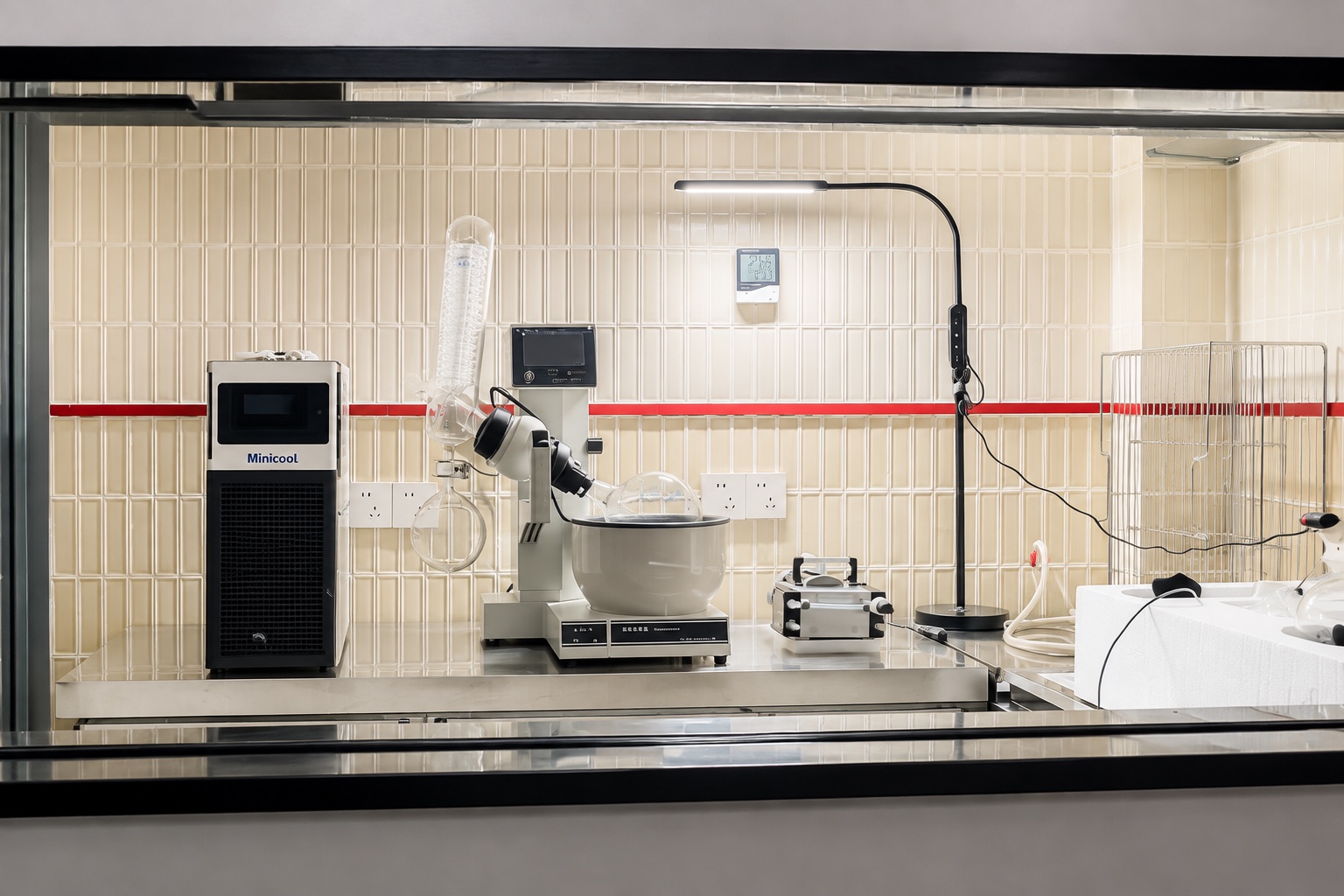 The phase-by-phase duty explains most of the specification:
| Cycle phase | Shelf job | Loop duty character |
|---|---|---|
| Loading | Hold a mild temperature, often pre-chilled before product arrives | Light steady load |
| Freezing | Pull product through nucleation to full solidification on schedule | The refrigeration transient peak — sensible plus latent heat, on a ramp |
| Annealing (some recipes) | Hold, sometimes thermally cycle, at a defined sub-zero point | Steady, precision-weighted |
| Primary drying | Supply sublimation heat at a precisely controlled shelf temperature | Mild heating against a cold product |
| Secondary drying | Warm further still to desorb residual bound water | Heating; refrigeration idles |
Two readings matter for sizing a shelf loop. First, the refrigeration peak is the freezing phase — a crash-cooling transient of exactly the kind steady-state arithmetic misses: product sensible heat, latent heat of fusion (the large term), tray and shelf mass, all inside the ramp time the recipe demands. Second, after freezing, the loop’s job inverts — primary drying needs controlled warmth, which is why shelf systems are built around a fluid loop with both cooling and heating rather than direct refrigeration: one fluid, one circuit, both signs of heat flow.
The Freezing-Phase Budget
Lyophilizer shelf cooling gets sized at its worst hour, and the worst hour is the freeze.
A worked example at bench scale (all values assumed, substitute your own recipe’s): 1.5 L of aqueous product spread across trays, frozen from +5 °C to −30 °C in 90 minutes. Sensible heat above and below freezing contributes roughly 250 kJ; latent heat of fusion, at 334 kJ per kilogram of water, adds about 500 kJ; trays, shelves and fluid mass another 250 kJ. Call it 1,000 kJ in 90 minutes — an average near 185 W, with the instantaneous peak higher during the latent plateau, delivered at a fluid temperature descending toward −35 °C or below to keep driving force on the product.
The shape repeats the lesson of every crash: the latent plateau is where shelf circuits stall. Product sitting at its freezing point absorbs heat without moving temperature, the driving force shrinks as the fluid approaches its floor, and an underpowered loop turns a 90-minute recipe step into an afternoon, and the whole downstream schedule inherits the slip. Capacity at the fluid’s working depth — not nominal — is the number the budget must clear, with margin for the plateau.
Where the −40 °C Machine Class Serves
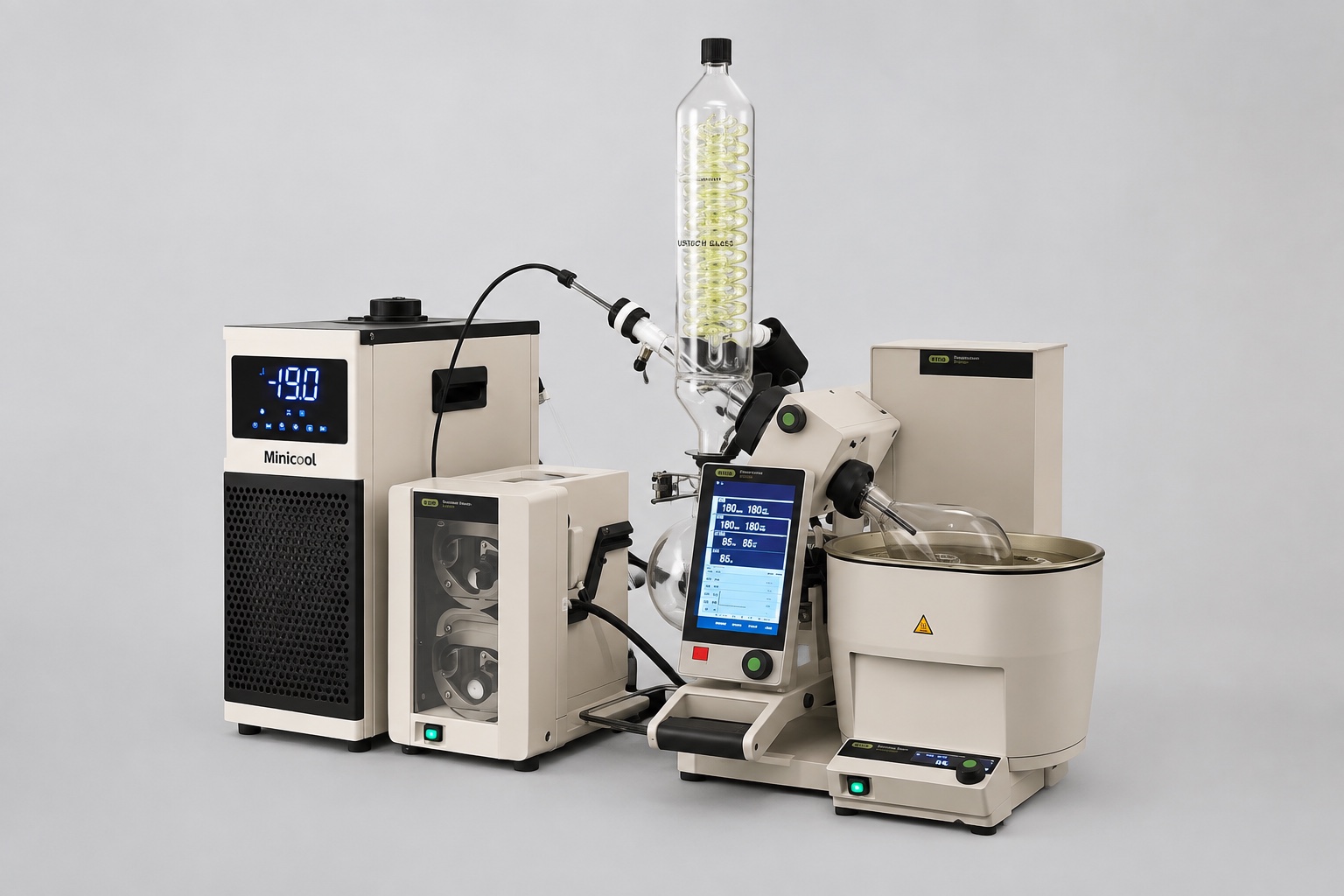 The boundary question decides the equipment, and it is worth stating as a grid rather than a hope:
| Shelf requirement | Fluid loop must reach | Equipment class |
|---|---|---|
| Freeze at −20 to −30 °C | Roughly −30 to −38 °C | Recirculating sub-zero chiller class — the MiniCool range envelope (450–850 W, 0 to −40 °C) |
| Freeze at −35 °C and below | Below −40 °C | Beyond this class — cascade refrigeration or LN2-assisted systems |
| Pre-freezing trays / product externally | −30 to −40 °C | Recirculating class, comfortably |
| Condenser (cold trap) duty | −50 °C and below | Always the deeper class — a separate subject, covered in our cold trap sizing guide |
The fluid must run several degrees below the target shelf temperature to drive the heat transfer through the shelf wall, which is what pushes a −30 °C shelf requirement toward the bottom of a −40 °C machine — workable, with the capacity-at-depth arithmetic done honestly — and pushes anything deeper out of the class entirely. A machine quoted on its envelope floor has no driving-force margin left; the honest selection sits the working fluid temperature a comfortable distance above the floor, or moves up an equipment class before the purchase order, not after.
Where this class fits cleanly is the perimeter of lyophilization rather than its pharmaceutical core: benchtop and pilot units with mild freeze points, external pre-freezing of trays and shelves, hold duties for loaded product awaiting a cycle, chilled-tray transport between rooms, and development work where formulations freeze high enough to leave margin. That perimeter is real work — and it is exactly where a general-purpose recirculating machine beats a dedicated system on flexibility, since the same chiller serves other bench duties between drying cycles.
Ramp Control: Why the Loop Needs Authority, Not Just Depth
Freezing rate is a product-quality variable, not a convenience. Ramp speed shapes ice crystal structure, and crystal structure shapes drying behavior — a recipe that specifies degrees per minute is making a claim about the cake it wants, and the loop either has the authority to honor it or quietly substitutes its own slower version. Lyophilizer shelf cooling authority is the margin between the loop’s capacity at depth and the load’s demand along the ramp: with margin, the controller commands the profile; without it, the profile commands whatever physics allows.
The practical test is the rehearsal, borrowed from every crash-cooling discipline: run the recipe’s freeze profile on a plain water load before product depends on it, log shelf fluid and tray temperatures against the schedule, and see where reality peels away from the plan. A loop that tracks the ramp with the heater occasionally trimming has authority; a loop that lags from the first minutes is delivering everything it has — and the recipe, not the display, is what suffers. The rehearsal number becomes the commissioning baseline, and its drift over seasons the earliest sign of fluid aging or channel fouling.
External Pre-Freezing: the Underused Configuration
The cleanest way to spare a small dryer’s refrigeration is not to ask it for the freeze at all. Pre-freezing product or trays externally — in a chest freezer for undemanding recipes, or against a recirculating chiller’s cold plate or bath where the ramp matters — moves the latent-heat mountain out of the dryer’s cycle entirely. The dryer receives frozen product, its own system handles only the hold and the drying phases, and the cycle clock shortens by the whole freezing phase.
Where lyophilizer shelf cooling capacity is the bottleneck on a busy bench, this split is frequently the cheapest throughput upgrade available: the external machine freezes the next batch while the dryer dries the current one, converting a serial process into a pipelined one at the cost of one more bench machine. The requirements transfer unchanged — capacity at depth for the latent plateau, a fluid graded for the temperature, a rehearsed and logged ramp — but they land on a machine whose whole job they are.
Fluid and Loop Practice for Shelf Duty
- Silicone oil earns its default status: wide liquid range covering both the freeze and the drying-phase warmth, stable, and compatible with the both-directions duty. Grade on viscosity at the coldest working point — circulation uniformity across parallel shelf channels is what makes shelves agree with each other.
- Shelf-to-shelf uniformity is a flow problem. Parallel channels starve the far shelf when flow is marginal; the symptom is trays freezing at different rates, and the fix ranks flow ahead of a colder setpoint.
- Insulate for the dew point: every cold line grows condensation, then frost, then a puddle under the machine — ordinary sub-zero loop hygiene, applied next to vacuum hardware that dislikes water. The fluid-side maintenance rhythm follows our coolant selection guide, silicone chemistry included.
- Log the ramp, not just the setpoint. A shelf circuit’s health is visible in its ramp rate at a standard load; recorded at commissioning, the number quietly arbitrates every later “the freeze is slower than it used to be” conversation — fluid aging and shelf channel fouling both stretch the ramp while the display keeps holding its setpoint faithfully. The comparison costs a rehearsal run per season and saves a service call per misdiagnosis.
For positive-temperature holds and gentler jacket duties around the lab, the DV compact liquid chiller family (100–550 W, −20 to +20 °C) covers the shallow half of the same plumbing logic — same loop discipline, gentler fluid, easier arithmetic.
If you want a shelf or pre-freeze duty checked against a machine curve, send the following and our engineers will advise: product volume and freeze target, required ramp time, tray and shelf mass if known, fluid in use, and whether the duty is the dryer’s own shelf circuit or external pre-freezing. Send your cycle details to our engineering team.
Frequently Asked Questions
What does the shelf cooling circuit in a lyophilizer actually do?
It circulates a heat-transfer fluid — typically silicone oil — through channels inside each shelf, cooled by refrigeration and warmed by a heater, so the shelf surface follows the recipe’s temperature schedule. The same loop freezes the product, holds it, and then supplies the controlled warmth that drives sublimation: one fluid circuit, both directions of heat flow, one set of plumbing to maintain.
Can a recirculating chiller run lyophilizer shelf cooling?
Within a boundary. Freeze points of −20 to −30 °C, external tray pre-freezing, and hold duties sit inside the sub-zero recirculating class, with the fluid running several degrees below the shelf target and the capacity read at that depth. Shelf requirements of −35 °C and below push the fluid past −40 °C — cascade or LN2-assisted territory, a different equipment class.
Why does the freezing phase dominate the sizing?
Latent heat. Water surrenders 334 kJ per kilogram at the freezing plateau — typically the largest single term in the budget — absorbed while the product’s temperature stands still and the driving force is at its thinnest. The worked bench example lands near 185 W average at depth for 1.5 L in 90 minutes; the plateau peak runs higher, and margin for it is what keeps recipes on schedule.
Why do my trays freeze at different rates?
Almost always shelf-to-shelf flow imbalance: parallel fluid channels starve the far shelf when circulation is marginal, and the starved shelf lags the schedule. Viscosity growth at depth makes it worse. Verify and fix flow distribution before reaching for a colder setpoint — the cold that never arrives at the far shelf cannot freeze anything.
What fluid should a shelf loop use?
Silicone oil is the standing default: liquid across both the deep freeze and the drying-phase warmth, stable over years of cycles, and forgiving to pumps. Select the grade on viscosity at the coldest working point rather than the catalog’s room-temperature figure — uniformity across the shelves is manufactured by free circulation, and lost to syrup.
Is the cold trap the same circuit as the shelves?
No — the condenser that captures sublimed water vapor runs far colder than the shelves, typically −50 °C and below, and is served by its own deeper refrigeration stage. The two systems share a cabinet and a recipe but not an equipment class, and conflating them is the commonest way dryer cooling requirements get mis-specified; sizing the trap is its own exercise, covered separately in our cold trap guide.