
Ship Battery Cooling in Marine Battery Enclosures Is a Different Engineering Problem
As electric propulsion, hybrid vessels, auxiliary battery banks, and electrified onboard subsystems become more common, ship battery cooling moves from a secondary packaging detail to a reliability-critical design decision. In marine environments, the battery enclosure is not simply a steel or aluminum box with a fan. It is a thermal, corrosion, moisture, vibration, and maintenance interface all at once. What works for a stationary battery cabinet on land can fail early when installed inside a hull, under a deck, or near a machinery compartment exposed to salt-laden air.
For shipbuilders, system integrators, and OEM engineers, the challenge is not only removing heat from lithium battery modules, battery management electronics, contactors, and DC conversion hardware. The challenge is doing so in a confined enclosure where ambient conditions change fast, service access is limited, conductive contamination is a real concern, and any condensate or corrosion product can create downstream electrical problems. That is why marine battery cooling discussions need to go beyond cooling capacity alone.
In smaller electric vessels and auxiliary battery installations, a compact DC air conditioning module can play a useful role. It can help stabilize enclosure temperature, manage localized hot spots, and reduce humidity-related thermal drift in electronics cabinets. But the marine use case demands a tighter design review: corrosion control, airflow path integrity, condensate routing, vibration tolerance, and maintainability all matter just as much as the nominal cooling number on a datasheet.
This article looks at where compact DC air conditioning fits in marine battery compartments, what salt spray resistant design considerations matter most, and where the application boundary should be drawn. The focus is on small battery compartments, control cabinets, and auxiliary enclosures on electric vessels, not on replacing the primary thermal management system of a large propulsion battery room.
Why a Marine Battery Enclosure Is Harder to Cool Than a Land-Based Battery Box
Marine battery enclosures face a multi-factor heat load that is rarely present in the same combination on land. First, vessel packaging is tight. Designers often have to place batteries near structural members, bulkheads, cable trays, pumps, or other equipment that restricts airflow and service clearance. Free air volume is limited, and recirculation can become severe if return and supply paths are not clearly separated.
Second, ambient temperature is unstable. A battery compartment may see cool conditions at dawn, solar gain by mid-day, engine room heat transfer while underway, and higher humidity when the vessel is idle in harbor. Unlike a stationary cabinet in a climate-controlled room, the marine enclosure is exposed to changing outside air conditions, warm equipment nearby, and hull-side temperature swings.
Third, vessel motion changes the operating reality. Pitch, roll, slamming, and continuous vibration affect fasteners, tubing support, condensate behavior, and fan performance. Components that appear secure in bench testing may loosen or fret over time when mounted in a moving platform. Service loops, drain routing, and coil support need to be reviewed as marine design items, not afterthoughts.
Fourth, marine battery compartments often contain mixed thermal sources. The cells generate heat, but so do battery management systems, busbars with current loading, DC/DC converters, chargers, fuses, and communication hardware. Some of these sources tolerate heat poorly, and some are more sensitive to salt contamination than the battery modules themselves. The result is a non-uniform heat map. A single enclosure temperature reading can miss local hot zones around control electronics or dead-air pockets behind module frames.
How Salt Spray and Humidity Change Cooling Module Design
Salt spray changes the cooling problem because it is not only a corrosion issue. It is also a contamination and insulation issue. Salt deposits attract moisture, lower surface resistance, accelerate galvanic activity, and increase the chance of conductive residue on terminals, PCBs, connectors, and fan assemblies. Even enclosures that are not directly open to seawater can ingest salt aerosols through ventilation openings, leaky cable penetrations, or maintenance events when doors are opened on deck.
Humidity makes the picture more complicated. High moisture content in the air shifts the design question from “How do we cool this compartment?” to “How do we cool it without creating a condensate or corrosion path onto sensitive hardware?” In marine service, that distinction matters. An evaporator can lower air temperature effectively, but if the air path, drip handling, or insulation strategy is poor, the same system can introduce moisture into the wrong location.
For engineers specifying a small cooling module, material choices and mechanical details deserve close scrutiny. Aluminum heat exchangers, copper tubing, steel brackets, fasteners, electrical terminals, and enclosure walls may all be present in the same system. If they are combined without thought to marine exposure, galvanic couples and crevice corrosion sites can appear over time. Protective coatings, isolation washers, compatible fastener selection, and physically separated wet/dry zones all help reduce long-term degradation.
Corrosion control starts with material selection and separation. That means looking at more than the cooling unit itself. Drain pans, mounting rails, electrical glands, hose clamps, sensor probes, and door hardware should be reviewed as part of the same environment. Salt-laden moisture often reaches the weakest detail first, not the most visible component. A cooling module may remain functional while the surrounding drain hardware, connector shell, or support bracket deteriorates and creates a secondary failure.
Air filtration and airflow direction also deserve careful attention. In many small marine enclosures, designers cannot fully isolate the compartment from vessel air. If outside air or machinery-space air enters the battery space, the intake path should minimize direct exposure to salt mist and spray, while the internal circulation path should avoid drawing contaminated air across the most sensitive electronics first. In short, the airflow route is part thermal design and part contamination control.
The Role of DC Air Conditioning in Small Marine Battery Compartments
DC air conditioning is a localized thermal management tool in marine service. It is most useful where the enclosure is relatively compact, the heat load is meaningful but not room-scale, and the design objective is to protect batteries and supporting electronics from temperature rise and moisture-driven instability. Typical examples include small battery compartments on electric workboats, auxiliary lithium banks on hybrid vessels, control cabinets associated with battery systems, and other enclosed spaces where adding chilled liquid loops would be disproportionate in cost or complexity.
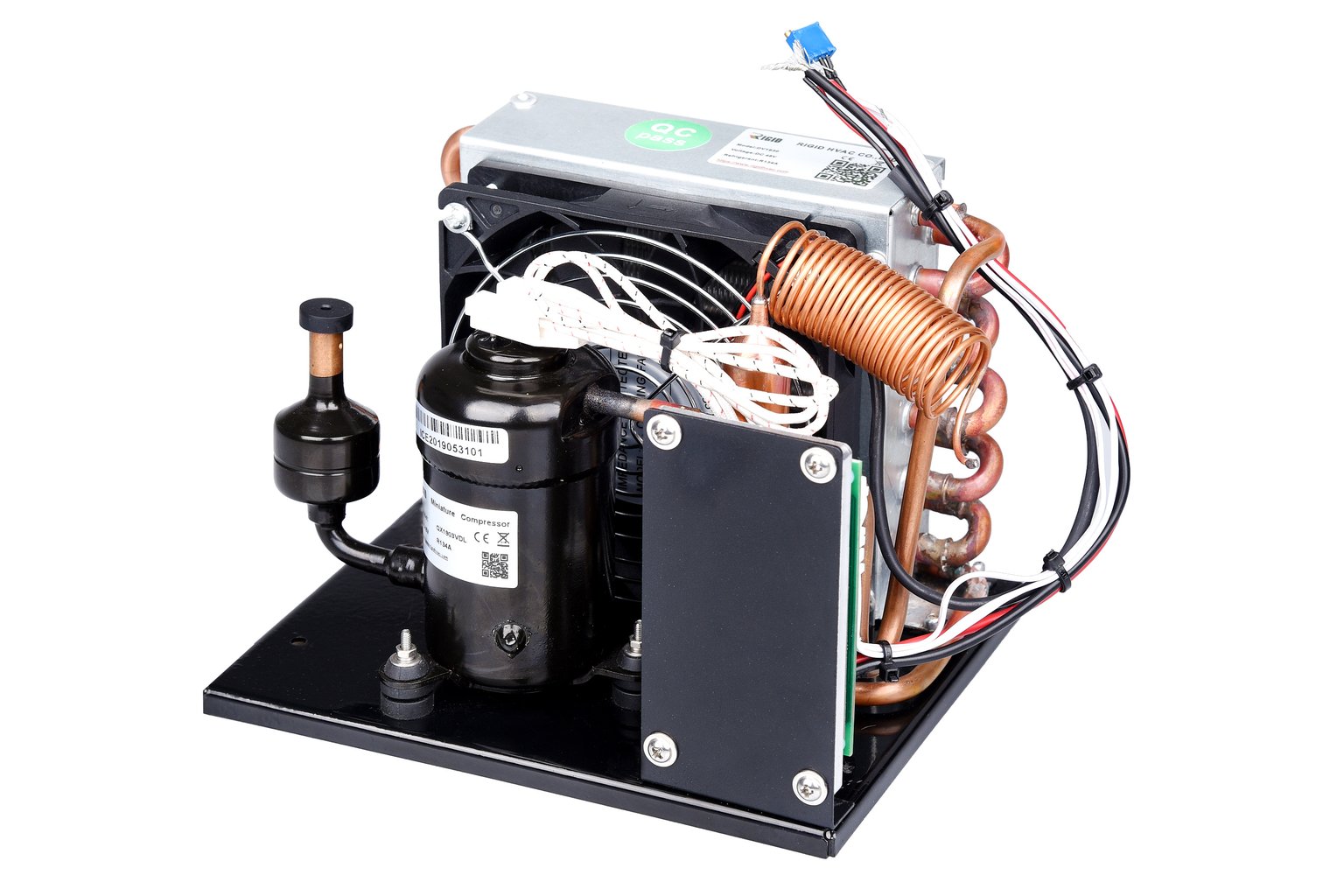
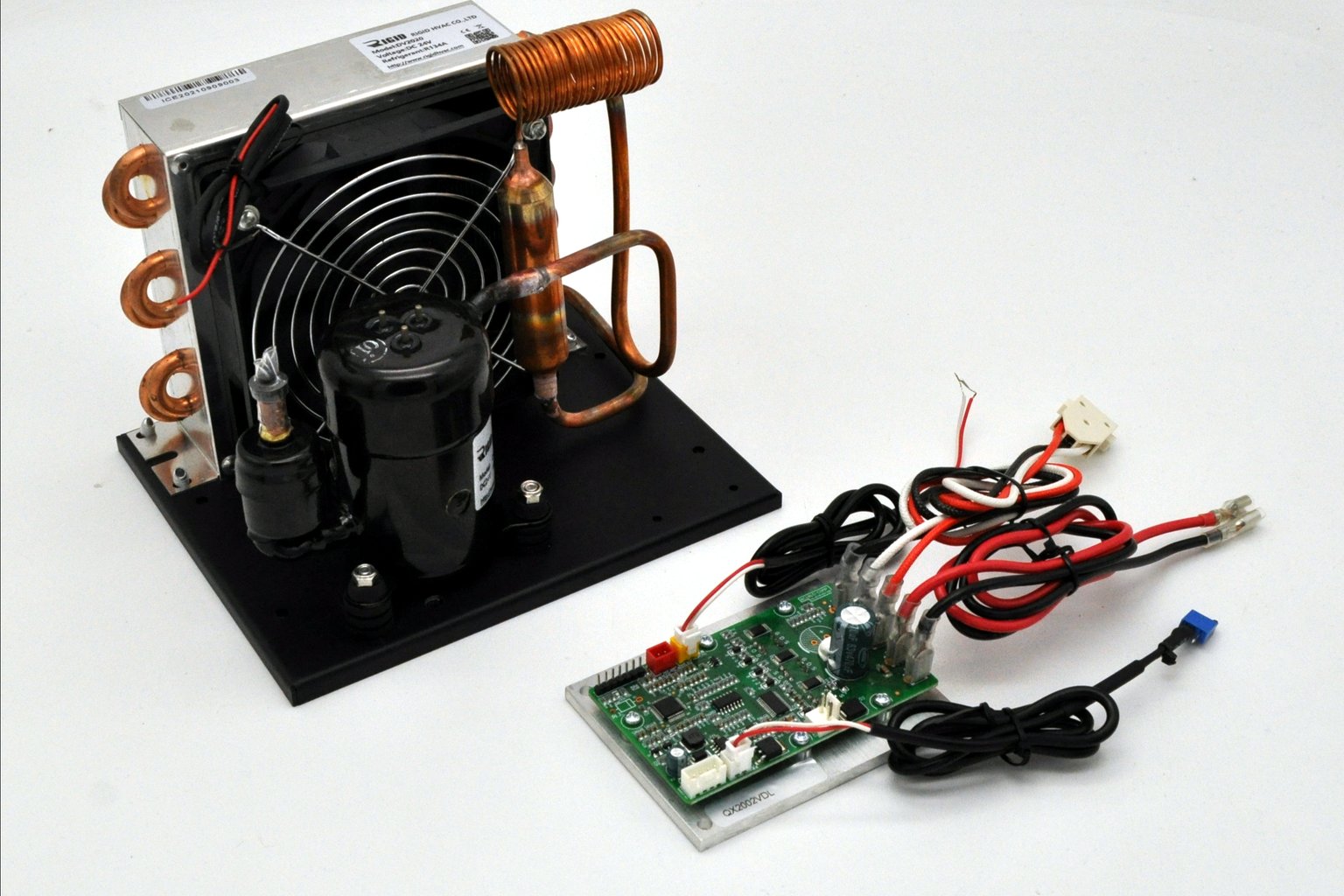
Publicly available information for RIGID Micro DC Aircon shows compact units in 450W to 900W cooling classes, with 12V, 24V, and 48V options, R134a or R290 configurations depending on model, BLDC variable-speed operation, low package weight around 5kg or 11lbs, and a comfort cooling range of about 5°C to 30°C. For engineers working on compact vessel platforms, those characteristics are relevant because they support packaging into constrained spaces where weight, DC power architecture, and installation flexibility matter. The product reference is here: Micro DC Aircon.
That said, the value of a DC air conditioner in a marine battery enclosure is not simply that it is compact. Its value is that it can provide active closed-loop cooling without forcing the integrator to open the enclosure widely to ambient marine air. In many cases, reducing uncontrolled ventilation is beneficial because it limits salt and humidity ingress. A properly arranged closed or semi-closed cooling approach can therefore improve both thermal stability and contamination control.
In practice, a compact DC aircon module is often a better fit for auxiliary enclosures than for large propulsion spaces. On a small vessel, there may be a battery box serving hotel loads, navigation electronics, thrusters, deck equipment, or low-voltage propulsion support systems. These installations can experience localized heat buildup but do not justify a full machinery-room HVAC architecture. Here, a miniature DC system can cool the enclosure air, protect sensitive electronics, and help reduce thermal stress on the battery support hardware.
Airflow Path Design Matters as Much as Cooling Capacity
In marine battery cooling, poor airflow design can waste most of the benefit of an otherwise suitable cooling unit. A common mistake is allowing supply air to short-cycle directly back to the evaporator intake instead of washing over the hottest components. Another is focusing on overall compartment temperature while ignoring shielded regions behind battery modules, near power electronics, or around cable entry zones where heat can accumulate.
For compact marine enclosures, the supply air should be directed to where temperature-sensitive components actually sit. Return air should represent the warmest mixed air in the enclosure rather than the easiest air to capture. Simple baffles, partitions, or guided channels can improve distribution markedly. In many cases, this is more effective than selecting a larger cooling unit but leaving the internal flow path undefined.
The condenser side also matters. Heat rejected from the cooling module must have a stable path away from the battery compartment. If the condenser breathes preheated machinery air, is boxed into a stagnant void, or is mounted where salt accumulation blocks fins, thermal performance degrades rapidly. Designers need to think about how the hot side behaves after weeks or months at sea, not just how it behaves during initial dock trials.
Condensate Management, Corrosion, Vibration, and Service Access
Condensate management must be engineered, not assumed. In a marine battery enclosure, condensate is not harmless water. It can carry dissolved contaminants, wet cable jackets, pool in low points, and migrate toward electrical terminations if the drain path is poorly planned. Drain pans should be sloped, drains should remain functional under vessel attitude changes, and tubing should avoid traps that retain water and biofilm. The outlet location should not discharge where spray can be re-entrained or where runoff can affect adjacent equipment.
Insulation of cold surfaces is equally important. Any section of tubing, fitting, or evaporator housing that drops below dew point can become an unintended drip source. In a compact compartment, even small amounts of recurring moisture can stain supports, attack coatings, and reduce connector reliability over time. Engineers should inspect not only the nominal drain point but every potential condensation site around the cooling module.
Vibration resistance is another marine-specific concern. Refrigerant tubing, mounting points, fan housings, electrical connectors, and drain lines all see dynamic loads. Supports should prevent rubbing and edge contact. Fasteners should be chosen and retained for vibration service. Wiring should be clamped so that long unsupported spans do not fret against enclosure structure. These details are routine in marine engineering, but they become especially important when a compact HVAC module is retrofitted into a battery box that was not originally designed around active cooling.
Service access also has direct thermal consequences. If technicians cannot reach the filter, fan, drain, or connectors without removing battery modules or disconnecting major cabling, preventive maintenance tends to be delayed. Marine projects benefit from designing inspection points early: a clear drain access, visible coil face, removable panel for electrical checks, and enough clearance to clean the unit without disturbing the battery stack.
Application Boundaries and Risk Warnings
Define the application boundary early. Compact DC air conditioning is suitable for small battery compartments, control cabinets, auxiliary enclosures, and localized thermal management tasks on electric vessels. It is not a drop-in replacement for the primary thermal management system of a large propulsion battery room. Those spaces may require integrated room ventilation, fire safety strategy, gas detection interfaces, redundancy planning, higher air volume management, and battery-system-level controls that go beyond what a small enclosure cooling module is designed to do.
Oversizing expectations creates poor outcomes. The right question is not “Can this module cool batteries?” but “Which battery enclosure, under which duty cycle, in which marine environment, with what airflow path and maintenance plan?”
There are also integration risks that deserve explicit attention. Any modification to a battery enclosure should be reviewed against the battery supplier’s thermal, electrical, and safety requirements. Penetrations for ducting, drains, or wiring should not create leakage paths that undermine the enclosure function. Cooling should not direct airflow in a way that bypasses critical sensors or masks developing hot spots. And no marine thermal solution should be specified without checking how it behaves during startup, idle berth conditions, partial load, and hot ambient operation.
Selection Checklist for a Salt-Spray Conscious Marine Installation
For shipyards, OEM teams, and vessel retrofit engineers evaluating a compact DC air conditioning approach for ship battery cooling, the following checklist is a useful starting point:
- Define the enclosure type clearly: battery compartment, control cabinet, or auxiliary electronics enclosure.
- Map all heat sources inside the enclosure, not only the battery cells.
- Confirm whether a compact DC system is being used for localized enclosure cooling rather than as a substitute for room-scale thermal management.
- Review the marine exposure level: sheltered interior, machinery space, deck-adjacent compartment, or intermittent salt-laden air exposure.
- Check materials and interfaces for corrosion risk, galvanic pairing, and wet/dry zone separation.
- Design the supply and return airflow path so air reaches hot components and avoids short-circuit recirculation.
- Plan condenser heat rejection so the hot side is not trapped in stagnant or preheated air.
- Verify condensate drainage through all expected vessel attitudes and operating motions.
- Inspect every cold surface for unintended condensation risk.
- Evaluate vibration support for tubing, brackets, fans, connectors, and drains.
- Provide maintenance access for filter cleaning, coil inspection, drain checks, and electrical inspection.
- Align the cooling strategy with battery supplier guidance and vessel-level safety requirements.
When these items are addressed early, compact DC air conditioning can be a practical part of a marine battery enclosure strategy. When they are ignored, thermal performance may look acceptable on paper yet become unreliable in service.
Conclusion
Marine battery cooling is not only about lowering temperature. It is about preserving enclosure reliability in a wet, salty, vibrating, space-constrained environment. That is why ship battery cooling for electric vessels must be approached as an environmental integration task rather than a standalone refrigeration choice.
For smaller battery compartments, control cabinets, and auxiliary enclosures, compact DC air conditioning can be a sensible option when the design emphasizes corrosion control, airflow discipline, condensate routing, vibration resistance, and serviceability. For larger propulsion battery rooms, the role of a small DC module is limited and should not be confused with primary room-level thermal management. Engineers who keep that boundary clear are more likely to build marine battery systems that remain stable not only at commissioning, but through daily exposure to salt, humidity, and vessel motion.