
Micro AC Unit Applications That Engineers Actually Deploy in the Field
When thermal engineers hear “micro AC unit,” they typically picture a miniature version of a window air conditioner. The reality is far more interesting. Micro AC units built on vapor compression technology — specifically BLDC-driven rotary compressors running on 12V, 24V, or 48V DC — have carved out a distinct niche in applications where conventional cooling simply cannot fit, cannot run on battery power, or cannot survive the vibration and environmental stress of the deployment site.
This guide maps the real-world applications where micro AC units deliver measurable value. Not theoretical use cases from a marketing slide deck, but deployments that engineering teams have validated with thermal data, runtime logs, and field failure reports. Each application section includes the thermal challenge, why a micro AC unit solves it better than alternatives, and the critical sizing parameters that determine success or failure.
Telecom Cabinet Cooling: The Application That Started It All
Telecom base stations generate between 200W and 800W of heat inside sealed outdoor cabinets. These cabinets sit on rooftops, alongside highways, and in remote rural locations where grid power may be unreliable or unavailable. The equipment inside — radio units, power amplifiers, battery banks — needs to stay below 45°C to maintain signal quality and component lifespan.
Traditional cabinet cooling uses thermoelectric (Peltier) modules or filtered fan systems. Peltier modules work, but their coefficient of performance (COP) hovers around 0.3–0.5, meaning they consume 2–3 watts of electricity for every watt of heat they remove. In a solar-powered or battery-backed site, that inefficiency translates directly into larger battery banks, more solar panels, and higher capital expenditure.
A micro AC unit with vapor compression technology delivers COP values between 1.8 and 2.5 under typical ambient conditions. For a cabinet generating 450W of internal heat, the micro AC unit draws approximately 180–250W of electrical power — compared to 900–1500W for a Peltier system removing the same heat load. That difference funds itself within months through smaller battery requirements alone.
Sizing Parameters for Telecom Cabinets
The critical sizing question is not just “how much heat does the equipment generate?” It is “what is the maximum ambient temperature, and what internal temperature must the cabinet maintain?” In desert deployments where ambient hits 55°C and the target internal temperature is 40°C, the temperature differential is only 15°C — which means the micro AC unit works harder and its effective capacity drops. At standard rating conditions (35°C ambient, 27°C return air), RIGID’s DV1920E-AC delivers 450W of cooling. At 55°C ambient, expect roughly 60–70% of rated capacity.
For most telecom applications, the RIGID Micro DC Aircon in the 450W–550W range (DV1910E-AC through DV3220E-AC) handles the thermal load with adequate margin. Sites with high-power radio units pushing 600W+ of heat may require the DV2820E-AC (700W cooling) or DV3820E-AC (900W cooling) models.
EV Battery Enclosure Thermal Management
Electric vehicle battery packs are thermally sensitive in both directions: too hot and the cells degrade rapidly; too cold and charging efficiency drops. The optimal operating window for lithium-ion cells is typically 20–35°C. Battery management systems (BMS) monitor cell temperatures continuously, but they rely on an external thermal system to actually move the heat.
Large EV manufacturers use liquid cooling loops integrated into the battery pack structure. But for smaller EV applications — electric utility vehicles, golf carts, low-speed neighborhood electric vehicles, electric forklifts, and aftermarket conversions — liquid cooling adds complexity, weight, and cost that the platform cannot justify.
A micro AC unit mounted to the battery enclosure provides direct air cooling that keeps cell temperatures within the safe operating window. The 12V or 24V input matches the battery bus voltage directly, eliminating the need for a DC-DC converter or inverter. The system draws from the same battery it protects, which means runtime calculations must account for the parasitic load.
Runtime and Parasitic Load Calculations
For a 48V/100Ah lithium battery pack (4.8 kWh total energy), a DV1930E-AC micro AC unit drawing approximately 200W of input power would consume roughly 4.2% of the pack’s energy per hour of continuous operation. Over an 8-hour deployment, that is approximately 1.6 kWh — about one-third of the total pack energy. This is a significant parasitic load, which is why proper thermal insulation of the battery enclosure is essential to reduce the cooling demand and extend the operational window.
Engineers working on EV battery thermal management should start with the heat generation rate of the cells under peak discharge, calculate the enclosure’s thermal resistance (including insulation), determine the target internal temperature at maximum ambient, and then select a micro AC unit with at least 20% capacity margin above the calculated steady-state heat load.
Drone Docking Stations and Autonomous Systems
Autonomous drone operations — package delivery, infrastructure inspection, security surveillance — require ground-based docking stations where drones land, recharge, and wait for their next mission. These docking stations are sealed enclosures exposed to direct sunlight, and they contain charging electronics that generate substantial heat.
The thermal challenge is twofold. First, the charging electronics (typically 1–3 kW chargers) generate 50–150W of waste heat inside a compact enclosure. Second, solar heat gain through the enclosure walls and any transparent panels can add another 100–300W depending on orientation and climate. Without active cooling, internal temperatures in a sun-exposed docking station can exceed 70°C — well beyond the operating limits of both the charging electronics and the drone’s battery.
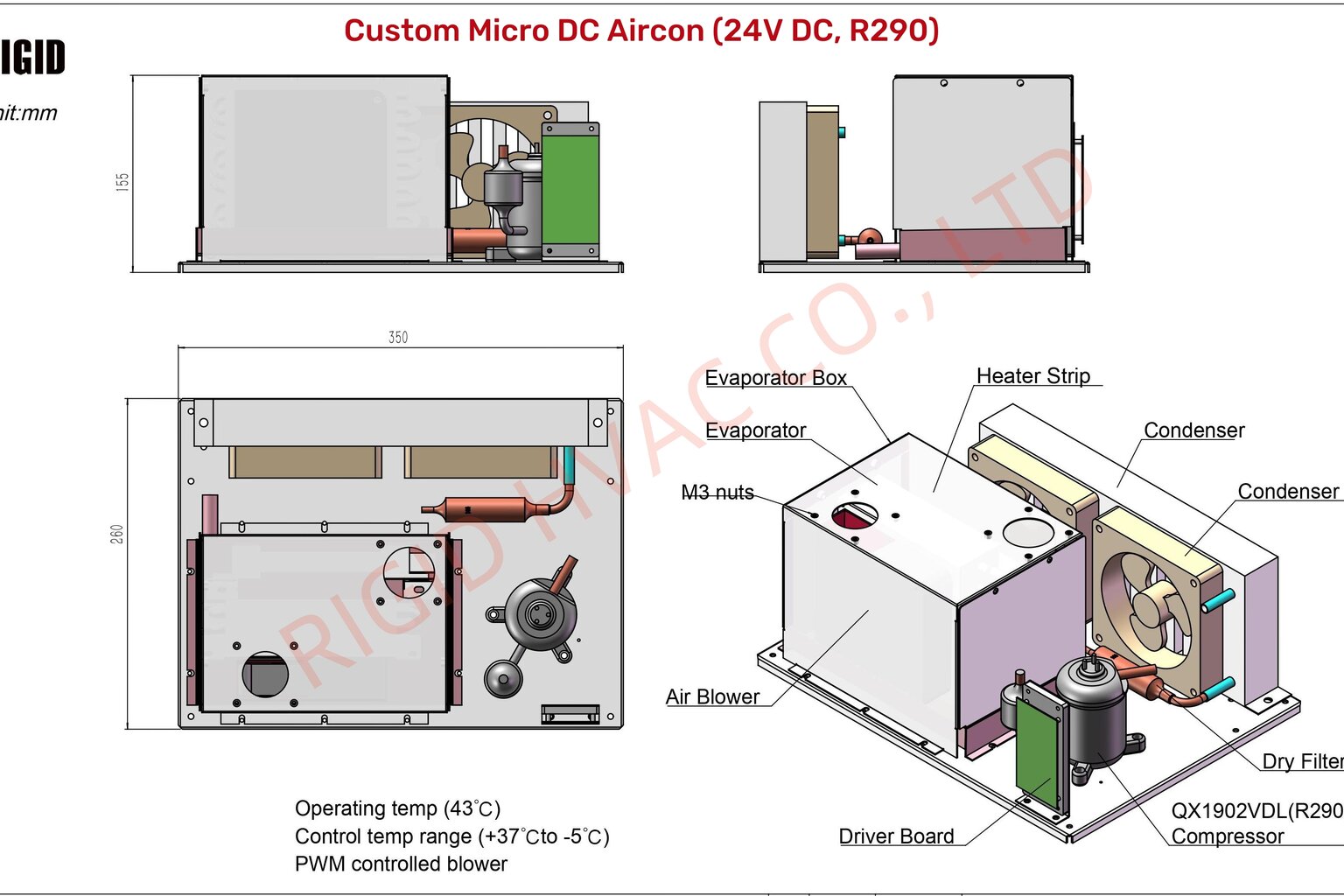
A micro AC unit in the 450W–700W cooling range handles most drone docking station thermal loads. The 24V or 48V input voltage matches common drone charging bus voltages, simplifying the power architecture. The unit’s compact footprint (typically 350mm × 260mm × 180mm) fits within the docking station structure without competing for space with the landing pad and charging contacts.
Why Not Just Use Ventilation?
Filtered ventilation fans are cheaper and simpler, but they fail in two critical scenarios. In dusty environments (construction sites, agricultural areas, desert regions), filtered fans require frequent maintenance and the filters restrict airflow as they load up, reducing cooling effectiveness over time. In high-humidity environments, ventilation introduces moisture that condenses on electronics when temperatures drop at night, causing corrosion and short circuits.
A micro AC unit operates as a sealed system — no outside air enters the enclosure. This eliminates dust ingress and controls humidity simultaneously. For autonomous systems that operate without human maintenance for weeks or months, this sealed-system advantage is often the deciding factor.
Medical Device Cooling: Portable Diagnostics and Field Labs
Portable medical devices — point-of-care diagnostic instruments, portable MRI components, blood analysis equipment, and vaccine transport systems — generate heat during operation and often require precise temperature control to maintain measurement accuracy.
Laboratory-grade cooling systems are too large, too heavy, and require AC mains power. Thermoelectric coolers can provide localized cooling but lack the capacity and efficiency for devices generating more than 50–100W of heat. A micro AC unit bridges the gap: enough cooling capacity (450–900W) for the thermal load, battery-compatible voltage input, and a form factor that fits inside or alongside the medical device housing.
Temperature Stability Requirements
Medical devices often require temperature stability within ±1–2°C. Achieving this with a micro AC unit requires a properly tuned thermostat and variable-speed compressor control. BLDC compressors used in RIGID’s micro AC units support PWM speed control, allowing the compressor to modulate its output rather than cycling on and off. This reduces temperature oscillation and provides smoother thermal control compared to fixed-speed systems.
For applications requiring temperature stability tighter than ±1°C, a liquid chiller module is typically more appropriate than an air-based micro AC unit. But for the majority of portable medical applications where ±2°C stability is sufficient, the micro AC unit is the most practical solution.
Industrial Control Panel and PLC Cabinet Cooling
Factory automation systems generate heat inside sealed control panels. PLCs, variable frequency drives (VFDs), servo controllers, and power supplies all contribute to the internal heat load. NEMA 4X or IP66 rated enclosures must remain sealed to protect against washdown, dust, and chemical exposure — ruling out ventilation-based cooling.
Traditional panel coolers use compressor-based systems designed for industrial environments, but they are typically oversized and overpriced for smaller control panels. A micro AC unit provides an appropriately sized cooling solution for panels with heat loads in the 200–900W range, at a fraction of the cost of industrial panel coolers.
Vibration and Mounting Considerations
Factory environments involve vibration from nearby machinery. Micro AC units with BLDC rotary compressors are inherently more vibration-resistant than reciprocating compressor systems because the rotary mechanism produces less mechanical shock. However, mounting orientation matters: the compressor should remain within ±15° of its design orientation to ensure proper oil return and refrigerant flow.
For panels mounted on vibrating equipment (stamping presses, CNC machines), rubber isolation mounts between the micro AC unit and the panel wall reduce transmitted vibration and extend compressor lifespan.
Security and Surveillance System Enclosures
Outdoor surveillance cameras, radar systems, and license plate readers are increasingly housed in sealed enclosures with edge computing hardware that processes video locally rather than streaming raw footage to a central server. This edge computing hardware — GPUs, FPGAs, or specialized AI inference chips — generates 100–400W of heat in enclosures designed to withstand vandalism, weather, and temperature extremes.
A micro AC unit keeps the electronics within operating temperature while maintaining the enclosure’s IP rating. The low power draw (typically 150–250W input for 450W cooling) is compatible with solar+battery power systems commonly used at remote surveillance sites where grid power is unavailable.
Agricultural and Greenhouse Control Systems
Greenhouse automation controllers, irrigation system electronics, and agricultural sensor hubs are deployed in environments with high temperatures, high humidity, and corrosive chemicals (fertilizers, pesticides). Sealed enclosures protect the electronics, but they trap heat.
Micro AC units solve the thermal problem while maintaining the environmental seal. The 12V or 24V input voltage matches the DC power systems commonly used in agricultural settings, where solar panels and batteries provide off-grid power.
Product Line Overview: Matching Application to Model
Selecting the right micro AC unit starts with two questions: what is the cooling load (in watts), and what is the available DC voltage?
The RIGID Micro DC Aircon product line covers four cooling tiers:
- Entry tier (450W / 1,535 BTU): DV1910E-AC (12V), DV1920E-AC (24V), DV1930E-AC (48V). Best for telecom cabinets, small control panels, sensor enclosures, and surveillance system housings with heat loads under 400W.
- Mid-range (550W / 1,876 BTU): DV3220E-AC (24V). Suits medium control panels, EV battery enclosures for smaller packs, and drone docking stations with moderate solar heat gain.
- High-performance (700W / 2,387 BTU): DV2820E-AC (24V, R134a) and DV2820E-AC-T (24V, R290). Handles larger enclosures, high-heat-load medical devices, and industrial panels with multiple VFDs.
- Flagship (900W / 3,069 BTU): DV3820E-AC (24V) and DV3830E-AC (48V). Maximum cooling capacity for the largest enclosed applications — large battery enclosures, multi-equipment control panels, and high-power drone charging stations.
All models share the same compact form factor (approximately 350mm × 260mm × 180mm), use pre-charged R134a or R290 refrigerant, and feature BLDC variable-speed compressors for efficient partial-load operation.
What Micro AC Units Are Not Designed For
Honesty builds credibility. Micro AC units excel in enclosed, compact applications with moderate heat loads. They are not designed for:
- Large room or cabin cooling: A 450–900W micro AC unit cannot meaningfully cool a 20m² room. For truck cabs, sleeper berths, or large enclosed spaces, look at higher-capacity DC air conditioning systems.
- Sub-zero cooling: Micro AC units provide comfort-level cooling (typically down to 5–10°C supply air). For freezing temperatures, a condensing unit or dedicated refrigeration system is required.
- Continuous heavy-duty cycling in extreme heat: At ambient temperatures above 50°C, micro AC unit capacity drops significantly and compressor duty cycle approaches 100%. Ensure adequate capacity margin or consider supplemental insulation and shading.
Making the Selection: A Practical Decision Framework
Step 1: Calculate the total heat load — equipment waste heat plus solar/environmental heat gain minus any heat loss through enclosure walls.
Step 2: Identify the available DC voltage. Match it to the micro AC unit voltage options (12V, 24V, or 48V). Using the native bus voltage eliminates conversion losses.
Step 3: Determine the ambient temperature range at the deployment site. Derate the micro AC unit’s cooling capacity by 30–40% for extreme ambient conditions (above 45°C).
Step 4: Add a 20% capacity margin above the calculated cooling requirement. This margin covers measurement uncertainty, future equipment additions, and capacity degradation over the unit’s lifespan.
Step 5: Consider the refrigerant. R134a is widely available and familiar to service technicians. R290 (propane) has a lower global warming potential and slightly better thermodynamic efficiency, but requires compliance with local regulations regarding flammable refrigerants in enclosed spaces.
The right micro AC unit is the one that matches the thermal load with adequate margin, runs on the available voltage, fits in the available space, and survives the environmental conditions of the deployment site. Everything else is secondary.
Installation Best Practices Across Applications
Regardless of the specific application, several installation practices apply universally to micro AC unit deployments and directly affect long-term performance and reliability.
Condenser Placement and Airflow
The condenser must reject heat to the outside environment. In enclosure-mounted installations, the condenser section should face outward with unobstructed airflow on the exhaust side. A minimum clearance of 200mm from any wall, structure, or adjacent heat source prevents hot air recirculation. In applications where multiple micro AC units are installed on adjacent enclosures, stagger the condenser exhaust directions to prevent one unit’s exhaust from becoming another unit’s intake air.
For applications in dusty or debris-heavy environments, install a removable mesh screen over the condenser air intake. Clean or replace the screen during scheduled maintenance intervals. A blocked condenser screen can reduce cooling capacity by 20-30% before the compressor’s thermal protection intervenes.
Electrical Connection and Protection
Wire gauge selection must account for the peak startup current, not just the running current. BLDC compressor startup current typically reaches 3-5 times the steady-state running current for 1-2 seconds. Undersized wiring causes voltage drop at the unit’s terminals, which reduces compressor speed and cooling capacity during normal operation and can trigger low-voltage protection during startup.
Install a properly rated fuse or circuit breaker at the battery or power distribution panel. For a micro AC unit with 8A running current on 24V, a 20A slow-blow fuse accommodates the startup transient while still protecting against wiring faults. Never use a fuse rated more than 2.5 times the running current — an oversized fuse defeats the purpose of overcurrent protection.
Condensate Management
The evaporator coil extracts moisture from the air as it cools. This condensate must be drained away from the enclosure and its contents. In horizontal installations, a gravity drain through the enclosure floor is simplest and most reliable. In inverted or sidewall installations where gravity drainage is not feasible, a small condensate pump (5-10W) can route the water to an appropriate drain point.
In high-humidity environments, condensate volume can reach 0.5-1.0 liters per hour during initial pull-down. Ensure the drain path can handle this flow rate without backing up into the evaporator tray, which causes water overflow inside the enclosure — exactly the kind of moisture damage the sealed enclosure was designed to prevent.
Vibration Isolation in Mobile Applications
For installations on vehicles, machinery, or any platform subject to mechanical vibration, mount the micro AC unit on rubber isolation pads or spring-loaded mounting brackets. The compressor contains precision bearings and close-tolerance mechanical components that are designed to handle some vibration but will wear prematurely under sustained high-frequency or high-amplitude excitation.
After installation, run the vehicle or equipment at normal operating speed while monitoring the micro AC unit for unusual noise, vibration, or intermittent electrical faults. Resonance between the mounting system and the operating vibration frequency can amplify vibration rather than reduce it — reposition or add damping material if resonance is detected.