
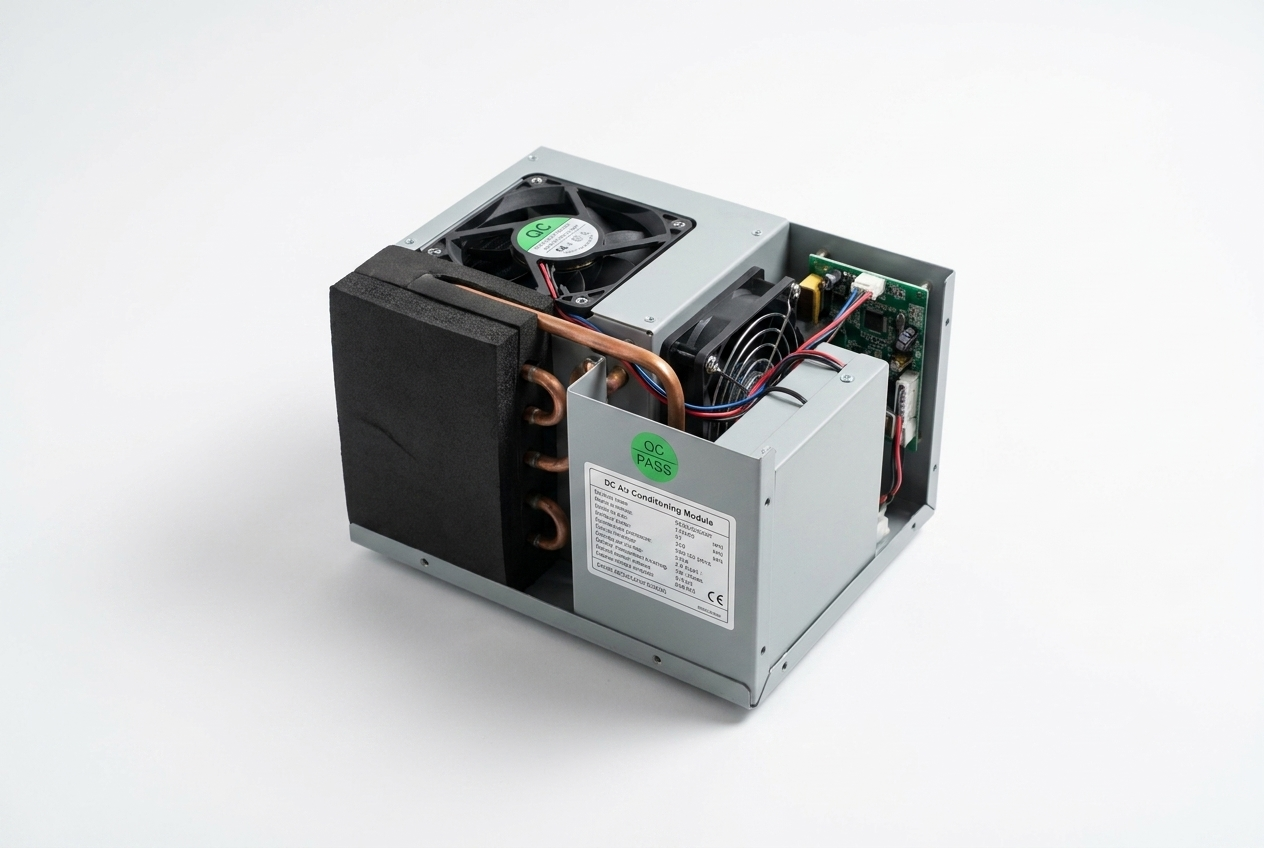
If you have searched for a small, portable cooling solution, you have probably come across three very different types of products — all marketed under the umbrella of “micro ac unit.” One uses a miniature compressor and refrigerant, another relies on thermoelectric (Peltier) chips, and the third simply evaporates water. They look similar in size. They are all called “air conditioners” or “coolers” online. But beneath the housing, these three technologies work in fundamentally different ways, and the cooling performance gap between them is enormous.
This article breaks down all three approaches — vapor compression, thermoelectric (Peltier), and evaporative cooling — across the dimensions that actually matter: cooling capacity, energy efficiency, temperature control precision, reliability, and real-world suitability. If you are evaluating a micro ac unit for a vehicle cab, equipment enclosure, small shelter, or any off-grid scenario, this comparison will help you understand what each technology can and cannot do.
How Each Micro AC Unit Technology Actually Works
Before comparing performance numbers, it helps to understand the engineering principles behind each approach. The differences in how they move heat explain why the results are so different.
Vapor Compression (Miniature Compressor Systems)
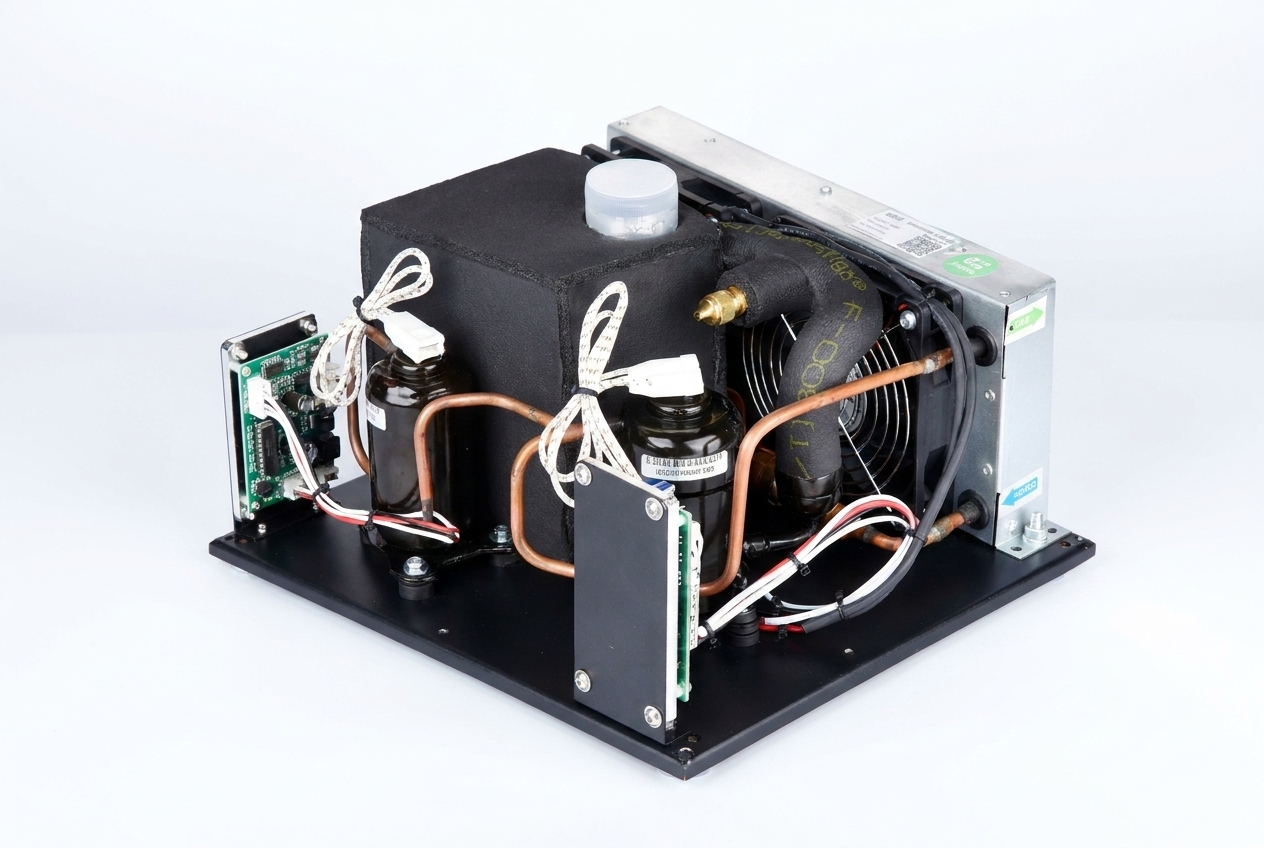
This is the same refrigeration cycle used in household air conditioners and refrigerators — scaled down to a compact module. A small BLDC (brushless DC) compressor circulates refrigerant through a closed loop: the compressor raises the pressure and temperature of the refrigerant gas, the condenser releases that heat to the outside, an expansion valve drops the pressure, and the evaporator absorbs heat from the target space as the refrigerant changes phase from liquid back to gas.
The key advantage is phase-change heat transfer. When a refrigerant evaporates, it absorbs a large amount of energy per unit mass. This is why even a palm-sized compressor system can produce meaningful cooling — often measured in hundreds or thousands of BTU/h.
Thermoelectric / Peltier Cooling
Peltier coolers use semiconductor chips that transfer heat from one side to the other when an electric current passes through them. There are no moving parts in the cooling element itself (though fans are needed to dissipate heat). The technology is simple, silent, and physically compact.
However, Peltier chips are inherently limited in efficiency. They typically achieve a Coefficient of Performance (COP) well below 1.0, meaning they consume more electrical energy than the heat they remove. As the temperature difference between the hot and cold sides grows, efficiency drops further. In practical terms, a Peltier module that draws 60W of power might only deliver 20-30W of actual cooling — and it also generates 60W of waste heat that needs to be expelled from the same general area.
Evaporative Cooling
Evaporative coolers — sometimes called “swamp coolers” — blow air across a wet pad or wick. As water evaporates, it absorbs heat from the air, lowering the air temperature. This process works well in hot, dry climates where the air has significant capacity to absorb moisture.
The critical limitation is that evaporative cooling cannot lower air temperature below the wet-bulb temperature. In humid environments (above roughly 50-60% relative humidity), the cooling effect becomes negligible. Evaporative coolers also add moisture to the air, which can be problematic in enclosed spaces, electronics enclosures, or any application where humidity control matters.
Efficiency and Energy Consumption: Where the Numbers Diverge
For anyone running a micro ac unit on battery power — whether in a vehicle, boat, off-grid shelter, or portable setup — energy efficiency is not a nice-to-have. It determines how long your system runs and whether it actually keeps the space cool.
Vapor compression systems typically achieve a COP of 2.0 to 3.5, meaning for every watt of electrical input, they move 2 to 3.5 watts of heat. Miniature DC compressor modules tend to land on the lower end of this range due to scale, but they still deliver significantly more cooling per watt than the alternatives.
Peltier modules typically operate at a COP of 0.3 to 0.7 in real-world conditions. That is roughly 3 to 5 times less efficient than a compressor-based system for the same cooling output. To match the cooling capacity of a small compressor unit, a Peltier setup would need to draw substantially more power — power that may not be available in battery-limited scenarios.
Evaporative coolers are very energy-efficient in terms of fan power, but this comparison is misleading because their actual cooling output depends entirely on ambient humidity. In dry desert air at 15% humidity, an evaporative cooler performs well. At 70% humidity, it barely cools at all. You cannot assign a consistent efficiency rating because the output is a function of weather, not just input power.
Here is a practical comparison for a roughly equivalent cooling target:
- Vapor compression micro ac unit — As a starting estimate, approximately 450W input can produce around 1,500 BTU/h of cooling capacity
- Peltier cooler — To achieve similar cooling output, a Peltier array would typically require 3 to 5 times the electrical input
- Evaporative cooler — Low power draw (often under 50W for the fan), but actual cooling output varies from near-zero in humid conditions to moderate in arid climates
Temperature Control Precision and Reliability
The ability to maintain a target temperature — not just blow slightly cooler air — separates genuine air conditioning from simple cooling assistance.
Compressor-based systems with variable-speed (inverter) drives can modulate cooling output continuously. When the target temperature is reached, the compressor slows down rather than cycling on and off. This means tighter temperature control with fewer energy-wasting start-stop cycles. Modern BLDC compressor modules can hold temperature within a narrow band, which matters for sensitive equipment, medical supplies, or personal comfort in a sleeping cabin.
Peltier coolers can be voltage-regulated for some degree of proportional control, but their narrow effective temperature differential limits the practical range. Once the ambient-to-target temperature difference exceeds roughly 15-20°C, Peltier performance degrades sharply. They work as supplemental coolers for small enclosures but struggle to maintain a set temperature in a space with any significant heat load.
Evaporative coolers offer no active temperature control at all. The output temperature depends on the incoming air’s dry-bulb and wet-bulb temperatures. You cannot set a target — you get whatever the psychrometric conditions allow.
Reliability and Maintenance
Each technology has different long-term reliability characteristics:
- Compressor systems — Factory-charged refrigerant in a sealed loop means no user maintenance for the refrigeration circuit. BLDC compressors have fewer wear points than traditional AC motors. The primary maintenance item is keeping the condenser and evaporator clean. Expected service life typically extends to thousands of operating hours.
- Peltier modules — No moving parts in the chip itself, but the thermal cycling (constant heating and cooling of the semiconductor junction) causes degradation over time. Performance loss of 10-20% after a year or two of continuous use is commonly reported. Fan bearings in the heatsink assembly are another failure point.
- Evaporative coolers — Require regular water refilling and pad/wick replacement. Mineral buildup from hard water can clog the system. In humid storage, mold and bacteria growth on wet pads is a known issue.
Where Each Technology Makes Sense — and Where It Does Not
No single cooling technology is appropriate for every scenario. Understanding the application boundaries is critical to making the right choice.
Vapor Compression Micro AC Units Are Suited For:
- Enclosed spaces that need actual temperature reduction — Vehicle cabs, small shelters, equipment enclosures, medical transport boxes
- Battery-powered or solar-powered setups where every watt counts
- High-humidity environments where evaporative cooling fails
- Applications requiring precise, repeatable temperature control
- Continuous-duty cooling over hours or days
Vapor Compression May Not Be the Right Fit When:
- The application requires absolute silence (compressors produce some operational noise, typically 35-50 dB)
- The space is fully open-air with no enclosure (cooled air dissipates immediately)
- Budget is extremely constrained and cooling needs are minimal
Peltier Coolers May Work For:
- Very small, sealed enclosures with low heat loads (electronics boxes, small beverage coolers)
- Applications where vibration from a compressor is unacceptable (certain laboratory instruments)
- Scenarios where the temperature differential needed is small (5-10°C below ambient)
Peltier Coolers Are Typically Not Suited For:
- Cooling a living or working space for a person
- Any application where energy efficiency matters
- High ambient temperature environments (performance degrades as the delta-T increases)
Evaporative Coolers May Work For:
- Outdoor or well-ventilated areas in arid climates (below 30-40% humidity)
- Situations where adding humidity is acceptable or even desired
- Temporary, low-cost cooling where precise temperature is not required
Evaporative Coolers Are Not Suited For:
- Enclosed spaces (humidity builds up, cooling effect drops, and condensation or mold risk increases)
- Humid climates (most of the southeastern US, coastal areas, tropical regions)
- Any scenario requiring dehumidification or precise temperature hold
Why Vapor Compression Stands Out for Serious Micro Cooling
When you strip away the marketing language and compare the physics, vapor compression is the only technology among these three that provides genuine air conditioning — meaning it can both lower temperature and dehumidify air, regardless of ambient humidity levels. Peltier and evaporative technologies have valid niche uses, but they are not air conditioners in any meaningful sense when applied to personal or equipment cooling.
The efficiency advantage is particularly significant in mobile and off-grid applications. If you are running on a 12V or 24V battery bank, a compressor-based micro ac unit delivering 1,500+ BTU/h at 450W is a fundamentally different proposition than a Peltier array consuming 1,500W+ for the same cooling output. One extends your battery runtime; the other drains it.
RIGID Micro DC Aircon: Compressor Cooling in a 5 kg Module
RIGID’s Micro DC Aircon line puts vapor compression technology into a module weighing approximately 5 kg (11 lbs). These are complete air conditioning sub-systems — BLDC variable-speed compressor, condenser, evaporator, driver board, and pre-charged refrigerant — ready for integration into your application.
Key specifications across the product range:
- Cooling capacity: 450W to 900W (approximately 1,535 to 3,069 BTU/h) — this is actual cooling output, not input power consumption
- Voltage options: 12V, 24V, and 48V DC models available, matching common battery system voltages
- Refrigerants: R134a (most models) and R290 (low-GWP option on the DV2820E-AC-T)
- Airflow: 27.8 CFM from the integrated evaporator fan
- Compressor type: BLDC inverter compressor with variable speed control via potentiometer, 0-5V signal, PWM, or TTL communication
- Maintenance: Factory-charged with refrigerant and oil; no field charging required. A refill valve is included for future service if ever needed.
The product range spans eight models to cover different voltage, capacity, and refrigerant requirements:
- DV1910E-AC / DV1920E-AC / DV1930E-AC — 450W cooling, 12V/24V/48V options
- DV3220E-AC — 550W cooling, 24V
- DV2820E-AC — 700W cooling, 24V (also available as DV2820E-AC-T with R290 refrigerant)
- DV3820E-AC / DV3830E-AC — 900W cooling, 24V/48V
These units are designed as sub-systems — they integrate into your enclosure, vehicle, or equipment rather than functioning as standalone consumer appliances. Wiring is straightforward: connect DC power, connect the driver board to the compressor, and wire your own on/off switch. No HVAC technician is required for installation.
Condensate drainage is handled through a built-in drain port, which can be routed via tubing to a collection tank or simply directed outside the enclosure.
Explore the full Micro DC Aircon lineup, specifications, and wiring details at the RIGID Micro DC Aircon product page.
Choosing the Right Cooling Technology: A Decision Framework
Rather than defaulting to the cheapest or most familiar option, work through these questions to match the technology to your actual needs:
1. Is your space enclosed or open?
Enclosed spaces need vapor compression. Evaporative coolers require airflow and actually raise humidity in enclosed areas, making things worse. Peltier coolers lack the capacity for most enclosed spaces larger than a small electronics box.
2. What is the typical humidity in your operating environment?
Above 40-50% relative humidity, evaporative cooling becomes increasingly ineffective. Vapor compression works regardless of humidity and actively dehumidifies. Peltier performance is humidity-independent but capacity-limited.
3. How large is your power budget?
On limited battery power, efficiency matters most. Vapor compression delivers the most cooling per watt by a significant margin. If power is unlimited (grid-connected), the efficiency gap matters less — but then you could also just use a conventional air conditioner.
4. What temperature differential do you need?
As a rule of thumb, if you need more than 10°C below ambient, Peltier systems struggle. Evaporative systems cannot reach below the wet-bulb temperature. Only vapor compression can reliably achieve and hold large temperature differentials in a compact package.
5. How long must cooling run continuously?
For multi-hour or continuous-duty applications, compressor reliability and efficiency compound. Peltier degradation accelerates with extended use. Evaporative coolers need frequent water refills.
Conclusion: Technology Matters More Than Size
The term “micro ac unit” covers products that range from effective to nearly useless, depending on the underlying technology. A compact vapor compression module that weighs 5 kg can deliver genuine air conditioning — measurable temperature reduction, dehumidification, and precise control — in spaces and scenarios where Peltier chips and evaporative pads simply cannot perform.
This does not mean Peltier or evaporative cooling have no value. They serve specific niches well. But if your application demands reliable, efficient cooling in an enclosed or humid environment — especially on battery power — vapor compression is the technology that matches the need.
Evaluate your specific requirements, understand what each technology actually delivers, and choose accordingly. The physics does not change based on marketing claims.