
What a Micro Air Conditioner Actually Is — and Why It Matters
A micro air conditioner is not a fan. It is not a misting device or a thermoelectric cooler that barely drops the temperature a few degrees. It is a genuine vapor-compression cooling system — the same technology your home AC uses — shrunk down to a unit that weighs about 11 pounds and runs on DC battery power.
That distinction matters because the market is flooded with products calling themselves “micro air conditioners” when they are really just fans with ice trays, evaporative coolers that add humidity, or Peltier-based devices that move heat so inefficiently they can barely keep a shoebox cool. If you need actual temperature control — holding a space at a specific temperature regardless of humidity or ambient conditions — you need a compressor-based unit.
This guide covers the RIGID Micro DC Aircon line, which ranges from 450W (1,535 BTU) to 900W (3,069 BTU) of real cooling capacity. We will walk through what each model can actually handle, which applications make sense, and where these units hit their limits. No inflated claims, no marketing fluff — just practical information so you can buy the right unit for your space.
The Micro Air Conditioner Lineup: Seven Models from 450W to 900W
RIGID currently offers seven models in the Micro DC Aircon series. They all share the same core technology — a BLDC inverter compressor running R134a refrigerant (with R290 variants available) — but differ in cooling capacity and input voltage.
Entry Level: 450W / 1,535 BTU
Three models cover the 450W tier, differentiated by voltage:
- DV1910E-AC — 12V DC input. Best for vehicles and small battery systems.
- DV1920E-AC — 24V DC input. Common in marine and industrial applications.
- DV1930E-AC — 48V DC input. Suited for larger battery banks and telecom systems.
Price range: $580–$650. All three deliver the same 1,535 BTU of cooling. The voltage choice depends entirely on your power system.
Mid-Range: 550W and 700W
- DV3220E-AC — 24V, 550W (1,876 BTU). A step up for applications where 450W falls just short.
- DV2820E-AC — 24V, 700W (2,387 BTU). The sweet spot for many users. Enough capacity for medium enclosures and small occupied spaces without the power draw of the 900W model.
Flagship: 900W / 3,069 BTU
- DV3820E-AC — 24V, 900W (3,069 BTU). Maximum cooling in the lineup.
- DV3830E-AC — 48V, 900W (3,069 BTU). Same capacity, higher voltage for systems where 48V is standard.
Price range for the 900W models: $770–$790.
Every model in the series weighs approximately 11 pounds (5 kg), produces 27.8 CFM of airflow, and can maintain cooling temperatures between 5°C and 30°C (41°F to 86°F). They run directly on DC power — no inverter needed — which eliminates conversion losses and simplifies installation.
How Much Space Can a Micro Air Conditioner Actually Cool?
This is the question everyone asks, and the honest answer is: it depends on your specific conditions. But we can give you practical starting points.
Cooling capacity is not just about room size — it is about heat load. A well-insulated server cabinet with 200W of internal heat generation is a completely different challenge from a tent in direct sunlight. The unit needs to remove more heat than the space gains, and how fast it gains heat depends on insulation, ambient temperature, internal heat sources, and solar exposure.
Rule-of-Thumb Estimates
For well-insulated, small enclosed spaces (like equipment cabinets, pet crates, or insulated van sleeping areas), a rough starting estimate is 20–30 BTU per cubic foot. This is an approximation, not a hard specification — real performance varies with conditions.
Using that range:
| Model | Cooling Capacity | Estimated Volume Range | Example Applications |
|---|---|---|---|
| DV1910E / DV1920E / DV1930E | 1,535 BTU | ~50–75 cubic feet | Equipment cabinets, pet travel crates, small kiosks |
| DV3220E-AC | 1,876 BTU | ~60–95 cubic feet | Telecom enclosures, larger equipment cabinets, compact storage |
| DV2820E-AC | 2,387 BTU | ~80–120 cubic feet | Small server racks, van sleeping zones, outdoor kiosks |
| DV3820E / DV3830E | 3,069 BTU | ~100–150 cubic feet | Larger enclosures, camping tents (small), mobile workstations |
Important caveat: These estimates assume reasonable insulation and moderate ambient temperatures (up to about 40°C / 104°F). In direct desert sun with no insulation, actual capacity could be half these figures. In a well-insulated, shaded enclosure with minimal internal heat, you might exceed them. Always treat these as starting estimates for initial sizing, not guaranteed performance specs.
Real-World Applications Where Micro Air Conditioners Shine
The micro air conditioner is not trying to cool your living room. It excels in specific scenarios where its compact size, DC power capability, and genuine cooling performance solve real problems.
Equipment and Electronics Enclosures
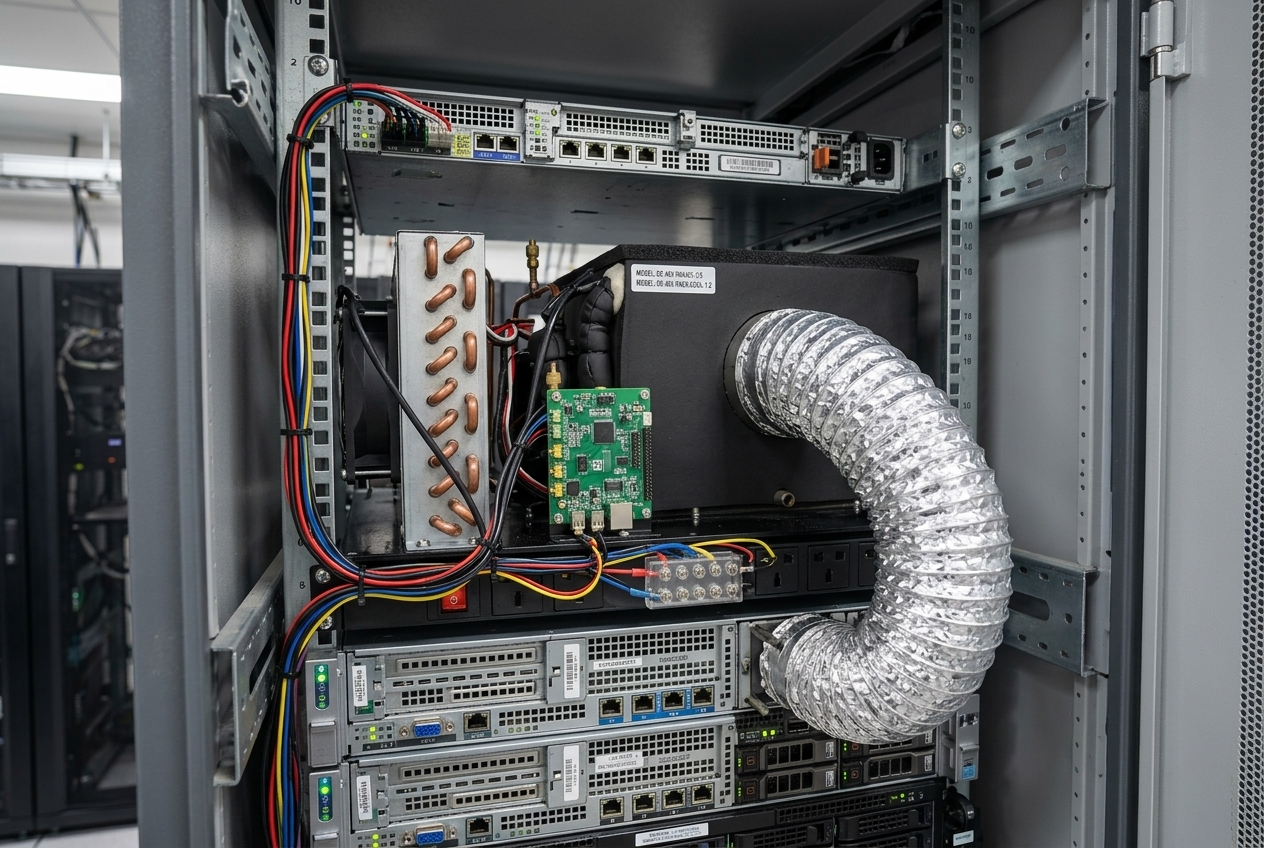
Server cabinets, telecom equipment, battery management systems, and industrial controllers all generate heat in sealed enclosures. A micro air conditioner maintains stable internal temperatures without opening the enclosure to dust, moisture, or contamination. The 450W models handle cabinets with moderate heat loads (under 300W internal dissipation), while the 700W and 900W models cover higher-density equipment.
Pet Safety in Vehicles
Leaving a pet in a parked vehicle is dangerous — interior temperatures can reach lethal levels in minutes. A 450W or 700W micro air conditioner running on the vehicle’s battery (or a dedicated battery pack) can maintain safe temperatures in a pet crate or small vehicle cabin. This is a genuine safety application, not a convenience feature.
Camping and Overlanding
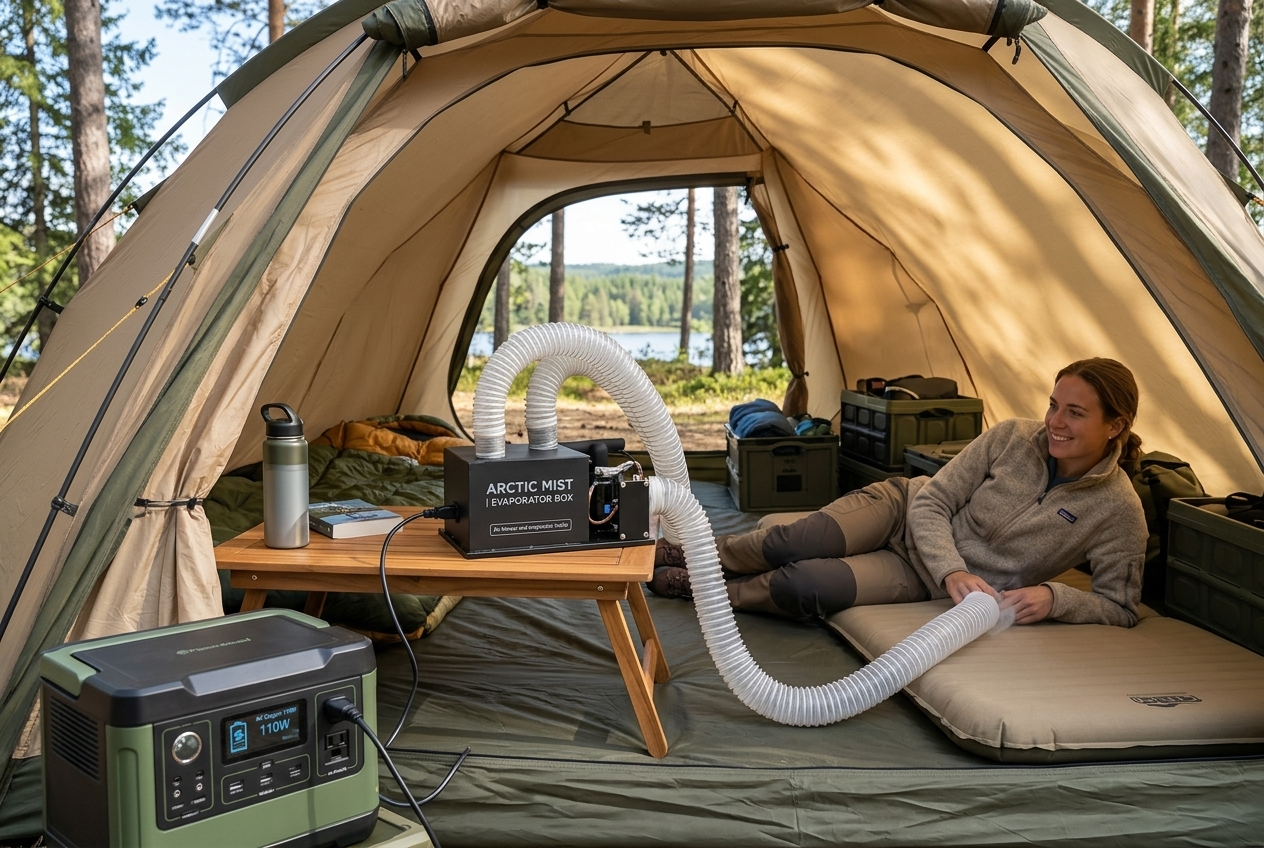
Small tents and van sleeping areas are ideal for the 700W or 900W models. Unlike evaporative coolers that add humidity (miserable in a tent) or fans that just move hot air around, a compressor-based micro air conditioner actually lowers the air temperature. Running on a 12V or 24V battery bank charged by solar panels, these units can provide overnight cooling without a generator.
Mobile Workstations and Kiosks
Outdoor kiosks, mobile medical units, portable testing stations, and construction site offices all benefit from compact, battery-powered cooling. The DC operation means no need for a generator or shore power — the unit runs directly from batteries or solar.
What a Micro Air Conditioner Cannot Do
Being honest about limitations builds more trust than overselling. Here is where these units are not the right choice:
- Large rooms or open spaces. Even the 900W model maxes out at about 3,069 BTU. A typical bedroom needs 5,000–8,000 BTU. These units are not room air conditioners.
- Poorly insulated spaces. A metal shipping container in direct sun with no insulation will overwhelm any micro unit. Insulation is not optional — it is part of the system.
- High ambient temperatures without margin. At ambient temperatures above 45°C (113°F), cooling capacity drops. The units still function, but the temperature differential they can achieve narrows.
- Spaces with very high internal heat loads. If your enclosure generates 1,000W of waste heat internally, even the 900W (3,069 BTU ≈ 900W) model cannot keep up. You need a larger system.
- Humidity control in large volumes. While vapor compression does dehumidify as a side effect, these units are sized for temperature control in small spaces, not for dehumidifying a warehouse.
If your application falls into any of these categories, a micro air conditioner is the wrong tool. Look at larger split DC systems or traditional HVAC instead.
Why Compressor Beats Peltier and Evaporative for Micro Cooling
When shopping for small cooling solutions, you will encounter three technologies. Here is how they actually compare:
Peltier (Thermoelectric) Coolers
Peltier devices use semiconductor junctions to move heat. They are small, silent, and have no moving parts — which sounds great until you look at efficiency. Typical Peltier COP (Coefficient of Performance) falls between 0.3 and 0.7, meaning they consume 1.4 to 3.3 watts of electricity for every watt of cooling produced. For a micro air conditioner application, a Peltier device drawing 100W of power delivers only 30–70W of cooling. A compressor-based unit at the same power input delivers 150–300W of cooling.
Peltier coolers work for very small, low-heat applications (beverage coolers, small electronic component cooling), but for anything requiring meaningful temperature reduction in an enclosed space, the efficiency penalty makes them impractical.
Evaporative Coolers
Evaporative coolers blow air through wet media, using water evaporation to drop air temperature. They are cheap and use very little electricity. The catch: they only work in dry climates, they add humidity (bad for electronics, uncomfortable for people in already-humid environments), and they cannot cool below the wet-bulb temperature. In a sealed enclosure, they fail completely — they need dry air flowing through to function.
Vapor Compression (Compressor-Based)
This is what the RIGID Micro DC Aircon uses. A BLDC inverter compressor circulates refrigerant through a sealed loop, actively pumping heat from inside to outside. COP for vapor compression micro systems typically ranges from 1.5 to 3.0 — meaning 1.5 to 3 watts of cooling for every watt of electricity consumed. It works in any humidity, any climate, and in sealed enclosures. The tradeoff is slightly more complexity (compressor, refrigerant lines) and higher unit cost compared to a fan or Peltier device.
For genuine cooling — holding a specific temperature in a real application — vapor compression is the only technology that delivers reliably at this scale.
Installation Basics: What You Need to Know
Installing a micro air conditioner is simpler than a traditional split system, but there are a few things to get right:
Airflow
The unit needs to exhaust heat somewhere. The condenser side (hot side) must have access to outside air or a heat sink. Mounting the condenser inside the same sealed enclosure you are trying to cool defeats the purpose — you are just moving heat from one side of the unit to the other inside the same space.
Power
Match the model voltage to your power system. The 12V models draw more current than the 24V or 48V models for the same cooling output (same wattage divided by lower voltage equals higher current). If your wiring is long, higher voltage models reduce voltage drop and allow thinner cables.
Drainage
Vapor compression produces condensate (water from dehumidification). Plan for a drain path or collection container. In enclosed installations, this moisture needs to go somewhere.
Mounting
At 11 pounds, these units are light enough for wall mounting, shelf mounting, or integration into equipment panels. The compact dimensions allow installation in spaces where traditional AC units simply will not fit.
How to Choose the Right Model
Here is a simple decision framework:
- Estimate your heat load. Add up internal heat sources (electronics, motors, lighting) plus heat gain from the environment (sun exposure, ambient temperature, insulation quality). If you cannot calculate it precisely, start with the rule-of-thumb table above.
- Pick a voltage. Match your battery system or power supply. 12V for vehicles, 24V for most industrial and marine, 48V for telecom and larger battery banks.
- Add margin. If your estimated heat load is 400W, do not buy a 450W unit and hope for the best. Go to 700W. Real-world conditions always add surprises — a hot day, degraded insulation, an extra piece of equipment. A unit running at 70% capacity lasts longer and cools better than one running at 100% all the time.
- Consider future needs. If you might add more equipment or expand the enclosure later, size up now rather than replacing the unit later.
Cost and Value: What You Are Paying For
The Micro DC Aircon line ranges from $580 to $810. That is significantly more than a $30 USB fan or a $150 Peltier cooler. But consider what you are getting:
- Real cooling performance. 1,535–3,069 BTU of actual heat removal, not just air movement.
- Efficiency. COP of 1.5–3.0 means lower operating costs per watt of cooling compared to Peltier alternatives.
- Reliability. BLDC compressors have long service lives with minimal maintenance.
- DC native operation. No inverter losses, no generator dependency. Direct battery operation.
- Compact form factor. 11 pounds and small enough to fit where traditional AC cannot.
If your application genuinely needs cooling — not just airflow — the cost difference pays for itself in performance. If you only need air circulation, buy a fan. Know what you need before you spend.
Frequently Asked Questions
How long will a micro air conditioner run on battery?
Runtime depends on battery capacity, ambient conditions, and the unit’s duty cycle. A 450W model on a 100Ah 12V battery (1,200Wh) could theoretically run for several hours, but actual runtime varies with heat load. The variable-speed compressor reduces power draw when the target temperature is reached, extending battery life compared to fixed-speed alternatives.
Can I use a micro air conditioner in a car?
Yes, particularly the 12V DV1910E-AC model. It is designed for DC vehicle systems. However, it is sized for small zones (pet crate, sleeping area) rather than cooling an entire vehicle cabin — your car’s built-in AC handles that job better.
Do I need a special inverter?
No. These units run directly on DC power. That is one of their key advantages — no inverter means no conversion losses, less complexity, and one fewer component that can fail.
How loud are they?
BLDC inverter compressors are generally quieter than fixed-speed compressors because they ramp up and down rather than cycling on and off at full power. Exact noise levels depend on installation — vibration isolation and mounting method affect perceived noise significantly.
Can I use R290 refrigerant instead of R134a?
Yes. R290 (propane) variants are available for the DV2820E-AC-T model. R290 has lower global warming potential than R134a and slightly different performance characteristics. Consult with RIGID on which refrigerant suits your application and regulatory requirements.
Bottom Line
A micro air conditioner makes sense when you need genuine, reliable cooling in a space too small for traditional AC, running on DC power without an inverter. The RIGID Micro DC Aircon line covers 450W to 900W — enough for equipment enclosures, pet safety, camping, kiosks, and similar compact applications. It is not a room AC and does not pretend to be one. Know your heat load, size accordingly, and these units deliver what fans, Peltier coolers, and evaporative devices cannot: actual temperature control.