
Micro Air Conditioner Power Consumption Is a Band, Not a Number
Ask what a small DC cooling module costs to run and the honest first answer is a question back: costs to run under what duty cycle, at what ambient, on what supply voltage. The number people usually quote — the cooling capacity in watts — is not the number that shows up on the electricity bill or drains the battery.
A micro air conditioner is a variable-load device bolted to a load that is itself variable. The cabinet heats up, the module works harder; the sun goes down, it barely runs. Any running-cost figure that ignores that is arithmetic performed on the wrong quantity.
This piece works through the numbers in the order that actually produces a defensible answer: read the current band, convert it to an input-power envelope, apply a duty cycle you can justify, and only then multiply by a tariff.
The Two Watt Figures That Get Confused
Every datasheet for a compact DC module carries at least two figures in watts, and they describe opposite sides of the machine.
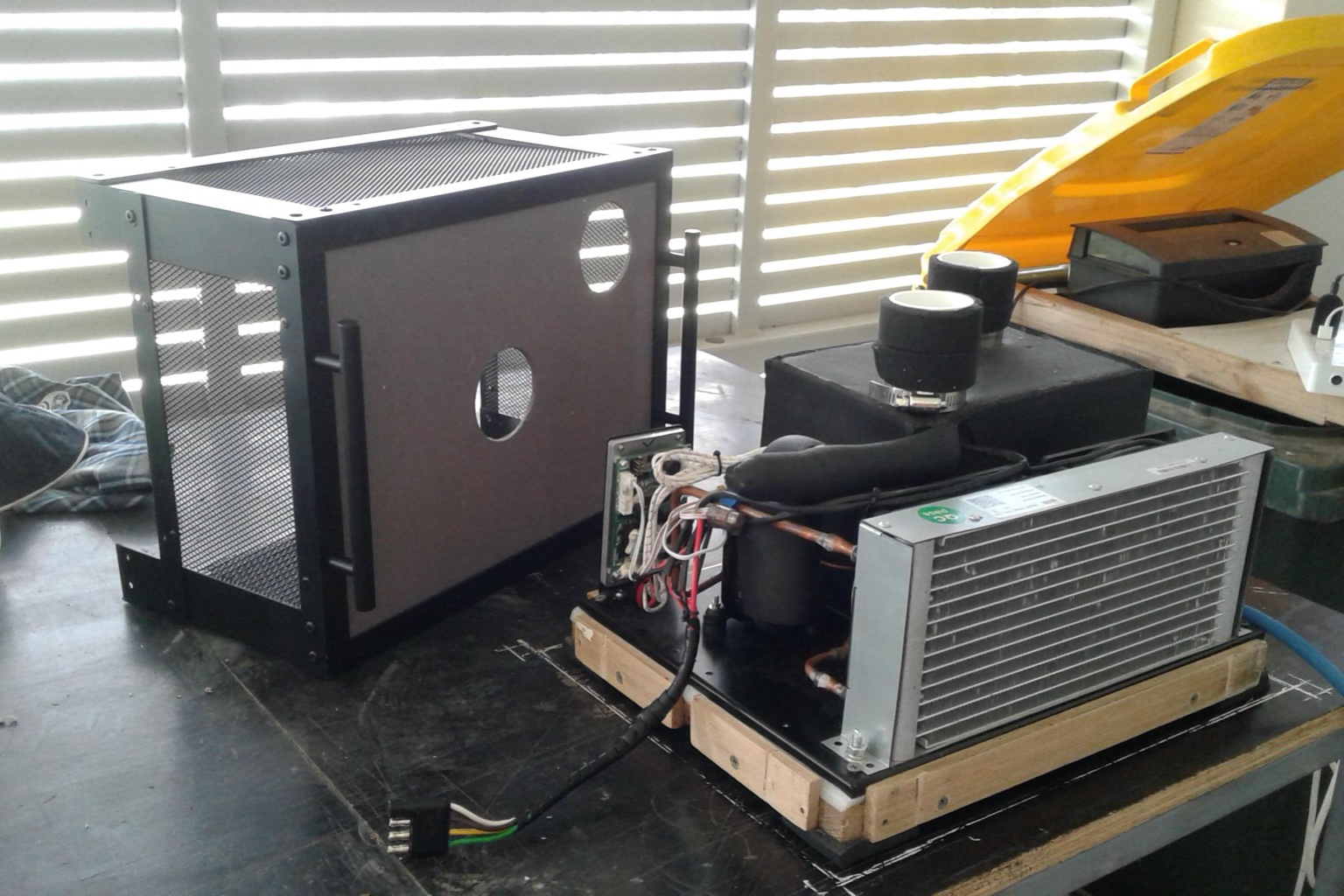
Cooling capacity is heat moved out of the enclosure. On the RIGID Micro DC Aircon modules this is 450 W for the DV1910E-AC, DV1920E-AC and DV1930E-AC, and 550 W for the DV3220E-AC — equivalently 1,535 BTU/h and 1,876 BTU/h.
Input power is electrical energy consumed to do that. It is not published directly on these modules; what is published is the current draw, per voltage, as a band.
Confusing the two inflates estimates by a factor of several. A 450 W module does not consume 450 W. It consumes whatever the compressor and fans need to move 450 W of heat, and on a well-designed DC system that is a fraction of the capacity figure.
One caveat worth stating plainly, because it governs how much weight the capacity number can carry: the product pages give capacity without stating the ambient and evaporating temperatures at which it was measured. Capacity always falls as ambient rises, so treat the figure as a nameplate rating and confirm the test point with the supplier if your cabinet runs hot.
Reading the Current Band on a DC Module
Current draw on these modules is given as a range plus a maximum, and the range is the useful part. Multiplying by supply voltage converts it into an input-power envelope you can budget against.
| Model | Supply | Stated capacity | Current draw | Derived input envelope |
|---|---|---|---|---|
| DV1910E-AC | 12 V DC | 450 W / 1,535 BTU/h | 1–8 A, max 10 A | 12–96 W, peak 120 W |
| DV1920E-AC | 24 V DC | 450 W / 1,535 BTU/h | 1–7 A, max 8.5 A | 24–168 W, peak 204 W |
| DV1930E-AC | 48 V DC | 450 W / 1,535 BTU/h | 1–4 A, max 7.5 A | 48–192 W, peak 360 W |
| DV3220E-AC | 24 V DC | 550 W / 1,876 BTU/h | 1–10.3 A, max 12.5 A | 24–247 W, peak 300 W |
Two ways to use this table, one legitimate and one not.
Legitimate: sizing wiring, fusing, battery banks and solar arrays against the envelope. The maximum current column is what your conductors and protection devices have to survive; the band is what your energy budget has to feed.
Not legitimate: comparing efficiency between the voltage variants by looking at the derived watts. The datasheet does not state which operating point each end of the band corresponds to, so the columns are not measured at a common condition. Treat the envelope as a bound, not a benchmark.
Duty Cycle Is the Multiplier That Decides Everything
A micro air conditioner in a sealed cabinet does not run flat out. It runs enough to hold the setpoint against the heat that leaks in and the heat the electronics generate, and that fraction of the hour is your duty cycle.
Duty cycle is where estimates go wrong by 200 to 300 percent, in both directions. Some rules of thumb that hold up in the field:
A cabinet sized with margin runs at low duty. If the internal dissipation is 150 W and the module is rated 450 W, the compressor spends most of the hour off or turned down. Duty cycles of 25 to 40 percent are common.
A cabinet sized tight runs near continuous. When internal load plus solar gain approaches the module’s derated capacity at that ambient, duty climbs toward 90 percent and stays there through the afternoon.
Duty follows the day. An outdoor enclosure in direct sun can sit near continuous from noon to five and near zero overnight. A daily average hides that, which is fine for the electricity bill and dangerous for the battery bank.
If you have no measured data, estimate duty as internal heat load divided by derated capacity at your worst ambient, then add margin. If you have a clamp meter and an afternoon, measure it — an hour of logging beats any assumption on this page.
Worked Example: What a Year Actually Costs
Take a 24 V telecom-style cabinet with a DV1920E-AC, electronics dissipating roughly 180 W, and a measured average duty cycle of 40 percent across the year.
Midband current on that module is around 4 A, so average input power while running is about 96 W. At 40 percent duty that is 38 W averaged over the full day, or roughly 0.92 kWh per day.
Over a year: about 336 kilowatt-hours. At a commercial tariff of $0.15 per kWh — substitute your own — that is close to $50 per year.
Two observations people find counterintuitive. First, the annual cost of running a small DC cooling module is usually smaller than one service callout, which reframes the whole maintenance-versus-neglect argument. Second, the same cabinet at 80 percent duty costs $100, not $50 — duty cycle is directly proportional, so anything that lowers it pays back linearly and forever.
Off-Grid Changes the Question From Dollars to Amp-Hours
On a solar or battery-fed site the tariff is irrelevant and the daily energy is everything. Convert the same example: 0.92 kWh per day at 24 V is about 38 Ah per day drawn from the bank.
Against a 100 Ah battery at 24 V, with usable depth of discharge held to 50 percent to protect cycle life, you have roughly 50 Ah available — a little over one day of autonomy for the cooling load alone, before anything else on the site is counted.
That is the calculation that decides whether a micro air conditioner is viable off-grid, and it is why the peak column in the table matters as much as the average. Charge controllers and inverters are sized on peaks; battery banks are sized on daily energy. Our battery and solar sizing guide walks the array side of that in more detail.
Five Things That Quietly Raise Running Cost
Every one of these shows up as duty cycle, which is to say as money.
Condenser fouling. Dust on the condenser raises condensing temperature, which raises compressor work per unit of heat moved and lowers capacity at the same time. The module compensates by running longer. This is the single largest avoidable cost on dusty sites, and it accumulates silently.
Recirculation between the hot and cold sides. If condenser discharge finds its way back to the condenser inlet, the module is fighting its own exhaust. Clearances exist for this reason.
Enclosure sealing. A gasket that no longer seals turns a closed-loop cabinet into a partially open one, admitting ambient heat and humidity continuously. Condensate load rises with it.
Setpoint set lower than the equipment needs. Every degree below what the electronics require is bought at full price. If the gear is rated to 45 °C, holding the cabinet at 20 °C is a choice with an annual invoice attached.
Supply voltage sag. Undersized conductors mean the module sees less than nominal voltage and draws more current to compensate, with the difference dissipated in the wiring rather than in cooling. This is one of several reasons the choice between 12 V, 24 V and 48 V is worth making deliberately.
Variable Speed Versus Fixed Speed on the Bill
A fixed-speed compressor has two states, and it meets a partial load by alternating between them. A variable-speed DC compressor can match the load continuously, which changes the energy picture in three ways.
It avoids the start current penalty of repeated cycling. It runs at lower compression ratios for longer, which is where efficiency lives. And it holds a steadier cabinet temperature, so you can set the setpoint closer to the equipment limit without risking excursions.
The trade is a driver board that must be wired, configured and occasionally diagnosed, rather than a thermostat and a contactor. For a cabinet that runs most of the year, the energy argument generally wins; for a module that runs twenty days a summer, it usually does not.
A Specification Checklist Before You Commit
Six questions to put to any supplier, including us, before a micro air conditioner goes into a budget.
At what ambient and internal temperature is the capacity rating measured? If the answer is not on the page, ask for it. Every number downstream depends on it.
What is the current band, and at what conditions do the ends of the band occur? The band bounds your wiring and your battery; the conditions tell you where in the band you will actually live.
What is the maximum current, including any starting transient? This sizes protection and, off-grid, the charge controller.
What clearance does the condenser need? Published dimensions — 350 × 260 × 180 mm on these modules — are the box, not the installation envelope.
What refrigerant, and does it constrain the installation? These modules use R134a; flammable alternatives carry charge-limit and enclosure requirements that change the mechanical design.
What does the module do when supply voltage drops below the low-voltage cutoff? On battery sites this determines whether you lose cooling gracefully or repeatedly restart into a sagging bank.
If a cabinet is already installed and cooling costs more than expected, the fault is far more often airflow or fouling than the module itself — the troubleshooting sequence is the faster place to start than a replacement quote.
Frequently Asked Questions
How much power does a micro air conditioner use per hour?
Multiply supply voltage by the current draw stated for that model, then multiply by duty cycle. A 24 V module drawing 4 A while running consumes about 96 W during operation; at 40 percent duty that averages roughly 38 W over the hour, or 0.038 kWh. The cooling capacity in watts is not the consumption figure and will overstate it several times over.
Does a 450 W cooling module consume 450 W of electricity?
No. Cooling capacity is heat moved out of the enclosure; input power is electricity consumed to move it. On these DC modules the published current bands correspond to input power well below the capacity figure. Confusing the two is the most common error in DC cooling energy budgets.
Is 48 V cheaper to run than 12 V?
The published current bands are lower at higher voltage, and the wiring losses on the supply side fall sharply because loss rises with the square of current. That is a real system-level saving. The module’s own efficiency at a common test condition is not published, so treat the benefit as a wiring and distribution argument rather than a compressor efficiency claim.
What raises running cost the most after installation?
Condenser fouling, by a wide margin, because it degrades capacity and raises compressor work simultaneously and gives no warning. Cleaning intervals matched to the site environment are the cheapest energy measure available. Airflow recirculation and failed enclosure seals come next.
Can a micro air conditioner run on solar alone?
Often yes, if the daily energy is calculated honestly and the battery is sized for the worst consecutive cloudy days rather than the average. The example above, 0.92 kWh per day, is within reach of a modest array — but the peak current still sizes the charge controller, and the duty cycle in a heatwave will be far above the annual average.
Where to Take This Next
The usable version of this exercise takes about an hour: get the internal heat load, get the worst-case ambient, get the capacity at that ambient from the supplier, divide to get duty cycle, and multiply through. Everything else on this page is a refinement of that sequence.
If you want the numbers checked against a specific enclosure — internal dissipation, ambient profile, supply voltage, whether it is grid or battery fed — send us the details and we will work the duty cycle and the energy budget with you rather than quoting a nameplate.