
Micro Air Conditioner Server Rack Cooling: Why Edge Computing Needs Active Thermal Management
Edge computing is no longer a future concept. It is happening right now on cell towers, inside retail stores, across factory floors, and within street-side telecom cabinets. The servers powering these distributed workloads sit in locations that were never designed for IT equipment. There is no raised floor, no chilled water loop, no building management system monitoring supply air temperature. There is just a sealed metal enclosure, a power feed, and a compute load generating hundreds of watts of heat in a volume smaller than a household refrigerator.
Traditional data center cooling assumes scale. Precision air handlers, computer room air conditioning units, and hot-aisle containment systems all depend on large air volumes and centralized infrastructure. None of that applies when your entire compute footprint is a single 12U rack bolted to the side of a building or mounted inside a weatherproof cabinet at a cell site. The thermal challenge at the edge is fundamentally different: small volumes, high heat density, no external air handling, and often no AC power grid at all.
This is where micro DC aircon systems earn their place. Purpose-built for sealed enclosures and DC power environments, these compact cooling units solve the specific thermal problem that edge deployments create. They are not miniaturized versions of traditional HVAC. They are engineered from the ground up for the constraints of remote, unmanned IT infrastructure.
The Thermal Reality of Edge Server Cabinets
A typical edge deployment places one to four rack-mounted servers inside a sealed outdoor cabinet. These servers have thermal design power ratings between 100W and 300W each. At typical operating loads, actual heat dissipation runs at 60 to 80 percent of TDP. A four-server cabinet with 250W TDP servers running at 70 percent load generates roughly 700W of continuous heat output.
Add network switches drawing 30 to 50W each, a small UPS with 5 to 10 percent conversion losses, and you quickly reach 800W or more of heat inside a sealed volume that might measure 600mm wide by 600mm deep by 1200mm tall. That is less than half a cubic meter of air absorbing nearly a kilowatt of thermal energy with no natural ventilation path.
Without active cooling, internal cabinet temperatures climb rapidly. Server inlet temperatures exceed 35°C within minutes of sustained load. At 45°C, most servers begin thermal throttling. At 55°C, hardware protection circuits force shutdown. In direct sunlight, cabinet wall temperatures can add another 10 to 15°C of solar heat gain on top of the internal server load.
The math is unforgiving. Sealed cabinets need active refrigeration, not just fans moving hot air around. And that refrigeration system needs to match the unique constraints of edge infrastructure: compact size, DC power compatibility, sealed operation, and variable capacity to match dynamic compute loads.
How Micro DC Aircon Systems Address Edge Cooling
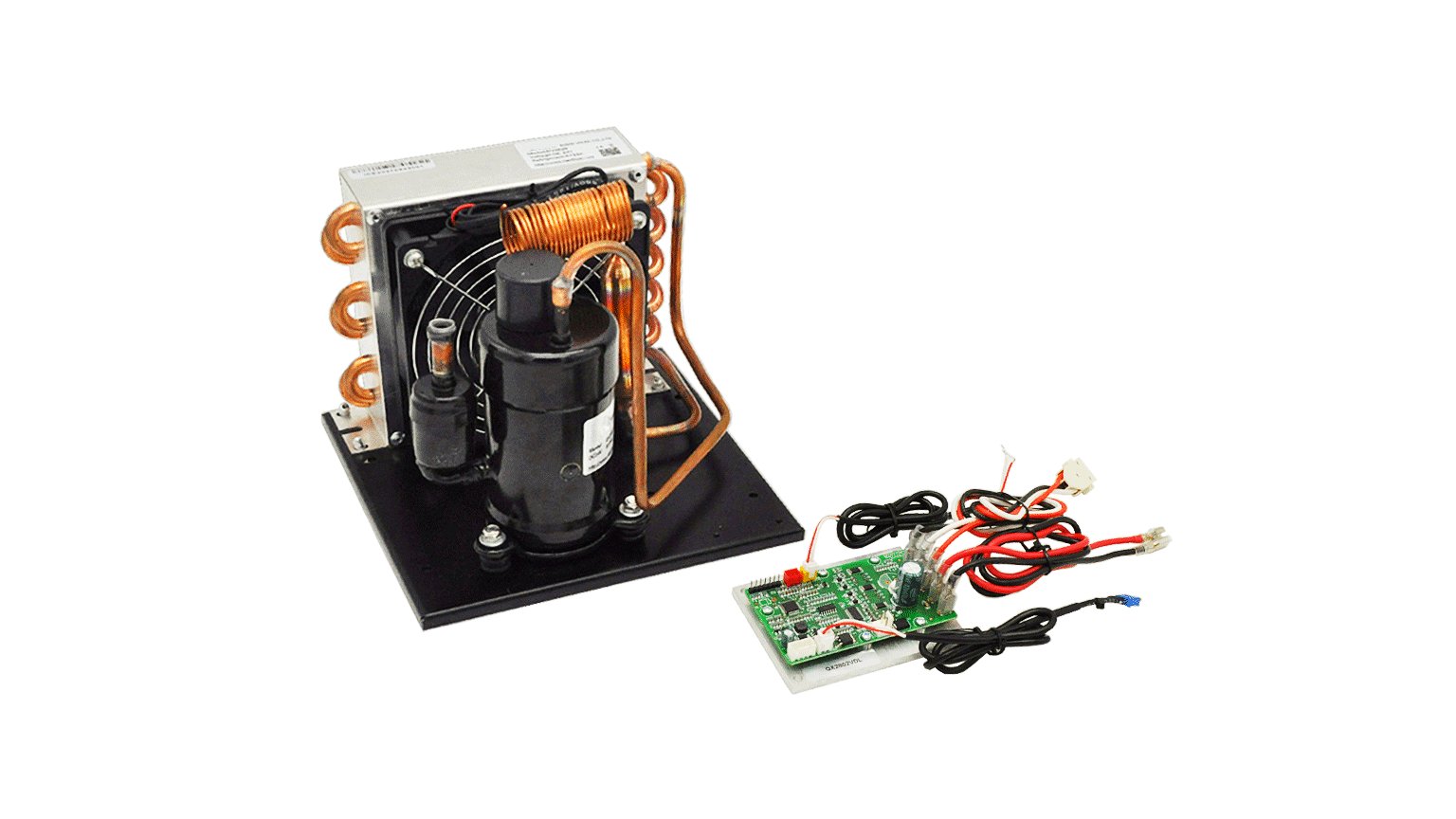
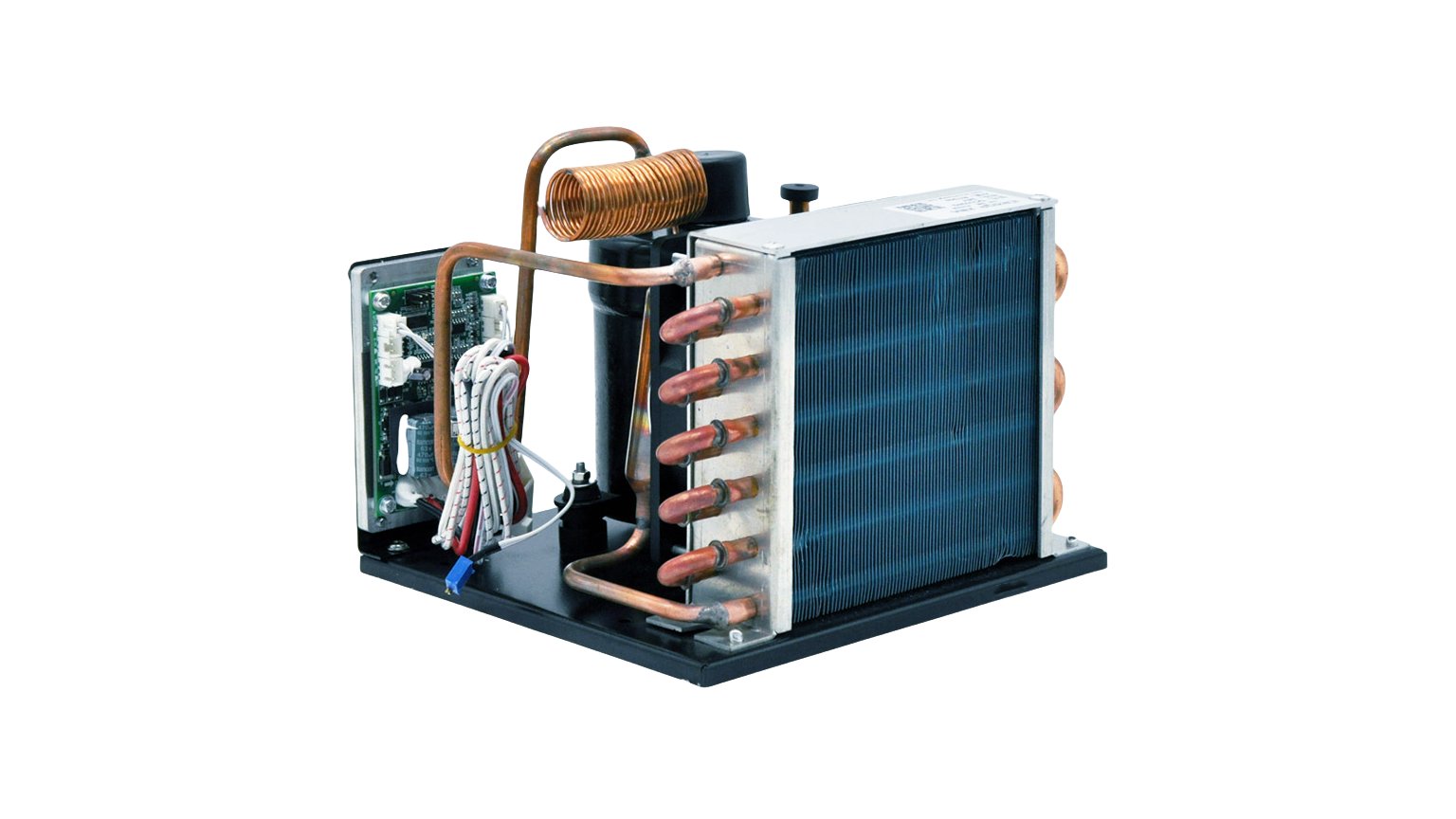
Micro DC aircon units are self-contained vapor compression cooling systems designed specifically for small enclosure applications. Unlike split-system air conditioners that require separate indoor and outdoor units with refrigerant piping between them, micro DC units integrate the compressor, condenser, evaporator, and controls into a single compact assembly that mounts directly to or within the equipment cabinet.
DC Power Native Operation
The most significant engineering distinction is native DC power operation. Telecom and edge computing infrastructure runs on 48V DC power buses. Traditional air conditioners require AC power, which means adding an inverter, increasing system complexity, reducing efficiency, and introducing another potential failure point in a remote, unmanned location.
Micro DC aircon units connect directly to the 48V DC bus that already powers the servers and network equipment. The DV1930E-AC model draws approximately 4A at 48V to deliver 450W of cooling capacity. The larger DV3830E-AC draws roughly 8A at 48V for 900W of cooling. Running from the same power source as the compute equipment simplifies installation, eliminates AC/DC conversion losses, and allows the cooling system to share the same battery backup and power monitoring infrastructure.
Sealed Enclosure Compatibility
Edge cabinets are sealed for good reason. Outdoor environments expose equipment to dust, humidity, salt spray, insects, and condensation. Any cooling system that introduces outside air into the cabinet defeats the purpose of sealing it in the first place.
Micro DC aircon systems maintain the cabinet seal by operating as closed-loop refrigeration. The evaporator side circulates and cools internal cabinet air without any air exchange with the outside environment. The condenser side rejects heat to the external atmosphere through a separate, sealed heat exchanger. Internal and external air streams never mix. Dust stays out. Humidity stays controlled. The IP rating of the cabinet remains intact.
Compact Form Factor
At approximately 5kg and dimensions that allow mounting within or alongside standard server racks, these units occupy minimal space. In a 12U cabinet where every rack unit matters, the cooling system might occupy 2 to 3U of space or mount externally on the cabinet roof or side panel. The compact footprint means cooling does not compete with compute for rack space in already constrained deployments.
Variable Speed Compressor Technology
Server workloads at the edge are rarely constant. A retail analytics server might idle at 30 percent utilization during off-hours and spike to 90 percent during peak shopping periods. A cell tower compute node might handle baseline traffic most of the day but surge during events or emergencies.
Variable speed compressor technology in micro DC aircon units matches cooling output to actual heat load in real time. When servers idle, the compressor slows down, reducing power consumption and noise. When compute loads spike, cooling capacity ramps up to match. This dynamic response prevents both overcooling (wasted energy) and undercooling (thermal throttling), maintaining optimal server inlet temperatures across the full range of workload conditions.
Sizing a Micro DC Aircon System for Your Edge Deployment
Proper thermal sizing prevents both undersized systems that cannot maintain safe temperatures and oversized systems that waste power and capital budget. The sizing process for edge cabinet cooling follows a straightforward engineering methodology.
Step 1: Calculate Server Heat Load
Start with the thermal design power of each server. This is the maximum heat output the server can produce under full load. Actual heat generation at typical workloads runs at 60 to 80 percent of TDP. For sizing purposes, use 80 percent of TDP as your baseline heat load to account for periodic compute bursts without oversizing for worst-case scenarios that rarely occur.
Example: Two servers rated at 200W TDP each, running at typical 75 percent load, generate approximately 300W of combined heat.
Step 2: Add Auxiliary Equipment Heat
Network switches, power distribution units, and UPS systems all generate heat. Switches typically add 30 to 80W depending on port count and throughput. UPS conversion losses add 5 to 10 percent of the total power load as heat. For a 600W total IT load, UPS losses might add another 30 to 60W of heat.
Step 3: Account for Solar Heat Gain
Outdoor cabinets exposed to direct sunlight absorb solar radiation through their walls and roof. Depending on cabinet color, insulation, and geographic location, solar heat gain can add 50 to 200W during peak sun hours. Dark-colored cabinets in tropical or desert climates see the highest solar loads. Light-colored, insulated cabinets in temperate climates see the lowest.
Step 4: Apply Safety Factor
Size the cooling system at 1.3 to 1.5 times the calculated total heat load. This safety factor accounts for degraded performance as refrigerant charge slowly decreases over years of operation, higher-than-expected ambient temperatures during heat waves, and future equipment additions that increase heat load.
Following the example above: 300W server heat plus 50W switch plus 40W UPS losses plus 100W solar gain equals 490W total. At 1.4x safety factor, you need approximately 690W of cooling capacity. The DV3830E-AC at 900W provides comfortable headroom. For lighter deployments under 350W total heat load, the DV1930E-AC at 450W cooling capacity is sufficient.
Application Scenarios and Boundaries
Telecom Edge Nodes
5G small cells and multi-access edge computing platforms deploy compute resources at the base of cell towers and on rooftops. These locations have 48V DC power from the telecom rectifier system but no HVAC infrastructure. Micro DC aircon units integrate directly into the existing power architecture and provide sealed cooling for the compute equipment processing local traffic, caching content, and running network functions.
Retail and Branch Office IT Closets
Point-of-sale systems, local inventory databases, security camera NVRs, and branch networking equipment often share a small closet or wall-mounted cabinet. These spaces lack dedicated cooling and rely on building HVAC that may shut down overnight or on weekends. A micro DC aircon unit provides independent thermal management that operates regardless of building HVAC schedules.
Industrial Control Cabinets
Manufacturing facilities, water treatment plants, and power substations deploy industrial PCs and edge servers for process control, SCADA systems, and local analytics. These environments combine high ambient temperatures with dust, chemical vapors, and vibration. Sealed cabinets with dedicated micro cooling protect sensitive compute equipment while maintaining the environmental isolation required for reliable operation.
Micro Data Centers
Prefabricated micro data centers housing one to four racks represent the upper end of micro DC aircon applications. Multiple cooling units can operate in parallel for redundancy and increased capacity. At this scale, the 900W DV3830E-AC units can be deployed in N+1 configurations to provide both adequate cooling capacity and fault tolerance.
Where Micro DC Aircon Is Not the Right Solution
Understanding application boundaries is as important as understanding capabilities. Micro DC aircon systems are not designed for full data center rooms with dozens of racks and multi-kilowatt heat loads per rack. They are not appropriate for high-density GPU computing clusters where individual servers can generate 500W to 1000W each. These applications require dedicated precision cooling systems, liquid cooling loops, or rear-door heat exchangers that operate at a fundamentally different scale.
If your deployment exceeds four racks or your per-rack heat density exceeds 3kW, you have moved beyond the micro DC aircon application envelope and need to evaluate larger cooling architectures.
Installation and Integration Considerations
Mounting Options
Micro DC aircon units offer flexible mounting to accommodate different cabinet configurations. Top-mount installations work well for standard floor-standing cabinets where the unit can reject heat upward into open air. Side-mount configurations suit wall-mounted cabinets or installations where vertical space above the cabinet is limited. Internal mount options exist for larger cabinets where the cooling unit occupies rack space but keeps the external cabinet profile clean.
Power Integration
Connection to the 48V DC bus requires appropriate circuit protection and wire sizing for the current draw. The 450W model at 4A and the 900W model at 8A are well within standard telecom power distribution capabilities. Most edge deployments already have 48V distribution panels with available circuit positions for cooling equipment. The cooling system should be on the same battery backup as the compute equipment to maintain thermal protection during grid power outages.
Monitoring and Alerting
Remote edge sites operate unmanned. Cooling system health monitoring is essential for maintaining uptime without physical site visits. Micro DC aircon systems provide temperature sensor outputs and operational status signals that integrate with existing site monitoring platforms. Setting alert thresholds for cabinet temperature, compressor current draw, and condenser airflow allows operations teams to identify cooling degradation before it causes server thermal events.
Maintenance Planning
Sealed refrigeration systems require minimal maintenance compared to filter-based air handling systems. There are no air filters to replace, no condensate drains to clear in normal operation, and no belts or bearings in the airflow path. Periodic condenser cleaning to remove external dust accumulation and annual refrigerant pressure verification represent the primary maintenance tasks. For remote sites with quarterly or semi-annual visit schedules, this maintenance profile aligns well with existing site service routines.
Comparing Cooling Approaches for Edge Cabinets
Several cooling technologies compete for edge cabinet applications. Understanding the tradeoffs helps select the right approach for specific deployment conditions.
Thermoelectric Coolers (Peltier)
Peltier-based coolers use solid-state heat pumping with no moving parts except fans. They offer high reliability and zero refrigerant concerns. However, their coefficient of performance is significantly lower than vapor compression systems, typically achieving COP of 0.3 to 0.5 compared to 1.5 to 2.5 for micro DC aircon compressor systems. This means Peltier coolers consume two to five times more power to move the same amount of heat. For battery-backed edge sites where power efficiency directly impacts backup runtime, this efficiency gap is significant.
Heat Exchangers (Air-to-Air)
Air-to-air heat exchangers transfer heat from internal cabinet air to external air without mixing the two streams. They maintain the cabinet seal and have no refrigerant. However, they cannot cool below ambient temperature. When external air reaches 40°C or higher, the heat exchanger can only maintain internal temperatures above that level. For outdoor deployments in warm climates, this limitation makes heat exchangers insufficient as the sole cooling method.
Vented Cooling with Filters
Filtered fan systems draw outside air through the cabinet, providing high cooling capacity at low cost. The tradeoff is breaking the environmental seal. Filters require regular replacement, and in dusty or humid environments, filter maintenance becomes a significant operational burden. For unmanned remote sites, filter-based cooling creates a maintenance dependency that conflicts with the low-touch operational model edge computing demands.
Vapor Compression (Micro DC Aircon)
Micro DC aircon systems combine sealed operation, active cooling below ambient temperature, reasonable efficiency (COP 1.5 to 2.5), and DC power compatibility. The tradeoff is mechanical complexity — a compressor is a moving part that will eventually wear. However, modern DC compressor technology delivers 50,000 to 100,000 hours of operational life, translating to 6 to 12 years of continuous operation. For edge deployments with 5 to 7 year refresh cycles, compressor life aligns well with equipment lifecycle.
Getting Started with Edge Cabinet Thermal Design
Every edge deployment has unique thermal characteristics driven by server selection, workload profiles, geographic location, cabinet construction, and power architecture. A proper thermal assessment considers all these variables to specify the right cooling capacity, mounting configuration, and monitoring integration for your specific application.
The Micro DC Aircon product line includes models spanning 450W to 900W cooling capacity with 48V DC power input, covering the majority of edge computing thermal loads from single-server telecom nodes to multi-server micro data centers.
If you are planning an edge deployment and need to validate your thermal design, request an engineering assessment. Provide your server specifications, expected workload profiles, cabinet dimensions, installation environment details, and power architecture. A thermal analysis will confirm whether micro DC aircon is the right fit for your application and which model provides the appropriate capacity with adequate safety margin for your operating conditions.