
Quick Answer: A micro air conditioner sized between 450W and 900W cooling capacity handles heat loads in enclosures from 0.3 m³ to 2 m³. To size correctly, calculate your internal heat load in watts, add a 20-30% safety margin, then select the unit that matches your DC voltage supply (12V, 24V, or 48V). Installation requires separating condenser airflow from the cooled space and allowing 150 mm clearance for air circulation.
Who This Guide Is For
This guide is written for facility managers maintaining telecom cabinets, electronics enclosure designers integrating thermal management into sealed housings, and operators cooling small confined spaces powered by DC or battery systems. If you need to remove 450W to 900W of heat from a space smaller than a refrigerator, this is your reference.
How to Size a Micro Air Conditioner for Your Enclosure
Sizing a micro air conditioner starts with one number: your internal heat load. Every component inside your enclosure — power supplies, processors, amplifiers, lighting — generates heat measured in watts. Your cooling unit must remove that heat plus account for solar gain or ambient heat transfer through enclosure walls.
Step 1: Calculate Internal Heat Load
Add up the power dissipation of every heat-generating component inside the enclosure. For electronics, this is typically 60-90% of the input power rating. A 500W power supply operating at 80% efficiency dissipates roughly 100W as heat. Sum all components to get your baseline heat load.
Step 2: Account for External Heat Gain
If your enclosure sits outdoors or in an unconditioned space, solar radiation and ambient temperature add heat. For metal enclosures in direct sunlight, add 100-300W depending on surface area and color. For indoor installations in conditioned spaces, external gain is minimal.
Step 3: Apply Safety Margin
Add 20-30% to your total calculated heat load. This accounts for component aging, peak load conditions, and future additions. A calculated load of 400W becomes a target cooling requirement of 480-520W.
Step 4: Match to Available Cooling Capacity
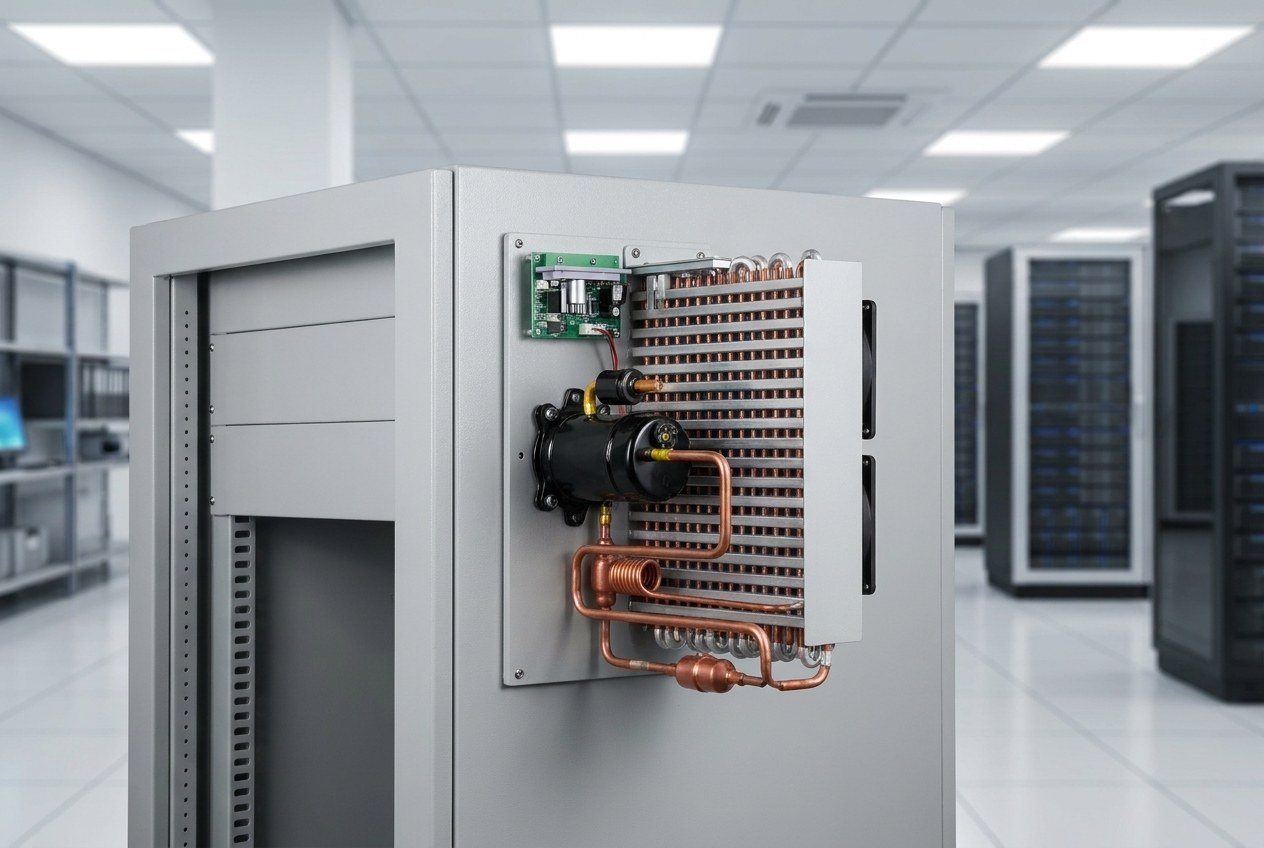
RIGID Micro DC Aircon units are available in 450W (1,535 BTU), 550W (1,876 BTU), 700W (2,387 BTU), and 900W (3,069 BTU) configurations. Select the unit whose rated capacity meets or exceeds your calculated requirement with safety margin.
Key Decision Framework: Choosing the Right Configuration
Before selecting a specific model, answer these three questions:
- What is your DC voltage supply? — 12V (vehicle/battery), 24V (telecom/solar), or 48V (industrial/telecom rack)
- What is your total heat load with safety margin? — This determines whether you need a single-cylinder (450-550W) or twin-cylinder (700-900W) unit
- What are your space constraints? — Single-cylinder units weigh approximately 5 kg and fit in tighter spaces; twin-cylinder units deliver higher capacity but require more mounting volume
Selection Matrix: Micro Air Conditioner Models by Application
| Application | Heat Load | Voltage | Recommended Model | Why This Fits |
|---|---|---|---|---|
| Telecom cabinet (indoor) | 300-450W | 48V | DV1930E-AC | Matches standard telecom DC bus, compact form factor |
| Outdoor telecom shelter | 500-700W | 48V | DV3830E-AC-T | Twin-cylinder handles solar gain + equipment load, R290 option |
| Vehicle electronics bay | 300-450W | 12V | DV1910E-AC | Direct battery connection, no inverter needed |
| Solar-powered instrument enclosure | 300-450W | 24V | DV1920E-AC | Matches common solar battery bank voltage |
| Industrial control panel | 500-700W | 24V | DV3820E-AC-T | Higher capacity for VFDs and PLCs, R290 refrigerant |
| Medical device housing | 400-550W | 24V | DV3820E-AC | R134a refrigerant, variable speed for temperature stability |
| Military/rugged enclosure | 600-900W | 24V/48V | DV3830E-AC | Twin-cylinder, high capacity for sealed MIL-spec housings |
| Laser/optical equipment | 400-600W | 24V | DV3820E-AC | Precise temperature control via variable-speed compressor |
Vapor Compression vs Passive Cooling: When a Micro AC Is Necessary
| Factor | Micro Air Conditioner (Vapor Compression) | Passive Cooling (Fans/Heatsinks) |
|---|---|---|
| Cooling capacity | 450W – 900W | Limited to 50-150W in sealed enclosures |
| Temperature differential | Can cool 20-30°C below ambient | Cannot cool below ambient |
| Sealed enclosure compatible | Yes — no outside air enters | Requires ventilation openings |
| Dust/moisture protection | Maintains IP rating of enclosure | Compromises IP rating if vented |
| Energy efficiency (COP) | ~2.5 | N/A (no active cooling) |
| Weight | ~5 kg | Varies, typically lighter |
| Suitable heat load range | 200W – 900W | Under 150W |
If your enclosure must remain sealed (IP55 or higher) and your heat load exceeds 150W, passive cooling cannot maintain safe operating temperatures. A micro air conditioner with vapor compression is the practical solution.
Send us your enclosure dimensions, heat load, and voltage supply and our team can recommend the correct model and mounting configuration for your application.
Installation Guide: Mounting a Micro Air Conditioner in Small Enclosures
Pre-Installation Planning
Before mounting, verify three things: panel thickness can support the unit weight (approximately 5-7 kg), the chosen panel location allows condenser airflow without obstruction from walls or adjacent equipment, and the DC power source can deliver sustained current at the required voltage without excessive voltage drop over the wire run.
Mounting Orientation Options
RIGID Micro DC Aircon units support multiple mounting orientations, each suited to different enclosure configurations:
- Top-mount: Condenser faces up/outward, evaporator blows down into enclosure. Common for outdoor cabinets where roof space is available. Provides natural convection assist on the condenser side.
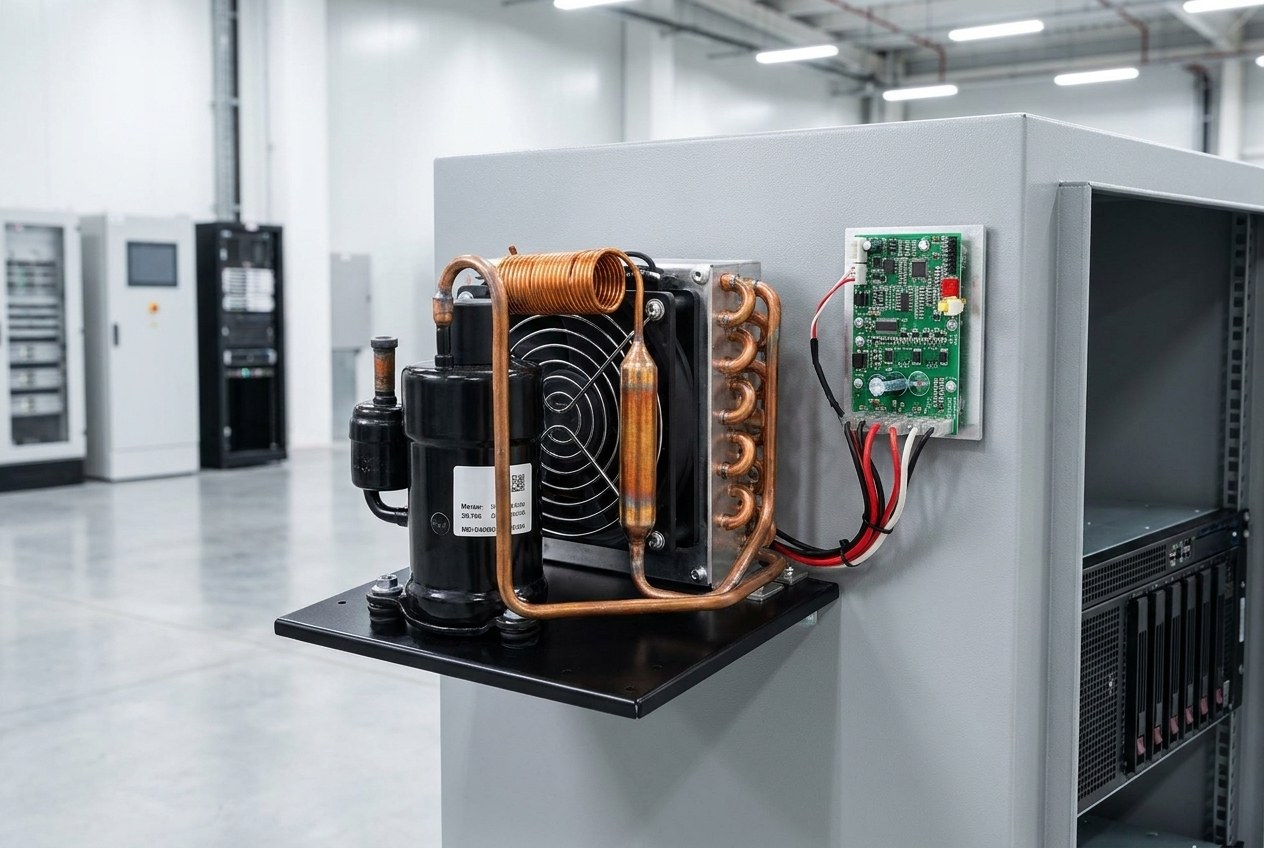
- Side-mount: Unit mounts on enclosure wall with condenser exhausting externally. Preferred for rack-style cabinets and wall-mounted enclosures. Keeps the enclosure footprint compact.
- Rear-mount: Unit integrates into the back panel of the enclosure. Useful when front and side access must remain clear for maintenance or cable routing.
- Split configuration: Evaporator inside, condenser outside with refrigerant lines connecting them. Used when no single panel has enough space for the complete unit or when the condenser must be located remotely from the enclosure.
Airflow Separation
The condenser (hot side) must exhaust heat to the external environment. The evaporator (cold side) circulates air inside the sealed enclosure. These two airflows must remain completely separated — this is the most critical installation requirement. Any mixing between condenser exhaust and evaporator intake reduces cooling performance dramatically and can cause condensation on internal components.
Use the supplied gasket or apply closed-cell foam tape around the mounting cutout to create an airtight seal between internal and external air volumes. Verify the seal integrity after installation by checking for air leaks with the unit running.
Clearance Requirements
- Minimum 150 mm clearance around condenser air inlet and outlet for unrestricted airflow
- Minimum 100 mm between evaporator outlet and nearest obstruction inside enclosure
- Ensure no cables, cable trays, or components block airflow paths on either side
- If mounting near a wall, maintain at least 200 mm between the condenser exhaust and the wall surface to prevent recirculation of hot air
Electrical Connection
Connect directly to your DC bus. No inverter is required — the BLDC compressor runs natively on 12V, 24V, or 48V DC. Wire gauge should match the unit’s maximum current draw (typically 15-40A depending on model and voltage). Include appropriate fusing on the positive lead.
For 12V systems, voltage drop over long wire runs becomes significant. Keep wire runs under 3 meters or increase wire gauge to compensate. A 1V drop on a 12V system represents an 8% voltage reduction that affects compressor performance. For 48V systems, voltage drop is less critical and longer runs are acceptable with standard gauge wire.
Thermostat and Controller Wiring
Most RIGID Micro DC Aircon units include an integrated thermostat controller. Set the target temperature based on your component requirements — typically 25-35°C for electronics, 20-25°C for temperature-sensitive instruments. The variable-speed compressor modulates automatically to maintain setpoint without cycling on and off, providing stable temperature control within ±1-2°C.
Condensate Management
When cooling air below its dew point, condensation forms on the evaporator coil. Route the condensate drain to the exterior of the enclosure using a gravity drain line or to an internal collection tray with a float switch that triggers an alarm or pump. In dry environments with moderate cooling (target temperature above dew point), condensation may be minimal or absent. For humid environments or aggressive cooling, plan for continuous condensate drainage.
What Enclosures Work With a Micro Air Conditioner
Ideal Applications
- Telecom cabinets: NEMA 4/4X outdoor cabinets housing radio equipment, batteries, and power systems. These enclosures typically generate 300-600W of heat from rectifiers, radios, and battery charging systems while requiring sealed construction to protect against weather and dust.
- Electronics enclosures: Sealed IP55+ housings for PLCs, VFDs, servers, and instrumentation. Industrial control panels in factories, substations, and processing plants where airborne contaminants prevent ventilated cooling.
- Medical device housings: Temperature-sensitive diagnostic or therapeutic equipment requiring stable thermal environments. MRI components, laser systems, and analytical instruments that drift out of calibration with temperature variation.
- Vehicle compartments: Battery-powered cooling for mobile command centers, ambulances, specialty vehicles, and military platforms. The 12V/24V native DC operation eliminates inverter losses and complexity in vehicle electrical systems.
- Portable shelters: Small tents, equipment cases, or temporary structures under 2 m³. Field-deployed communications equipment, portable laboratories, and emergency response systems.
- Kiosk and vending enclosures: Outdoor payment terminals, digital signage housings, and automated retail units exposed to solar gain and ambient temperature extremes.
Enclosure Material Considerations
The enclosure material affects both heat gain and mounting approach:
- Steel enclosures: Standard mounting with through-bolts. Steel conducts heat moderately — painted white or light colors reduce solar gain by 30-40% compared to dark finishes.
- Aluminum enclosures: Higher thermal conductivity means more ambient heat transfer in hot environments but also better heat spreading. Lighter weight supports larger units without reinforcement.
- Fiberglass/GRP enclosures: Lower thermal conductivity reduces ambient heat gain but requires reinforcement plates for mounting heavy cooling units. Drill carefully to avoid delamination.
- Stainless steel: Common in food processing and marine environments. Lower thermal conductivity than carbon steel. Use appropriate fasteners to prevent galvanic corrosion at mounting points.
Application Boundaries
微型空调并非适用于所有情况。了解这些限制可以避免选型过大、过小,或者完全选错技术:
- 热负荷低于 50W 时:珀尔帖/热电冷却模块可能更简单且足够。微型空调的最小功率为 450W,在极低负荷下会频繁启停。
- 零振动要求: BLDC 压缩机产生的振动很小,但并非零振动——光学对准或敏感测量设备可能需要隔离安装或珀尔帖效应替代方案。
- 大于 3 立方米的空间:对于较大空间,请考虑使用标准分体式直流空调系统。单个微型空调机组可能无法在大空间内提供足够的空气分配。
- 环境温度高于 55°C:请咨询制造商了解高温环境配置。标准冷凝器尺寸设计基于环境温度低于 50°C 的情况。
- 爆炸性环境(ATEX/IECEx 区域):标准微型空调机组不适用于危险区域。定制防爆配置需要专门的工程设计。
请将您的应用需求(包括环境温度范围和目标内部温度)发送给我们,我们的团队可以确认微型空调是否适合您。
OEM 和定制项目的成本考量
标准型刚性微型直流空调机组的价格根据型号和制冷剂类型不同,价格区间为 580 美元至 810 美元。对于 OEM 集成项目,价格取决于订购数量、定制程度和具体要求:
- 标准单位(1-10 件):网上商店售价为每单位 580-810 美元
- OEM 批量(50 件以上):请联系我们获取项目报价——包含集成技术支持
- 定制修改:可为符合条件的项目提供更改外形尺寸、定制电压范围、特定控制器接口或修改制冷剂回路等服务。
对于超过 200W 的热负荷,蒸汽压缩式空调的总体拥有成本优于珀尔帖效应等其他替代方案。一台 450W 的微型空调,其能效比 (COP) 约为 2.5,仅需消耗 180W 的电力——相比之下,珀尔帖效应阵列要达到相同的制冷效果则需要消耗 750-1500W 的电力。连续运行 3-5 年后,仅节能一项就足以抵消较高的初始成本。
常见问题解答
我的饲养箱需要多大功率的微型空调?
计算您的总内部热负荷(单位:瓦特),加上 20-30% 的安全余量,然后选择制冷量等于或高于此值的空调。例如,对于 400 瓦的热负荷,550 瓦的空调就足够了。对于超过 600 瓦的热负荷,请选择 700 瓦或 900 瓦的双缸空调。
微型空调能否保持IP65外壳密封性?
是的。该装置通过密封垫圈安装在机箱面板和装置外壳之间。冷却后的空气完全在密封空间内循环,而冷凝器产生的热量则排出到外部。外部空气不会进入机箱。
微型空调有哪些电压选项?
RIGID 微型直流空调机组可使用 12V、24V 或 48V 直流电源。每种电压都有针对该电源优化的专用型号。无需交流电源或逆变器——BLDC 压缩机可直接使用直流电源运行。
微型空调耗电量是多少?
能效比约为 2.5 的 450W 制冷机组耗电量约为 180W,而 900W 的机组耗电量约为 360W。变速运行意味着功耗会根据实际制冷需求而变化。
微型空调使用什么制冷剂?
标准型号使用 R134a 制冷剂。对于需要低全球变暖潜值 (GWP) 制冷剂的应用,可选用 R290(丙烷)制冷剂。两种制冷剂在 450-900W 范围内均能提供相同的制冷性能。
微型空调可以任意方向安装吗?
顶部安装和侧面安装是标准配置。倒置(底部安装)安装需要就压缩机回路中的回油问题咨询制造商。如有非标准安装要求,请联系工程团队。
微型空调噪音有多大?
RIGID 微型直流空调采用无刷直流变频压缩机,运行噪音低于定速压缩机。典型噪音水平适用于办公室、医院和住宅环境。具体分贝值因型号和运行速度而异。
工作温度范围是多少?
制冷温度输出范围为 5°C 至 30°C。环境运行条件取决于具体型号——标准机型可应对高达 45-50°C 的环境温度。可根据要求提供高温环境配置。
你们是否提供用于OEM集成的定制微型空调设计?
是的。RIGID 可根据客户需求定制冷却系统,包括修改外形尺寸、控制器接口、电压范围和制冷剂回路。定制项目有最低订购量要求。我们的工程团队与 OEM 客户直接合作,从设计到生产全程参与。
微型空调在连续运行的情况下能用多久?
采用无刷直流压缩机的机组设计用于连续运行,预期使用寿命为5-10年,具体取决于运行条件。无刷电机消除了电刷磨损,密封的制冷剂回路在正常情况下无需补充制冷剂。
后续步骤
只要了解热负荷、电压供应和安装限制,为小型空间选择和安装微型空调就非常简单。关键在于准确计算热负荷——空调过大会浪费能源和空间,而空调过小则会导致热失控。
请将您的外壳规格、热负荷数据和运行环境详情发送给我们,我们的团队可以为您的特定应用提供完整的尺寸建议和安装图纸。