
Micro Air Conditioner: The Gap Between Fans and Full-Size AC
There is a cooling gap that most people discover the hard way. A fan moves air but does not lower temperature. A standard air conditioner lowers temperature but needs a window, a wall sleeve, or ductwork — plus a 120V or 240V outlet. Between these two options sits a category of problems that neither can solve: spaces too small for conventional AC, too hot for a fan, and often too far from grid power to plug anything in.
A micro air conditioner fills that gap. It uses the same vapor compression cycle as a full-size air conditioner — compressor, condenser, evaporator, refrigerant — but shrinks the entire system to roughly 5 kg (11 lbs). It runs on 12V, 24V, or 48V DC power, which means it can operate directly from a battery, a solar panel, or a vehicle electrical system without an inverter.
This is not a marketing term for a small portable AC. It is a fundamentally different product category, designed for applications where conventional air conditioning cannot physically fit or electrically connect. Understanding what it can and cannot do is the first step toward solving a cooling problem that fans and standard AC units leave unaddressed.
How a Micro Air Conditioner Actually Works
The operating principle is identical to every refrigerator and air conditioner ever built: a compressor circulates refrigerant through a closed loop, absorbing heat from one side (evaporator) and rejecting it on the other (condenser). The thermodynamic cycle is the same whether the system weighs 5 kg or 50 kg.
What makes a micro air conditioner micro is the compressor. Conventional AC compressors are designed for household or commercial loads — 2,000W to 15,000W of cooling capacity. They run on alternating current, weigh several kilograms by themselves, and require significant mounting space.
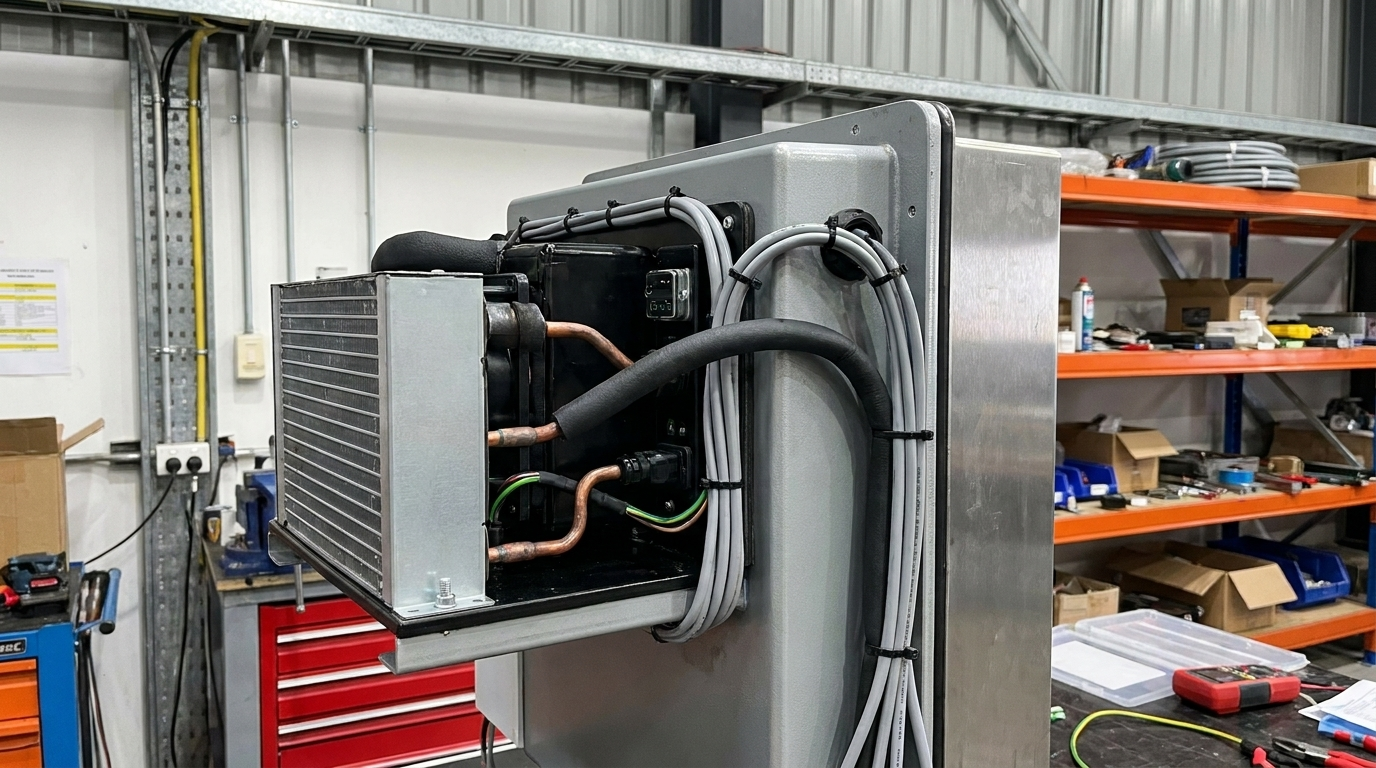
A micro air conditioner uses a BLDC (brushless direct current) miniature compressor with displacement volumes measured in cubic centimeters rather than cubic inches. These compressors run directly on DC power with variable speed control. No inverter. No start capacitor. No heavy-gauge AC wiring. The entire refrigeration system — compressor, heat exchangers, fans, controls, and pre-charged refrigerant — fits in a package smaller than a shoebox.
The cooling capacity ranges from 450W (1,535 BTU/h) to 650W (2,216 BTU/h) depending on the model. In practical terms, that is enough to maintain comfortable temperatures in enclosed spaces up to approximately 2–3 cubic meters, or to remove 450–650W of heat from a sealed enclosure in industrial applications.
What a Micro Air Conditioner Can Cool
The applications fall into two broad categories: spaces where people need comfort cooling in confined areas, and enclosures where equipment needs thermal protection.
Vehicle sleeping areas. Van conversions, truck cabs during rest stops, and trailer sleeping compartments are classic applications. The vehicle battery or an auxiliary battery bank provides 12V or 24V power. A micro air conditioner mounted in the sleeping area maintains comfortable temperatures without idling the engine — no fuel cost, no emissions, no noise from a running motor.
Pet safety in vehicles. Leaving animals in parked vehicles is dangerous in warm weather. A battery-powered micro air conditioner can maintain safe temperatures in a vehicle cabin or a dedicated pet compartment. The DC power requirement means it operates independently of the vehicle ignition, and the low power draw extends battery runtime to several hours.
Camping and outdoor shelters. Tents, popup campers, and small outdoor structures lack the electrical infrastructure for conventional AC. A micro air conditioner running from a portable battery or solar setup provides real cooling — not just air movement — in environments where grid power does not exist.
Small cabins and guard booths. Security guard stations, toll booths, and small site offices often have limited electrical capacity. A 12V or 24V micro air conditioner can cool these spaces without upgrading the electrical panel or running dedicated circuits.
Equipment enclosures. Telecom cabinets, battery compartments, EV charging station housings, and industrial control panels generate heat that must be removed to prevent equipment failure. A micro air conditioner mounted on or integrated into the enclosure provides active cooling without breaking the environmental seal.
What It Cannot Do
Setting honest boundaries prevents expensive mistakes:
- It will not cool a room. A 650W cooling unit cannot meaningfully lower the temperature in a standard bedroom or office. These units are designed for confined spaces measured in cubic meters, not rooms measured in square meters.
- It is not a dehumidifier. While any air conditioner removes some moisture as a byproduct of cooling, a micro air conditioner is not sized or designed for dedicated dehumidification tasks.
- It does not replace engine-driven vehicle AC. For cooling a full vehicle cabin while driving, the vehicle’s built-in air conditioning system is the right tool. A micro air conditioner is for stationary or low-power situations where the engine AC is off.
- Deep cooling below 5°C is outside the design envelope. These units maintain temperatures in the 5°C to 30°C range. Refrigeration or freezing applications require different equipment.
Battery Runtime: The Math That Matters
The most common question about battery-powered micro air conditioners is how long they run. The answer depends on three variables: battery capacity, unit power draw, and cooling load.
A micro air conditioner with 450W cooling capacity draws significantly less electrical power than 450W — because the compressor is more efficient than a 1:1 conversion. The Coefficient of Performance (COP) of these units typically ranges from 1.5 to 2.5, meaning the compressor delivers 1.5 to 2.5 watts of cooling for every watt of electricity consumed.
At COP 2.0, a 450W cooling unit draws approximately 225W of electrical power. On a 12V system, that is roughly 19A. On a 24V system, roughly 9.4A. A 100Ah lithium battery at 12V (usable capacity approximately 80Ah with depth-of-discharge limits) would provide roughly 4 hours of continuous full-load operation.
In practice, runtime is often longer because the compressor does not run at full load continuously. Variable speed control means the compressor slows down once the target temperature is reached, reducing power draw substantially. In a well-insulated space with moderate ambient temperatures, actual runtime can be 1.5 to 2 times the continuous full-load calculation.
The takeaway: battery runtime is real and calculable, but it depends heavily on insulation quality, ambient temperature, and how much heat is entering the cooled space. A well-insulated van in 30°C weather will get significantly more runtime than an uninsulated tent in 40°C heat.
Choosing the Right Voltage
Micro air conditioners are available in 12V, 24V, and 48V DC variants. The cooling performance is the same across voltage options for a given model — the difference is in current draw and system compatibility.
12V matches standard automotive electrical systems. Best for single-vehicle installations where the existing battery is the power source. Higher current draw means heavier wiring for longer cable runs.
24V is common in commercial vehicles, marine systems, and larger battery banks. Lower current draw for the same power means thinner wiring and lower voltage drop over distance. This is the most versatile option for new installations.
48V aligns with telecom power systems, some solar installations, and newer EV auxiliary power architectures. Lowest current draw, most efficient for longer cable runs, but requires a 48V power source.
Choose the voltage that matches your existing power infrastructure. Converting voltage with a DC-DC converter adds cost, complexity, and efficiency losses that defeat the purpose of a direct-DC system.
Noise Levels in Practice
Noise matters in every micro air conditioner application. In a sleeping area, excessive noise prevents rest. In a pet compartment, it causes stress. In a guard booth, it interferes with communication.
BLDC compressors are inherently quieter than conventional compressors because they lack the mechanical contact points that generate vibration in traditional designs. Variable speed operation further reduces noise — at partial load, which is the normal operating condition once the space reaches target temperature, the compressor runs slowly and quietly.
Actual installed noise depends on mounting method and enclosure construction. A unit hard-mounted to a thin metal panel will transmit more vibration noise than one installed with rubber isolation mounts on a rigid structure. For noise-sensitive applications, proper isolation mounting is worth the small additional effort during installation.
The practical result: in a well-installed system at partial load, the micro air conditioner is typically quieter than the ambient noise in a moving vehicle, and comparable to a quiet desk fan in a stationary installation.
R134a vs R290: Which Refrigerant and Why
The two refrigerant options in micro air conditioners — R134a and R290 (propane) — serve different priorities.
R134a is the established default. Non-flammable, widely available, decades of service history. Its higher Global Warming Potential (GWP of 1,430) is a regulatory concern in some markets but not a practical limitation for the small refrigerant charges used in micro systems.
R290 offers better thermodynamic efficiency — more cooling per gram of refrigerant — and a GWP of 3, effectively eliminating climate impact from refrigerant leakage. The trade-off is flammability, which requires appropriate safety considerations in the installation environment.
For most consumer and light commercial applications, R134a is the practical choice. R290 variants are relevant when regulations require low-GWP refrigerants or when the efficiency advantage meaningfully extends battery runtime in power-constrained applications.
Installation Considerations
A micro air conditioner is a split system in miniature. The evaporator side goes inside the space being cooled. The condenser side faces the outside ambient air. Refrigerant lines connect the two through the enclosure wall or vehicle panel.
Key installation factors:
- Condenser airflow. The condenser must have unobstructed access to ambient air for heat rejection. Blocking the condenser airflow reduces cooling capacity and can damage the compressor.
- Condensate management. When the evaporator cools air below its dew point, water condenses. This moisture needs a drain path or collection tray. In vehicle installations, routing the condensate drain to the exterior prevents interior moisture problems.
- Vibration isolation. In vehicle and mobile applications, the compressor should be mounted with vibration isolation to prevent noise transmission and protect refrigerant connections from fatigue failure.
- Electrical connections. Use appropriately sized wire for the current draw at your operating voltage. Include a fuse or circuit breaker rated for the maximum starting current, which is briefly higher than running current.
Durability and Service Life
A micro air conditioner built for mobile and industrial applications is not a disposable consumer product. BLDC compressors are rated for tens of thousands of operating hours. The sealed refrigerant circuit requires no recharging under normal conditions — the same charge that ships with the unit continues working for the life of the compressor.
The components most likely to need attention over time are the air filters (if equipped) and the condensate drain. Keeping the condenser and evaporator fins clean maintains cooling efficiency. Beyond that, these are low-maintenance systems by design — no belts, no oil changes, no seasonal refrigerant top-offs.
When a Micro Air Conditioner Is the Right Answer
The decision framework is simple: if the space is too small or too remote for conventional AC, and a fan is not enough, a micro air conditioner is likely the right solution. It occupies a specific niche in the cooling landscape — one that no other product category addresses as directly. The specific conditions that point to this product category:
- The space is enclosed and measures less than approximately 3 cubic meters
- The available power is DC (12V, 24V, or 48V) from batteries, solar, or vehicle electrical
- The heat load is under 650W
- Active temperature reduction — not just air circulation — is required
- Weight and size constraints eliminate conventional AC options
If all five conditions apply, a micro air conditioner is not just an option — it is probably the only option that works. The technology has matured to the point where these units deliver reliable, efficient cooling in applications that were previously considered too small, too remote, or too power-constrained for real air conditioning.
See the full Micro DC Aircon product range to match your specific space and power requirements.