
Micro DC Air Conditioner 450W Cooling: What This Rating Actually Means in Practice
A micro dc air conditioner with 450w cooling capacity sounds modest on paper. In BTU terms, that translates to approximately 1,535 BTU/h — a fraction of what residential window units deliver. But comparing these numbers to household air conditioning misses the point entirely.
The 450W cooling figure represents the heat removal rate from a defined enclosed space, not the electrical input power. The DV1910E-AC (12V), DV1920E-AC (24V), and DV1930E-AC (48V) achieve this cooling output while drawing significantly less electrical power thanks to BLDC compressor efficiency with COP values typically between 1.5 and 2.5 depending on ambient conditions and temperature differential.
This distinction matters because the target applications — sealed electronics enclosures, small equipment cabinets, portable instrument housings — generate concentrated heat loads in confined volumes. A 450W cooling capacity matched against a 300-400W internal heat load in a 0.3-0.5 m³ enclosure maintains stable operating temperatures with meaningful headroom.
Heat Load Context: Where 450W of Cooling Capacity Fits
Understanding where a micro dc air conditioner with 450w cooling sits in the thermal management hierarchy requires examining actual heat loads in target applications:
Electronics enclosures (0.2-0.5 m³): Typical internal heat dissipation ranges from 150W to 400W depending on component density. Power supplies, processors, communication modules, and voltage regulators all contribute. A 450W cooling unit provides 12-50% excess capacity above the heat load — enough to handle ambient temperature spikes without thermal throttling.
Portable instrument housings: Field-deployed analytical equipment, laser modules, and precision measurement devices often generate 100-250W of waste heat in volumes under 50 liters. The compact form factor of a micro DC unit (approximately 5 kg, fitting within a 300×200×150mm envelope) integrates without consuming the limited internal volume.
Battery compartments: Lithium battery packs in charging or high-discharge states generate heat proportional to I²R losses. A 48V/100Ah pack at 1C discharge might produce 200-350W of waste heat depending on cell chemistry and state of health. The 450W cooling capacity maintains cell temperatures within the 20-35°C optimal window.
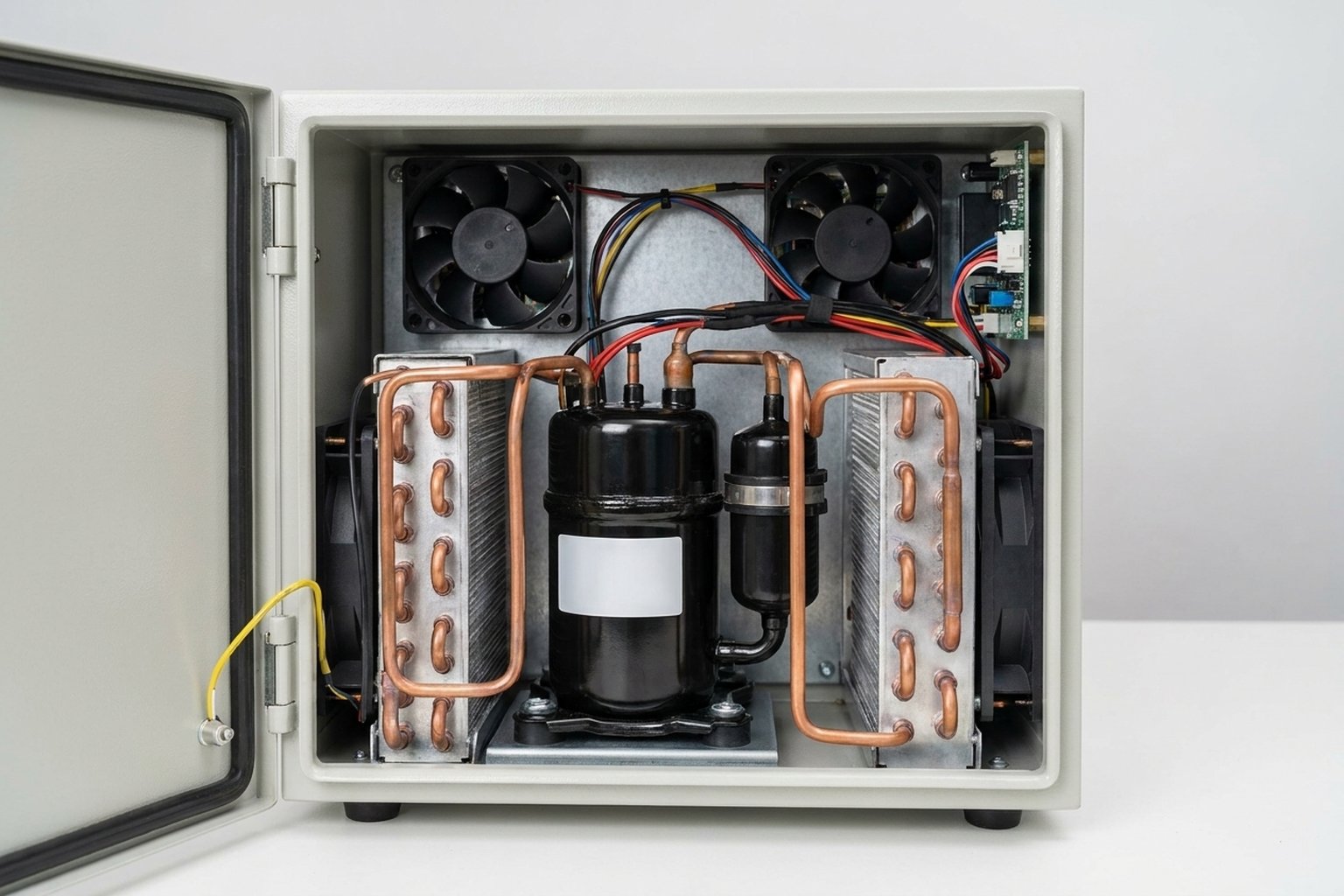
Vapor Compression vs. Alternatives at This Scale
At the 450W cooling level, three technologies compete: thermoelectric coolers (Peltier/TEC), vapor compression (what this micro dc air conditioner uses), and passive solutions (heat sinks + fans). The engineering tradeoffs are significant:
Thermoelectric (Peltier): Achieves 450W cooling only by stacking multiple modules, consuming 900-1,500W of electrical input (COP 0.3-0.5). The electrical penalty makes TEC impractical for battery-powered or solar-fed systems. Heat rejection also becomes problematic — the hot side must dissipate the cooling load plus the electrical input.
Passive cooling (heatsink + fan): Cannot cool below ambient temperature. If the enclosure sits in 45°C desert sun, internal temperatures will always exceed 45°C regardless of fan capacity. For applications requiring sub-ambient conditions, passive solutions simply cannot compete.
Vapor compression (BLDC micro compressor): Delivers 450W cooling with approximately 180-300W electrical input depending on conditions. Can maintain 15-20°C temperature differentials below ambient. The R134a refrigerant cycle provides genuine refrigeration — not just heat spreading.
The efficiency advantage compounds over time. In a 24/7 deployment running on solar + battery, the 3-5x electrical efficiency difference between vapor compression and TEC translates directly into smaller solar arrays and fewer battery cells.
Real Application Boundaries: What 450W Cannot Do
Honest engineering requires stating limitations clearly:
Cannot cool occupied spaces for human comfort. A 450W (1,535 BTU) unit cannot meaningfully condition a room, vehicle cab, or tent for human occupancy in hot climates. Human metabolic heat alone is 75-150W per person, and building/vehicle envelope heat gain in direct sun easily exceeds 1,000W. This unit is designed for equipment, not people.
Cannot overcome extreme ambient-to-setpoint differentials. If ambient temperature is 55°C and the target is 25°C (ΔT = 30°C), the compressor operates near its performance limit. COP drops significantly at high lift conditions. Practical design should target ΔT ≤ 20°C for reliable continuous operation.
Cannot handle high-humidity condensate loads without drainage planning. In tropical environments (35°C, 90% RH), a 450W cooling unit can generate 0.5-1.0 liters of condensate per hour. The enclosure design must accommodate drainage or evaporation — the cooling unit alone does not solve moisture management.
Cannot replace dedicated liquid cooling for concentrated heat sources. If a single component (laser diode, power MOSFET) generates 200W in a 10cm² area, air cooling — even refrigerated air — may not provide sufficient local heat flux removal. Liquid cold plates or direct-contact solutions may be necessary for the hotspot, with the micro DC unit handling ambient enclosure temperature.
Electrical Integration: Power Budget Reality
The micro dc air conditioner 450w cooling models operate across three voltage platforms:
- DV1910E-AC (12V): Working current 16A. Requires 14 AWG minimum wiring for runs under 3 meters, 12 AWG for longer distances. Fuse at 20A.
- DV1920E-AC (24V): Working current 8A. Standard 16 AWG wiring sufficient for most installations. Fuse at 10A.
- DV1930E-AC (48V): Working current 4A. Minimal wiring requirements, lowest I²R losses, preferred for solar installations where 48V battery banks are common.
The variable-speed BLDC compressor does not draw rated current continuously. At partial load (when the enclosure temperature approaches setpoint), the compressor reduces speed and current draw proportionally. Actual average power consumption in a well-insulated enclosure with moderate heat load may be 40-60% of rated maximum.
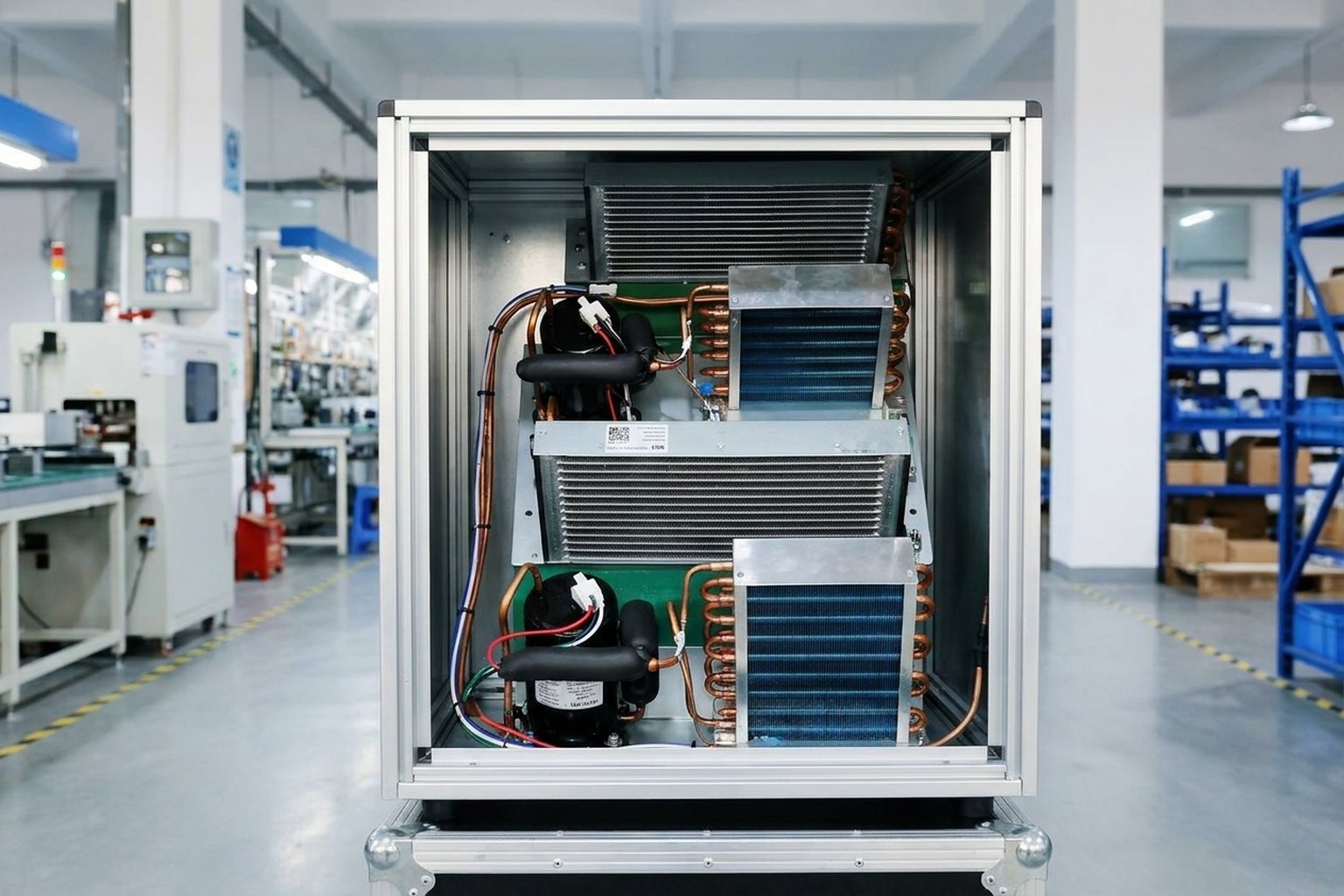
Installation Considerations for Enclosed Spaces
A micro dc air conditioner with 450w cooling requires both an evaporator (cold side, inside the enclosure) and a condenser (hot side, outside the enclosure). This split architecture means:
Enclosure penetrations: Refrigerant lines (typically 6mm OD copper) must pass through the enclosure wall. Proper sealing maintains IP rating. The unit ships with pre-charged refrigerant — no field brazing or vacuum pump required.
Condenser airflow: The external condenser requires unobstructed airflow. Minimum 150mm clearance on the air intake and exhaust sides. In dusty environments, a washable pre-filter extends maintenance intervals.
Vibration: The BLDC compressor produces minimal vibration compared to conventional AC compressors, but rubber isolation mounts are still recommended for sensitive instrument applications. Vibration levels are typically below 0.5g at the mounting points.
Orientation: Unlike some reciprocating compressors, the rotary compressor in these units tolerates mounting angles up to 30° from horizontal without oil management issues. This flexibility suits mobile and vehicle-mounted applications.
Sizing Validation: A Practical Example
Consider a roadside traffic monitoring cabinet in Phoenix, Arizona:
- Cabinet volume: 0.4 m³ (600×400×400mm internal)
- Internal heat load: 180W (camera processor + communication module + power supply)
- Peak ambient: 48°C
- Target internal temperature: ≤35°C (component rated maximum 50°C, with 15°C margin)
- Cabinet insulation: 25mm polyurethane (U-value ~1.2 W/m²·K)
Heat gain through cabinet walls at peak: 1.2 × 1.28m² surface area × (48-35)°C ΔT = ~20W
Total cooling requirement: 180W + 20W = 200W
Available cooling capacity: 450W
Capacity ratio: 450/200 = 2.25x (adequate headroom for degraded conditions)
The DV1930E-AC (48V) paired with a 48V/100Ah LiFePO4 battery and 600W solar array provides 24/7 autonomous operation with approximately 2 days of battery reserve during overcast conditions.
Second example — offshore wind turbine nacelle controller: A nacelle-mounted control cabinet in the North Sea houses PLCs, frequency converter interfaces, and SCADA communication modules generating 280W combined heat load. Ambient temperature inside the nacelle reaches 40°C during summer operation due to gearbox and generator proximity. Target internal temperature is 30°C to maintain PLC reliability margins. Wall conduction adds approximately 15W through the insulated cabinet. Total load: 295W. The 450W unit provides 1.53x headroom — sufficient for this application, though the engineer should verify that condenser performance remains adequate given the restricted airflow paths typical of nacelle interiors. The 24V DV1920E-AC integrates directly with the turbine’s 24V DC bus, eliminating the need for a dedicated power supply.
Third example — mobile veterinary diagnostic van: A converted van carries blood chemistry analyzers and centrifuges in a rear equipment bay (0.6 m³). Combined heat load from instruments during operation peaks at 220W, with an additional 40W solar gain through the van body during summer parking. The van operates on a 12V system with dual batteries (main + auxiliary 150Ah AGM). The DV1910E-AC maintains the equipment bay at 25°C while the van interior reaches 50°C+ when parked. Average current draw in steady state is approximately 10A, providing 15 hours of cooling from the auxiliary battery alone — more than sufficient for a full day of farm visits with engine charging between stops.
Noise Levels and Acoustic Considerations
Acoustic performance matters in applications where the micro dc air conditioner 450w cooling unit operates near personnel or noise-sensitive equipment. The BLDC rotary compressor produces significantly less noise than reciprocating designs due to continuous rotation rather than piston impacts.
Measured noise levels: At full speed, the compressor unit generates approximately 45-50 dB(A) at 1 meter distance. At partial load (typical steady-state operation), noise drops to 35-42 dB(A) as the compressor speed reduces. The condenser fan contributes an additional 30-38 dB(A) depending on speed setting.
Frequency spectrum: The dominant noise component is the compressor rotation frequency and its harmonics, typically in the 80-400 Hz range. This low-frequency character means the sound attenuates poorly through thin enclosure walls but is less objectionable to human hearing than high-frequency whine. For installations near occupied spaces, 10mm of acoustic foam on the compressor compartment reduces perceived noise by 5-8 dB(A).
Sensitive environments: In laboratory settings where acoustic noise could interfere with measurements (vibration-sensitive microscopy, audio recording equipment, or patient-facing medical devices), mounting the compressor and condenser remotely — connected via extended refrigerant lines up to 3 meters — moves the noise source away from the quiet zone. The evaporator operates near-silently since it has no moving parts beyond an optional low-speed circulation fan.
Night operation: For deployments in residential-adjacent locations (rooftop telecom cabinets, neighborhood EV charging stations), the variable-speed capability allows programming a “night mode” that caps compressor speed at 60-70% of maximum. This reduces cooling capacity proportionally but keeps noise below 40 dB(A) — comparable to a quiet refrigerator — during noise-sensitive hours.
Maintenance and Longevity Considerations
The sealed refrigerant circuit in a micro dc air conditioner 450w cooling unit requires no scheduled refrigerant service. The R134a charge is factory-sealed with no field-accessible service ports in standard configurations. Expected compressor lifespan exceeds 30,000 hours of continuous operation — equivalent to over 3 years of 24/7 runtime or 8-10 years of typical duty-cycled operation.
Condenser maintenance: The primary maintenance item is condenser coil cleaning. In clean environments (indoor, climate-controlled), annual inspection is sufficient. In dusty or outdoor environments, quarterly cleaning with compressed air or low-pressure water maintains heat rejection performance. A fouled condenser forces the compressor to work harder (higher discharge pressure), reducing efficiency and accelerating wear. Monitoring discharge pressure or compressor current provides early warning of condenser fouling.
Filter replacement: If a pre-filter is installed on the condenser intake, replacement or washing every 3-6 months prevents progressive airflow restriction. Filter condition can be assessed visually or by monitoring condenser air temperature differential.
Electrical connections: Vibration in mobile applications can loosen terminal connections over time. Annual inspection of power connections, particularly crimp terminals and screw terminals on the compressor driver board, prevents resistive heating at contact points. Torque specifications are provided in the installation manual.
Condensate drainage: Evaporator drain paths should be inspected seasonally to ensure they remain clear. Algae growth in warm, humid environments can block drain tubes. A 1% bleach solution flush annually prevents biological fouling of the drain system.
End-of-life indicators: Gradual loss of cooling capacity over years typically indicates slow refrigerant migration through elastomeric seals — a normal aging process. If the unit maintains setpoint but runs at higher compressor speeds than when new, refrigerant charge may have decreased slightly. Units are designed for field replacement rather than field repair; the sealed system approach prioritizes reliability over serviceability.
When to Step Up: Recognizing the 450W Ceiling
If your thermal analysis shows cooling requirements exceeding 350W sustained (leaving less than 25% headroom), consider the next tier:
- DV2820E-AC (700W / 2,387 BTU): 56% more capacity, still compact at ~5 kg, 24V platform
- DV3820E-AC (900W / 3,069 BTU): Double the 450W capacity for high-density enclosures
The modular product line means you can right-size without over-engineering. A 450W unit costs less, draws less power, and generates less noise than a 900W unit running at partial load — even though both could technically maintain setpoint in a light-load application.
Specific scenarios that push beyond 450W:
- Multi-server edge computing nodes: Edge deployments with 3+ server blades in a single outdoor cabinet commonly generate 500-800W of heat. The DV2820E-AC (700W) handles most configurations, while dense GPU-accelerated nodes may require the DV3820E-AC (900W).
- High-power RF amplifier enclosures: Cellular base station power amplifiers operating at 100-200W RF output with 30-40% efficiency reject 300-500W as heat. Combined with supporting electronics, total cabinet loads reach 600-700W in multi-band configurations.
- Industrial laser systems: CO2 and fiber laser sources with integrated power supplies in sealed enclosures can generate 400-600W of waste heat at moderate output powers. The thermal stability requirements (±2°C) also favor the larger units running at partial load for tighter temperature control.
- EV charging station electronics: DC fast chargers with 50-150kW output contain power conversion stages that reject 2-5% of throughput as heat inside the cabinet. A 100kW charger at 97% efficiency generates 3,000W of waste heat — well beyond any single micro unit. However, the control electronics and communication modules in a separate auxiliary cabinet typically generate 300-500W, making the 700W DV2820E-AC an appropriate choice for that subsystem.
Engineering Assessment
A micro dc air conditioner with 450w cooling capacity serves a specific and well-defined role: maintaining sub-ambient temperatures in small enclosed volumes with moderate heat loads, powered by DC sources. It excels in autonomous, unattended deployments where electrical efficiency directly impacts system cost and complexity.
The key question is not whether 450W is “enough” in absolute terms — it is whether your specific heat load, volume, ambient conditions, and temperature target fall within the operating envelope. If they do, this is likely the most efficient and compact solution available. If they do not, the same technology platform offers higher-capacity options without changing the integration architecture.
For thermal analysis support or application-specific sizing, contact our engineering team with your heat load data, ambient conditions, and target temperature range.