
Why a Micro DC Air Conditioner Telecom Solution Beats Traditional Cabinet Cooling
Telecom cabinets generate relentless heat. Every switch, router, power supply, and battery bank inside an outdoor enclosure converts electrical energy into waste heat — and that heat has nowhere to go. In remote cell tower sites, roadside cabinets, and rooftop installations, ambient temperatures can push internal cabinet air well above 50°C during summer months. Equipment rated for 40°C or 45°C starts throttling, dropping packets, or shutting down entirely.
For operations leads and site managers responsible for network uptime, thermal management isn’t optional. It’s the difference between a site that runs unattended for years and one that generates truck rolls every heat wave. The challenge is finding a cooling solution that works on DC power, fits inside or alongside compact enclosures, and doesn’t consume more energy than the equipment it protects.
This article examines why traditional approaches fall short for telecom cabinet cooling, how micro DC air conditioning systems address those gaps, and what to consider when sizing and integrating one into your site architecture.
The Heat Problem in Telecom Cabinets
Outdoor telecom cabinets face a double thermal load. Internal electronics generate heat continuously — typically 200W to 800W depending on the equipment density. Simultaneously, solar radiation on metal enclosures can add another 100W to 300W of heat gain, depending on cabinet color, orientation, and geographic location.
Unlike indoor server rooms with building HVAC, outdoor cabinets rely entirely on their own thermal management. The enclosure must remain sealed against dust, moisture, and insects (typically IP55 or higher), which means passive ventilation through filtered openings has limits. Once ambient temperature exceeds the target internal temperature, no amount of airflow helps — you need active cooling that can pump heat out of the enclosure against the temperature gradient.
The consequences of overheating are well-documented across the telecom industry: reduced battery lifespan (lithium-ion cells degrade rapidly above 35°C), increased bit error rates in optical transceivers, premature capacitor failure in power supplies, and unplanned outages that violate SLA commitments. For a remote site, each truck roll to replace heat-damaged equipment can cost hundreds or thousands of dollars — far exceeding the cost of proper thermal management.
Traditional Solutions and Their Pain Points
Filtered Fan Systems
The simplest approach is forced ventilation: fans pulling outside air through filters into the cabinet. This works when ambient air is cooler than the target internal temperature. The problems emerge quickly in practice:
- Filters clog with dust, pollen, and insects, reducing airflow over time
- Humid air introduces moisture that corrodes connectors and circuit boards
- When ambient exceeds 35°C, fans actually push hot air into the enclosure
- Maintenance cycles for filter replacement add operational cost
- No cooling below ambient temperature is physically possible
For sites in temperate climates with mild summers, filtered fans may suffice. For anything in a hot, dusty, or humid environment, they’re inadequate as a primary cooling strategy.
Peltier/Thermoelectric Coolers (TEC)
Peltier modules use the thermoelectric effect to pump heat from one side of a semiconductor junction to the other. They’re solid-state with no moving parts (aside from their heat sink fans), which makes them attractive on paper. In practice, telecom deployments reveal significant limitations:
- Coefficient of Performance (COP) typically ranges from 0.3 to 0.6 — meaning they consume more power than the heat they remove
- Cooling capacity drops sharply as the temperature differential increases
- At high ambient temperatures (when you need cooling most), performance degrades significantly
- Power consumption is substantial relative to cooling output, straining battery backup systems
- Multiple modules needed for loads above 100-150W, adding complexity and cost
For very small heat loads (under 50W) in mild climates, Peltier coolers can work. But for typical telecom cabinets with 300W+ heat loads in hot environments, their inefficiency makes them impractical — especially on battery-backed DC power systems where every watt matters.
Traditional AC-Powered Air Conditioners
Conventional split or packaged air conditioners offer genuine cooling capacity, but they introduce their own problems at remote telecom sites:
- Require AC mains power or a DC-to-AC inverter, adding conversion losses
- Inverters introduce another failure point and consume standby power
- Standard units are oversized for small cabinets (typically 1kW minimum)
- Designed for room-scale cooling, not sealed enclosure applications
- Condensate management in sealed cabinets requires additional plumbing
- Weight and size often exceed what cabinet mounting points can support
When AC power is available and cabinet size permits, traditional air conditioning works. But many telecom sites — particularly small cells, rural base stations, and roadside repeater cabinets — run entirely on DC power from solar panels or battery banks.
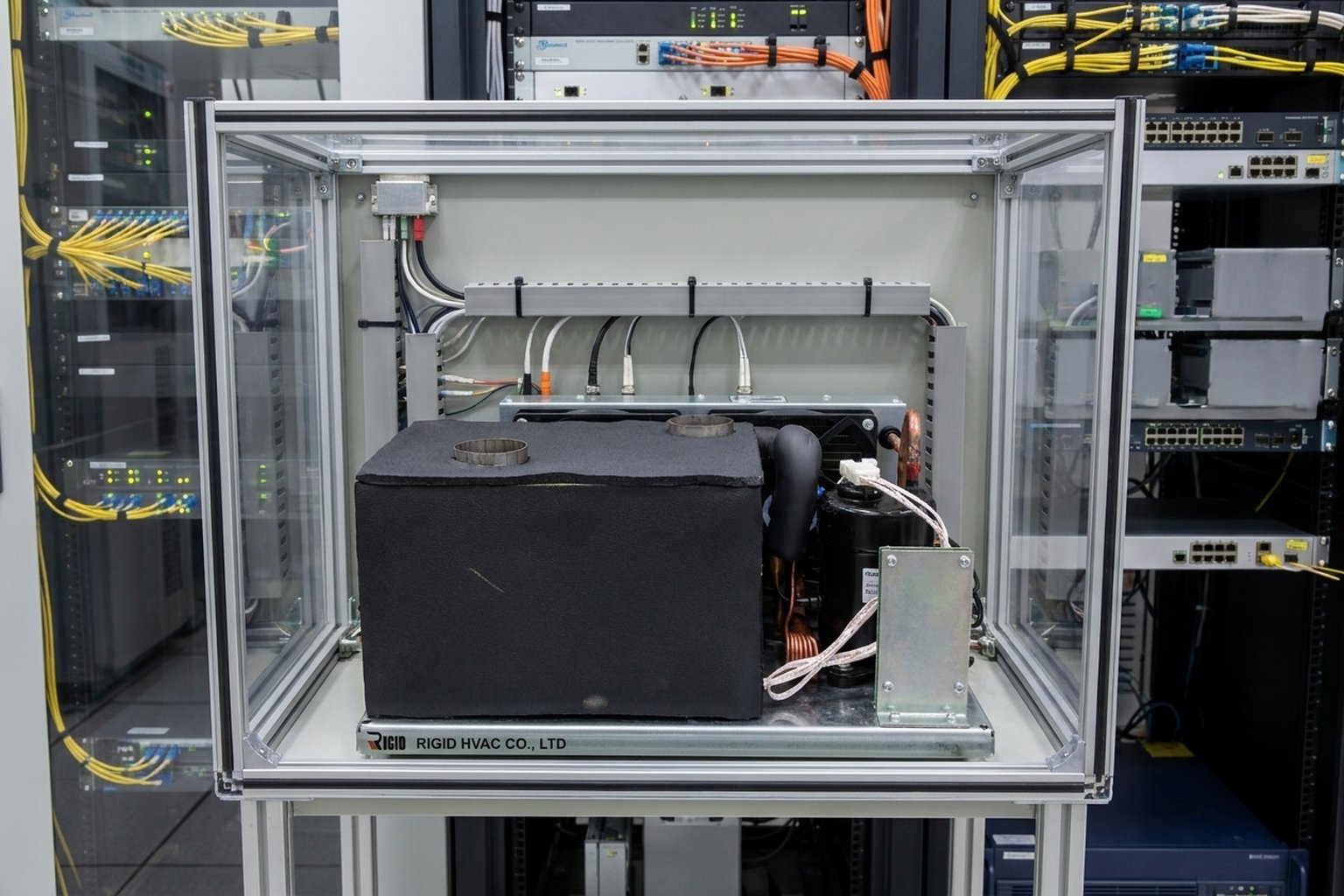
DC Aircon Advantages for Telecom Applications
A micro DC air conditioning system addresses the specific constraints of telecom cabinet cooling by combining vapor compression refrigeration (the same physics as your home AC) with a DC-native design that eliminates the inverter entirely.
All-DC Architecture
The core innovation is a BLDC (brushless DC) compressor that runs directly from 12V, 24V, or 48V DC power — the same voltages already present in telecom power systems. There’s no inverter stage, no AC conversion losses, and no additional failure point. The system connects directly to the site’s DC bus alongside the telecom equipment it protects.
Available voltage options (12V, 24V, 48V) align with standard telecom power architectures. A 48V system connects directly to a -48VDC telecom power plant. A 24V unit works with solar-battery systems common in rural installations. The 12V option serves mobile or vehicular telecom applications.
Vapor Compression Efficiency
Unlike Peltier coolers, a vapor compression cycle achieves COP values of 1.5 to 3.0 or higher under typical conditions. This means for every watt of electrical input, the system moves 1.5 to 3 watts of heat out of the cabinet. That’s roughly 3-5x more efficient than thermoelectric cooling for the same heat removal task.
In practical terms: removing 450W of heat from a cabinet might require 150-300W of compressor input power with vapor compression, versus 750-1500W with Peltier modules. On a battery-backed system, that efficiency difference translates directly into longer backup runtime during power outages.
Compact Form Factor
At approximately 11 lbs (5 kg), these units are designed to mount directly on cabinet walls or doors without structural reinforcement. The compact dimensions allow installation on standard 19-inch rack enclosures and smaller roadside cabinets where a traditional split AC system simply won’t fit.
Cooling Performance
The system delivers 27.8 CFM of conditioned airflow with a controllable temperature range of 5°C to 30°C. Models range from 450W to 900W cooling capacity, covering the thermal loads of most small-to-medium telecom cabinets. The R134a refrigerant (standard) or R290 eco-friendly option provides reliable performance across a wide ambient temperature range.
Available models and their specifications:
- DV1910E-AC: 12V DC, 450W cooling capacity
- DV1920E-AC: 24V DC, 450W cooling capacity
- DV1930E-AC: 48V DC, 450W cooling capacity
- DV3220E-AC: 24V DC, 550W cooling capacity
- DV2820E-AC: 24V DC, 700W cooling capacity
- DV2820E-AC-T: 24V DC, 700W cooling capacity (R290 refrigerant)
- DV3820E-AC: 24V DC, 900W cooling capacity
- DV3830E-AC: 48V DC, 900W cooling capacity
Sizing Considerations for Telecom Cabinets
Selecting the right cooling capacity requires understanding your total heat load. This includes both internal heat generation and external heat gain.
Estimating Internal Heat Load
As a rough estimate, most electronic equipment converts 60-90% of its input power into heat. A cabinet drawing 500W from the DC bus likely generates 300-450W of waste heat. Check equipment datasheets for thermal dissipation figures where available — these are more accurate than rules of thumb.
Common telecom equipment heat contributions (approximate ranges):
- Small cell radio units: 50-150W per unit
- Switches/routers: 30-200W depending on port count
- Power conversion equipment: 20-80W (efficiency losses)
- Battery charging systems: 30-100W during charge cycles
Note: these are general industry ranges for estimation purposes, not exact figures. Always verify with your specific equipment datasheets.
Estimating External Heat Gain
户外柜体的太阳辐射量取决于表面积、颜色、朝向和当地气候。一个粗略的参考标准是:深色柜体在阳光直射下,每平方米向阳面可能会吸收 50-150 瓦的热量。浅色柜体、遮阳罩或遮阴装置可以显著降低辐射量。
地理位置至关重要。位于亚利桑那州凤凰城的橱柜与位于明尼苏达州的橱柜面临的热工性能挑战截然不同。设计时应考虑最恶劣的夏季环境,而非年平均温度。
容量选择
所需总制冷量 = 内部热负荷 + 外部热增益 + 安全裕量(通常比计算负荷高 10-20%)。将此值与可用型号的制冷量相匹配:
- 轻负载(总功率低于 450W):DV1910E-AC、DV1920E-AC 或 DV1930E-AC
- 中等负载(450-550W):DV3220E-AC
- 较高负载(550-700W):DV2820E-AC 或 DV2820E-AC-T
- 大功率负载(700-900W):DV3820E-AC 或 DV3830E-AC
如有疑问,请选择较大的型号。功率过大的设备运行频率较低,可减少压缩机磨损。功率过小的设备则需要持续运行,即使在高峰工况下也无法维持目标温度。
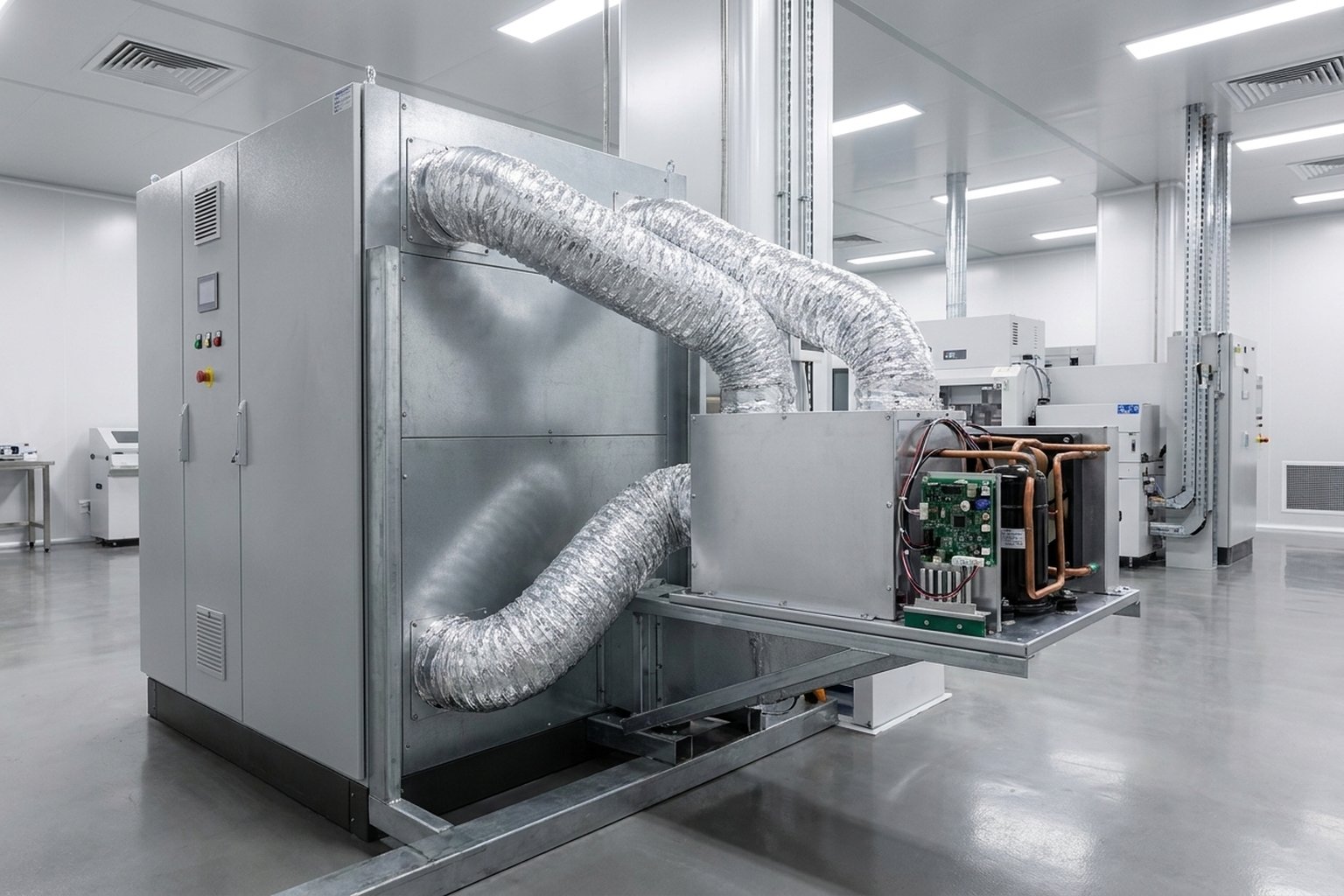
直流空调的优点和缺点
理想应用
- 室外电信机柜(基站、小型基站、中继器)
- 仅使用直流电源的偏远地区(太阳能+电池系统)
- 需要IP防护等级冷却的密封外壳(不允许外部空气进入)
- 有些场所的珀尔帖冷却器无法有效应对热负荷。
- 电池备用装置,其电源效率可延长备用时间
- 在炎热气候下,被动冷却不足以满足需求的橱柜
不太理想
- 需要数千瓦制冷的大型封闭空间或掩体——这些需要更大的专用暖通空调系统。
- 适用于热负载超过 900W 的应用——这是该产品系列的最大可用容量。
- 需要冗余冷却的环境——单个冷却单元就是一个单点故障(关键场所可考虑使用双冷却单元)
- 在交流电源供应充足且机柜尺寸足以容纳标准交流发电机的场所,直流电的优势就不那么明显了。
- 极寒环境,供暖而非制冷才是主要考虑因素。
站点部署集成说明
安装和气流
安装设备时,应使冷凝器(热端)朝外,并留出足够的散热空间。蒸发器(冷端)应将冷空气输送到设备各处,理想情况下应自上而下或直接吹向温度最高的部件。避免将冷凝器排气与冷凝器进气口回流。
电源连接
通过合适的电路保护装置(根据设备最大电流选择合适的保险丝或断路器)直接连接到现场直流母线。确保直流电源电压与设备的额定电压相符——在 48V 母线上运行 24V 设备会损坏压缩机。通电前请确认极性。
冷凝水管理
与任何空调系统一样,蒸发器在对柜内空气进行除湿时会产生冷凝水。排水管应从柜体低洼处排出,确保冷凝水不会倒流回柜体内部。在寒冷气候下,可考虑使用冷凝水加热器或内置蒸发盘。
监控和报警
大多数电信站点都配备了环境监测系统。将机柜内的温度传感器与网络管理系统集成,以验证冷却系统是否维持目标温度。设置高温(冷却故障)和低温(过冷或传感器故障)报警。
选择合适的制冷剂
标准型号使用R134a制冷剂,这种制冷剂在暖通空调行业应用广泛且易于理解。DV2820E-AC-T型号使用R290(丙烷),这是一种天然制冷剂,其全球变暖潜值较低(R290的全球变暖潜值仅为3,而R134a的全球变暖潜值高达1430)。
在一些地区,由于相关法规正在逐步淘汰高全球变暖潜值(GWP)制冷剂,R290 的使用率正在上升。需要注意的是,R290 被归类为易燃制冷剂(根据某些地区标准,例如 ASHRAE 34,属于 A3 类),这可能会影响安装要求,具体取决于当地法规和部署环境。这些微型装置的充注量很小,但仍需确认是否符合您所在地区的适用法规。
总体拥有成本视角
在评估电信机柜的冷却方案时,冷却装置的购置价格通常是成本中最小的部分。请考虑以下因素:
- 能源成本:珀尔帖系统的能耗是蒸汽压缩式机组的 3-5 倍,在 10 年的使用寿命内会累积大量的能源成本。
- 电池容量:更高的冷却功耗意味着需要更大(更昂贵)的电池组才能达到备用时间目标。
- 维护保养:过滤式通风系统需要定期维护;密封式蒸汽压缩系统基本无需维护。
- 设备更换:散热不足会缩短昂贵电信设备的使用寿命——过早失效造成的损失远高于适当的散热管理。
- 停机成本:因过热关机导致的网络中断会产生服务水平协议 (SLA) 罚款并影响客户。
对于大多数部署而言,直流蒸汽压缩冷却的效率优势可在 1-3 年内通过降低能耗和避免设备故障来收回成本。
直流机柜冷却入门
如果您正在评估适用于电信站点的微型直流空调,首先需要记录您的热负荷和站点电源架构。将电压(12V、24V 或 48V)与现有直流母线匹配,估算包括太阳能辐射在内的总冷却需求,并选择容量充足且留有余量的型号。
如需详细规格、型号选择指南和集成支持,请访问微型直流空调产品页面。RIGID 的工程团队可协助进行非标准外壳的热计算,并提供用于机械集成规划的 CAD 模型。对于有批量部署需求的机组,可提供定制电压或容量配置。
电信行业已开始从珀尔帖冷却器和过滤通风转向直流蒸汽压缩冷却。随着基站密度的提高,越来越多的设备被安置在更小的室外机柜中,高效紧凑的冷却系统不再是锦上添花,而是确保网络可靠运行的先决条件。