
Military Cooling Vest Continuous Operation: The Variable Nobody Budgets for Until It Costs Everything
There is a number that every tactical planner knows but rarely writes into the operations order: the hour at which a fully kitted operator begins making decisions as though they slept three hours and drank nothing since yesterday.
It is not a morale problem. It is not a fitness problem. It is a core temperature problem, and it arrives on a schedule as predictable as sunrise. When the body’s internal temperature climbs past 100.4 °F (38 °C), cognitive throughput drops. Working memory narrows. Reaction time stretches. Fine motor control—the kind that keeps a reticle steady at 300 meters—degrades measurably. By 101.3 °F (38.5 °C), the operator is not who they were two hours ago.
This article is written for the equipment officers and logistics planners responsible for fielding solutions against that curve. Not comfort solutions. Not morale purchases. Systems that maintain the human weapon system’s performance envelope during continuous operations lasting 8, 12, or 24+ hours in ambient heat.
The question is not “how do we cool people down.” The question is: how do we prevent the decline from starting?
The Physiology of Decline: What Happens at Hour 3, Hour 6, Hour 10
The human thermoregulatory system is robust—for about 90 minutes. Under sustained exertion in body armor, with ambient temperatures above 90 °F (32 °C), the system begins losing ground. Heat production from muscular work and the insulative shell of protective equipment outpace the body’s ability to shed heat through sweat and convection.
Published research on military heat casualties paints a consistent picture:
- Hour 0–2: Performance baseline. Core temperature rises slowly. Operators feel warm but remain sharp. Decision speed and accuracy hold.
- Hour 2–4: Core temperature enters the 99.5–100.4 °F range. Perceptual narrowing begins. Operators stop scanning peripheral threats as thoroughly. Hydration alone cannot reverse the trajectory.
- Hour 4–6: Working memory degrades. Multi-step tasks (radio procedures, coordinate calculations, breach sequencing) take longer and produce more errors. Shooting groups open up—not from fatigue alone, but from fine motor loss driven by thermal load.
- Hour 6+: Without intervention, risk of heat exhaustion rises sharply. But the operational cost already occurred hours ago—in the decisions not made, the targets not identified, the communications garbled.
The military does not lose operators only when they collapse. It loses them incrementally, one degree at a time, long before any medic is called.
Field note: Units operating in Iraq and Afghanistan reported that marksmanship qualification scores taken in morning cool versus afternoon heat showed measurable group-size expansion even among experienced shooters. The rifle did not change. The optic did not change. The operator’s core temperature did.
Why Ice-Based Cooling Fails Continuous Operations
The default solution for decades has been ice—ice vests, ice sheets, coolers full of frozen water bottles. And for a two-hour security halt or a pre-mission cool-down, ice works. Nobody disputes that.
But continuous operations are not two-hour problems. They are twelve-hour problems. Twenty-four-hour problems. And ice introduces three failure modes that scale with duration:
1. Finite cooling duration
Ice melts. A standard ice vest provides meaningful cooling for roughly 60–90 minutes in ambient temperatures above 95 °F. After that, the operator is wearing a wet, warm weight. In a continuous operation, this means resupply cycles—someone has to stage frozen vests, someone has to swap them, and the cooling gap between swaps is a performance gap.
2. Logistics burden
Ice requires freezers. Freezers require power. Power requires generators. Generators require fuel. In a forward operating position, every kilogram of fuel consumed on ice production is a kilogram not allocated to mission-critical systems. For a 40-person element operating in 12-hour rotations, the ice resupply chain becomes a logistics tail of its own.
3. Inconsistent thermal output
Ice does not cool at a constant rate. It cools aggressively when fresh, then fades. This means the operator experiences a cold shock followed by a gradual return to thermal stress—a sawtooth pattern that the body never fully adapts to. Consistent, moderate cooling is physiologically superior to intermittent cold jolts.
Field note: Logistics officers have reported that in sustained desert operations, the daily ice requirement for a company-sized element can exceed 500 lbs—transported, stored, and distributed under the same threat conditions as ammunition and water. The question becomes: is this the best use of that lift capacity?
Compressor-Driven Cooling: The Shift from Consumable to Continuous
The engineering answer to the ice problem is the same answer the HVAC industry arrived at decades ago: a vapor-compression refrigeration cycle. Instead of relying on a phase-change consumable (ice melting), the system uses a compressor to circulate refrigerant through a closed loop, extracting heat continuously for as long as power is supplied.
This is not new physics. What is new is making it small enough and light enough to be operationally relevant at the individual or small-team level.
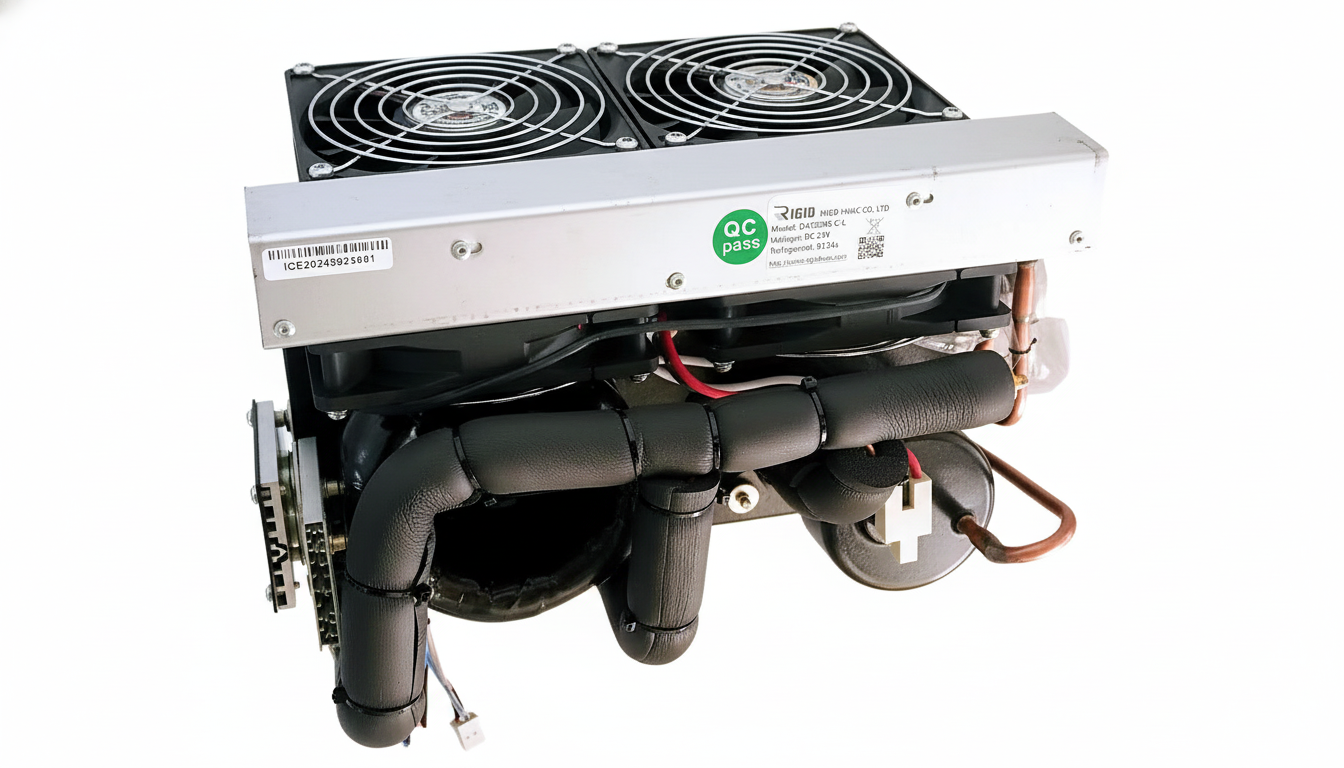 The RIGID Micro Cooler represents the current state of this miniaturization. Key specifications relevant to military continuous operation planning:
- Weight: Under 7 kg (15 lbs)—comparable to a standard combat load plate carrier without plates.
- Cooling temperature: Capable of cooling fluid to below 35 °F (1.7 °C). In practice, cooling suit delivery temperature is regulated higher for physiological safety, but the system has significant thermal headroom.
- Power draw: Maximum 18–22 amps, depending on installation configuration and ambient conditions.
- Refrigerant: Freon, sealed within a rotary micro-compressor system. No field servicing of the refrigerant circuit required.
- Operation: Plug-and-play connectivity to standard cooling suit garments. Remote control included for operator adjustment without removing equipment.
- Maintenance: Virtually maintenance-free. No ice procurement, no water refills for cooling medium, no consumable replacement.
The micro-compressor at the heart of this system delivers the equivalent cooling power of compressors five times its physical size—a function of RIGID’s rotary compressor engineering rather than simply scaling down a conventional unit.
Operational Integration: Where This System Fits and Where It Does Not
Honesty about application boundaries matters more than marketing claims. Here is a realistic assessment of where compressor-driven cooling suits serve continuous military operations effectively, and where the operational picture gets more complex.
Strong fit: Vehicle-mounted and fixed-position operations
Any scenario where 12V/24V DC power is available and the operator is relatively stationary for extended periods. This includes:
- Armored vehicle crews (gunners, drivers, commanders) during multi-hour mounted patrols
- Forward observation posts and overwatch positions
- Command post operations in non-climate-controlled structures
- EOD and CBRN teams operating in encapsulated protective equipment
- Helicopter and fixed-wing ground crews on the flight line
- Medical treatment teams in field hospitals without adequate HVAC
Experience value: Vehicle crews report the most immediate and measurable benefit. In an armored vehicle with interior temperatures regularly exceeding 120 °F (49 °C), core temperature management is not a comfort issue—it is a crew-readiness issue that directly affects engagement speed and target discrimination accuracy.
Conditional fit: Dismounted operations with resupply access
For dismounted patrols, the system’s 7 kg weight and power requirement mean it is not a “wear and walk” solution in the way an ice vest is. However, for operations where a vehicle or power source is staged within the patrol’s operating radius—enabling operators to cycle through cooling stations—the system can extend the effective operating window of a dismounted element significantly.
Experience value: Units have configured cooling stations at patrol bases and checkpoints, allowing operators returning from 2–3 hour dismounted segments to actively cool their core temperature back to baseline in 15–20 minutes rather than the 45–60 minutes passive rest typically requires. This faster recovery cycle means more operators at effective readiness at any given time.
Not the right tool: Unsupported long-range dismounted operations
If the mission profile involves 48 hours of foot movement with no vehicle linkup, no resupply, and every gram of load is contested, this system is not the answer. Lightweight phase-change vests or ice vests staged at cache points may be more appropriate for those specific mission sets. The point is not that one technology replaces all others—it is that for the majority of modern military operations, which involve some combination of mounted movement and position-based activity, compressor-driven cooling provides a capability that consumable-based systems cannot match.
The Performance Maintenance Argument: Reframing Cooling as a Force Multiplier
The procurement conversation around cooling equipment is typically framed as a health and safety issue—preventing heat casualties. And it is. Heat stroke kills, and heat exhaustion removes personnel from the fight just as effectively as enemy fire.
But the larger argument—the one that belongs in the operations brief rather than the medical brief—is about sustained performance across the entire force element across the entire operation.
Consider a 12-hour cordon-and-search operation in 105 °F ambient heat:
- Without active cooling: By hour 6, the element has effectively lost 20–30% of its cognitive and fine-motor capacity. Not because operators have fallen out—because the ones still standing are operating at diminished capacity. Decisions take longer. Communication errors increase. Positive identification becomes less reliable. The element is physically present but operationally degraded.
- With active cooling for key positions (vehicle crews, team leaders, designated marksmen, communications operators): Those individuals maintain baseline cognitive and motor performance through the entire operation. They remain the operators they were at hour 1. This is not a theoretical advantage—it is the difference between a 12-hour operation that degrades into a 6-hour effective operation, and a 12-hour operation that delivers 12 hours of effective capability.
The arithmetic is straightforward: if active cooling extends effective operating time by even 40%, the unit gets more mission out of the same personnel, the same vehicles, and the same operational window.
Field note: Communications operators—often stationary, often in partially enclosed positions, often wearing additional equipment—are among the highest-value targets for cooling intervention. A communications breakdown due to operator cognitive degradation cascades across the entire element far faster than the loss of a single rifleman’s accuracy.
Power Planning: Realistic Considerations for Continuous Use
Any system that requires electrical power in a tactical environment demands honest power planning. The RIGID Micro Cooler’s 18–22 amp maximum draw is a real number that must be accounted for in the vehicle’s or generator’s power budget.
Practical considerations for planners:
- Vehicle integration: Most military vehicles with 24V systems can support one or more units directly from the vehicle’s electrical system, though installation should include proper circuit protection and should be validated against the specific vehicle’s alternator capacity and existing electrical load. Work with your vehicle electrical shop.
- Generator power: For fixed-position operations, a single tactical generator can support multiple cooling units. The power draw is comparable to other standard field equipment.
- Duty cycle: In practice, the compressor does not draw maximum amperage continuously. Once the coolant loop reaches operating temperature, the system cycles, and average draw is lower than the rated maximum. Actual power consumption depends on ambient temperature, coolant flow rate, and the operator’s metabolic heat output.
- Battery operation: Short-duration battery-powered operation is possible with appropriately sized lithium batteries, though this is typically a bridging solution (moving between powered positions) rather than a primary operating mode for continuous operations.
Experience value: Units that have integrated the system into vehicles report that the most common installation challenge is routing the coolant lines from the unit to the operator’s cooling garment in a way that does not interfere with egress. This is a solvable problem, but it needs to be addressed during installation planning—not discovered during a mission.
Maintenance Profile: What “Virtually Maintenance-Free” Means in Practice
The sealed Freon refrigerant system means there is no field-level maintenance on the cooling circuit itself. No refrigerant checks, no compressor oil changes, no filter replacements on the refrigerant side. This is a significant advantage over systems with open-loop water circuits or consumable cooling media.
What does require attention:
- Cooling garment: The vest or suit that interfaces with the operator’s body will need periodic cleaning and inspection. Connector fittings should be checked for tightness.
- Coolant lines: Visual inspection for kinks, abrasion damage, or connector leaks—standard hose maintenance.
- Airflow: The condenser requires unobstructed airflow to reject heat. In dusty environments, periodic cleaning of the condenser surface maintains efficiency.
- Electrical connections: Standard checks for corrosion, secure connections, and proper fusing.
This maintenance profile is well within the capability of any unit-level maintenance section and does not require specialized training or tools.
Procurement Framing: Cost Per Operating Hour, Not Cost Per Unit
When evaluating cooling systems for continuous operations, the relevant metric is not unit purchase price—it is cost per effective operating hour delivered.
An ice-based system has a low unit cost but a high recurring cost: ice procurement, freezer operation, transport logistics, and the personnel time dedicated to the resupply cycle. Over a 6-month deployment with daily operations, these costs compound substantially.
A compressor-driven system like the RIGID Micro Cooler has a higher unit cost but near-zero recurring cost: electrical power (which is already being generated for other systems) and minimal maintenance. Over the same deployment, the total cost of ownership is competitive or favorable—and the system delivers consistent cooling every hour of every day without supply chain dependency.
For a procurement officer building a case, the strongest data point is not the thermodynamic specification. It is the number of hours per day the system extends effective operator readiness, multiplied by the number of operators served, multiplied by the number of days in the deployment. That is the return on investment.
Summary: The System That Does Not Fade
The core narrative of this assessment is simple: in continuous military operations conducted in heat, the enemy is not just the adversary across the objective. It is the relentless accumulation of thermal load that degrades every human system the mission depends on—judgment, precision, communication, endurance.
Ice addresses this for an hour. Hydration slows it by a fraction. Rest reverses it but costs operational time. Active, compressor-driven cooling—delivered continuously, without consumable resupply, at under 7 kg per system—is the engineering solution to the biological problem.
The RIGID Micro Cooler is not a comfort item. It is a performance maintenance system. It does not make operators cool. It keeps them from becoming less than they are.
That is not a nice-to-have. In continuous operations, it is the variable that determines whether the force you planned with is the force you have at hour 10.
Integration Support
RIGID provides technical consultation for military and institutional integration projects. Whether you are evaluating cooling solutions for a specific vehicle platform, planning a deployment-scale procurement, or configuring a cooling station for a forward operating base, RIGID’s engineering team can assist with system sizing, power planning, installation guidance, and cooling garment selection for your operational requirements.
Contact RIGID directly to discuss your mission profile and receive a configuration recommendation matched to your operating environment and force structure.