
Mini AC Compressor: How Small Compressors Power Portable and Micro Cooling
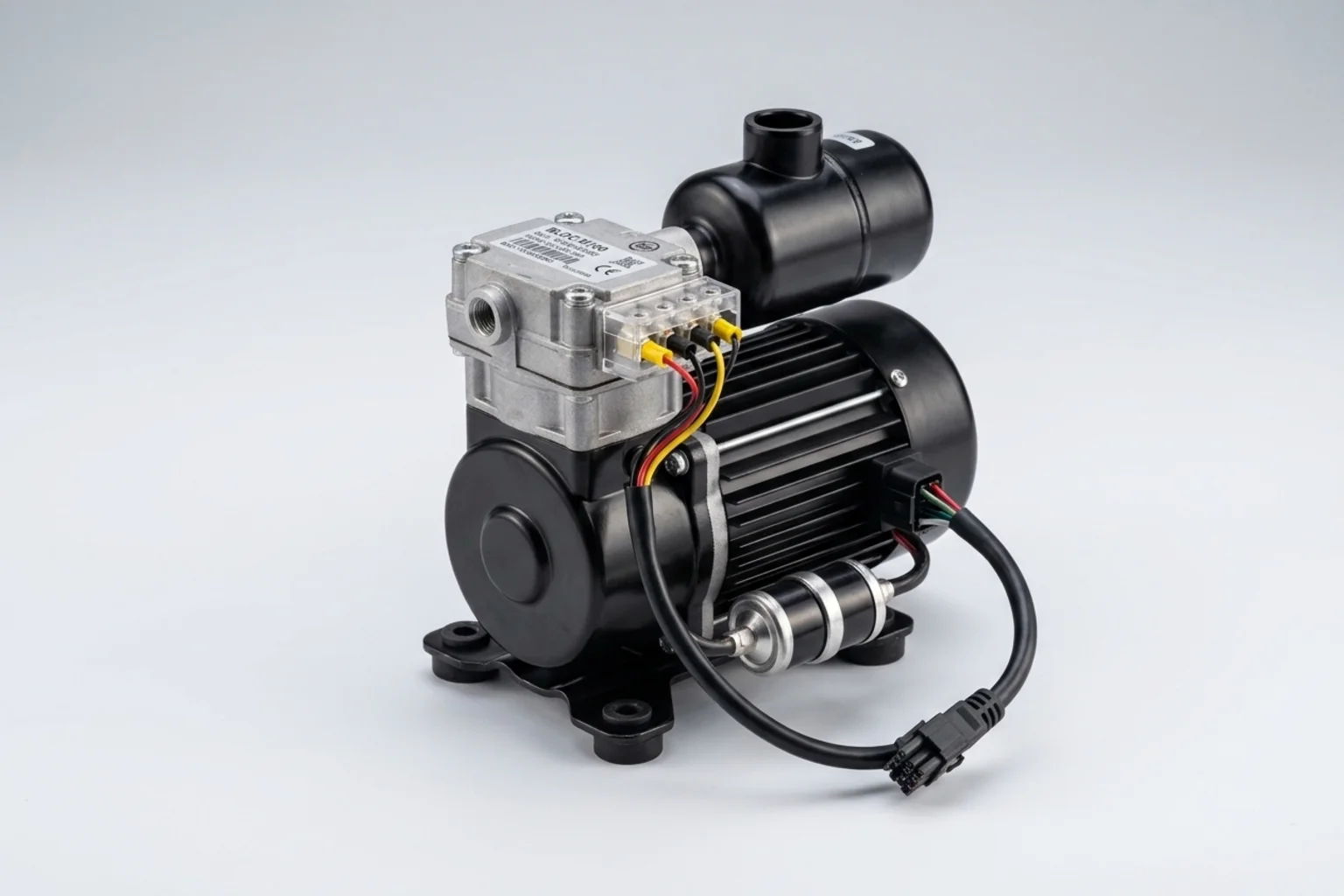
A mini AC compressor is a miniature vapor compression compressor — the same fundamental technology inside your home air conditioner or refrigerator, scaled down to fit in the palm of your hand. These compressors weigh under 1 kg, measure roughly 57×78 mm, and deliver 100–550W of real cooling capacity using the same refrigerant cycle that cools skyscrapers and semi-trucks.
This is not a marketing term for a small fan or a Peltier chip. A mini AC compressor physically compresses refrigerant gas, creating the pressure differential that drives heat transfer through evaporation and condensation. It is the core component that makes genuine portable air conditioning, compact refrigeration, and embedded thermal management possible in spaces where traditional compressors simply cannot fit.
What Makes a Compressor “Mini”?
Traditional AC compressors — the kind inside your home HVAC system — weigh 5–15 kg, stand 200–400 mm tall, and need 110V or 220V AC power. They deliver thousands of watts of cooling but require substantial mounting space, heavy wiring, and fixed installation.
A mini AC compressor flips these constraints:
| Parameter | Traditional AC Compressor | Mini AC Compressor |
|---|---|---|
| Weight | 5–15 kg | 0.7–1.0 kg |
| Dimensions | 200–400 mm height | 57×78 mm (fist-sized) |
| Cooling capacity | 2,000–15,000W | 100–550W |
| Power source | 110/220V AC | 12V, 24V, or 48V DC |
| Motor type | AC induction (fixed speed) | BLDC (variable speed) |
| Noise | 50–65 dB | Under 40 dB |
| Speed control | On/off cycling | 1,800–6,500 RPM continuous |
The key enabling technology is the BLDC (Brushless Direct Current) motor. By replacing the heavy AC induction motor with a compact permanent-magnet motor and electronic speed controller, mini compressors achieve 10–17 times the cooling power density (watts per kilogram) of conventional compressors. RIGID’s smallest compressor delivers the same cooling output as a traditional reciprocating compressor that weighs six times more.
How a Mini AC Compressor Works
The operating principle is identical to any vapor compression system — the only difference is scale. The mini compressor performs four functions in a sealed, hermetic housing:
- Suction: Low-pressure refrigerant gas enters the compressor from the evaporator, where it has absorbed heat from the space being cooled.
- Compression: The rotary mechanism compresses the gas, raising its pressure and temperature. Mini compressors use rotary (rolling piston) designs rather than reciprocating pistons — rotary action produces smoother compression with less vibration in a smaller package.
- Discharge: High-pressure, high-temperature gas exits the compressor and flows to the condenser, where it releases heat to the outside air.
- Cycle repeat: After passing through an expansion valve, the refrigerant returns to the evaporator as a cold, low-pressure liquid/gas mixture, ready to absorb heat again.
The BLDC motor drives this cycle at variable speed. When cooling demand is low — the space is already near the setpoint, or ambient temperature is moderate — the compressor slows down to 1,800 RPM, drawing minimal power and running almost silently. When maximum cooling is needed, it ramps up to 6,500 RPM. This variable-speed operation eliminates the on-off cycling noise of traditional compressors and reduces average power consumption by 20–40% compared to fixed-speed alternatives.
Where Mini AC Compressors Are Used
The combination of small size, DC power compatibility, and genuine vapor compression cooling opens applications that were previously impossible or impractical:
Portable and Personal Cooling
Mini compressors power the smallest genuine air conditioners available — complete micro AC units weighing 5 kg that deliver 450–900W of real cooling. These units cool tents, van sleeping areas, pet crates, and outdoor workstations without generators or AC power. Running directly from 12V or 24V batteries, they provide 10–20 hours of cooling on a single charge.
Custom Refrigerators and Coolers
DIY builders and OEM manufacturers use mini compressors to create custom fridges, freezers, and coolers for boats, vehicles, and specialty applications. A single mini compressor can maintain a 50–100 liter insulated box at refrigerator temperatures (2–8°C) while drawing only 2–5 amps from a 12V battery. Wine coolers, medical transport coolers, and specimen storage units all benefit from the compact form factor.
Electronic Equipment Cooling
Telecom cabinets, EV charging stations, server enclosures, and outdoor electronics generate heat that must be removed to prevent failures. Mini compressors fit inside these enclosures alongside the equipment they protect, providing active vapor compression cooling without the size and power demands of traditional cabinet air conditioners. A single 450W mini compressor system handles the heat output of most outdoor telecom or network equipment installations.
Medical and Scientific Instruments
Portable diagnostic equipment, point-of-care analyzers, and field laboratory instruments require precise temperature control in compact packages. Mini compressors deliver the temperature stability (±0.5°C) that Peltier coolers cannot match at comparable cooling loads, while fitting within the instrument’s housing. Vaccine transport coolers, blood bank transport units, and portable PCR machines increasingly use mini compressor technology.
Vehicle and Equipment Cooling
Forklifts, golf carts, small construction equipment, and electric vehicles need cab cooling without the weight and power penalty of traditional vehicle AC. Mini compressor-based systems deliver 450–900W of cooling from the vehicle’s existing 12V, 24V, or 48V battery system. No belt-driven compressor, no engine modification, no separate AC power system needed.
Mini AC Compressor vs Peltier Cooler: Why the Compressor Wins
Peltier (thermoelectric) coolers are the most common “alternative” to mini compressors in small cooling applications. They use semiconductor junctions to pump heat — no moving parts, no refrigerant, silent operation. Sounds ideal. But the physics tells a different story:
| Factor | Mini AC Compressor | Peltier Cooler |
|---|---|---|
| COP (efficiency) | 2.0–3.5 | 0.3–0.5 |
| Cooling capacity | 100–550W per unit | 10–60W per module |
| Max temperature drop | 20–40°C below ambient | 5–15°C below ambient |
| Waste heat generated | 30–50% of cooling capacity | 200–300% of cooling capacity |
| Battery runtime (for 100W cooling) | 10–20 hours (12V 100Ah) | 2–4 hours (12V 100Ah) |
| Weight for 200W cooling | 0.7–1.0 kg (compressor only) | 2–4 kg (multiple modules + heatsinks) |
The efficiency gap is the decisive factor. A Peltier module with a COP of 0.4 consumes 250W of electricity to deliver 100W of cooling — and dumps 350W of waste heat that must also be removed from the system. A mini compressor with a COP of 2.5 consumes 40W to deliver 100W of cooling, dumping only 140W of waste heat. In battery-powered applications, this 5–6× efficiency advantage translates directly to 5–6× longer runtime.
Peltier coolers still make sense for very small cooling loads (under 20W) where size matters more than efficiency, or for applications requiring solid-state reliability with zero vibration (certain optical and sensor cooling tasks). For anything above 50W of cooling — which includes all practical air conditioning and most refrigeration applications — a mini compressor is the superior choice.
How to Choose the Right Mini AC Compressor
Selecting a mini compressor for your project requires matching several parameters to your application:
1. Cooling Capacity
How many watts of heat must the compressor remove? This is the starting point for all sizing decisions:
- Personal cooling (tent, sleeping pod): 200–450W
- Small fridge/freezer (50–100L): 80–200W average, with compressor sized for 200–350W peak
- Equipment enclosure (telecom, EV charger): Match to equipment waste heat output
- Vehicle cab cooling: 300–550W for small cabs, more for larger spaces
2. Operating Voltage
Mini compressors are available in 12V, 24V, and 48V DC versions. Match to your power source:
- 12V: Cars, motorcycles, small consumer products, single-battery portable systems
- 24V: Trucks, marine, solar systems, industrial equipment, most professional applications
- 48V: Electric vehicles, large battery systems, telecom infrastructure, golf carts
Higher voltage means lower current draw for the same power — simpler wiring, less voltage drop, and better compatibility with longer cable runs.
3. Refrigerant
Most mini compressors use R134a, a well-established HFC refrigerant with excellent performance and wide availability. Some applications are moving to R290 (propane), a natural refrigerant with lower environmental impact and slightly better thermodynamic efficiency, but with flammability considerations that affect system design and certification.
4. Physical Size and Mounting
Mini compressors at the smallest end (57×78 mm, 720g) fit in virtually any enclosure. Larger models with higher capacity may reach 80×100 mm and 1–1.5 kg. Verify that your mounting space accommodates the compressor plus its driver board, connecting tubing, and adequate ventilation clearance.
5. Driver Board and Control
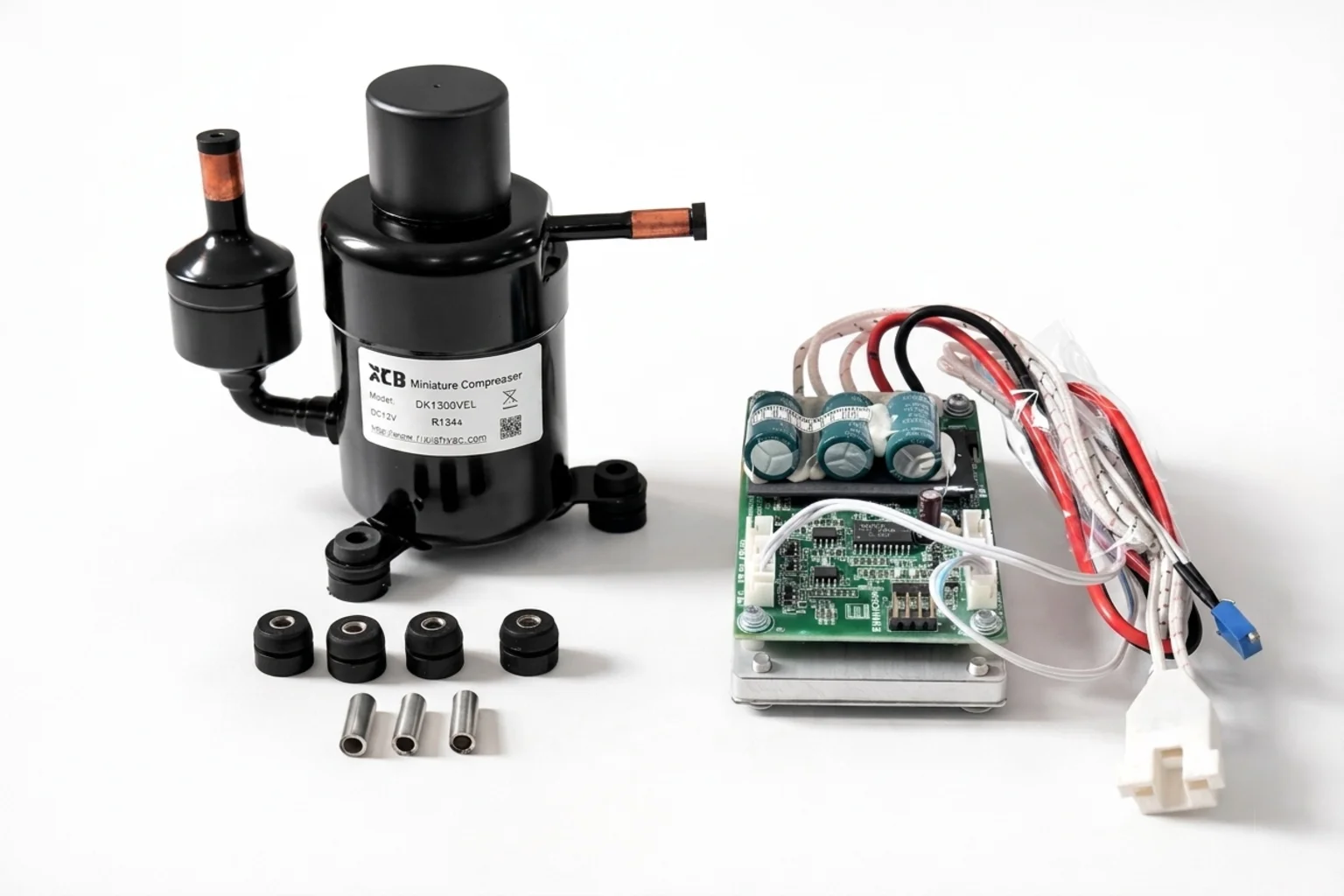
BLDC compressors require an electronic driver board (controller) for commutation and speed control. Some models include integrated controllers; others require a separate board. For OEM integration, check whether the controller accepts speed commands via PWM, analog voltage, or digital communication (UART) — and whether it includes built-in protections for overvoltage, undervoltage, overcurrent, and thermal overload.
Complete Systems vs Standalone Compressors
Mini compressors are available in two forms:
Standalone Compressor Modules
The bare compressor plus driver board, shipped as a component for OEM integration. You design and build the rest of the refrigeration system — evaporator, condenser, expansion device, tubing, and enclosure. This approach gives maximum design flexibility but requires refrigeration engineering expertise. Best for: product manufacturers, R&D engineers, and experienced DIY builders.
Complete Micro AC / Cooling Systems
Pre-assembled systems that integrate the mini compressor with evaporator, condenser, fan, expansion valve, and controller into a ready-to-install unit. You connect power (DC) and mount the unit — no refrigeration work required. Best for: end users, fleet operators, van lifers, campers, and anyone who needs cooling without building a refrigeration system from scratch.
RIGID offers both options. The mini compressor product line includes standalone compressor modules from 100W to 550W for OEM and custom applications, as well as complete micro DC aircon and compact chiller systems for end-user installation. All units use BLDC variable-speed compressors with R134a refrigerant, available in 12V, 24V, and 48V configurations.
Installation Tips for Mini Compressor Systems
Whether you are integrating a standalone compressor or installing a complete micro AC system, these practices ensure reliable operation:
- Mount the compressor on vibration isolation pads. BLDC rotary compressors produce minimal vibration compared to reciprocating types, but some vibration is inherent. Rubber mounts prevent transmission to the enclosure or vehicle structure.
- Ensure adequate condenser airflow. The condenser rejects heat from the refrigeration cycle. If it is enclosed without airflow, head pressure rises, capacity drops, and the compressor eventually shuts down on thermal protection. Maintain at least 100 mm clearance around the condenser and provide fan-forced airflow in enclosed installations.
- Size wiring for peak current. BLDC compressors draw maximum current during startup and high-speed operation. A 550W compressor on 12V can draw 30–40A peak. Use wire gauge rated for the maximum current, not the average. Fuse at the battery terminal, not at the compressor end.
- Handle refrigerant lines carefully. Mini compressor systems use small-diameter copper or aluminum tubing. Do not kink, over-bend, or route tubing where it can contact sharp edges or vibrating components. Kinked tubing restricts flow and degrades performance.
- Provide condensate drainage. Any system that cools air below its dew point produces condensation. Plan for where this water goes — a drain line, collection tray, or drip pan. In vehicle installations, route the drain to the exterior.
What a Mini AC Compressor Cannot Do
Understanding the limits prevents disappointment:
- A single 100–550W mini compressor will not cool a full-size room. For whole-room cooling (10–20 m²), you need 2,000–5,000W — that is traditional AC territory. Mini compressors excel in confined spaces under 5 m³.
- Mini compressors are not designed for deep-freeze applications without system modifications. Standard configurations with R134a reach evaporator temperatures of approximately -10 to -20°C. Medical or laboratory applications requiring -40°C or below need specialized low-temperature systems with cascade refrigeration or different refrigerants.
- DIY integration requires basic refrigeration knowledge. If you are building a custom system from a standalone compressor, you need to understand refrigerant charging, expansion device sizing, and system pressures. Improper refrigerant charge is the most common cause of poor performance in DIY builds.
Frequently Asked Questions
How long do mini AC compressors last?
BLDC mini compressors are designed for 30,000–50,000+ hours of operation — equivalent to over 10 years of continuous use. The absence of brushes, the reduced mechanical stress from variable-speed operation, and the hermetically sealed housing (no dust or moisture intrusion) all contribute to long service life. Actual lifespan depends on operating conditions, ambient temperature, and power quality.
Can I run a mini compressor from solar panels?
Yes, but through a battery. Connecting a compressor directly to solar panels causes voltage fluctuations that can damage the controller. The recommended setup is: solar panel → charge controller → battery → compressor. The battery provides stable voltage and handles the compressor’s variable current draw.
What is the noise level of a mini AC compressor?
Under 40 dB at typical operating speed — quieter than a household refrigerator. At minimum speed during light load conditions, noise drops further to approximately 30–35 dB. This makes mini compressors suitable for noise-sensitive applications including sleeping areas, medical devices, and office equipment.
Do I need to add refrigerant to a mini compressor system?
No. Complete systems and pre-charged compressor modules ship with the correct refrigerant charge sealed inside. Under normal operation, the system should not require refrigerant service during its entire lifespan. If you notice declining performance after years of use, the cause is almost always a dirty condenser or evaporator — not a refrigerant issue.