
Mini Air Conditioner: Three Words, Five Completely Different Products
Search for a mini air conditioner and you will find five distinct product categories all claiming the same name. Some of them cool air. Some of them do not. The difference between a comfortable space and a disappointing purchase comes down to understanding which technology is inside the box — and whether that technology can actually lower temperature or just create the sensation of airflow.
This is not a ranking of brands. It is a breakdown of the technologies sold under the mini air conditioner label, what each one can and cannot do, and how to match the right technology to your actual cooling problem.
Category 1: Evaporative Coolers (Swamp Coolers)
The most common products labeled as mini air conditioners are evaporative coolers. They pull air through a wet filter or pad. As water evaporates, it absorbs heat from the air, lowering the air temperature on the output side.
What they actually do: Lower air temperature by 3–10°C in dry climates. The cooling effect depends entirely on the humidity of the incoming air. In dry desert conditions (below 20% relative humidity), evaporative cooling works well. In humid conditions (above 50% relative humidity), the cooling effect drops to nearly zero because the air cannot absorb more moisture.
What they cannot do: Cool a sealed space. Evaporative coolers add moisture to the air. In a closed room, humidity rises until the air is saturated, and cooling stops entirely. They require ventilation — an open window or exhaust path — which means you are cooling incoming air, not reducing the temperature of a sealed space.
The honest assessment: Evaporative coolers are effective, inexpensive spot coolers in dry climates with good ventilation. They are not air conditioners in any thermodynamic sense. If you live in a humid climate or need to cool a sealed space, an evaporative cooler will disappoint you.
Category 2: USB Desktop Fans
The cheapest products in the mini air conditioner search results are small USB-powered fans, sometimes with a tiny water reservoir for a misting effect. These are fans. They move air across your skin, which accelerates sweat evaporation and creates a cooling sensation.
What they actually do: Create airflow. The wind chill effect makes you feel cooler, but the air temperature in the room does not change. If you put a thermometer in front of the fan and behind it, the readings will be identical.
What they cannot do: Lower the temperature of anything — not air, not a room, not an enclosure. They consume electricity and convert it to air movement plus a small amount of heat from the motor. The room actually gets slightly warmer with a fan running.
The honest assessment: A $15 USB fan is a fine personal comfort device at a desk. Calling it a mini air conditioner is marketing, not engineering.
Category 3: Thermoelectric (Peltier) Coolers
Thermoelectric coolers use the Peltier effect — running electricity through a semiconductor junction to create a temperature differential. One side gets cold, the other gets hot. Air blown across the cold side comes out cooler.
What they actually do: Create a genuine temperature differential across the Peltier element. The cold side can reach temperatures well below ambient. In that narrow sense, they are real cooling devices.
The limitation: Efficiency. A Peltier element converts roughly 30–50% of its electrical input into useful cooling. The rest becomes waste heat on the hot side. For a 60W Peltier module, you might get 20–30W of cooling — enough to noticeably cool a very small space (a pet crate, a small electronics enclosure) but not enough to cool a room or even a large tent.
The scaling problem: To get more cooling, you need more Peltier elements, which means more waste heat, which means bigger heat sinks and fans on the hot side. The system quickly becomes larger, heavier, and less efficient than a compressor-based system at the same cooling capacity.
The honest assessment: Peltier coolers fill a narrow niche — very small cooling loads (under 50W) where simplicity and lack of moving parts (no compressor) matter more than efficiency. For anything above 50W of cooling, compressor-based systems are 3–5 times more efficient.
Category 4: Portable Compressor Air Conditioners
These are genuine air conditioners in miniature. They use the same vapor compression cycle as a window unit or central AC system — compressor, condenser, evaporator, refrigerant — but packaged in a portable format. Most run on 120V AC power and include an exhaust hose for heat rejection.
What they actually do: Real air conditioning. They remove heat from the room and reject it outside through the exhaust hose. They dehumidify as a byproduct. They can maintain a set temperature in a small room.
The limitation: They are not that mini. The smallest portable AC units weigh 15–25 kg, require a window or wall opening for the exhaust hose, and need a standard electrical outlet. They are portable in the sense that they have wheels, not in the sense that you can carry one in a backpack.
The honest assessment: If you have AC power and a window for the exhaust hose, a portable compressor AC is a legitimate cooling solution for a small room. But it is not truly portable, not battery-powered, and not suitable for vehicles, tents, or off-grid locations.
Category 5: DC Micro Air Conditioners
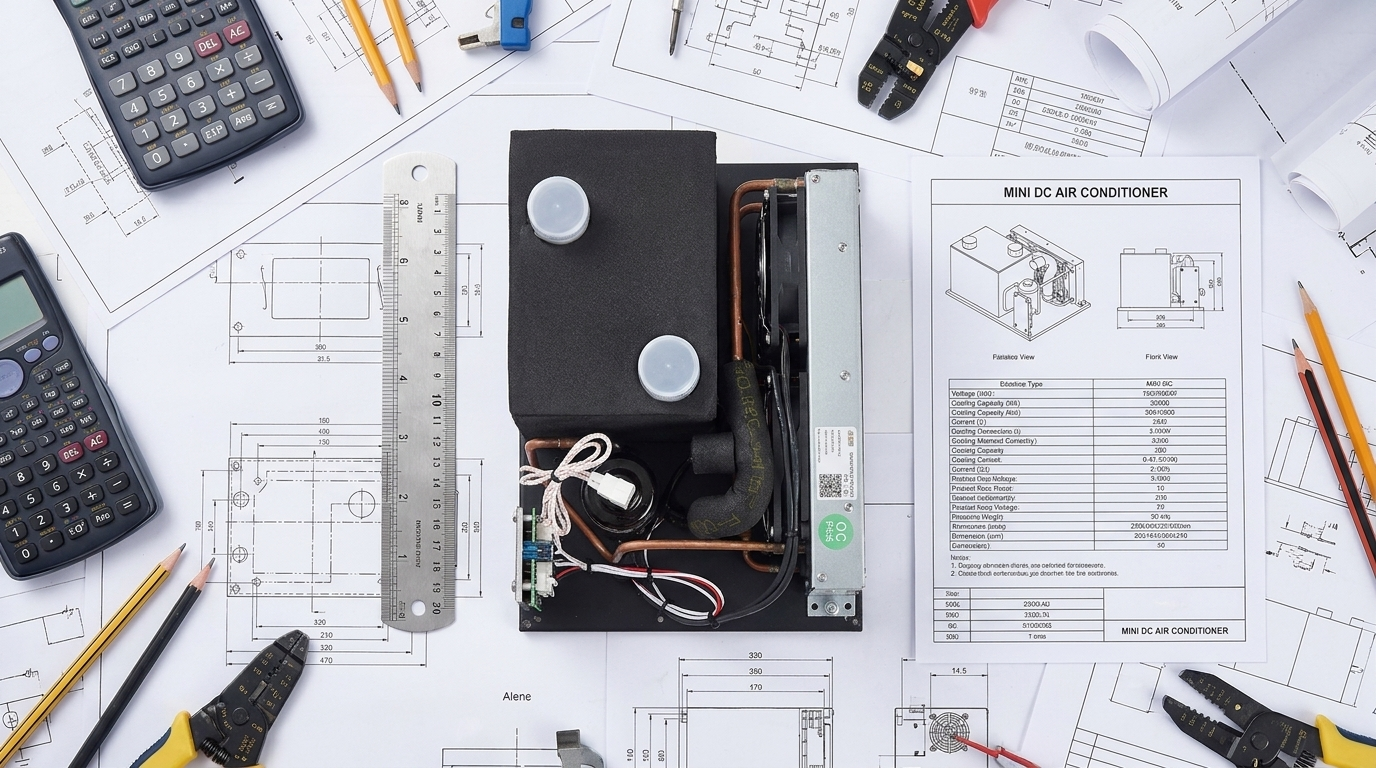
The newest category — and the one that most closely matches what people imagine when they search for a mini air conditioner. These are compressor-based vapor compression systems that run on 12V, 24V, or 48V DC power directly from batteries. They weigh approximately 5 kg (11 lbs) and deliver 450–650W of real cooling capacity.
What they actually do: Everything a full-size air conditioner does — compress refrigerant, absorb heat from the evaporator, reject heat through the condenser — but at a scale that fits in spaces where no other real AC can go. They run from vehicle batteries, portable power stations, or solar panels without an inverter.
The key advantage: DC operation eliminates the inverter that portable AC units need to convert battery DC to household AC. This is not just a convenience feature — it is an efficiency gain. Every DC-to-AC conversion loses 10–15% of the energy as heat. A direct-DC system puts more of the battery’s stored energy into actual cooling.
Cooling capacity in context: 450–650W of cooling handles enclosed spaces up to approximately 2–3 cubic meters. That covers vehicle sleeping areas, pet compartments, camping tents, equipment enclosures, and small cabins. It does not cover a standard bedroom — for that, you need a conventional AC unit.
Noise: The Overlooked Factor
In sleeping areas, pet compartments, and small workspaces, noise matters as much as cooling capacity. Each technology has a different noise profile:
Evaporative coolers: Fan noise only. Typically 30–45 dB depending on fan speed. Quiet, but again — not actually cooling in most conditions.
Peltier coolers: Fan noise from the heat sink fans, plus a faint electrical hum from the Peltier module. Similar to evaporative coolers at 30–45 dB. No compressor noise.
Portable compressor AC (120V): Compressor noise plus fan noise. Typically 50–65 dB. Noticeably louder than the other categories, and the compressor cycling on and off can be disruptive during sleep.
DC micro air conditioner: BLDC compressor noise plus fan noise. Typically 35–50 dB. Quieter than conventional portable AC because the BLDC compressor runs at variable speed — at partial load, it slows down rather than cycling on and off, producing a steady, lower-volume sound rather than intermittent loud cycling.
For noise-sensitive applications, the variable-speed operation of a DC micro air conditioner is a meaningful advantage over conventional portable AC units that cycle between full power and off.
The Comparison That Matters
Here is what each category delivers per watt of electrical input:
- USB fan: 0W of cooling per watt of input. It moves air, it does not cool it.
- Evaporative cooler: Variable, climate-dependent. Effective in dry conditions, useless in humid ones. Cannot cool sealed spaces.
- Peltier cooler: 0.3–0.5W of cooling per watt of input. Real cooling, but inefficient.
- Portable compressor AC (120V): 2.0–3.0W of cooling per watt of input. Efficient, but requires AC power and exhaust hose.
- DC micro air conditioner: 1.5–2.5W of cooling per watt of input. Efficient, battery-powered, no inverter needed.
The efficiency gap between Peltier and compressor-based systems is the single most important fact in this comparison. A compressor system delivers 3–5 times more cooling from the same battery. For battery-powered applications, this difference determines whether you get 2 hours of cooling or 8 hours.
Matching Technology to Your Problem
The right mini air conditioner depends on what you are actually trying to cool and what power you have available:
Desk comfort in an air-conditioned office: A USB fan is fine. The room is already cooled; you just want personal airflow.
Outdoor patio in a dry climate: An evaporative cooler works well. Open air provides the ventilation it needs, and low humidity lets it perform.
Small electronics enclosure under 50W heat load: A Peltier cooler is simple and has no moving compressor parts. The inefficiency is acceptable at this small scale.
Small room with AC power and a window: A portable compressor AC unit is the right tool. It has the capacity and the power source.
Vehicle, tent, off-grid cabin, or equipment enclosure without AC power: A DC micro air conditioner is the only option that provides real cooling from a battery. Nothing else in the mini air conditioner category can do this.
Runtime Reality Check: Battery Hours by Technology
For anyone considering a mini air conditioner for a battery-powered application — a vehicle, a portable power station, an off-grid installation — runtime is the deciding factor. Here is what each technology delivers from a 100Ah 12V lithium battery (approximately 960Wh usable capacity after depth-of-discharge limits):
Evaporative cooler (15W draw): 64 hours of fan operation. But remember — this is not air conditioning. In humid conditions, it provides zero cooling regardless of how long it runs.
Peltier cooler (60W draw for ~20W cooling): 16 hours. You get 20W of actual cooling — enough to lower the temperature in a very small sealed space by a few degrees, but not enough for a vehicle cabin or tent.
DC micro air conditioner (225W average draw for 450W cooling): Approximately 4 hours at full load. With variable speed operation at partial load, 6–8 hours is realistic in moderate conditions. And you get 450W of real cooling — enough to maintain comfortable temperatures in a vehicle sleeping area or small tent.
The math is clear: a DC micro air conditioner delivers 20 times more cooling per battery amp-hour than a Peltier cooler. The Peltier runs longer, but it barely cools. The micro air conditioner runs shorter, but it actually works.
What to Check Before You Buy
Regardless of which category fits your needs, verify these specifications before purchasing:
- Cooling capacity in watts or BTU. If the listing does not state a cooling capacity — just airflow in CFM or a vague “cooling power” claim — it is probably a fan or evaporative cooler, not an air conditioner.
- Power source. Does it need 120V AC? 12V DC? USB? This determines where you can use it.
- Heat rejection method. Real air conditioners must reject heat somewhere — through an exhaust hose, a condenser exposed to outside air, or a water loop. If there is no heat rejection path, it is not an air conditioner.
- Weight. Genuine mini compressor AC units weigh 5–25 kg depending on capacity. If a “mini air conditioner” weighs 500 grams, it is a fan.
- Refrigerant type. Real air conditioners use refrigerants (R134a, R290, R410A). If no refrigerant is listed, the product does not use vapor compression and cannot deliver the same cooling performance.
The mini air conditioner market is crowded with products that use the term loosely. Understanding the technology behind each category protects you from buying a fan when you need an air conditioner, or an air conditioner when a fan would suffice. See the Micro DC Aircon product line for battery-powered vapor compression cooling that delivers real temperature reduction in the smallest possible package.