
What Is a Mini Compressor and Why Does It Matter?
The term mini compressor appears everywhere—from portable tire inflators in your car trunk to the tiny refrigeration units inside medical coolers. But here is the problem: not all mini compressors do the same thing. Some pump air. Some circulate refrigerant. Others drive hydraulic fluid in micro-machinery. If you search for a mini compressor without understanding these distinctions, you risk buying a product that has nothing to do with your actual need.
This guide breaks down the three main categories of miniature compressors, walks through real-world applications for each, and then focuses on how to select the right mini refrigeration compressor when your goal is compact, reliable cooling.
Three Types of Mini Compressors You Should Know
Before diving into specifications, it helps to understand the fundamental categories. Each type of mini compressor serves a completely different purpose, even though they share the word “compressor” in the name.
1. Mini Air Compressors (Pneumatic)
A mini air compressor takes ambient air, compresses it, and stores it in a tank or delivers it directly through a hose. These units are common in workshops, garages, and even households. Typical uses include inflating tires, powering small pneumatic tools like nail guns or airbrushes, and blowing dust off electronics.
Mini air compressors usually run on AC mains power or 12V DC from a vehicle cigarette lighter socket. They are measured by airflow rate (CFM or L/min) and maximum pressure (PSI or bar). Most portable models produce between 100 and 150 PSI, which is more than enough for car tires, bicycle tires, sports balls, and inflatable mattresses. If your project involves moving air or inflating objects, this is the category you need.
2. Mini Hydraulic Compressors (Micro Pumps)
Sometimes referred to as micro hydraulic power units, these miniature compressors pressurize hydraulic fluid to operate small actuators, lifts, or robotic joints. You will find them in industrial automation, compact construction equipment, and certain medical devices that require precise mechanical movement.
Mini hydraulic compressors are niche products. They are characterized by high pressure output relative to their size and typically use specialized hydraulic oil rather than air or refrigerant. Unless you are designing hydraulic micro-systems or compact robotic actuators, you probably will not encounter them in everyday shopping. They are worth mentioning here because an uninformed search for “mini compressor” can surface these products and cause confusion.
3. Mini Refrigeration Compressors (Vapor Compression)
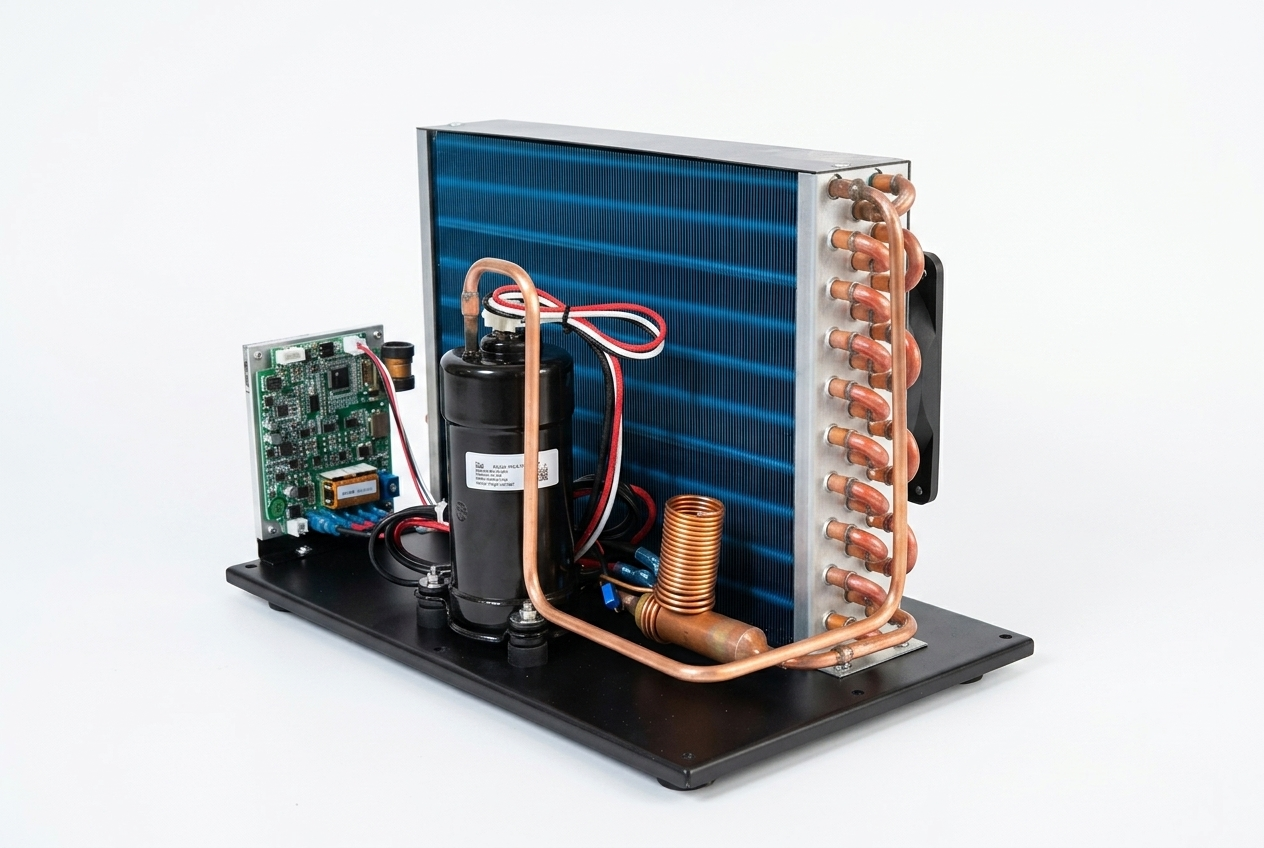
This is where things get interesting for anyone who needs cooling. A mini refrigeration compressor works by compressing refrigerant gas—such as R134a or R290—through a closed vapor-compression cycle. As the refrigerant expands after compression, it absorbs heat from the surrounding environment, producing a cooling effect.
Mini refrigeration compressors are the heart of portable coolers, compact medical refrigerators, mobile air conditioners, and countless other thermal management systems. They are measured by cooling capacity (in watts or BTU), voltage input, and the type of refrigerant they use.
For the remainder of this guide, we focus on this third category—because choosing the wrong refrigeration compressor can mean the difference between a product that cools reliably for a decade and one that fails within months.
Where Are Mini Refrigeration Compressors Used?
The applications for miniature refrigeration compressors have expanded dramatically over the past decade. As devices get smaller and power sources become more portable, the demand for compact cooling has surged across industries.
Mobile and Vehicle Cooling
Truck sleeper cabs, RVs, boats, and electric vehicles all need climate control that runs off DC power. A 12V mini compressor can power a small air conditioning system or a built-in refrigerator without requiring an AC inverter or a running engine. This saves fuel, reduces emissions, and keeps systems quiet. Long-haul drivers, for example, can maintain comfortable cabin temperatures overnight without idling the engine—a significant cost and compliance benefit in regions with anti-idling regulations.
Medical and Laboratory Equipment
Vaccine transport coolers, portable blood storage units, and benchtop laboratory chillers all rely on miniature compressors for precise temperature control. In these applications, noise levels below 40 dB and consistent cooling capacity are non-negotiable requirements.
Consumer Electronics and Portable Appliances
Countertop ice makers, personal beverage coolers, skincare refrigerators, and even wearable cooling vests use mini compressors. The trend toward smaller appliances with genuine cooling performance—not just thermoelectric Peltier modules—is driving adoption of vapor-compression technology at a miniature scale. Unlike Peltier coolers, which struggle to achieve more than a 20°C temperature differential and consume significant power doing so, mini vapor-compression compressors can reach much lower temperatures with far greater energy efficiency.
Industrial and Aerospace Thermal Management
Electronics enclosures on factory floors, avionics cooling systems in aircraft, and thermal regulation for laser equipment all present scenarios where space is limited but heat loads are significant. Miniature DC compressors offer a solution that fits where traditional compressors simply cannot.
Key Specifications for Choosing a Mini Compressor
When you have decided that a mini refrigeration compressor is what you need, the next step is matching specs to your application. Here are the parameters that matter most.
Cooling Capacity (Watts or BTU)
Cooling capacity tells you how much heat the compressor can remove per unit of time. A 100W compressor is suitable for a small personal cooler. A 500W unit can handle a compact air conditioning system or a large mobile refrigerator. Always calculate your heat load first, then select a compressor with capacity that meets or slightly exceeds that figure. Undersizing leads to continuous full-speed operation, higher energy consumption, and accelerated wear. Oversizing wastes money and space.
Operating Voltage
Mini compressors for portable and mobile applications typically come in 12V, 24V, or 48V DC variants. A 12V model connects directly to standard vehicle batteries and solar panel setups. A 24V version is common in commercial trucks and marine systems. A 48V option suits larger solar installations and certain industrial equipment. Choose the voltage that matches your available power source to avoid conversion losses from inverters. Running a 12V compressor through an AC-to-DC converter, for instance, typically adds 10 to 15 percent energy loss compared to direct DC connection.
Refrigerant Type
The refrigerant affects both performance and environmental compliance. R134a is the most widely used and accepted across industries. R290 (propane) offers superior thermodynamic efficiency and a lower global warming potential, making it increasingly popular in eco-conscious designs. R600a (isobutane) is common in household refrigeration. Confirm that the compressor you choose is verified for the refrigerant your system design requires.
Physical Dimensions and Weight
In compact applications, every millimeter counts. Some miniature compressors measure as small as 56.5 mm in diameter and 78 mm in height, weighing under 750 grams. Compare these dimensions against your available mounting space. A compressor that technically meets your cooling needs but physically does not fit is useless.
Speed Range and Variable Speed Control
Brushless DC (BLDC) compressors with variable speed drives can adjust their RPM—commonly from 1,800 to 6,500 RPM—based on cooling demand. This means the compressor runs slower when less cooling is needed and ramps up during peak loads. The result is lower energy consumption, reduced noise, and extended lifespan compared to fixed-speed alternatives.
Ambient Temperature Rating
If your application operates in hot climates or enclosed spaces, pay attention to the maximum ambient temperature rating. Standard miniature compressors may be rated for indoor use up to around 43°C. Tropical-rated models can handle up to 52°C, which is essential for outdoor enclosures, desert environments, or vehicle compartments exposed to direct sun.
DC vs. AC: Why 12V BLDC Compressors Dominate the Mini Segment
Traditional compressors run on AC mains power and use induction motors. They are reliable, well-understood, and widely available. However, they present significant drawbacks at the miniature scale.
AC compressors require a stable power grid connection. In mobile, off-grid, or battery-powered applications, this means adding an inverter—which introduces weight, cost, conversion losses, and another potential point of failure. AC induction motors also run at a fixed speed, meaning they cycle on and off rather than modulating output, which increases wear and creates temperature fluctuations.
12V BLDC (brushless DC) compressors solve these problems. They connect directly to batteries, solar panels, or vehicle electrical systems. Their brushless motors eliminate mechanical commutation, which reduces friction, heat generation, and noise. Variable speed control via an electronic driver board allows precise modulation of cooling output.
The energy savings are substantial. A BLDC compressor running at partial speed to maintain a set temperature uses considerably less power than an AC compressor cycling between full power and off. This translates directly into longer battery runtime, smaller solar panel requirements, and quieter operation. For any application that is portable, mobile, remote, or battery-dependent, a 12V BLDC mini compressor is almost always the better engineering choice.
How RIGID 12V BLDC Mini Compressors Address These Needs
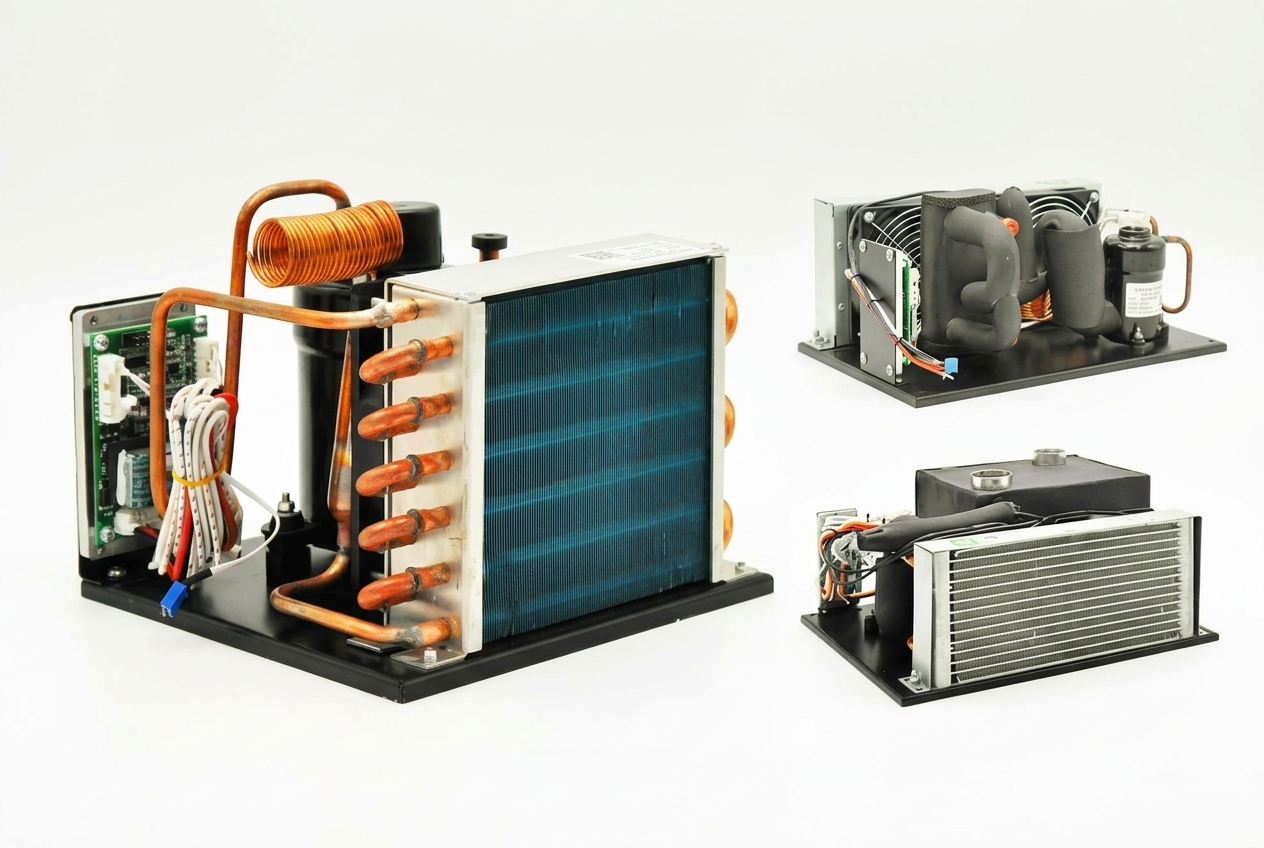
RIGID Technology has been engineering miniature rotary compressors since 2010, and their product line directly addresses the challenges discussed above.
Extreme Compactness
RIGID mini compressors measure as small as 56.5 × 78 mm and weigh just 720 grams (1.6 lbs). To put this in perspective, a traditional reciprocating DC compressor of equivalent cooling capacity typically weighs around 9.5 lbs and occupies roughly three times the volume. RIGID achieves a cooling power density that is up to 17 times greater per unit volume and 10.5 times greater per unit weight than conventional alternatives. This extraordinary power density opens design possibilities that were simply not feasible with traditional compressor technology.
Wide Cooling Range
With models covering 100W to over 550W of cooling capacity, RIGID compressors handle everything from personal coolers to mobile air conditioning systems. They support low back pressure (LBP) applications like freezers with evaporator temperatures below −20°C, medium back pressure (MBP) systems like food coolers, and high back pressure (HBP) systems like chillers and air conditioners.
Flexible Voltage and Refrigerant Options
RIGID compressors are available in 12V, 24V, and 48V DC configurations. They are verified for use with R134a, with additional options for R290 and R600a depending on the model and application requirements. This flexibility allows engineers and product designers to match the compressor to their specific power source and regulatory environment.
Variable Speed Driver Board
Every RIGID BLDC compressor comes with a matched electronic driver board that enables variable speed operation from 1,800 to 6,500 RPM. This is not an add-on accessory—it is an integrated part of the system, ensuring reliable speed modulation and protection features from the start.
Engineered for Harsh Conditions
The T-tropical series, developed in 2017, is rated for continuous operation at ambient temperatures up to 52°C. Low vibration is achieved through anti-vibration cushion mounting. Noise output stays below 40 dB across the operating range. These are not theoretical numbers—they reflect real-world performance in demanding environments across aerospace, medical, and vehicle applications.
Long Service Life
RIGID compressors are designed for a minimum operational lifespan of 10 years with proper installation and maintenance. High-quality internal components and the inherently low-wear nature of brushless motor technology contribute to this durability.
Practical Steps to Choose Your Mini Compressor
Here is a straightforward decision process to follow when selecting a mini refrigeration compressor for your project.
Step 1: Define the cooling requirement. Calculate the heat load your system needs to reject. Consider the target internal temperature, ambient conditions, insulation quality, and any heat-generating components inside the cooled space.
Step 2: Determine the power source. Are you running on 12V vehicle batteries, 24V marine systems, 48V solar arrays, or AC mains? This narrows your compressor voltage options immediately.
Step 3: Check the physical constraints. Measure the available mounting space in all three dimensions. Account for airflow clearance around the condenser and any vibration isolation requirements.
Step 4: Select the refrigerant. Consider regional regulations, environmental goals, and thermodynamic performance. R134a is the safest default. R290 offers better efficiency with appropriate safety measures for its mild flammability.
Step 5: Evaluate the operating environment. Hot climates or enclosed spaces require a tropical-rated compressor. Applications in vehicles or boats need vibration-resistant mounting. Medical or consumer devices demand ultra-low noise.
Step 6: Request a consultation. Miniature compressor selection involves trade-offs. Working with the manufacturer—especially one that offers custom solutions—ensures you get a compressor matched to your exact requirements rather than a generic off-the-shelf unit.
Conclusion
The world of mini compressors is broader than most people realize. Air compressors, hydraulic micro-pumps, and refrigeration compressors all carry the “mini compressor” label, but they serve entirely different functions. For anyone who needs compact, efficient cooling, a miniature refrigeration compressor—specifically a 12V BLDC rotary model—offers the best combination of size, performance, energy efficiency, and reliability.
Understanding the key specifications—cooling capacity, voltage, refrigerant, size, speed control, and ambient rating—gives you the framework to make an informed decision. And when the application demands the smallest possible footprint with the highest cooling power density, RIGID 12V BLDC mini compressors represent a proven solution backed by over a decade of engineering and real-world deployment across some of the most demanding industries on the planet. Whether you are designing a portable medical cooler, a vehicle climate system, or a next-generation consumer appliance, the right mini compressor choice starts with understanding the technology—and ends with choosing a partner that can deliver exactly what your design requires.