
Thermal management challenges are shrinking along with the devices they serve. From handheld medical diagnostics to benchtop laser systems, engineers need cooling solutions that fit inside tight enclosures yet still deliver measurable, repeatable results. A mini cooling system answers that need — but the term covers several fundamentally different technologies, each with its own strengths and trade-offs.
This guide breaks down the four dominant technology routes, explains where each one excels, and shows why vapor-compression micro chillers have become the go-to choice for applications that demand deep temperature reach and laboratory-grade precision.
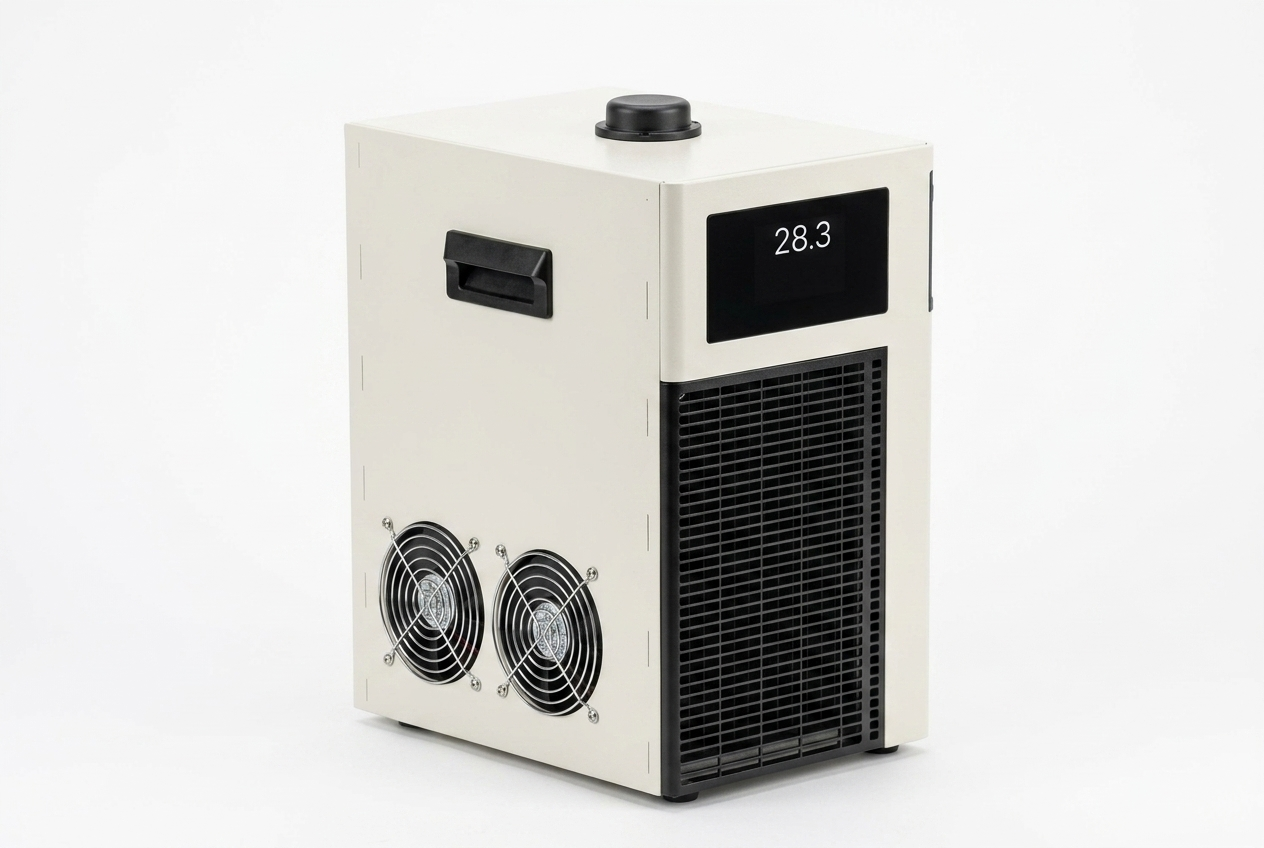
What Is a Mini Cooling System and Why Does It Matter?
A mini cooling system is any thermal management device engineered for a compact footprint — typically small enough to sit on a countertop, embed inside an instrument enclosure, or mount in a mobile platform. Unlike full-scale industrial chillers that occupy entire mechanical rooms, these systems weigh a few kilograms, run on standard AC or DC power, and still maintain precise temperature setpoints.
The demand for miniaturized cooling has surged because modern equipment keeps getting smaller while heat loads stay the same — or grow. Semiconductor test stations, portable PCR analyzers, aesthetic laser handpieces, and compact spectrometers all generate concentrated thermal energy that must be removed quickly and quietly. A well-designed compact cooling system handles that heat without adding bulk, noise, or excessive power draw to the host device.
Choosing the right technology, however, depends on three critical variables: how much heat you need to remove, how cold you need to go, and how tightly you need to hold the target temperature. These three variables determine which of the four main technology routes will serve your application best. Let us examine each one in detail.
Four Technology Routes for Miniature Cooling
Every small cooling system on the market traces its roots to one of four thermodynamic approaches. Understanding each one helps engineers match the technology to the application instead of forcing a compromise that sacrifices performance or wastes energy.
1. Vapor Compression — Maximum Cooling Power in Minimum Space
Vapor-compression refrigeration is the same cycle that powers household refrigerators and commercial chillers, scaled down to fit inside a shoebox-sized enclosure. A miniature compressor circulates refrigerant through an evaporator and condenser, absorbing heat at low pressure and rejecting it at high pressure. The result is high cooling capacity — typically 450 W to well over 1 kW — combined with the ability to reach temperatures as low as −40 °C.
Modern micro compressors use brushless DC motors with variable-speed drives, which means the system adjusts its output to match the actual heat load in real time. That translates into energy savings, low acoustic noise, and temperature stability that can reach ±0.1 °C with a properly tuned PID controller. Refrigerants such as R134a, R290, and R1234yf provide excellent thermodynamic properties while meeting evolving environmental regulations.
Vapor compression is the preferred route when an application demands deep sub-ambient cooling, high heat-flux removal, or continuous operation over long duty cycles. It dominates in laboratory recirculating chillers, medical device cooling, and semiconductor thermal testing — anywhere the required temperature is significantly below room temperature and the heat load is measured in hundreds of watts.
2. Peltier (Thermoelectric) — Solid-State Simplicity
Thermoelectric coolers (TECs) use the Peltier effect: when direct current flows through a junction of two dissimilar semiconductors, one side absorbs heat while the other releases it. Because there are no moving parts, Peltier modules are silent, vibration-free, and extremely compact. They can be stacked or arrayed to reach lower temperatures, though each additional stage reduces net cooling capacity.
The trade-off is efficiency. TECs rarely exceed 10 % of Carnot efficiency at practical temperature differentials, which means they consume far more electrical energy per watt of cooling than a vapor-compression system. Cooling capacity is also limited — most single-stage Peltier modules top out around 50–80 W, and multi-stage cascades that reach −40 °C sacrifice capacity rapidly as the temperature differential increases.
Peltier cooling works well for spot cooling of individual electronic components, temperature stabilization of optical sensors, and portable beverage coolers where the heat load is small and the required ΔT is modest (typically under 20 °C). For higher loads or deeper temperature requirements, engineers generally turn to vapor compression.
3. Liquid Cooling (Pump-Based) — Moving Heat, Not Making Cold
Pump-based liquid cooling circulates water or a water-glycol mixture through cold plates, heat exchangers, or microchannels attached to the heat source. The warm liquid then travels to a remote radiator or fan-cooled heat exchanger where it dumps the heat to ambient air. Because water has roughly 25 times the volumetric heat capacity of air, liquid loops can transport large amounts of energy through small-diameter tubing, enabling sleek system layouts.
This approach is highly effective at spreading heat away from concentrated sources — which is why it dominates in high-performance computing, power electronics, and EV battery thermal management. However, liquid cooling alone cannot cool below ambient temperature. If the room is 25 °C, the coolant will always be warmer than 25 °C after passing through the radiator, no matter how large the radiator is.
For sub-ambient applications, liquid cooling must be paired with an active refrigeration source — such as a vapor-compression chiller — to pre-cool the circulating fluid before it reaches the load. Many recirculating lab chillers use exactly this architecture: a vapor-compression core chills the liquid, and a pump circulates it to the instrument. This hybrid design combines the transport efficiency of liquid cooling with the temperature-making capability of mechanical refrigeration.
4. Air Cooling — The Baseline
Fans and heatsinks remain the simplest and least expensive cooling method. Forced convection pushes ambient air across finned surfaces attached to the heat source, carrying energy away through the airstream. Air cooling is universal in consumer electronics, LED lighting, and low-power embedded systems because it requires no plumbing, no refrigerant, and minimal maintenance.
Its limitations become obvious when heat density rises or when the target temperature must be below ambient. Air has low thermal conductivity and low heat capacity compared with liquids, so removing more than a few hundred watts from a compact area requires large, noisy fan assemblies. For precision temperature control, air cooling is generally inadequate because airflow turbulence and ambient temperature swings introduce instability that is difficult to compensate for with feedback control alone.
Comparing the Four Technologies at a Glance
When deciding among these four approaches, engineers should weigh cooling capacity, achievable temperature range, energy efficiency, and form factor against the application’s true requirements. Each technology occupies a distinct performance zone.
Vapor compression stands alone in its ability to combine deep sub-ambient temperatures, high cooling capacity, and compact size. Peltier modules are ideal for low-wattage spot cooling where silence and zero vibration matter most. Pump-based liquid cooling excels at moving large heat loads away from a source but cannot go below ambient without an active refrigeration stage. Air cooling is the default for low-power, above-ambient scenarios where cost is the primary driver and precision is secondary.
For laboratories, medical devices, and industrial precision instruments, the choice almost always comes down to vapor compression — the only technology that delivers the full combination of capacity, temperature range, and stability these applications demand. When the heat load exceeds roughly 100 W, the target temperature dips below 15 °C, or temperature stability tighter than ±1 °C is needed, no other technology route competes effectively.
Application Categories for Mini Cooling Systems
Understanding where each technology fits helps narrow the selection process. Here are the most common application categories and the cooling approach best suited to each one.
Laboratory and Analytical Instruments
Rotary evaporators, viscometers, reaction vessels, and chromatography columns all require precise, stable coolant temperatures — often well below 0 °C. Vapor-compression recirculating chillers are the standard here because they deliver both the temperature range and the ±0.1 °C stability that analytical protocols demand. The closed-loop liquid design also eliminates the mess and safety hazards of dry ice and liquid nitrogen.
Medical and Diagnostic Devices
Aesthetic laser platforms, PCR thermal cyclers, and cryotherapy applicators need reliable sub-ambient cooling in enclosures small enough for a clinical environment. Vapor compression provides the cooling density; closed-loop liquid circulation delivers the heat to — and from — the treatment head or sample block. Quiet operation is essential in patient-facing settings, making variable-speed compressors with low-noise fans the preferred choice.
Electronics and Semiconductor Testing
Burn-in ovens, thermal cycling chambers, and device characterization stations subject components to rapid temperature transitions. A mini cooling system based on vapor compression can swing from −40 °C to ambient quickly, while liquid circulation ensures uniform thermal contact across the device under test. The ability to heat and cool from a single platform further simplifies the test setup and reduces equipment footprint.
Laser Systems
Diode lasers and fiber lasers generate intense, localized heat that degrades beam quality if not removed promptly. Liquid-cooled cold plates connected to a compact chiller maintain the laser diode junction at a fixed temperature, preserving wavelength stability and extending component life. Even a fraction of a degree of temperature drift can shift the emission wavelength enough to affect process quality in precision laser applications.
Food, Beverage, and Light Industry
Countertop dispensers, micro-batch brewing systems, and small-scale food processing lines benefit from compact refrigeration that fits inside existing equipment without requiring dedicated utility connections. Vapor compression offers the cooling power; DC-compatible designs allow integration into mobile or off-grid platforms powered by batteries or solar panels.
Why Vapor Compression Leads in Precision Miniature Cooling
Across the application categories above, vapor-compression micro chillers appear again and again. Three engineering advantages explain why this technology consistently wins the specification battle.
Energy efficiency. A vapor-compression cycle operating with modern variable-speed compressors achieves a coefficient of performance (COP) of 2–3 or higher at moderate temperature lifts. That means the system removes two to three watts of heat for every watt of electrical input — far exceeding Peltier modules at comparable temperature differentials and making vapor compression the most economical choice for continuous-duty applications.
Temperature range. Single-stage vapor compression with common refrigerants reaches −40 °C without exotic cascade arrangements. This broad range covers the vast majority of laboratory and industrial cooling needs in one platform, eliminating the need for multiple cooling technologies within a single instrument.
Scalable capacity. By varying compressor speed and heat-exchanger sizing, designers can tune a single platform from roughly 450 W to over 1 kW of cooling capacity — all within a countertop-friendly form factor that weighs under 30 kg.
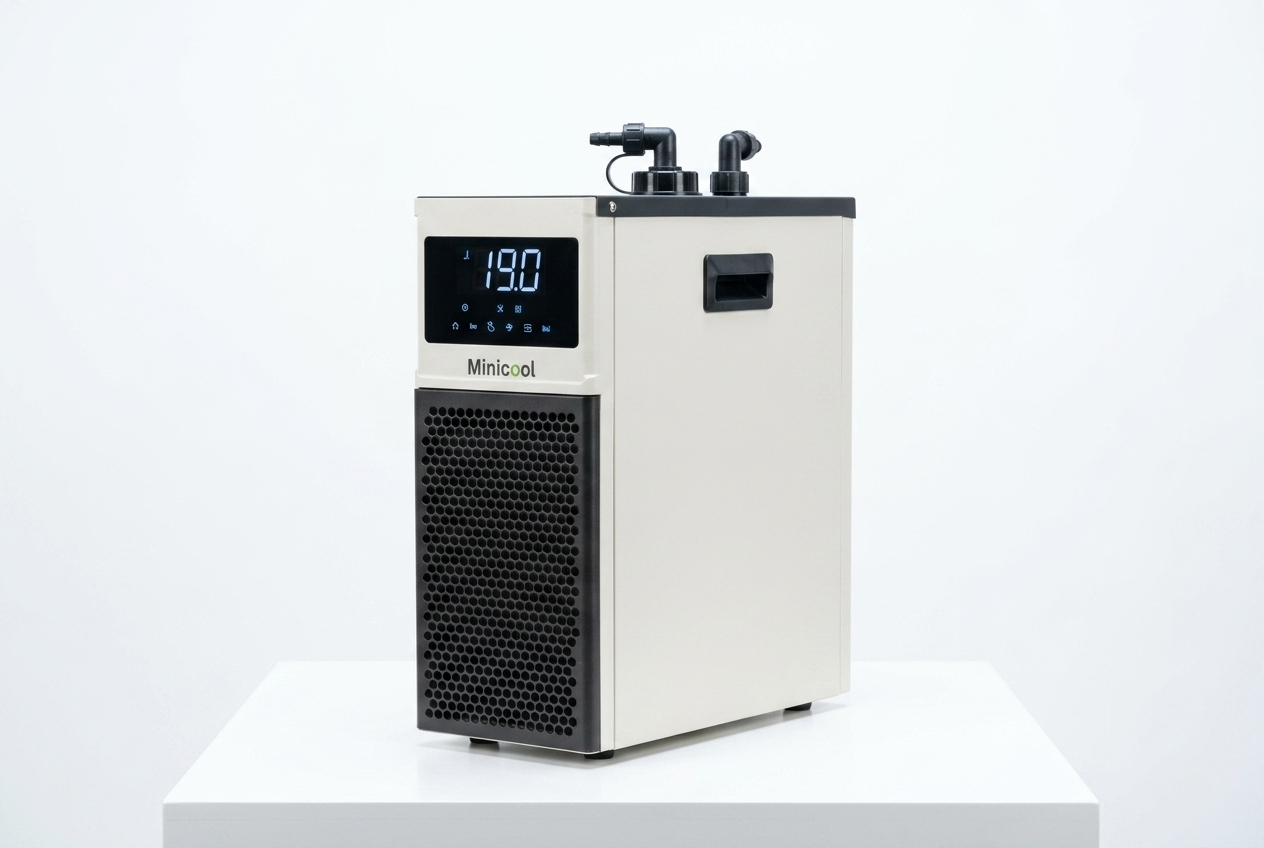
RIGID’s MiniCool™ countertop recirculating lab chiller exemplifies this approach. It packages a variable-speed BLDC compressor, closed-loop liquid circulation, and a PID-based temperature controller into a compact chassis that sits on a laboratory bench. With cooling capacity from 450 W to over 1 kW, a temperature range of 0 °C to −40 °C, and ±0.1 °C precision control, MiniCool delivers the performance profile that laboratories, medical OEMs, and industrial integrators require — without the size, weight, or noise penalty of traditional chillers. Its AC/DC power compatibility further extends its reach into mobile, off-grid, and battery-powered applications.
How to Choose the Right Mini Cooling System for Your Project
Selecting a miniature cooling solution starts with four fundamental questions that define the performance envelope your system must meet.
1. What is the heat load? Quantify the watts that must be removed at steady state and at peak. If the load exceeds 100 W or requires continuous duty, vapor compression is almost certainly the right path. Peltier modules struggle beyond 80 W, and air cooling cannot provide the thermal density needed for concentrated heat sources.
2. What target temperature do you need? If the setpoint is below ambient — especially below 0 °C — only vapor compression and multi-stage Peltier can reach it, and vapor compression does so far more efficiently. For above-ambient applications, simpler liquid or air cooling may suffice.
3. How tight is the temperature tolerance? Applications requiring ±0.5 °C or better benefit from closed-loop liquid cooling driven by a vapor-compression chiller with PID control. Air cooling and simple Peltier setups rarely achieve this level of stability because they lack the thermal mass and flow control that liquid loops provide.
4. What are the size and power constraints? Modern DC-compatible micro compressors allow vapor-compression systems to run on 12 V, 24 V, or 48 V supplies, making them viable for mobile, battery-powered, and solar-powered platforms where space and energy are at a premium. If your application is permanently connected to mains power and size is not a concern, a conventional chiller may be more cost-effective — but for everything else, a mini cooling system offers the best performance-to-footprint ratio available today.
By answering these four questions, engineers can quickly eliminate technologies that cannot meet their requirements and focus on the architecture that delivers the best balance of performance, efficiency, and footprint for their specific use case.
Final Thoughts
The mini cooling system landscape spans four distinct technologies, each with a clear performance envelope. Air cooling handles low-power, above-ambient loads at the lowest cost. Peltier modules serve niche spot-cooling tasks where silence and compactness outweigh efficiency concerns. Pump-based liquid cooling moves heat efficiently across distance but cannot go sub-ambient on its own. And vapor compression — particularly in its modern, variable-speed, DC-compatible form — stands as the most capable and versatile option for applications that demand real refrigeration in a compact package.
For engineers designing the next generation of laboratory instruments, medical devices, or precision industrial systems, understanding these technology routes is the first step toward a cooling architecture that performs reliably, fits the available space, and operates efficiently for years to come. The right mini cooling system does not just remove heat — it enables the performance, accuracy, and reliability that define world-class equipment.