
Quick Answer: If your mini fridge compressor has failed or you’re building a custom compact cooling project, this guide walks you through selecting the right DC compressor by displacement, voltage, refrigerant, and mounting configuration. RIGID miniature BLDC compressors range from 1.5cc to 8.5cc displacement, run on 12V/24V/48V DC, and deliver 100W to 550W cooling capacity — suitable for mini fridges, portable coolers, wine cabinets, and custom builds up to about 19 liters of internal volume per 100W of cooling.
Who This Guide Is For: DIY builders replacing a failed mini fridge compressor, repair technicians sourcing compact DC replacements, small appliance makers prototyping new products, and hobbyists building custom cooling systems from scratch.
Mini Fridge Compressor Selection: Key Decisions Before You Start
Before diving into specs and models, here’s the decision framework that determines which compressor fits your project:
- Cooling requirement — How many watts of cooling does your cabinet or enclosure need? (Measure or estimate heat load first.)
- DC voltage available — Are you running 12V (vehicle/battery), 24V (solar/marine), or 48V (industrial)?
- Refrigerant choice — R134a (most common, proven reliability), R290 (higher efficiency, flammable), or R600a (low GWP, household standard)?
- Physical space — What’s your available mounting envelope? Horizontal or vertical orientation?
- Operating temperature range — Ambient temperature at the condenser side, and target temperature inside the cooled space.
- Power source — Battery, solar panel, vehicle alternator, or AC-to-DC converter?
Why Mini Fridge Compressors Fail and When to Replace
Most mini fridge compressors fail for predictable reasons: worn bearings after years of continuous operation, refrigerant leaks from corroded tubing, or electrical faults in the motor windings. When a compressor fails in a thermoelectric cooler conversion or a traditional absorption-type mini fridge, replacing with a vapor-compression DC compressor is often the most effective upgrade path.
Signs your mini fridge compressor needs replacement:
- Compressor runs continuously but cabinet temperature rises
- Clicking or buzzing sounds without the compressor starting
- Compressor starts then shuts off within seconds (thermal overload tripping)
- Visible oil residue around compressor fittings (refrigerant leak)
- Cabinet reaches only 15-20°C instead of target 2-5°C
For DIY builders converting thermoelectric (Peltier) coolers to vapor compression, a miniature BLDC compressor delivers 3-4 times the cooling efficiency of a Peltier element at the same power draw, with better temperature differential capability.
Understanding Compressor Specifications for Mini Fridge Applications
Choosing the right replacement compressor means matching several parameters to your specific application. Here’s what each specification means in practical terms.
Displacement (cc)
Displacement determines the volume of refrigerant gas the compressor moves per revolution. RIGID miniature compressors range from 1.5cc to 8.5cc. A 1.5cc unit suits small personal coolers (6-15 liters), while an 8.5cc unit handles larger mini fridges (40-60 liters) or applications requiring faster pull-down times.
Cooling Capacity (Watts)
This is the actual heat removal rate under standard ASHRAE test conditions. RIGID compressors deliver 100W to 550W of cooling capacity depending on model, speed (RPM), and operating conditions. Do not confuse cooling capacity with electrical input power — a compressor drawing 50W of electrical power might deliver 150W of cooling capacity (COP of 3.0).
Variable Speed (RPM)
RIGID BLDC compressors use variable-speed driver boards with a range of 1,800 to 6,500 RPM. This means you can tune cooling output to match your load — run slower for energy savings during maintenance mode, or faster for rapid pull-down after door openings.
Voltage Options
Available in 12V, 24V, and 48V DC configurations. Choose based on your power source:
- 12V — Direct vehicle battery connection, small solar setups, portable applications
- 24V — Marine systems, larger solar arrays, truck APU systems
- 48V — Higher-efficiency applications, reduced current draw for the same power output
Refrigerant Compatibility
RIGID compressors are verified for R134a, with R290 and R600a options available. R134a remains the safest choice for DIY builders due to its non-flammable nature and wide availability of compatible components. R290 (propane) offers higher thermodynamic efficiency but requires careful handling and charge limits due to flammability.
Replacement Sizing: Matching Compressor to Your Mini Fridge
As a rough early-stage screening guideline (not a hard rule), here’s how to estimate the compressor size you need:
- Measure your cabinet volume in liters
- Estimate insulation quality — standard polyurethane foam (30-50mm) or thin polystyrene?
- Determine target temperature — fridge mode (2-8°C) or freezer mode (-18°C)?
- Consider ambient temperature — indoor (25°C) or outdoor/vehicle (up to 43°C)?
For a typical well-insulated 30-liter mini fridge targeting 5°C in a 25°C room, you need approximately 80-120W of cooling capacity. A RIGID compressor in the 2.5-3.5cc displacement range running at moderate RPM would handle this comfortably.
For freezer applications (-18°C target), the same cabinet volume requires roughly 50% more cooling capacity due to the larger temperature differential, pointing toward a 4.5-6.5cc displacement unit.
Selection Matrix: Compressor Model by Application
| Application | Cabinet Size | Cooling Need | Suggested Displacement | Voltage | Why |
|---|---|---|---|---|---|
| Personal cooler (car/camping) | 6-15L | 50-100W | 1.5-2.5cc | 12V | Smallest form factor, direct battery power, low current draw |
| Mini fridge (dorm/office) | 20-40L | 100-200W | 2.5-4.5cc | 12V or 24V | Balanced capacity and efficiency for standard mini fridge replacement |
| Wine cooler / cosmetic fridge | 15-30L | 80-150W | 2.5-3.5cc | 24V | Quiet operation priority, moderate cooling, stable temperature |
| Portable medical cooler | 5-20L | 60-120W | 1.5-3.5cc | 12V or 24V | Battery operation, precise temperature control via variable speed |
| Custom freezer build | 20-50L | 150-350W | 4.5-8.5cc | 24V or 48V | Higher capacity for low-temperature applications |
| Countertop ice maker | N/A | 200-400W | 5.5-8.5cc | 24V or 48V | High cooling demand, rapid cycle times |
| Solar-powered off-grid fridge | 30-60L | 100-250W | 3.5-5.5cc | 12V or 24V | Variable speed matches intermittent solar input |
Important: These are rough early-stage screening guidelines. Actual compressor selection depends on your complete system design including condenser sizing, evaporator configuration, ambient conditions, and duty cycle. RIGID engineers can validate your selection with detailed performance data.
Custom Build Options: Beyond Simple Replacement
For builders going beyond drop-in replacement — designing custom enclosures, converting thermoelectric coolers, or prototyping new products — RIGID offers several customization paths:
Mechanical Customization
- Mounting orientation — Horizontal or vertical mounting with appropriate oil management
- Mounting bracket modifications — Custom brackets for non-standard enclosures
- Connection tube length and angle — Adjusted suction and discharge tube routing
Electrical Customization
- Voltage variants — 12V, 24V, or 48V to match your power architecture
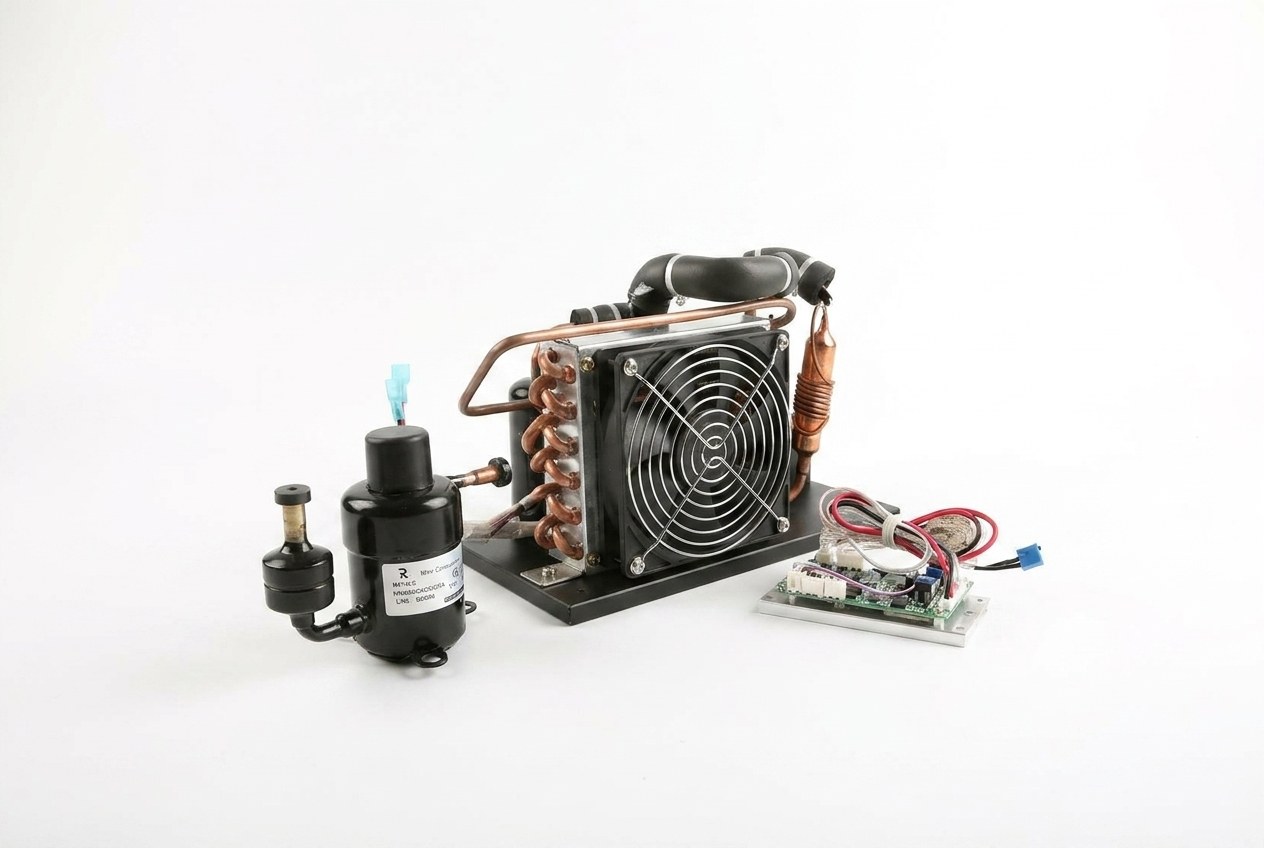
- Driver board integration — Standalone driver board or integrated controller options
- Speed control interface — PWM input, analog voltage, or serial communication for smart control
System-Level Support
- Refrigerant charge guidance — Recommended charge amounts for your system volume
- Capillary tube sizing — Matched to your evaporator and condenser design
- Performance curve data — Capacity and power consumption across your operating envelope
Minimum order quantity starts at 1 unit for engineering samples and prototypes, making it accessible for individual builders and small-batch manufacturers alike.
Installation Considerations for DIY Builders
Whether you’re replacing a failed compressor or building from scratch, these installation factors determine system reliability:
Mounting and Vibration
RIGID compressors include anti-vibration cushions and operate with low vibration characteristics. Mount the compressor on a solid surface with the supplied grommets. Keep the compressor upright during installation — oil can migrate into suction lines if tilted, causing brazing difficulties and potential contamination.
Brazing and System Assembly
All system components (tubing, evaporator, condenser, filter drier) must be internally clean and dry. RIGID recommends assembling components within 15 minutes of removing protective caps to prevent moisture absorption. Flow nitrogen through the system during brazing to prevent oxide formation.
Charging and Startup
After assembly, evacuate the system to remove moisture and non-condensibles. RIGID compressors ship with 25cc of RL-32H polyolester oil pre-charged. The system requires proper evacuation (below 500 microns) before refrigerant charging. Start with the manufacturer’s recommended charge amount and adjust based on superheat/subcooling measurements.
Operating Environment
RIGID compressors operate in ambient temperatures from +5°C minimum (required for proper lubrication) up to 52°C for the T-tropical series. Noise levels remain below 40dB, suitable for bedroom or office environments.
Comparing DC Compressor vs. Thermoelectric (Peltier) for Mini Fridge Builds
Many DIY builders start with Peltier modules due to simplicity, then upgrade to compressor-based systems for better performance. Here’s how they compare:
| Parameter | RIGID DC Compressor | Thermoelectric (Peltier) |
|---|---|---|
| Cooling capacity | 100-550W | 20-80W typical |
| Efficiency (COP) | 1.5-3.5 | 0.3-0.7 |
| Temperature differential | Up to 50°C+ | 15-25°C max practical |
| Power consumption for 100W cooling | 30-65W electrical | 150-300W electrical |
| Weight for equivalent cooling | 1-2 kg system | 3-5 kg (multiple modules + heatsinks) |
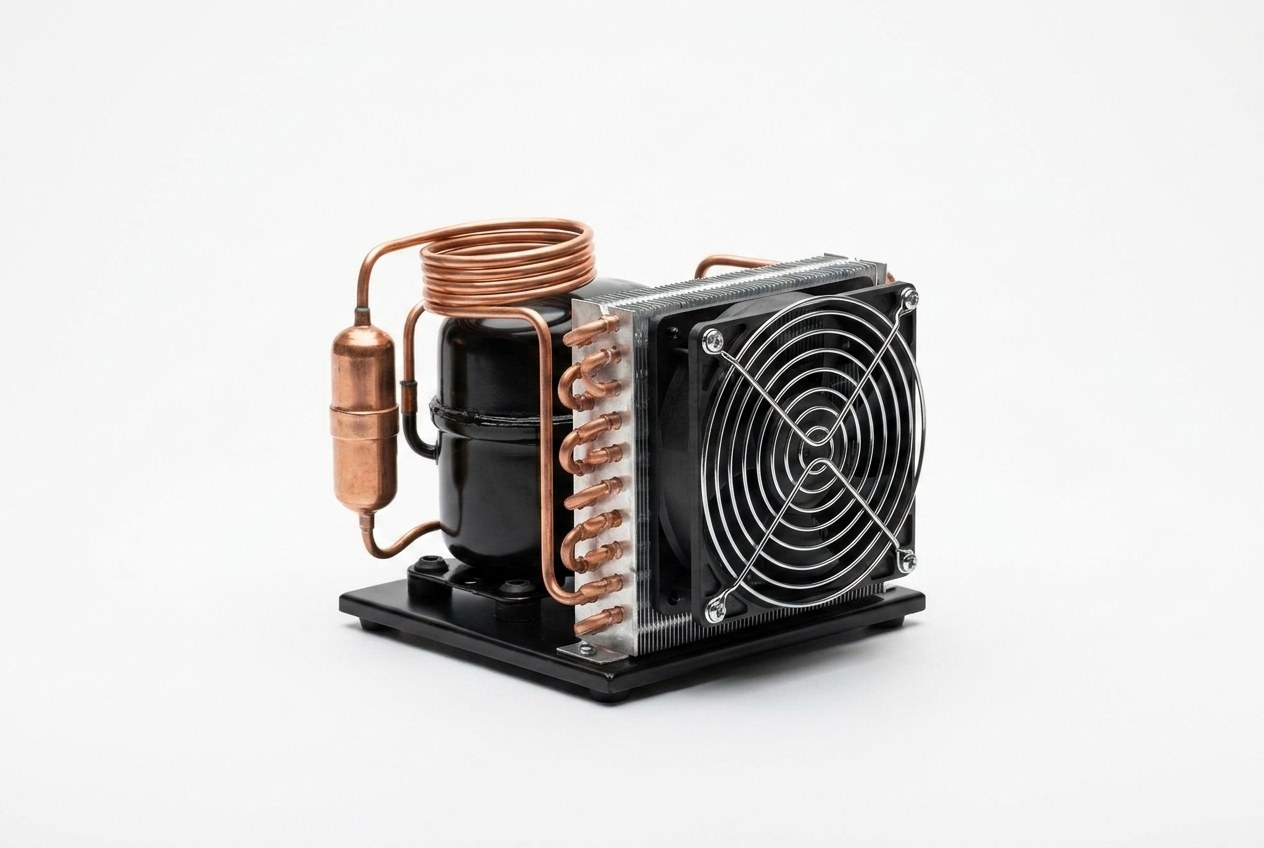
| Volume for equivalent cooling | Compact (fist-sized compressor) | Large heatsink assemblies required |
| Noise | <40dB | Fan noise only (but more fans needed) |
| Complexity | Requires refrigerant system | Simple DC connection |
| Freezer capable | Yes (-18°C and below) | Not practical |
| Lifespan | 10+ years | 2-5 years typical |
For any application requiring more than 60W of cooling, temperature targets below 10°C, or operation in warm ambient conditions, a vapor-compression system with a miniature DC compressor significantly outperforms thermoelectric solutions.
Cost Considerations for Mini Fridge Compressor Projects
Pricing for miniature DC compressors varies by model, configuration, quantity, and customization requirements. Key factors that affect cost:
- Displacement/capacity — Larger displacement models cost more
- Voltage configuration — Standard voltages (12V, 24V) vs. custom
- Quantity — Single prototype units vs. production batches
- Customization level — Standard catalog vs. modified mounting, tubing, or driver board
- Refrigerant type — R134a standard; R290/R600a may require specific sealing materials
For individual builders and repair technicians, RIGID offers single-unit samples for evaluation before committing to larger orders. This lets you validate fit, performance, and integration in your specific application before scaling up.
Application Boundaries: What These Compressors Are and Aren’t For
RIGID miniature compressors are designed for compact, DC-powered cooling applications. To set clear expectations:
Well-suited applications:
- Mini fridges and personal coolers (6-60 liters)
- Portable medical and vaccine transport coolers
- Wine coolers and cosmetic refrigerators
- Custom vehicle refrigeration (trucks, RVs, boats)
- Solar-powered off-grid refrigeration
- Countertop beverage dispensers and ice makers
- Electronics cooling and thermal management enclosures
- Laboratory sample storage
NOT suitable for:
- Full-size household refrigerators (300+ liters)
- Commercial walk-in coolers or freezers
- Large-capacity ice machines (50+ kg/day)
- Central air conditioning systems
- Industrial process cooling requiring kilowatts of capacity
- Applications requiring AC-powered compressors with standard household plug operation
The cooling capacity ceiling of 550W defines the practical upper boundary. If your heat load calculation exceeds this, you need a larger compressor platform. For applications within this range, RIGID miniature compressors offer a compelling combination of compact size, DC power compatibility, and variable-speed efficiency.
For related DC-powered cooling solutions including portable air conditioning units, see our guide on micro DC air conditioning systems.
Frequently Asked Questions
What size compressor do I need for a 20-liter mini fridge?
For a well-insulated 20-liter mini fridge targeting 2-5°C in a 25°C room, a compressor with 80-120W cooling capacity is typically sufficient. This corresponds to approximately 2.5-3.5cc displacement in the RIGID range. Actual sizing depends on insulation thickness, door seal quality, and how often the door opens.
Can I replace my mini fridge’s AC compressor with a DC compressor?
Yes, but it requires system redesign beyond a simple swap. You’ll need to match the refrigerant type, resize the capillary tube or expansion device, and add a DC power supply or battery system. The physical mounting may also differ. RIGID compressors are significantly smaller than most AC mini fridge compressors, so space is rarely an issue.
How long do RIGID miniature compressors last?
With proper installation and clean system practices, RIGID compressors are designed for 10+ years of operation. Key factors affecting lifespan include system cleanliness (no moisture or contaminants), proper oil charge, adequate condenser cooling, and operating within specified ambient temperature limits.
What refrigerant should I use for a DIY mini fridge build?
R134a is the safest and most practical choice for DIY builders — it’s non-flammable, widely available, and has extensive component compatibility. R290 (propane) offers better thermodynamic efficiency but is flammable and requires certified handling. R600a (isobutane) is common in commercial mini fridges but also flammable. For first-time builders, start with R134a.
Can these compressors run on solar power?
Yes. RIGID DC compressors are well-suited for solar applications. The variable-speed capability (1,800-6,500 RPM) allows the compressor to modulate output based on available solar power. A 12V or 24V system with appropriate battery storage and charge controller can power these compressors effectively for off-grid refrigeration.
How quiet are RIGID mini compressors compared to standard mini fridge compressors?
RIGID compressors operate below 40dB, which is comparable to a quiet library or whispered conversation. Standard mini fridge compressors typically produce 42-50dB. The BLDC motor and rotary mechanism produce less vibration than reciprocating designs, further reducing noise transmission to the cabinet.
What’s the minimum order for a custom compressor configuration?
RIGID supports engineering evaluation and prototype development starting from single-unit samples. There’s no large minimum order requirement for initial evaluation. For production orders with custom specifications (modified voltage, displacement, mounting, or driver board), discuss your requirements directly with RIGID engineering to determine lead times and pricing.
Can I use these compressors for a freezer application (-18°C or below)?
Yes. RIGID compressors support Low Back Pressure (LBP) applications with evaporator temperatures below -20°C. For freezer builds, select a larger displacement model (4.5-8.5cc) to maintain adequate mass flow at the lower suction pressures. System design (condenser sizing, insulation, expansion device) becomes more critical at freezer temperatures.
Do I need a separate controller/driver board?
RIGID compressors use a BLDC motor that requires an electronic driver board for operation. The driver board is available as a separate component or can be integrated into your control system. It provides variable speed control (1,800-6,500 RPM) and typically accepts PWM or analog input signals for speed adjustment.
What’s the weight and size of the smallest RIGID compressor?
The smallest RIGID miniature compressor measures 56.5 × 78mm (diameter × height) and weighs 720g (1.6 lbs). Despite this compact size, it delivers meaningful cooling capacity — significantly more than thermoelectric modules of similar or larger size. This makes it suitable for space-constrained applications where every cubic centimeter matters.