
Why Every Precision Application Needs a Mini Water Chiller
Thermal management failures cost industries billions each year. In laser engraving shops, a temperature drift of just 2°C can ruin an entire batch of cut parts. In medical laboratories, unstable coolant temperatures compromise diagnostic accuracy and force repeat testing that wastes expensive reagents. In electronics testing facilities, overheated components produce unreliable data that delays product launches by weeks and erodes customer confidence in quality assurance processes.
A mini water chiller addresses these challenges by delivering compact, closed-loop liquid cooling that fits directly into space-constrained workflows. Unlike bulky industrial chillers that dominate floor space and require dedicated utility rooms, modern compact water chillers sit on a benchtop or inside a fume hood while providing the same precision cooling that sensitive applications demand. The shift toward smaller, more efficient cooling systems reflects a broader industry trend: equipment is getting more powerful and more compact simultaneously, and cooling solutions must keep pace.
This guide explores how different industries use mini water chillers to solve specific thermal problems — and what performance characteristics matter most in each scenario. Whether you work with fiber lasers, analytical instruments, or high-density circuit boards, understanding your application requirements helps you select a cooling solution that actually performs under real operating conditions rather than just meeting specifications on paper.
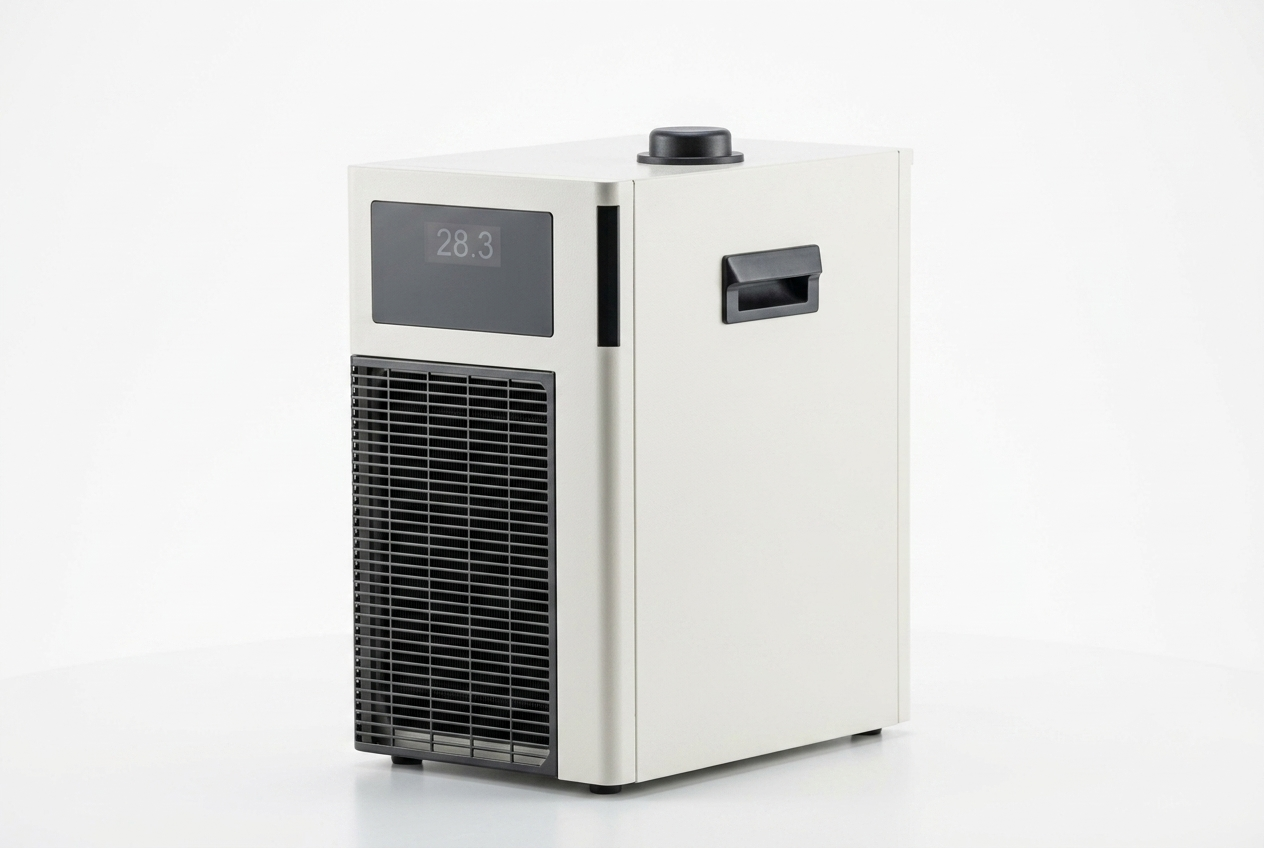
Laser System Cooling: Stability That Protects Your Optics
Laser systems generate concentrated heat at the source, and that thermal energy must be removed continuously to maintain beam quality and extend component life. CO2 lasers, fiber lasers, and diode lasers each produce different heat loads, but they share one critical requirement: consistent coolant temperature throughout the entire operating window.
When coolant temperature fluctuates, laser wavelength shifts. For CO2 laser cutters processing acrylic or wood, this means inconsistent cut depth and charred edges that require rework or scrap entire workpieces. For fiber lasers marking metal parts in manufacturing lines, wavelength drift creates uneven engraving depth that fails quality inspection and disrupts production schedules. Even small temperature variations compound over long cutting sessions, turning acceptable morning output into rejected afternoon production.
A compact water chiller designed for laser applications needs three key capabilities. First, it must hold temperature within a tight band — ideally ±0.1°C — throughout the entire operating cycle, including startup, steady-state operation, and varying ambient conditions. Second, it needs enough cooling capacity to handle the continuous heat output without cycling on and off, because compressor cycling introduces the temperature swings that cause beam instability. Third, the unit should operate quietly enough for workshop environments where operators spend full shifts nearby without hearing protection.
Small desktop lasers in the 40W to 100W range typically require 200W to 500W of cooling capacity. Higher-power fiber lasers used in metal fabrication may need 800W or more. The key metric is matching your laser’s actual heat rejection to the chiller’s sustained cooling capacity at your target temperature — not just the peak rating printed on a specification sheet. Ambient temperature plays a significant role as well, since a chiller rated at 500W in a 20°C room delivers considerably less capacity in a 35°C summer workshop without adequate ventilation.
Many laser operators discover that their cooling problems stem not from insufficient capacity but from poor temperature stability. A chiller that swings ±2°C around its setpoint creates the same quality issues as one that is slightly undersized. Precision control matters more than raw power in most laser cooling applications, and investing in tighter temperature regulation pays for itself through reduced waste and higher throughput.
Medical and Diagnostic Equipment: Where Accuracy Is Non-Negotiable
Medical devices operate under strict performance standards enforced by regulatory bodies, and thermal management directly affects diagnostic outcomes that influence patient care decisions. Blood analyzers, histology processors, PCR machines, and imaging systems all depend on precise temperature control to produce reliable, reproducible results that clinicians trust.
In clinical chemistry analyzers, reagent temperatures must remain stable during sample processing. A drift of even 0.5°C can alter enzyme reaction rates and produce inaccurate patient results that lead to misdiagnosis or unnecessary follow-up testing. For MRI and CT cooling subsystems, consistent heat removal prevents thermal shutdowns that interrupt scheduled patient scans and create costly delays in radiology departments already operating at capacity.
Medical cooling applications impose unique requirements beyond temperature precision. Equipment must operate at low noise levels in clinical environments where patients and technicians work in close proximity, often in enclosed rooms where sound reverberates. The cooling system must also be compact enough to integrate into or beside the medical device without requiring dedicated utility space that many clinics and hospitals simply cannot allocate.
Reliability carries extra weight in medical settings. A chiller failure during a diagnostic run can waste expensive reagents costing hundreds of dollars per test cartridge, delay critical patient results, and disrupt clinical workflows across entire departments. Medical-grade cooling solutions need proven compressor technology and closed-loop recirculating designs that minimize maintenance requirements and eliminate contamination risks from open water systems.
The temperature range matters significantly in medical applications. Histology tissue processors may need coolant at -20°C or below for paraffin embedding stations, while blood bank refrigeration systems operate near 4°C. Cryotherapy devices require even lower temperatures for targeted tissue treatment. A versatile small water chiller with a wide temperature range — from 0°C down to -40°C — covers the majority of medical cooling scenarios without requiring multiple dedicated units, simplifying procurement and reducing the total cost of ownership for healthcare facilities.
Electronics and Semiconductor Testing: Removing Heat from Tight Spaces
Modern electronics pack increasing processing power into shrinking form factors, and the thermal density challenge grows with each product generation. Testing these components under thermal stress requires cooling solutions that can remove concentrated heat loads from small areas without introducing vibration or electromagnetic interference that corrupts sensitive measurements.
Semiconductor burn-in testing subjects chips to elevated temperatures for extended periods, then requires rapid cooling to verify performance across the full operating range. Power electronics testing generates intense, localized heat that must be dissipated to prevent component damage during validation cycles that may run for days or weeks continuously. LED manufacturing requires precise thermal management during binning and sorting processes to ensure accurate color temperature classification that determines product pricing and application suitability.
Electronics cooling applications present a distinct challenge: the heat loads are often intermittent and highly variable. A testing station might run at 200W heat rejection for one cycle, then jump to 800W for the next test sequence. The chiller must respond quickly to changing loads without overshooting or undershooting the target temperature, because thermal transients during load changes can damage sensitive devices under test or invalidate calibration procedures.
Vibration isolation matters enormously in electronics testing environments. Sensitive measurement equipment including oscilloscopes, network analyzers, and precision balances can pick up mechanical vibrations from nearby cooling systems, corrupting test data and requiring expensive retesting. A benchtop water chiller with low-vibration compressor technology eliminates this interference without requiring separate vibration-dampening mounts or physical isolation from the test bench.
For semiconductor fabs and electronics testing labs, the cooling system’s footprint often determines whether it can be deployed at all. Floor space in these facilities is allocated by the square meter at premium rates, and every piece of support equipment competes with production tools for room. A countertop chiller that delivers industrial-grade cooling performance without claiming floor space solves a real facility planning problem that project managers face during every equipment installation cycle.
Laboratory and Research Applications: Flexibility for Evolving Experiments
Research laboratories face a cooling challenge that differs fundamentally from production environments: requirements change constantly as projects evolve and new experiments begin. A chemistry lab running rotary evaporators this month might switch to reflux condensers next month. A materials science group testing thermal conductivity samples needs different temperature setpoints for each material under study, sometimes adjusting multiple times per day.
This variability demands a portable water chiller that adapts quickly to new configurations. Researchers need to adjust temperature setpoints without complex reprogramming or technician support, connect to different instruments without custom plumbing that takes days to fabricate, and relocate the unit between workstations as projects evolve throughout the academic year.
University and institutional labs face additional constraints that commercial facilities rarely encounter. Budget cycles mean equipment purchases must serve multiple purposes across different research groups to justify capital expenditure approvals. Space in shared laboratories is limited and politically allocated, and noisy equipment creates friction between neighboring research teams conducting different types of work. A single compact chiller that covers a wide temperature range and operates quietly earns its place in shared facilities far more readily than specialized units that serve only one research group.
For applications like chemical reaction temperature control, immersion cooling of samples, and analytical instrument conditioning, the chiller may also need to function as a heating and cooling bath. This dual capability eliminates the need for separate heating mantles and cooling systems, simplifying the experimental setup and reducing the number of instruments competing for precious bench space in crowded laboratories.
Environmental testing applications add another dimension to laboratory cooling requirements. Climate simulation chambers, accelerated aging tests, and material stress testing all require sustained cooling at specific temperatures for extended periods. The chiller must maintain its setpoint reliably over hours or days without operator intervention, because interrupted test cycles waste time and may invalidate results that took weeks to accumulate.
Matching Your Application to the Right Cooling Specifications
Selecting a mini water chiller based on application requirements — rather than price alone — prevents costly mismatches that result in equipment returns, performance compromises, or expensive upgrades six months after purchase. Here is how to evaluate the critical specifications for your specific use case.
Cooling capacity must exceed your actual heat load by a reasonable margin. Calculate your heat rejection based on the equipment’s power consumption and thermal efficiency, not just the manufacturer’s suggested chiller size. A 20% capacity margin provides headroom for ambient temperature variations, system aging over years of operation, and the occasional high-demand test cycle that exceeds normal operating parameters.
Temperature range determines which applications the chiller can serve today and in the future. Units reaching -40°C handle cryogenic sample preparation and low-temperature testing, while those limited to 5°C or above miss entire application categories including tissue processing, certain chemical reactions, and cold-temperature electronics validation. A broader range provides future flexibility as your needs evolve and new projects emerge.
Temperature stability — measured as the control band around the setpoint — directly affects result quality across every application discussed in this guide. For laser and medical applications, ±0.1°C stability is the practical threshold for professional-grade performance. Wider control bands may work for general-purpose cooling but will limit your ability to take on precision applications that demand tighter thermal control.
Physical footprint determines deployment feasibility in real-world environments. Measure your available space before evaluating thermal specifications. A chiller with perfect thermal performance is useless if it does not fit your workspace. Countertop designs that mount on, under, or beside existing equipment maximize installation flexibility and preserve valuable floor space for revenue-generating production equipment.
Power supply compatibility matters for mobile and specialized installations. Units supporting both AC and DC power inputs adapt to field deployments, vehicle-mounted systems, and facilities with non-standard electrical infrastructure. This versatility becomes increasingly important as applications move toward portable and distributed configurations.
How MiniCool Addresses Cross-Industry Cooling Demands
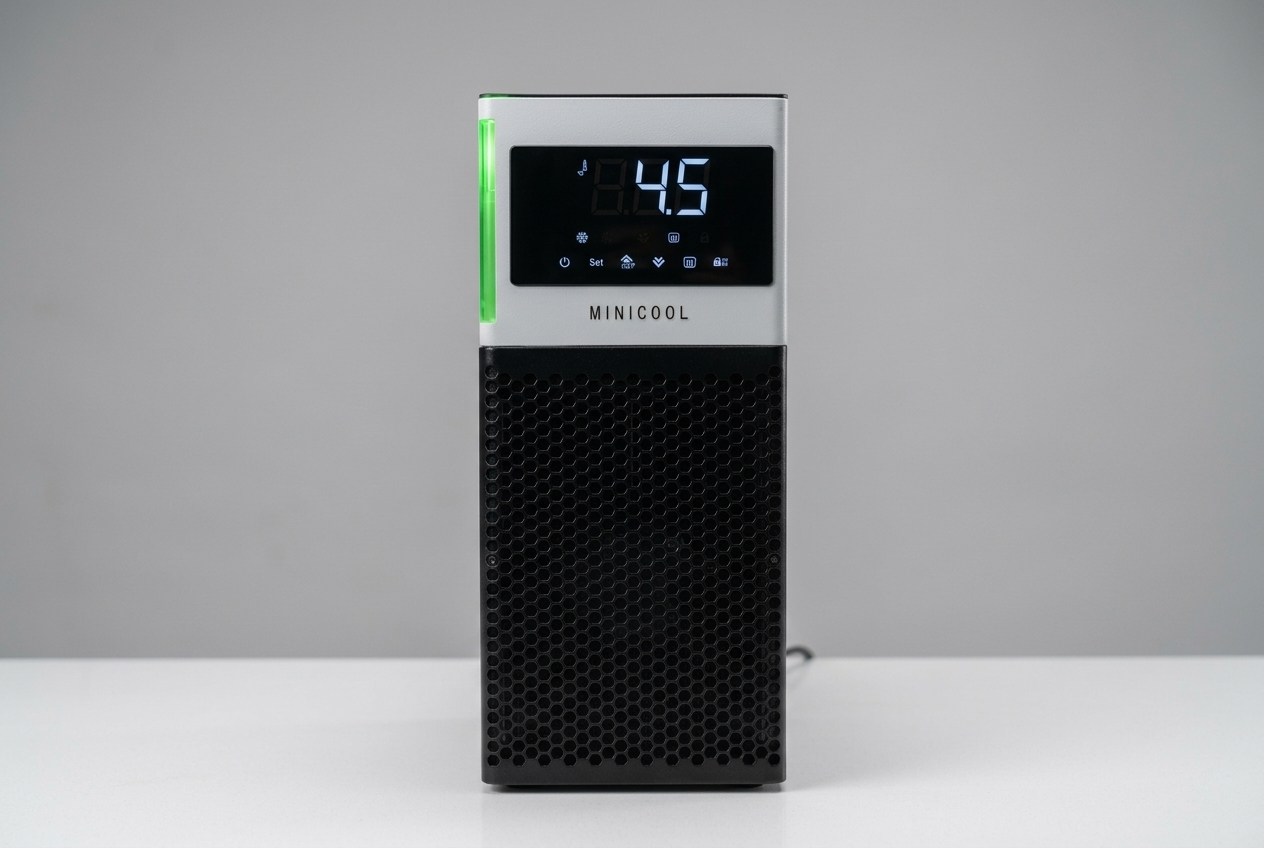
RIGID’s MiniCool countertop recirculating chiller was engineered specifically for the application scenarios described throughout this guide. With cooling capacity from 450W to over 1kW, a temperature range spanning 0°C to -40°C, and ±0.1°C precision control, it meets the thermal requirements of laser systems, medical devices, electronics testing stations, and research laboratories within a single platform.
The countertop form factor allows placement on laboratory benches, inside fume hoods, or beside production equipment without consuming floor space. Its closed-loop recirculating design minimizes water waste and contamination while reducing maintenance intervals compared to open cooling systems. Ultra-quiet operation keeps noise levels appropriate for clinical settings, shared laboratories, and production floors where operators work throughout the day.
Built on nearly a decade of miniature refrigeration expertise, MiniCool supports both AC and DC power configurations and accepts multiple refrigerant options including R134a, R290, and R1234yf. This flexibility allows engineers and facility managers to specify the exact configuration their application demands and their regulatory environment requires, without compromising on cooling performance or system reliability.
Some MiniCool models also function as heating and cooling baths, providing multi-functional performance that serves both active cooling applications and temperature-controlled immersion work. This dual capability is particularly valuable in laboratory environments where bench space is limited and researchers benefit from consolidating multiple thermal management functions into a single compact unit.
For organizations managing diverse cooling needs across multiple departments or project types, MiniCool’s broad temperature range and adaptable capacity reduce the total number of cooling units required. One platform serves applications that previously demanded two or three separate specialized chillers — simplifying procurement decisions, reducing maintenance complexity, and streamlining spare parts inventory across the facility.
Choosing the Right Mini Water Chiller for Your Industry
The cooling challenges across laser processing, medical diagnostics, electronics testing, and laboratory research share common themes: precision matters, space is limited, and reliability is essential. But each industry also brings unique requirements that a generic cooling solution cannot fully address without careful specification and application matching.
Start your selection process by documenting five critical parameters: your actual heat load in watts, required temperature range including both setpoint and ambient extremes, acceptable temperature stability for your quality standards, available physical space for the chiller installation, and power infrastructure at the deployment location. These five parameters eliminate the majority of unsuitable options and focus your evaluation on chillers that genuinely fit your application.
A well-matched mini water chiller does more than remove heat. It protects product quality in laser operations, ensures diagnostic accuracy in medical settings, produces reliable data in electronics testing, and provides the flexibility that research demands. The right cooling solution becomes invisible infrastructure — working continuously in the background so your primary equipment can perform at peak levels, day after day, without thermal compromises that limit your results.