
Chiller 50/60 Hz Compatibility Is a Whole-Machine Question
Chiller 50/60 Hz compatibility must be established for the complete machine at the destination supply conditions. Check the exact unit’s nameplate, configuration, and manufacturer documentation for voltage, frequency, phase, and other installation requirements. A broad voltage range or a DC-driven compressor does not prove that every pump, fan, power supply, and control component accepts both frequencies.
Before moving a laboratory chiller between sites, identify whether the destination supply is explicitly covered, explicitly outside the rating, or unresolved. That three-way decision is more useful than asking whether a plug adapter will fit. Physical connection is only one part of the transfer.
A component rating is not a complete-machine approval. A power supply labeled for both frequencies may serve only the electronics while another component has a different requirement. Use the machine-level specification and supplier confirmation for the actual configuration.
Classify the Transfer Before Arranging Shipment
| Evidence for the exact unit | Transfer decision | Remaining work |
|---|---|---|
| Destination voltage, frequency, and phase are explicitly covered | Proceed to installation and operating-condition review | Confirm circuit provision, connection, environment, and commissioning requirements |
| Destination conditions are outside the stated machine rating | Do not plan direct operation | Request a suitable documented equipment version or supplier-approved alternative |
| Documents conflict or omit the required frequency | Hold the compatibility decision | Obtain confirmation tied to the model, serial identity, and configuration |
| Only an internal component or family-level voltage claim is available | Treat whole-machine compatibility as unconfirmed | Resolve the complete supplied assembly before energizing it at the new site |
Keep the decision separate from shipping convenience. An available crate, similar socket, or spare transformer does not change the equipment rating. Resolve the electrical question while there is still time to select a different unit or configuration.
A unit approved for a destination supply may still need a site-specific installation review. Cable and connector arrangements, protective measures, available circuit capacity, and environmental conditions remain relevant. Approval of one rating entry does not settle every installation requirement.
Use a Chiller 50/60 Hz Compatibility Worksheet
| Comparison field | Machine evidence | Destination information | Disposition |
|---|---|---|---|
| Supply combination | Permitted voltage/frequency/phase combinations for the exact version | Facility-confirmed voltage/frequency/phase | Covered, outside the rating, or unresolved. |
| Version identity | Nameplate, ordered option, serial and modification history | Machine that will actually be relocated | Family data alone is insufficient if regional versions differ. |
| Installed auxiliaries | Evidence for the delivered pump, fan and controls | Required operating duty and site conditions | A compressor-only frequency statement leaves other loads unresolved. |
| Installation and duty | Applicable connection and operating instructions | Connection requirements, fluid duty and ambient | Assign the permitted installation and acceptance checks. |
Read combinations as combinations. A single version explicitly rated for both frequencies differs from a catalog listing separate regional versions. A document that lists voltage without frequency leaves the latter unresolved. These are three document cases, not examples of actual MiniCool ratings.
The decision should name the exact machine and destination. If all required supply combinations are covered, continue with the manufacturer’s installation requirements. If the destination lies outside the rating, obtain a supported solution before shipment. If evidence is missing, retain that uncertainty instead of treating a successful brief startup as a substitute for a rating.
Identify the Actual Machine and Its Supply Option
Record the full model, serial number, supply option, and any known modification history. Photograph the complete machine nameplate and retain the corresponding installation documents. A product-family brochure may combine several regional versions that are not interchangeable as delivered.
Copy the voltage and frequency statement exactly, including any combinations or separate rows. Do not combine a voltage entry from one configuration with a frequency entry from another. If the meaning of a rating is unclear, ask the supplier to identify which destination conditions are covered.
Record phase and the applicable connection information as well. A familiar nominal voltage does not establish the number or arrangement of supply conductors. The facility’s qualified electrical personnel should match the equipment requirements to the actual service.
Preserve the rating combination, not just individual numbers. A table of equipment versions describes alternatives; it is not permission to assemble a new rating from the most convenient value in each column.
List the Destination Conditions Before Asking the Supplier
For chiller 50/60 Hz compatibility, provide the destination’s documented supply characteristics rather than its country name alone. Facilities can use different services within the same region, and a laboratory may have dedicated equipment circuits that differ from general-purpose outlets.
Include the nominal voltage, frequency, phase, connection arrangement, and available circuit information through the facility team. Where relevant, identify whether the supply comes from utility service, a generator, or another supported source. The equipment supplier can then evaluate a defined electrical interface.
Also describe ambient temperature, ventilation, intended fluid, setpoint, load, and duty pattern. These do not replace the electrical review, but they define whether the transferred machine must perform under the same conditions as before. A successful previous installation may have operated in a cooler or less demanding environment.
Keep observed site values distinct from permitted limits. A measurement during a quiet period does not describe every operating condition. Use the applicable facility and equipment requirements to determine what evidence is needed for the transfer decision.

Review the Loads Behind the Main Power Connection
A refrigerated circulator can contain a compressor system, circulation pump, condenser fan, control electronics, and optional auxiliary loads. Their electrical architectures need not be identical. Some may be supplied through conversion electronics while others may depend more directly on the incoming AC supply.
The presence of a DC compressor does not establish how the rest of the machine is powered. Likewise, a universal-input control supply does not prove that a pump or fan connected elsewhere has the same frequency capability. Ask the manufacturer to confirm the assembly, rather than opening equipment to infer a rating from selected labels.
Do not use motor speed arithmetic to approve the complete chiller. Frequency can affect certain directly supplied motors and their driven components, but actual behavior depends on their design and controls. A general relationship is not an operating specification for an unidentified machine.
The supplier should identify whether a different regional configuration changes components, settings, or performance documentation. Keep those changes visible in the transfer record. Two machines sharing a family name may have different electrical bills of materials.
Separate Plug Adaptation, Voltage Conversion, and Frequency Conversion
A plug adapter changes a physical connection arrangement only to the extent of its actual design. It does not establish electrical compatibility of the connected appliance. The equipment still needs the permitted voltage, frequency, phase, protective arrangements, and circuit provision.
An ordinary voltage transformer changes voltage; it does not convert supply frequency. Selecting one therefore cannot resolve a frequency mismatch by itself. Its suitability for a particular machine is a separate engineering question, not a general answer to a cross-region transfer.
A frequency-conversion solution introduces another specified power system with its own output characteristics, capacity, installation, and compatibility requirements. Do not assume that a motor drive intended for one load can supply an entire chiller containing mixed electrical components.
Keep any conversion proposal subject to written equipment compatibility review. This guide does not prescribe rewiring or a field modification. Where the existing machine cannot be documented for the destination, a suitable factory configuration may be the clearer procurement route.
Confirm Performance After the Electrical Decision
Electrical permission to operate does not, by itself, prove the required cooling performance at the new site. Request the applicable performance basis for the permitted supply configuration. Retain any differences in pump delivery, cooling duty, or operating limits stated by the manufacturer.
Use the actual coolant, hoses, equipment connections, and installation ambient for the acceptance review. A relocated machine may see different hydraulic resistance even when the instrument is unchanged. Replacement couplings and longer routing can alter delivered flow.
For chiller 50/60 Hz compatibility, keep the electrical decision and the thermal acceptance linked but distinct. One establishes that the machine may operate on the proposed supply; the other establishes that the installed assembly meets the process requirement under the agreed conditions.
The refrigerated-bath replacement guide covers the broader task of defining a required cooling duty from existing equipment. For a relocation, retain that duty definition without assuming the old site’s installation automatically transfers to the new one.
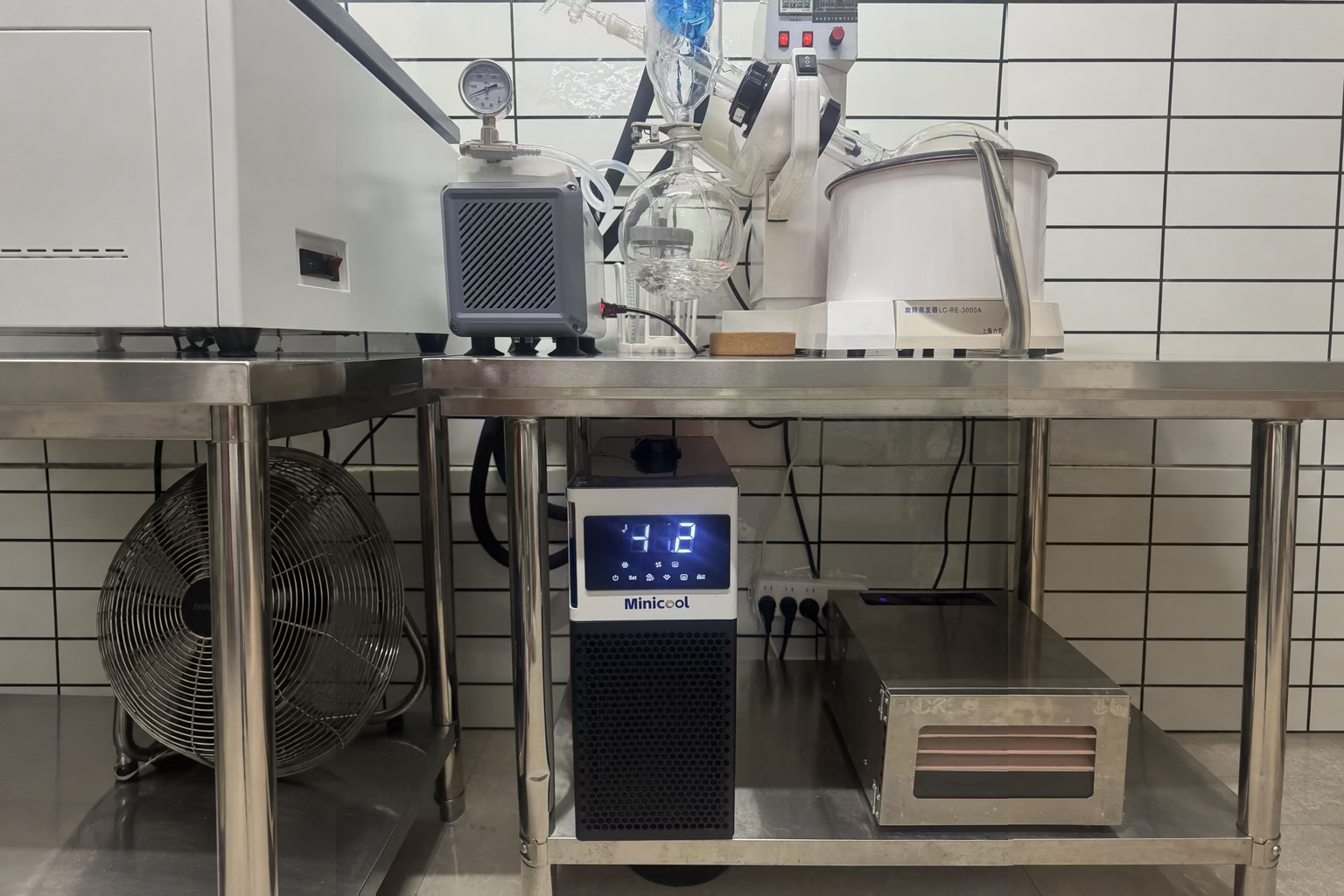
Apply the Same Evidence Standard to MiniCool
The RIGID MiniCool product information lists AC and DC supply options and a published −40 to 0°C operating range. Those family-level statements do not establish a specific machine’s 50/60 Hz capability.
For a MiniCool 450 transfer or purchase inquiry, request the exact supplied electrical version and destination compatibility. A broad AC voltage statement should not be interpreted as confirmation that every unit accepts every frequency, phase, or connection arrangement within a regional installation.
Keep model-level and order-level evidence together if they differ in specificity. If the machine label and supplied documents conflict, obtain a resolution from the responsible supplier before operation. Do not select the more convenient statement and treat the discrepancy as settled.
Record frequency as unconfirmed when it has not been documented. That is a procurement question to close, not a reason to invent a specification. Product photographs and the presence of a DC-driven refrigeration component cannot answer it.
Commission the Relocated Unit as a Defined Installation
Follow the manufacturer’s transport, installation, and startup instructions for the actual unit. Have the destination installation reviewed by the appropriate site personnel. The electrical interface should be established before an operating test is used to evaluate cooling behavior.
Record the final power arrangement, equipment identity, fluid, circuit, ambient, and applied duty. Verify the required temperature and circulation behavior at the relevant measurement points. Include the approved response to interruption and restart where it is part of the equipment requirement.
Do not interpret a brief successful start as proof of chiller 50/60 Hz compatibility. A test does not replace the machine rating, and a short run may not represent sustained duty. Use documented permission and an appropriate acceptance record together.
Leave the transfer decision and its supporting documents with the receiving site. Future maintenance should be able to identify the accepted configuration without repeating the reasoning from a photograph of the original plug.
Send a Complete Cross-Site Compatibility Request
Provide the machine nameplate, model and serial identity, existing documentation, destination supply information, intended load, and installation conditions. State any proposed conversion equipment separately. Request confirmation of the required chiller electrical configuration before treating a voltage range or connector change as approval for the move.
Frequently Asked Questions
Does a 120–240 V statement prove 50/60 Hz operation?
No. Voltage and frequency are separate rating information, and a family-level option does not identify every delivered version. Obtain the complete machine rating for the specific configuration and destination supply.
Does a DC compressor make the whole chiller frequency independent?
No. The pump, fans, power conversion, controls, and auxiliary components also need to be suitable. Confirm the complete assembly rather than generalizing from the compressor’s motor type.
Can a transformer fix a frequency mismatch?
An ordinary voltage transformer does not change frequency. Any proposed conversion arrangement needs its own engineering and manufacturer compatibility review for the complete machine.
Is a successful short run enough evidence?
No. Operation during a brief trial does not override the machine’s permitted supply conditions or establish sustained performance. Use the exact unit’s documentation and an approved installation acceptance plan.
What if the nameplate and brochure disagree?
Keep the compatibility decision open and request a resolution tied to the actual model, serial identity, and supplied configuration. Do not choose one statement solely because it permits the desired transfer.