
Angle: This article addresses the critical decision of selecting the correct NEMA-rated enclosure (3R, 4, 4X) and integrating a cooling solution. It focuses on preventing the two most common failure modes: water ingress from high-pressure washdowns and corrosion from environmental exposure. The dominant constraint is maintaining the enclosure’s seal integrity throughout the equipment’s lifecycle.
A Practical Guide to NEMA 4X Outdoor Cabinet Cooling
For an OEM engineer or system integrator, there are few failures more frustrating than a compromised outdoor electronics cabinet. A single failed seal can lead to catastrophic equipment damage, unplanned downtime, and expensive field service calls. The root cause is often not the electronics themselves, but a mismatch between the environmental reality and the enclosure’s specified protection level. Choosing the right NEMA rating is only half the battle; ensuring your thermal management solution maintains that rating is what defines a reliable system. Effective nema 4x outdoor cabinet cooling is a question of total system integrity, not just thermal performance.
By the end of this guide, you will be able to confidently differentiate between NEMA 3R, 4, and 4X requirements and develop a framework for selecting and integrating a cooling solution that preserves the enclosure’s specified protection. In this article, we prioritize the integrity of the complete sealed system over raw cooling power, because a compromised enclosure seal is the most common and costly point of failure in harsh environments.
Deployment Context: Where Protection Ratings Matter Most
Theoretical specs mean little without real-world context. The gap between a NEMA 3R and a NEMA 4X rating can be the difference between a successful deployment and a recurring field failure.
Scenario A: Coastal Telecom Repeater Station
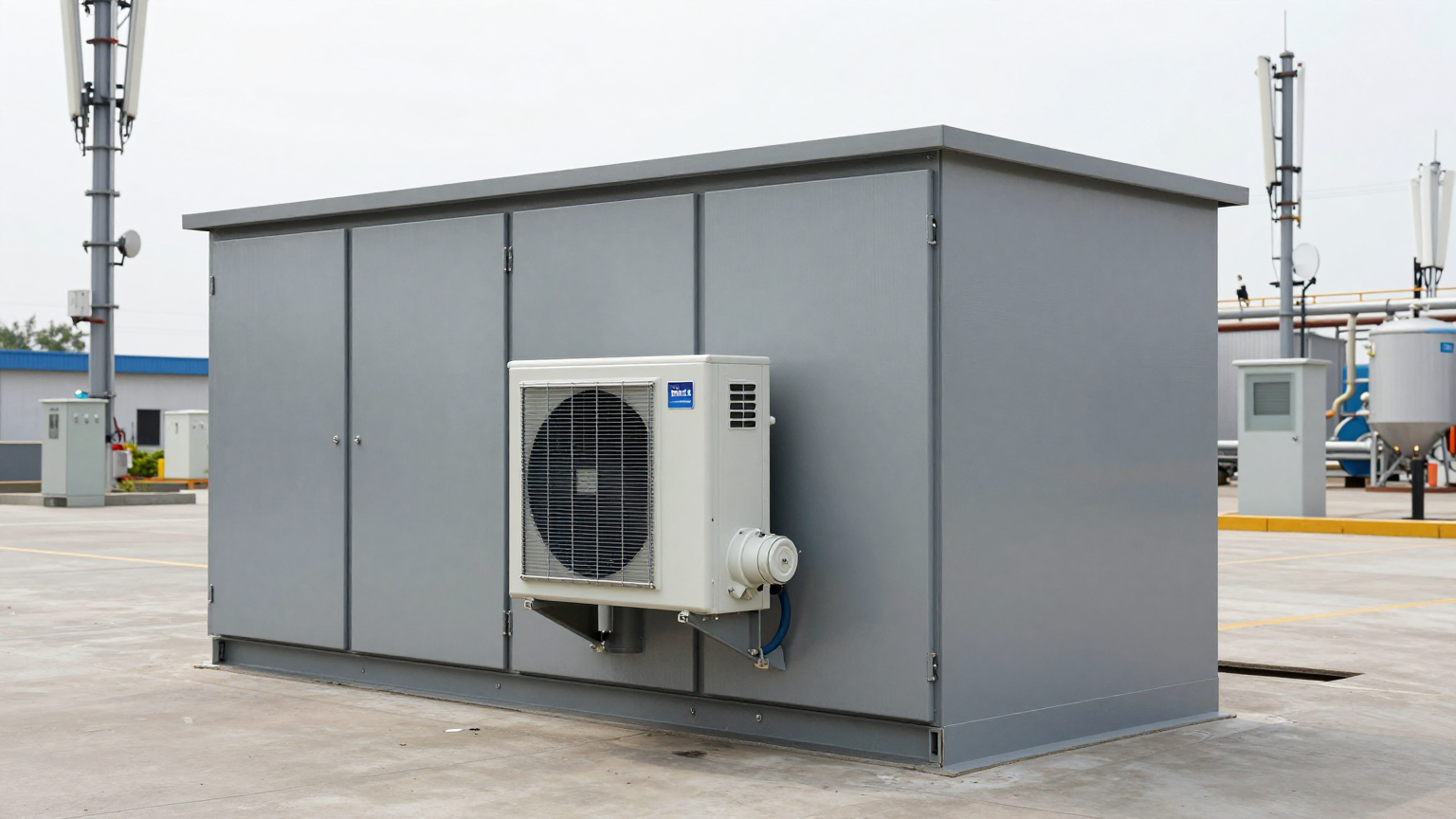
A telecom provider deployed a series of network repeater cabinets along a coastal highway. The cabinets were rated NEMA 3R, sufficient for falling rain and sleet. However, the constant salt fog and spray led to rapid galvanic corrosion on the standard steel hardware and the condenser coils of the third-party cooling unit. Within a year, the gasket around the cooler’s mounting flange degraded and failed, allowing moisture-laden salt air to enter the enclosure. This resulted in intermittent board-level failures and a costly, system-wide replacement with full NEMA 4X enclosures and appropriately specified cooling integrations.
Scenario B: Food & Beverage Processing Plant
A control cabinet for a bottling line conveyor system was located on a factory floor. The environment required daily high-pressure, caustic washdowns for sanitation. The integrator specified a NEMA 4 cabinet, correctly identifying the need for protection against water jets. However, the selected air conditioner was not designed for this environment. Its external fan was exposed, and its mounting system used a low-compression gasket. The high-pressure spray forced water past the seal and into the fan motor, causing the cooling system to fail and the cabinet to overheat. The proper specification was a NEMA 4X system, providing protection against both the water ingress and the corrosive cleaning agents.
Common Failure Modes & System Constraints
When integrating cooling into a rated enclosure, the risks extend beyond simple overheating. The most severe issues arise from compromising the enclosure’s primary function: protection. Here are the most common failure modes, ranked by impact.
- Gasket Failure → Water/Dust Ingress → Catastrophic electronics failure from short circuits or contamination.
- Condenser/Hardware Corrosion → Reduced Heat Transfer & Seal Failure → Gradual overheating followed by a breach in the enclosure’s protective barrier.
- Improper Mounting Cutout → Compromised Seal Integrity → Immediate loss of the specified NEMA rating, creating a direct path for contaminants.
- Internal Condensation Mismanagement → Dripping on Components → Hidden corrosion, intermittent faults, and eventual board failure.
- Unsealed Cable Glands → Bypassing Enclosure Protection → Providing an easy, often overlooked, entry point for moisture and dust.
- External Fan Vulnerability → Debris or Direct Water Intrusion → Premature failure of the cooling unit’s external loop, leading to system overheating.
- Solar Load Miscalculation → Undersized Cooling Unit → Inability to maintain safe internal temperatures on hot, sunny days, causing thermal throttling or shutdown.
- Vibration-Induced Fastener Loosening → Loss of Gasket Compression → A slow, insidious failure mode that compromises the seal over time in high-vibration environments.
Engineering Fundamentals: Closed-Loop Cooling and NEMA Ratings
To understand how to cool a sealed cabinet, you must first understand the National Electrical Manufacturers Association (NEMA) ratings. These standards define the types of environments an electrical enclosure can withstand. For outdoor applications, the most common are:
- NEMA 3R: Protects against falling rain, sleet, snow, and external ice formation. It does not protect against windblown dust or hose-directed water.
- NEMA 4: Provides the protection of NEMA 3R and adds protection against windblown dust and water from a direct hose spray. This is the baseline for a truly “watertight” enclosure.
- NEMA 4X: Includes all the protections of NEMA 4 but adds a significant degree of corrosion resistance. This is the standard for saltwater environments, wastewater treatment plants, and food processing facilities.
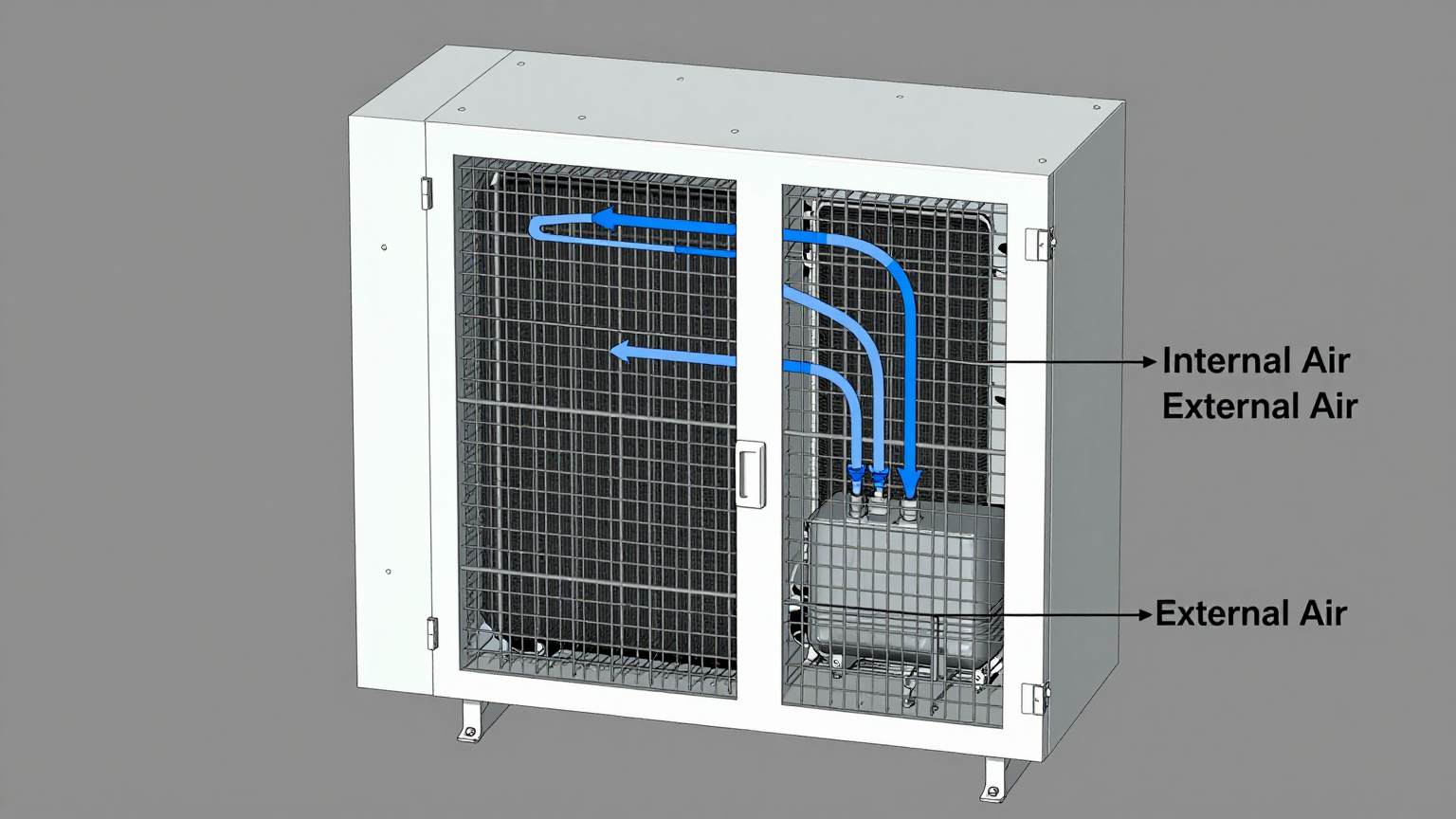
The critical concept for cooling these enclosures is maintaining a closed-loop system. A true cabinet air conditioner, like a Micro DC Aircon, is designed to operate as two sealed loops. The internal loop circulates and cools the air inside the cabinet, removing heat from the electronics. The external loop uses ambient air to discharge that collected heat from the condenser. The cooling unit itself forms a part of the cabinet wall, and the gasketed seal between the unit and the cabinet is what preserves the NEMA rating.
Common Misconception: “I can just cut a hole in my NEMA 4X box and mount a fan with a filter.”
Correction: This action immediately and permanently voids the NEMA 4/4X rating. A simple fan and filter create an “open-loop” system, actively drawing in the very dust, moisture, or corrosive agents the cabinet was designed to keep out. True nema 4x outdoor cabinet cooling requires a solution that removes heat without exchanging air between the inside of the cabinet and the outside environment.
Key Specifications for NEMA Enclosure Cooling
When specifying a cooling solution, you are not just buying a cooler; you are procuring a component that must uphold the integrity of your entire system. Before making a selection, you must confirm the following go/no-go specifications for the integrated system.
- Enclosure NEMA Rating (3R, 4, 4X): This is the foundational requirement. The cooling integration plan must be designed to meet or exceed this rating.
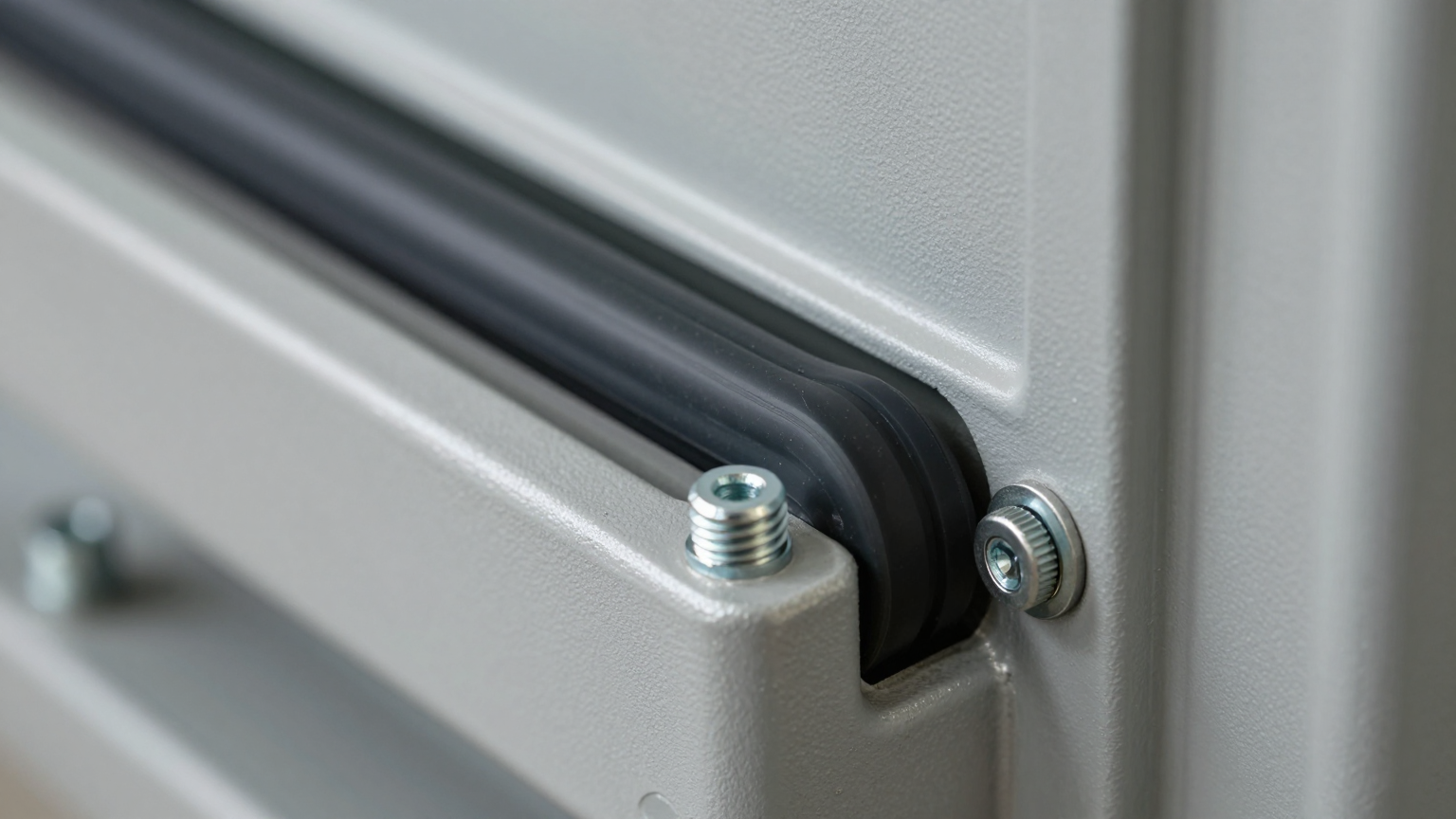
- Cooling Unit Sealing Method: Demand a high-quality, closed-cell or silicone gasket with a specified compression rating. This is the single most critical component for maintaining the seal.
- External Component Materials: For NEMA 4X applications, all externally exposed materials—including the condenser shroud, fasteners, and fan grilles—must offer proven corrosion resistance. Stainless steel (304 or, preferably, 316 for marine environments) is often required.
- Condensate Management System: The cooling unit will produce water (condensate) on the internal evaporator coil. A robust system must collect this moisture and route it outside the enclosure without creating a new potential leak path.
- Power System Compatibility: The cooling unit’s voltage must match the available power source. In remote telecom or off-grid applications, this is typically a DC voltage like 12V, 24V, or 48V.
- Verified Thermal Capacity (Watts or BTU/hr): The unit must be sized to handle the total heat load, which includes the internal electronics plus any solar gain on the cabinet walls. Always size for the worst-case ambient temperature.
- Operating Temperature Range: Ensure the cooling unit can function effectively in the maximum expected ambient temperature. Performance derates as ambient temperatures rise.

A Decision Map for Cooling Selection and Reliable Integration
Instead of marching through generic “steps,” use these checkpoints to move from a vague need (“keep the cabinet cool”) to a configuration you can defend—and verify in the field.
Checkpoint A: Confirm the Thermal Reality
- What to gather: Maximum continuous internal heat load (Watts), worst-case ambient temperature, and your allowable internal cabinet temperature.
- What you should end up with: A net cooling capacity target in Watts, plus a practical safety margin (commonly 20–25%) to cover uncertainty and minor losses.
Checkpoint B: Define the Survivability Bar
- What to document: The environmental exposures that actually drive failures—rain/snow, direct sun, wash-downs, salt spray, corrosive chemicals, dust ingress, vibration.
- What you should end up with: The minimum enclosure protection level you must design around (for example, NEMA 4X), which sets the sealing, materials, and service-access tradeoffs for the cooling solution.
Checkpoint C: Pick a Configuration That Fits Power + Packaging
- What to cross-check: Your thermal target + survivability requirement, then the available DC voltage (e.g., 24V or 48V) and the mounting/space constraints.
- What you should end up with: A short list of viable units and a mounting approach. For instance, if you need ~500W of cooling in a 24VDC NEMA 4X cabinet, you might shortlist a unit like the Rigid DV3220E-AC (Pro) (550W nominal) along with an appropriate corrosion-resistant mounting kit.
Checkpoint D: Prove It Works After Installation
- What to prepare: The manufacturer’s install guide, torque specs for fasteners, and a basic thermal profile of your critical components.
- What you should end up with: A post-install validation checklist—at minimum, a seal integrity check (e.g., low-pressure water test) and a thermal performance test under expected load conditions.
Implementation and Verification Checklist
A successful deployment depends on meticulous installation. A poor installation can void a NEMA rating just as easily as a poor component choice.
- Mechanical Installation
- Verify the cabinet mounting surface is flat, clean, and free of burrs or weld spatter.
- Use the manufacturer-provided cutout template. An incorrectly sized opening is a primary cause of seal failure.
- Position the gasket correctly on the cooling unit flange before mounting. Do not stretch or twist it.
- Tighten mounting fasteners in a star or crisscross pattern to the specified torque to ensure even gasket compression. Do not overtighten.
- Electrical Connection
- Use wiring of the appropriate gauge for the current draw and distance from the power supply.
- Install the recommended inline fuse or circuit breaker for overcurrent protection.
- Ensure all power and signal cables entering the cabinet pass through properly rated and sealed cable glands.
- Thermal Verification
- Place the cabinet’s primary temperature sensor in a location that represents the average internal air temperature, away from the direct cold air outlet of the cooler.
- Power on all internal electronics to simulate a full load and run the cooling system.
- Log the internal temperature over several hours to confirm it remains stable and below the target maximum.
- Maintenance Planning
- Ensure the external condenser coils are accessible for periodic cleaning with compressed air or a soft brush. Clogged coils are a leading cause of reduced performance.
- Schedule a semi-annual inspection of the mounting gasket and fasteners, especially in high-vibration or thermally cyclic environments.
Frequently Asked Questions (FAQ)
What is the real difference between NEMA 4 and NEMA 4X for a cooling project?
The primary difference is corrosion resistance. Both are watertight against hose-directed spray. However, NEMA 4X requires materials and construction that resist corrosion from agents like salt spray or harsh chemicals. If your cabinet is in a coastal, marine, or industrial chemical environment, NEMA 4X is non-negotiable.
How do I cool a sealed cabinet without compromising its NEMA rating?
You must use a closed-loop cooling system, such as a compressor-based DC air conditioner. This type of unit mounts through the wall of the enclosure and uses a robust gasket to maintain the seal, ensuring inside air and outside air never mix.
Will a DC air conditioner create condensation inside my cabinet?
Any air conditioner will create condensation on its cold coil (the evaporator) as it removes humidity from the air. A properly designed cabinet cooler has an integrated condensate management system that collects this water and drains it to the exterior of the cabinet, preventing it from ever dripping on your electronics.
Can these cooling units handle direct sun and high ambient temperatures?
Yes, but solar load must be factored into your thermal calculations. A cabinet in direct sunlight absorbs a significant amount of heat, which adds to the total load the air conditioner must remove. Additionally, all air conditioners have their performance derated at very high ambient temperatures. Always use the worst-case scenario (hottest day, full sun) for sizing.
What is the most critical measurement I need before selecting a cooler?
The internal heat load, measured in Watts. This is the total amount of heat generated by all the electronics inside the cabinet. An accurate heat load calculation is the foundation of proper cooler sizing.
How can I validate the seal is good after installing the cooling unit?
For NEMA 4 / 4X, a common field test is a controlled water spray test. Using a hose from a distance of 10-12 feet, spray all seams and seals of the cabinet and cooling unit for several minutes. Afterward, open the cabinet and inspect thoroughly for any signs of water ingress. Always de-energize electronics before performing this test.
Why use a compact DC air conditioner over a thermoelectric (Peltier) cooler?
The primary reasons are efficiency and capacity. Vapor-compression DC air conditioners offer a much higher coefficient of performance (COP), meaning they provide more cooling per watt of input power. They are significantly more effective for heat loads above 200W and in high ambient temperatures where thermoelectric coolers struggle.
Conclusion: The Right Fit for System Integrity
Selecting the correct approach to nema 4x outdoor cabinet cooling is a matter of risk management. The investment in a NEMA 4X enclosure and a properly integrated, closed-loop cooling system is an investment in reliability and uptime. This strategy is the best fit for critical applications where electronic failure is not an option, such as in remote telecom components cooling, industrial automation, and infrastructure control systems.
For projects with unique enclosure geometries, challenging power constraints, or extreme environmental conditions, a standard solution may not suffice. Our engineering team can assist with thermal modeling, system sizing, and developing integration strategies to ensure your equipment remains cool, dry, and protected. Contact us to discuss the specific requirements of your next project.