
One Chiller Multiple Instruments: Shared Loop or Dedicated Machines
Putting several instruments on a single recirculating chiller is attractive for obvious reasons — one machine, one footprint, one service item, one purchase. Established guidance says it works when total demand sits inside the chiller’s rated capacity with roughly 20 percent headroom and the pump can deliver adequate flow to each branch in parallel.
Both of those conditions are usually checked. The one that is usually not checked is what happens when the instruments interact, and that is where the one chiller multiple instruments decision is actually made. A shared loop couples every instrument to every other instrument through the coolant, so a load step on one becomes a temperature disturbance on all of them.
This guide covers when sharing works, the three failure modes it introduces, how to design a manifold that behaves, and where dedicated machines earn their extra cost.
The Two Conditions Everyone Checks
The one chiller multiple instruments calculation has two arithmetic parts, and they are worth doing properly before anything else.
Capacity. Sum the loads, add margin, and confirm the total sits inside what the machine delivers at your setpoint rather than at its headline condition. On the MiniCool range the published figures are 450 W, 800 W and 850 W, with the test conditions behind them not stated — so a shared loop close to the limit is a case where the capacity at your actual setpoint should be confirmed rather than assumed.
Flow. Each branch needs enough flow to keep its own temperature rise acceptable. Total flow is not the whole answer, because flow divides according to the resistance of each path, and paths are rarely equal. Two instruments on a shared loop with different internal geometries will not receive equal flow just because they were connected to the same manifold.
A worked check makes the flow question concrete. Suppose two instruments each need a 3 K maximum rise and each dissipates 150 W into the coolant. With a 50 percent propylene glycol mixture at roughly 3.4 kJ/kg·K and 1.04 kg/L, the flow each branch requires is 150 ÷ (3.4 × 3) = 14.7 g/s, or about 0.85 L/min per branch — 1.7 L/min total. That number, not the sum of the loads, is what the pump has to deliver against the combined resistance of both branches at the operating temperature.
Pump flow and head are not published for this range, which means a multi-branch loop is one of the cases where those figures are worth requesting before committing to the architecture.
The Three Failure Modes Sharing Introduces
Cross-talk between instruments
The first risk in a one chiller multiple instruments loop is coupling. When one instrument steps its load — a run starting, a stage warming, a sample loaded — the coolant returning to the chiller gets warmer. The chiller responds, but for the interval before it does, every other instrument on the loop sees the disturbance. On a measurement that needs stable temperature, that is another instrument’s schedule appearing in your data.
Quantifying it is straightforward using the same arithmetic as any load step. A 200 W step into a 3 L loop with a 60 second control response produces roughly a 1.1 K excursion — which every branch experiences, not only the one that caused it. Whether that matters depends entirely on what the other instruments are doing with the coolant.
The severity depends on thermal mass relative to the step size. A large reservoir buffers cross-talk; a small one passes it along.
Unequal flow distribution
Coolant takes the path of least resistance. An instrument with a restrictive internal circuit receives less flow than one with an open path, and the difference grows as fluid gets colder and more viscous. The result is a branch that performs correctly during commissioning at room temperature and starves at the operating setpoint.
Coupled maintenance
A shared loop shares its fluid, so a fluid change, a flush or a strainer clean stops every instrument connected to it. The same applies to any fault requiring the loop to be opened. On a single-instrument loop this is scheduled around one experiment; on a four-branch loop it has to be scheduled around four, which in practice means it happens less often than it should.
Single point of failure
One machine serving four instruments means one fault stopping four instruments. For a teaching laboratory that is an inconvenience; for an overnight run or a process with samples in progress, it can be expensive.
Designing a Manifold That Behaves
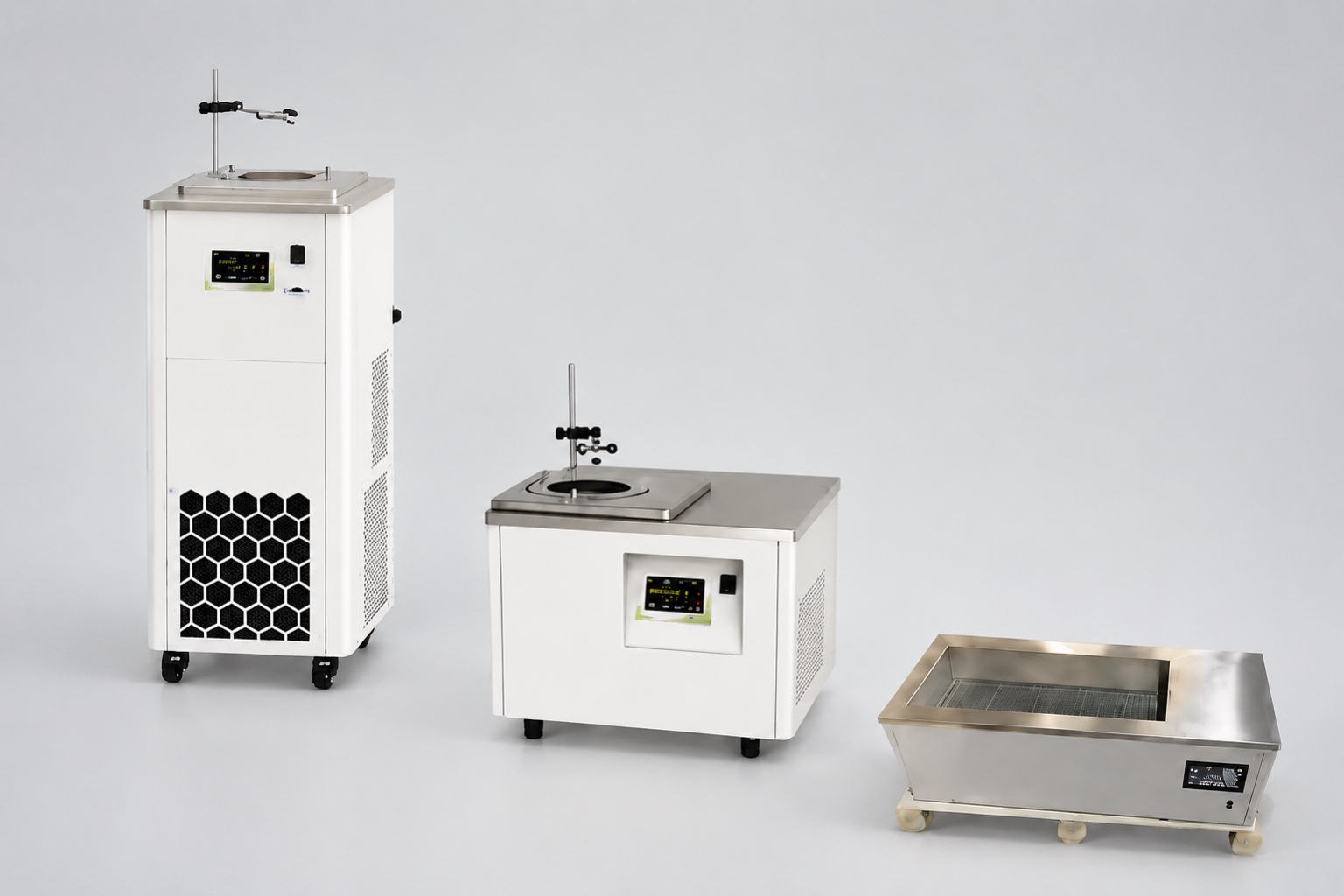
A one chiller multiple instruments loop that works is a designed manifold, not a tee fitting. The elements that matter:
- Individual balancing valves on each branch. This is the single most important addition, and the one most often omitted. Without them, flow distribution is whatever the plumbing happens to produce; with them, it is set deliberately.
- Parallel branches from a common supply and return manifold, never instruments in series. Series arrangement means each instrument receives coolant that has already been warmed by the one upstream.
- Manifold cross-section large relative to the branches, so the manifold itself is not a significant resistance and branch flows do not interact through it.
- Isolation valves per branch so one instrument can be disconnected without draining the loop.
- A way to measure each branch — a flow indicator, or at minimum accessible points to measure temperature rise across each instrument.
That last point is what makes a shared loop maintainable. Without per-branch measurement, a starving branch is invisible until its instrument misbehaves, and the diagnosis starts from symptoms rather than from data.
The Decision Table
| Situation | Choose | Reason |
|---|---|---|
| Instruments with similar, steady loads and the same setpoint | Shared | Little cross-talk; capacity and flow are the only questions |
| One instrument needs a different setpoint | Dedicated | A shared loop has one temperature; it cannot serve two |
| Measurement sensitive to tenths of a degree | Dedicated | Cross-talk from other instruments enters the data |
| Intermittent large load steps on one branch | Dedicated for that branch | It is the disturbance source; isolate it rather than buffering it |
| Overnight or unattended running | Dedicated, or accept the risk knowingly | Single point of failure across several experiments |
| Teaching or routine work, cost-sensitive | Shared | Consequences of a stoppage are low |
| Total load close to the machine’s capacity | Dedicated, or a larger machine | No headroom for simultaneous peaks |
The second row is absolute rather than a matter of degree. A single loop delivers one coolant temperature, so instruments needing different setpoints cannot share it regardless of capacity. This sounds obvious and is nonetheless a recurring cause of disappointment.
The Hybrid Most People Miss
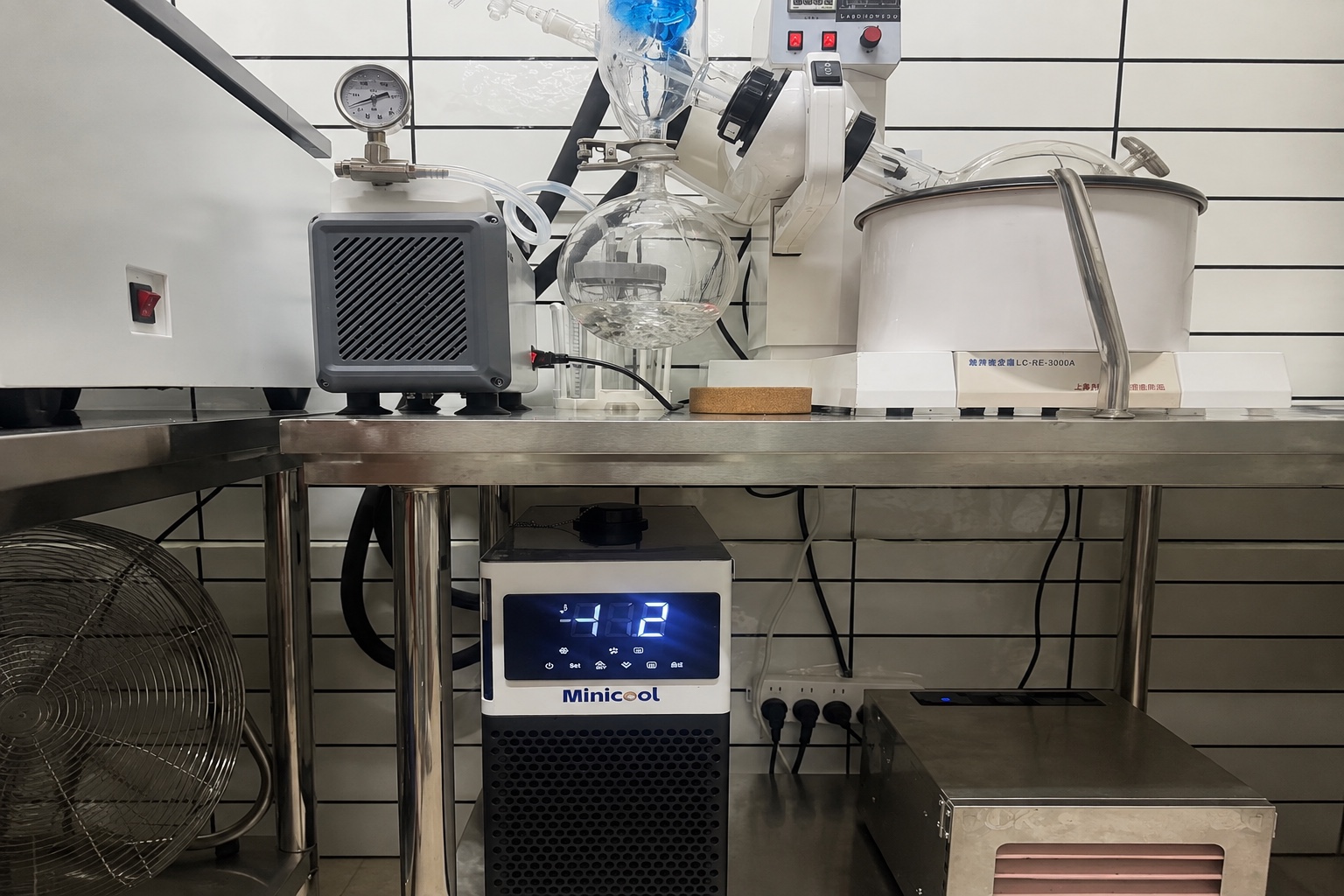
The one chiller multiple instruments choice is not binary. A useful middle ground is to share the chiller but decouple the sensitive branch:
- Put the disturbance-generating instrument on its own branch with a generous balancing valve setting, so its steps are absorbed by flow rather than by temperature.
- Give the sensitive instrument a local buffer — a small insulated volume in its branch — so short disturbances are damped before they reach it.
- Where the sensitive instrument has its own temperature controller, as precision baths and many analytical instruments do, cross-talk matters far less, because that controller rejects it. The chiller only has to supply a cold sink.
A fourth option exists where the instruments differ only slightly in setpoint: run the shared loop at the coldest requirement and let the warmer instrument trim upward locally, if it has that capability. This wastes some capacity but avoids a second machine entirely, and it is often cheaper than either alternative.
The third point resolves a surprising number of these cases. If the instrument controls its own temperature, sharing is much safer than intuition suggests. If it relies on the chiller to hold its process temperature directly, sharing is much riskier.
Commissioning a Shared Loop
Commissioning a one chiller multiple instruments loop follows a fixed order:
- Connect all branches and fill the loop, bleeding air properly — a shared loop has more high points than a single one, and air is the leading cause of post-installation flow problems.
- Bring the loop to the operating setpoint before balancing. Balancing at room temperature sets valves against the wrong viscosity.
- Measure temperature rise across each instrument at the setpoint, with all branches running.
- Adjust balancing valves until each branch shows an acceptable rise, then record the valve positions.
- Test the worst case: every instrument at full load simultaneously, at the highest realistic ambient.
- Record the balanced valve positions somewhere that survives staff turnover — a manifold whose settings are lost usually gets every valve opened fully, restoring exactly the uneven distribution the balancing corrected.
- Test the disturbance case: step one instrument’s load and observe the others.
Step 6 is the one that answers the cross-talk question with data rather than argument, and it takes minutes.
Instrument-specific cooling requirements are covered in our guide to chillers for analytical instruments, and thermal mass behavior under load steps in our discussion of peak load sizing. Model data for the MiniCool 450, 800 and 850 is on the MiniCool product page; positive-temperature loops between 0 °C and +20 °C are served by the DV compact liquid chiller range at 100–550 W.
If you want a shared architecture reviewed before it is plumbed, send the following and our engineers will advise: number of instruments and the load of each, whether they run simultaneously, required setpoint for each, whether any has its own temperature controller, internal flow resistance of each instrument if known, acceptable temperature rise per branch, coolant fluid, and whether unattended running is required. Send your loop layout to our engineering team.
Frequently Asked Questions
Can one chiller serve multiple instruments?
Yes, when total demand fits inside the machine’s capacity at your actual setpoint with headroom, the pump delivers adequate flow to each branch, and every instrument can accept the same coolant temperature. The one chiller multiple instruments question usually fails on the third condition rather than the first two — a single loop delivers one temperature, so instruments needing different setpoints cannot share it whatever the capacity.
Why does one instrument run warm when both are connected?
Because flow divides according to path resistance, not equally. The instrument with the more restrictive internal circuit receives less flow, and the imbalance grows as the coolant cools and thickens. Balancing valves on each branch fix this; without them, distribution is whatever the plumbing happens to produce. Balance at the operating setpoint, not at room temperature.
Will another instrument’s activity affect my measurement?
On a shared loop, yes, unless your instrument controls its own temperature. A load step anywhere on the loop warms the returning coolant, and every branch sees it until the chiller responds. If your instrument has its own controller — as precision baths and many analytical instruments do — it rejects that disturbance and sharing is far safer. If it relies on the chiller to hold process temperature directly, it will see the neighbor’s schedule.
Should instruments be plumbed in series or parallel?
Parallel, from a common supply and return manifold. Series arrangement means every instrument after the first receives coolant already warmed by the one before it, so the last in line runs warmest and the temperature each receives depends on what the others are doing. There is no situation in this class of application where series is preferable.
How much headroom should a shared loop have?
Established guidance suggests around 20 percent above the summed load, and more where the instruments can peak simultaneously. Remember to sum peaks rather than averages if simultaneous peaking is possible — a shared loop close to its limit has no reserve for the day two instruments both run hard, which is exactly the day it will be noticed.
Is a dedicated chiller per instrument worth the cost?
For critical applications it removes cross-interference entirely, and that is sometimes worth more than the machine costs. The clearest cases are different setpoints, measurements sensitive to tenths of a degree, and unattended overnight running where one fault would stop several experiments. For routine or teaching work with similar steady loads, a well-balanced shared loop is usually the better value.