
Open Tank Cooling Coils Need Liquid Contact and a Heat Path
Open tank cooling coils should be selected from the heat entering the tank, the required liquid condition and the way liquid moves around the coil. Tank volume alone does not establish cooling capacity. A suitable refrigeration module can still leave part of a tank warm if its coil is poorly immersed or the working liquid has no effective path past the cold surface.
RIGID’s stainless steel coil liquid-cooling module offers a cold source for an engineered tank arrangement. The equipment builder supplies or specifies the surrounding installation. This guide concerns immersion, mixing, load placement and continuous heat removal; it does not treat the module as a complete stirred bath or a ready-connected recirculator.
Identify the Coil as Part of the Sealed Refrigeration Circuit
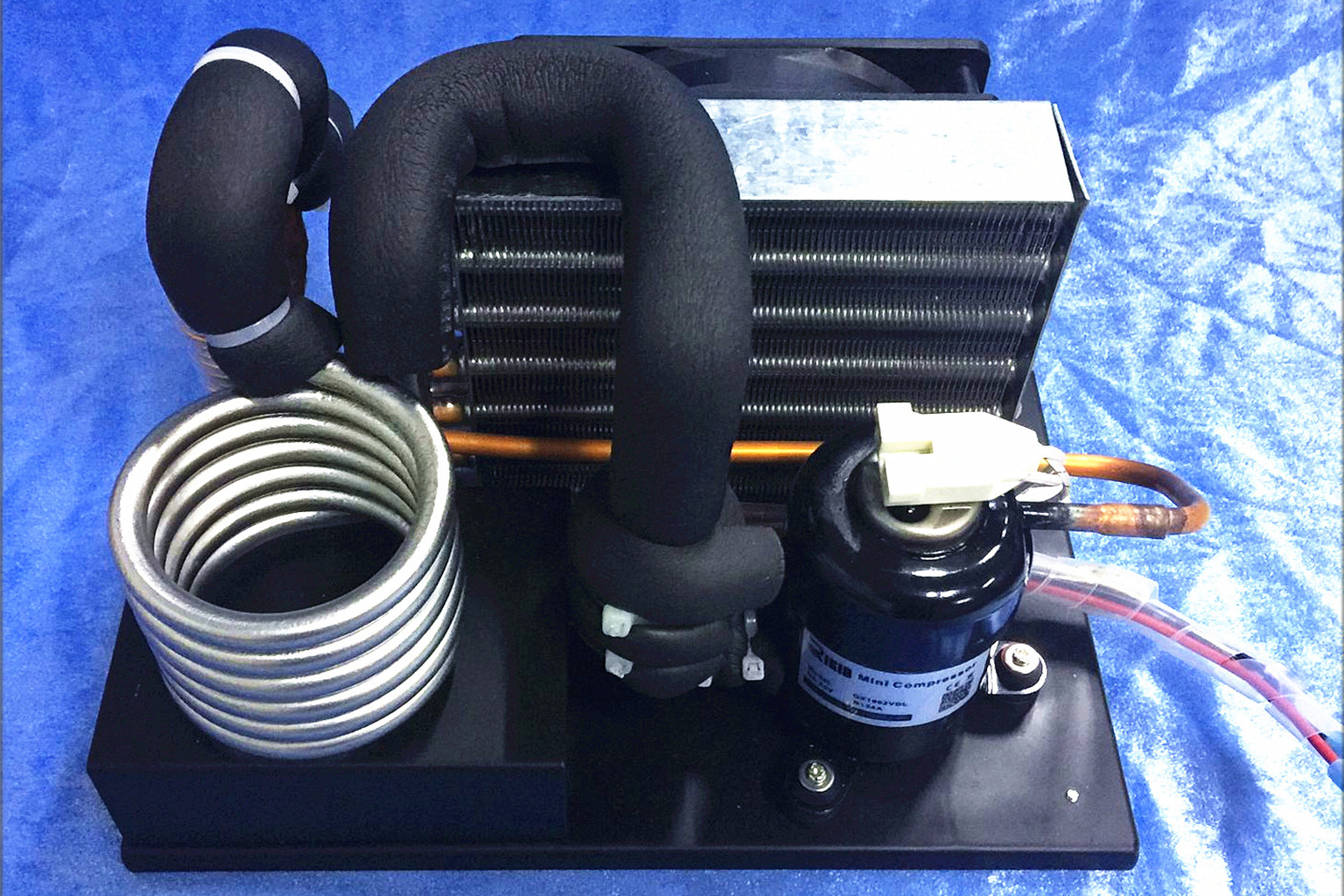
The visible stainless steel coil transfers heat from the surrounding tank liquid into the refrigeration system. It is not an open water pipe intended for a user to cut and connect to another instrument. Keep its construction, supports and refrigerant connections within the supplier’s specified arrangement.
Distinguish that refrigerant path from any external coolant circulation. A pump can move tank liquid through an instrument or around the tank without sending that liquid inside the refrigerant coil. This distinction matters when preparing a drawing: label the fluids and connection boundaries rather than calling every tube a cooling line.
Choose the heat-exchanger form before designing its installation. RIGID also supplies other liquid-cooling arrangements. The overview of liquid chiller heat-exchanger types explains that broader choice. This article specifically addresses the stainless steel immersion-coil form.
Define the Useful Tank Region Before Quoting a Temperature
A tank can contain different temperatures at different locations. Identify where the process receives coolant, where a cooled object sits or where the next instrument draws liquid. Those locations define the useful working region. A temperature measured beside the coil may describe a colder local condition than the process experiences.
Record the allowed variation across that region and over the operating cycle. A single displayed number does not establish either distribution. If the application requires a uniform working volume, define how that volume will be evaluated with the installed load and circulation arrangement.
Also distinguish tank temperature from the temperature inside a component placed in the tank. Heat still crosses its wall, contact surface or other interface. Open tank cooling coils remove heat from the liquid around them; they do not automatically control the internal temperature of every immersed object.
Specify Immersion Across the Full Operating-Level Envelope
The portion of coil in contact with liquid affects the available heat-transfer surface. Obtain the permitted installation orientation and operating liquid levels from RIGID. The fill level at the start of an unloaded demonstration may differ from the level after an external branch fills or a process item is removed.
List events that change the liquid level. These can include filling connected equipment, displacement by a workpiece and ordinary service operations. The design must keep the intended coil contact available through the permitted states rather than relying on a photograph taken when the tank happens to be full.
Evaluate the lowest permitted operating level. Do not compensate for inadequate immersion by lowering the temperature setpoint. That changes the thermal condition without restoring the missing contact area. Any level monitoring and required equipment response belong in the complete tank specification.
Give Warm Liquid a Route to the Cold Surface
Mixing affects the temperature difference and fluid motion next to the coil. Without an effective exchange between warm process regions and the cold region, the coil can be surrounded by relatively cold liquid while useful tank locations remain warmer. A low reading near the coil does not prove that the whole tank is adequately cooled.
Review the actual sources of liquid motion. An external return, dedicated circulation or another process movement may provide some mixing, but its effectiveness depends on location and operating state. Do not assume that a pump’s presence means the entire tank is swept uniformly.
| Tank feature | Question to resolve | Acceptance evidence |
|---|---|---|
| Coil position | Does the intended surface remain immersed? | Permitted level and installation record. |
| Warm return | Where does heat enter the liquid? | Drawing and loaded temperature observations. |
| Liquid motion | Which regions exchange fluid during the cycle? | Representative working-region measurements. |
| Process withdrawal | Is delivered liquid representative of the required condition? | Temperature at the actual supply location. |
Specify the circulation requirement with the tank supplier. No universal pump flow, stirrer speed or coil-to-wall clearance is established by this article.
Keep the Sensor Out of an Unrepresentative Cold Pocket
A controller sensor needs a location suited to the control arrangement. A separate verification sensor needs a location suited to the process requirement. Those purposes can differ. Identify each measurement before interpreting an apparent disagreement as controller error or inadequate refrigeration.
A probe touching the coil can respond to a condition unlike the surrounding useful liquid. A probe near a warm return may emphasize another local condition. Choose locations through the equipment design and verify their relationship during the relevant operating states, including changes in mixing or load.
Accept the working liquid at the point that matters. Keep the control reading associated with an independent process check where the application requires one. Do not claim that moving an observation probe changes the controlled temperature unless the actual controller supports that connection.
Separate Initial Cooldown From Continuous Heat Removal
Cooling the starting liquid requires removing stored thermal energy. Holding it during operation requires removing the ongoing load. Open tank cooling coils must be evaluated against both tasks, but the two calculations answer different questions. A fast empty-tank cooldown does not establish loaded holding performance.
For an explicitly hypothetical energy estimate, take 8 kg of approved liquid with an assumed specific heat of 3.5 kJ/(kg·K), cooling through 8 K. The liquid contribution is 224 kJ. Tank hardware, immersed objects and heat entering during cooldown are additional terms. These assumed properties are not a specification for a particular coolant or RIGID module.
Dividing that energy by a nominal catalog capacity would produce an idealized time, not a validated pull-down result. Available refrigeration changes with operating conditions, and the installed heat-transfer path also matters. Request performance relevant to the intended temperature and ambient environment.
Build a Load Budget Around the Actual Tank Boundary
List heat entering from the process, returning liquid, immersed equipment, the surrounding environment and any mixing hardware. Include a contribution only where it enters the cooled boundary. Counting the electrical input of an entire connected instrument can exaggerate the tank load when much of its heat goes elsewhere.
State which loads occur together and for how long. A repeated process can be more demanding than the first short cycle from a fully cooled tank. Identify the permitted recovery time and the temperature change allowed between successive operations rather than hiding those requirements in a large capacity margin.
Keep the duty estimate auditable. Preserve measured inputs, assumed properties and uncertain terms separately. That lets RIGID compare its proposed configuration with the actual requirement instead of receiving only an unexplained wattage and a tank volume.
Use Tank Volume for Its Actual Role
More liquid increases thermal mass and can slow a temperature change. It also increases the energy removed during initial cooldown or a setpoint change. Neither effect creates continuous refrigeration capacity. A large cold tank can conceal a sustained deficit during a short demonstration.
The guide to reservoir volume and thermal inertia addresses that tradeoff. For an immersion-coil installation, add the distribution question: more volume may also create regions that need an effective mixing path and usable sensor coverage.
Specify the working liquid volume after accounting for displaced equipment and the required operating levels. The empty vessel’s nominal volume is not necessarily the volume participating in the process or the amount available above the minimum coil-contact condition.
Confirm Materials and Surface Condition for the Actual Liquid
Stainless steel is a material category, not an approval for every acid, additive, cleaning agent or process liquid. Obtain compatibility confirmation for the coil and the complete wetted installation. Seals, pump parts, tank materials and other fittings can impose limits different from the coil itself.
Open tanks can receive contamination or deposits that change contact with the heat-transfer surface. Define the permitted inspection and cleaning approach with the supplier. Do not recommend an abrasive tool, a chemical cleaner or a bend in the coil without an approved procedure for that construction.
Keep process approval separate from cooling performance. A module that can remove the required heat is not thereby food-contact approved, suitable for an aggressive chemical bath or certified for a hazardous location. Those claims require their own applicable evidence.
Define the RIGID Stainless Steel Coil Supply Scope
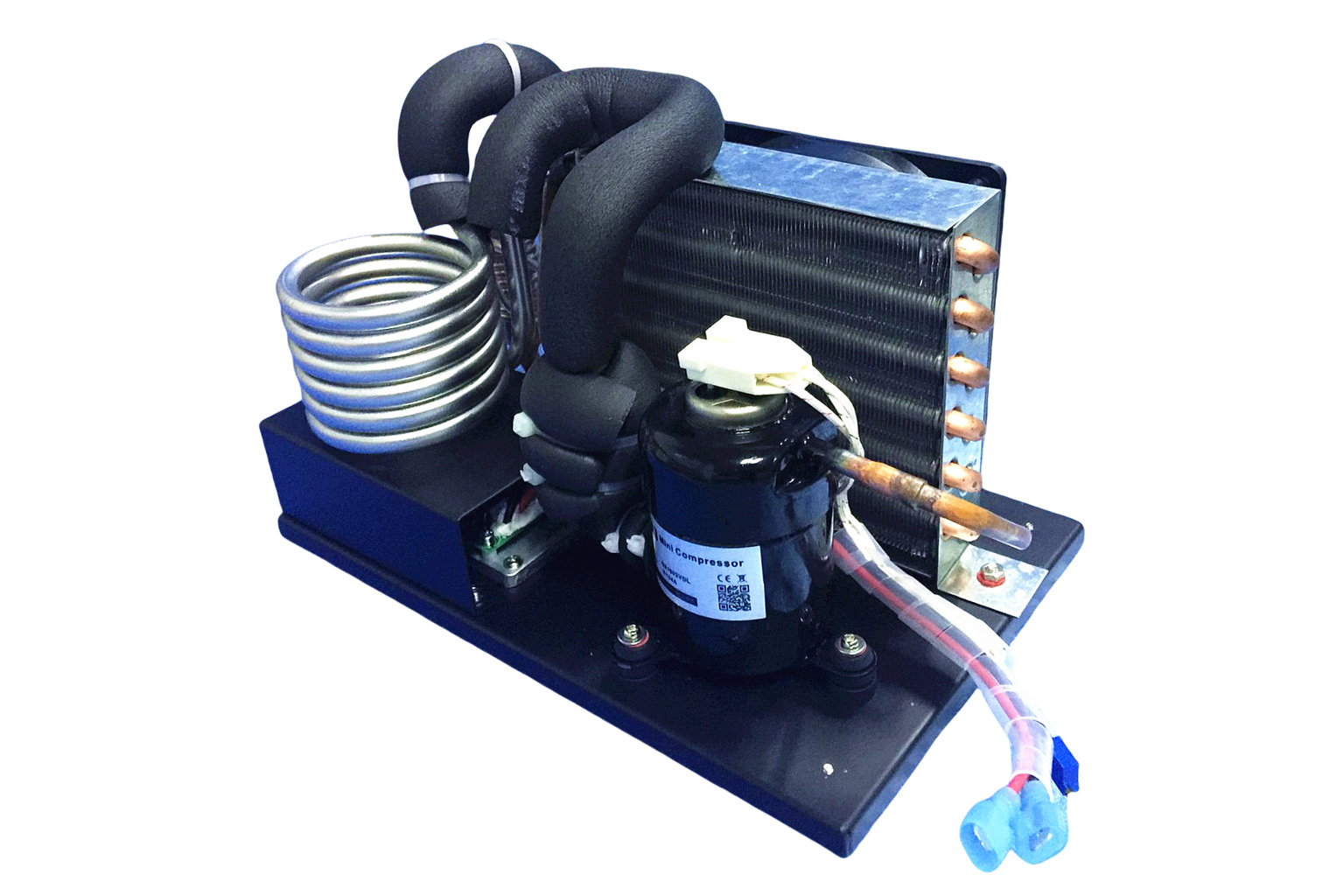
The RIGID compact liquid chiller family includes stainless steel coil configurations such as DV1920E-S. The family publishes a −20°C to +20°C temperature range and nominal capacities of 100–550 W. The rating conditions are not established here, so those figures do not guarantee duty at every liquid and ambient condition.
For open tank cooling coils, identify the selected coil configuration, mounting support, control arrangement and the equipment supplied around it. Confirm the tank, circulation or mixing equipment, level monitoring and insulation separately. Product-family photographs do not establish that these external items are included.
MiniCool is a different product form with a published upper temperature limit of 0°C. It should not be substituted into a positive-temperature tank requirement merely because both products cool liquid. Select from the actual temperature, interface and integration scope.
Verify Open Tank Cooling Coils Under the Loaded Cycle
Acceptance should represent the intended fluid, working level, installed process items and repeated operating cycle. Record temperatures at the relevant working locations as well as the controller indication. Include the mixing state and ambient condition so later results have a comparable basis.
Check the required holding condition after initial cooldown and during a representative load change. Where level or circulation can vary during permitted operation, include those states in the agreed assessment. A cold coil and a cold nearby sensor alone are insufficient evidence of a useful tank-wide result.
Send RIGID the tank drawing, approved liquid, working-level envelope, required temperatures and load schedule. Discuss a stainless steel coil configuration with the intended mixing and verification arrangement included.
Frequently Asked Questions
Can open tank cooling coils cool a tank without a circulation pump?
The required liquid motion depends on the installation. Natural movement or process circulation may contribute, but useful temperature distribution must be demonstrated. The presence or absence of a pump alone does not settle suitability.
Does a larger tank need a proportionally larger refrigeration module?
Not from volume alone. Volume affects cooldown energy and thermal inertia; continuous capacity follows the heat entering the tank. Coil contact, mixing and the required operating schedule also matter.
Can process liquid flow inside the stainless steel refrigerant coil?
No such arrangement is established. The coil belongs to the sealed refrigeration circuit and exchanges heat with surrounding approved liquid. Do not cut or reconnect it as an external water passage.
Does stainless steel establish compatibility with my process?
No. Confirm the actual formulation, temperatures, cleaning method and complete wetted assembly. A material name cannot replace application-specific compatibility evidence.
Why is the tank warm when the coil area reads cold?
Possible causes include inadequate liquid exchange, unrepresentative sensing or excessive load. Compare working-region temperatures and operating conditions before changing the setpoint or assuming the refrigeration module is faulty.