
Why Solar Heat Load Breaks Enclosure Sizing
An outdoor cabinet is usually sized from a component list. Add up what the electronics dissipate, add a margin, pick a cooler. The cabinet then runs perfectly through commissioning in spring and trips its high-temperature alarm on the first clear afternoon in July.
The missing term is sunlight. A vertical surface in direct sun receives on the order of 1,000 W per square meter at peak, and a dark cabinet absorbs most of it. On a small enclosure, solar heat load can equal or exceed the electronics load it was sized for.
This guide covers where the number comes from, how paint color changes it, a worked example for a pole-mounted cabinet, and when a sunshield is the cheaper answer than a bigger cooler.
Where the Heat Comes From
Three paths add heat to an outdoor enclosure, and only the first is usually calculated.
- Internal dissipation. Electrical input dissipated inside the box becomes heat there; power delivered out of the cabinet, as radio, mechanical or electrical output to an external load, should be subtracted.
- Conduction from hot air. Driven by the difference between ambient and internal set point, through the cabinet walls.
- Absorbed solar radiation. Driven by irradiance, surface absorptivity and the area actually facing the sun.
The third one is unusual because it does not depend on the internal temperature at all. It is an imposed load: the sun does not care that the cabinet is already at its limit.
That distinction has a practical consequence. Conduction falls as the internal set point rises, so a cabinet allowed to run warmer takes in less heat through its walls. The absorbed solar power does not fall with set point, so relaxing the temperature limit gives back less than people expect in full sun: the overall balance still improves, but only through the conduction term.
Absorptivity: the Number Nobody Specifies
How much of the arriving radiation becomes heat depends on the surface. Published values for common enclosure finishes vary over nearly a factor of four.
| Finish | Typical solar absorptivity | Share of 1,000 W/m² absorbed |
|---|---|---|
| White or light gray paint | about 0.25 | about 250 W/m² |
| Unpainted galvanized steel | about 0.65 | about 650 W/m² |
| Black powder coat | about 0.95 | about 950 W/m² |
Not all of that absorbed energy reaches the inside. Much of it is re-radiated and convected away from the outer skin, and how much gets through depends on the wall construction and the wind. But the ranking is unambiguous: repainting a black cabinet white removes more heat than most cooling upgrades add capacity.
A Worked Example: Pole-Mounted Cabinet
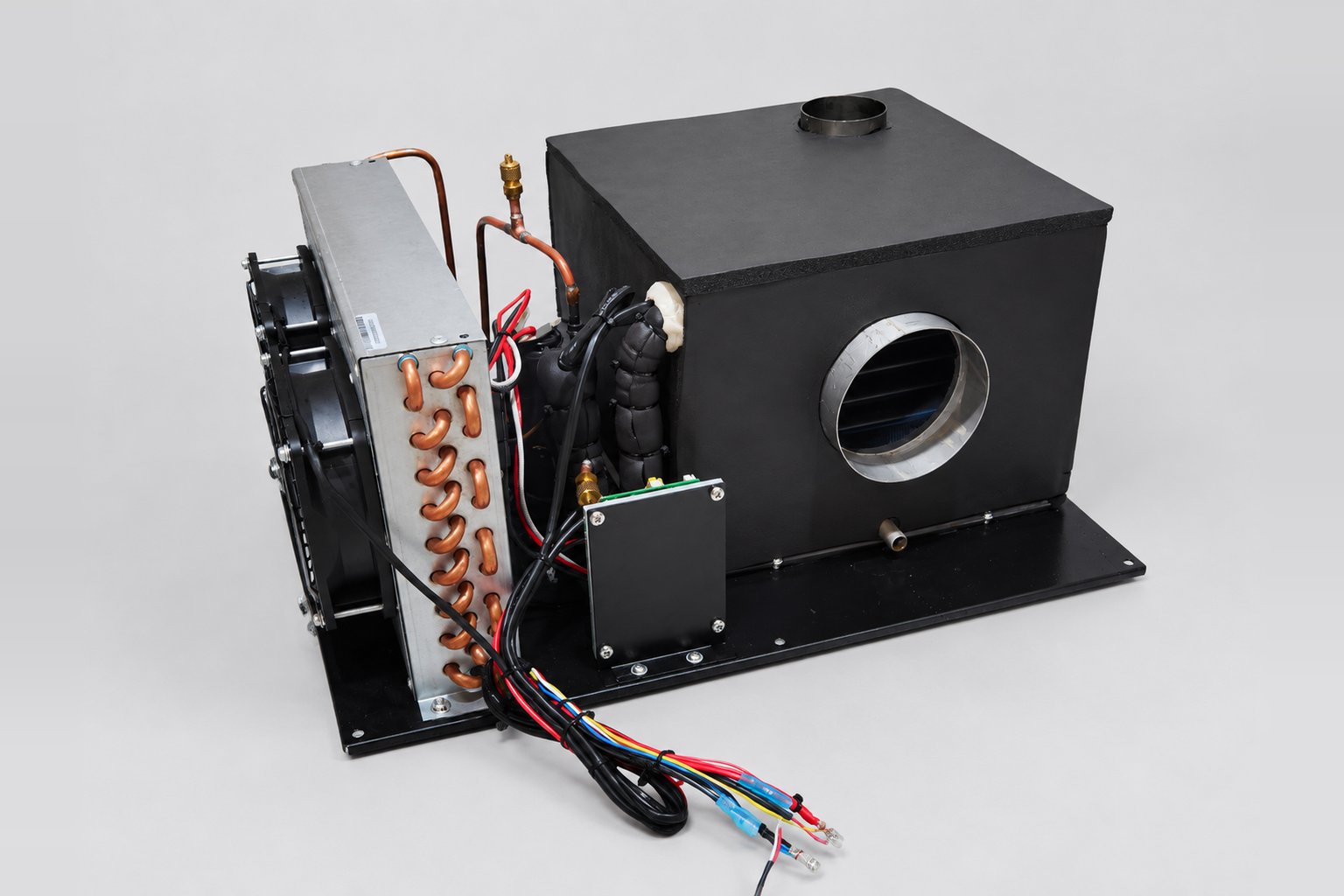 The worked example below uses assumed dimensions and conditions. Substitute your own site data; the method matters more than these numbers.
| Input | Assumption |
|---|---|
| Cabinet | 600 mm wide, 600 mm deep, 1,800 mm high |
| Sun-exposed surfaces at mid-afternoon | One side 1.08 m² plus roof 0.36 m², about 1.4 m² effective |
| Peak irradiance on those surfaces | 800 W/m² assumed for a vertical wall plus roof mix |
| Finish | Light gray, absorptivity 0.3 |
| Fraction of absorbed heat entering the cabinet | 0.3 assumed for an uninsulated steel wall with light wind |
| Electronics dissipation reaching the air | 300 W (electrical input less any power exported outside the cabinet) |
| Wall conduction at design ambient | UA assumed 6 W/K, ambient 35 °C, internal limit 40 °C, so heat flows outward and is counted as zero here |
Solar heat load enters the calculation in two steps. Absorbed at the skin: 1.4 m² × 800 W/m² × 0.3 = 336 W, where 0.3 is the absorptivity. Entering the cabinet at the assumed entering fraction of 0.3: about 100 W. Added to 300 W of electronics, the cooler faces about 400 W rather than 300 W.
Two cautions belong with that number. The entering fraction is an assumption for this wall construction and wind condition, not a reusable coefficient. And the total is only complete once wall conduction at your design ambient is included; here it works outward and is counted as zero, which is a conservative simplification rather than a general rule. Engineering methods that fold radiation into an equivalent outdoor temperature, such as the sol-air approach, exist precisely to combine the two terms without double counting.
Repeat the same arithmetic with a black cabinet and absorptivity 0.95: 1,064 W absorbed, roughly 320 W entering, and the cooling requirement doubles. Nothing inside the cabinet changed.
Sanity checks that cost nothing
- Compare your result against the rule of thumb that a mid-sized sunlit cabinet gains roughly 100 to 300 W of solar heat load in temperate conditions.
- Measure skin temperature on a sunny afternoon. A wall 25 K above ambient is telling you the absorbed flux is large.
- Log internal temperature against time of day. A peak that tracks the sun rather than the equipment duty cycle is solar, not electrical.
Orientation, Season and the Worst Hour
Solar load is not one number; it is a curve that depends on which face is lit.
- A west-facing wall catches its peak in mid-afternoon, when ambient temperature is also near its daily maximum. That coincidence, not noon, usually sets the design point.
- A south-facing wall in mid-latitudes receives more in winter than in summer, because the low sun strikes vertical surfaces more directly.
- Roofs dominate at noon in summer and matter little in winter.
- Reflective ground, snow, light-colored concrete or water adds a second, smaller contribution from below.
Size for the worst combination of ambient temperature and solar exposure, not the worst of each taken separately. In practice that means building a small table of hour-by-hour ambient and irradiance for the worst month at the site, then reading off the hour where the sum is largest. Weather data services publish both; one afternoon of spreadsheet work replaces a guess that the equipment will otherwise live with for a decade.
Shading, Finish and Ventilation Before Capacity
 Shading is almost always cheaper than cooling capacity, and it attacks the load instead of removing the consequences.
- Sunshields and double-skin roofs. An air gap over the lit surface lets absorbed heat leave before it reaches the wall.
- Light-colored finishes. The single most effective change per dollar on an existing cabinet.
- Orientation at installation. Turning a cabinet so the smallest face takes the afternoon sun is free at design time and impossible later.
- Insulation. Reduces both conduction and the fraction of absorbed solar energy that enters, but also traps internal heat, so it pays only where the cooler can handle the electronics load comfortably.
Only after those should capacity be increased. Our DC air conditioner sizing guide for enclosures covers the base calculation, and high-ambient outdoor cabinet cooling covers what happens when ambient itself is the problem.
Matching a Cooler to the Combined Load
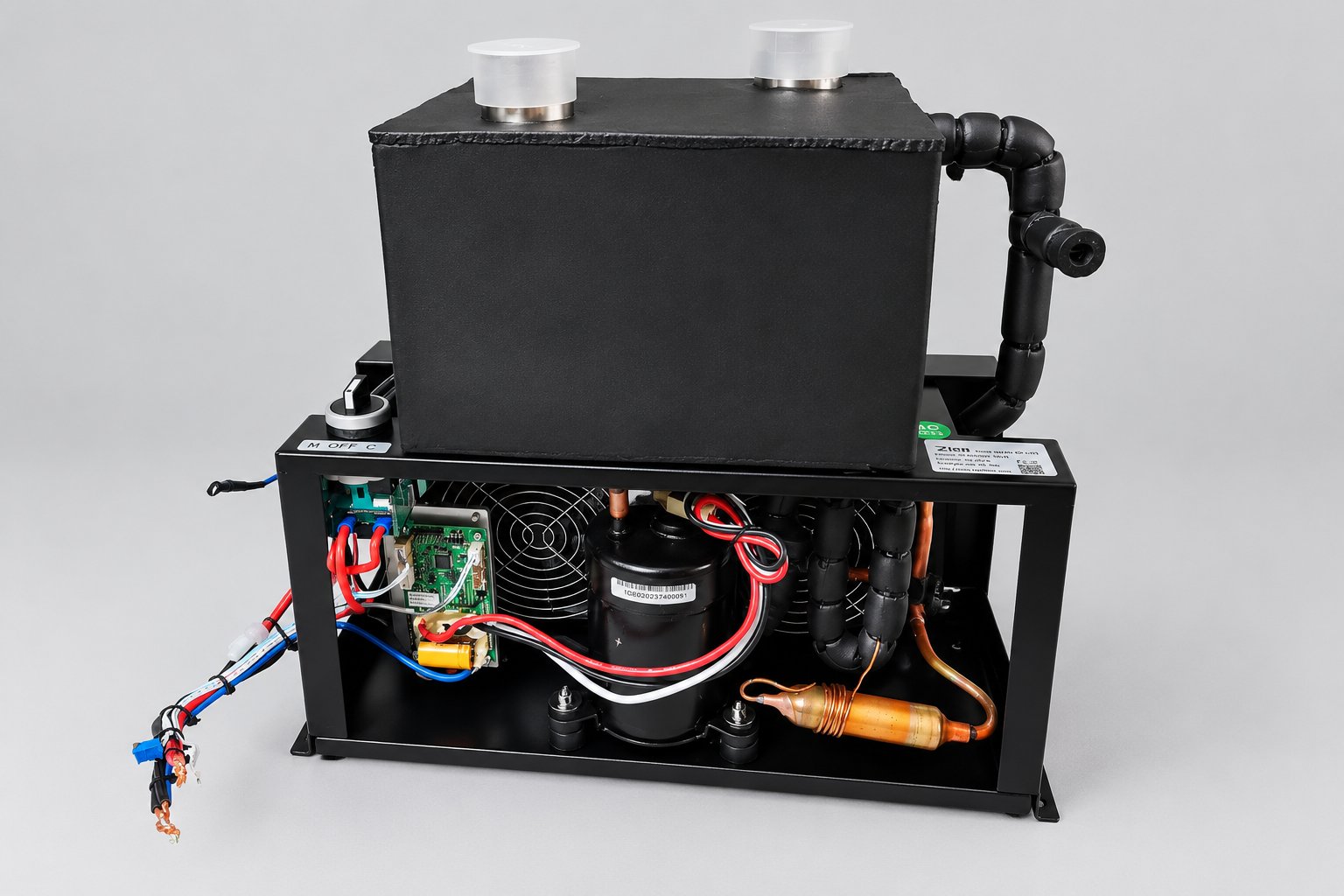
RIGID’s Micro DC Aircon modules are listed at 450 W for the 12 V, 24 V and 48 V models and 550 W for DV3220E-AC, with a brushless DC compressor, R134a or R290 refrigerant and a 350 × 260 × 180 mm body. Published cooling capacity is a single figure, so ask for capacity at the ambient temperature your site actually reaches, and remember the condenser is rejecting heat into that same hot air.
A practical sizing sequence for a sunlit cabinet:
- Total the electronics dissipation at the duty that coincides with the hottest hour.
- Add conduction through the walls at design ambient.
- Add solar heat load using area, irradiance, absorptivity and an assumed entering fraction.
- Decide the internal temperature limit from the weakest component, not from habit.
- Compare that total with capacity quoted at design ambient, not at laboratory conditions.
- Check the power budget: a cooler running most of the afternoon changes the battery or supply sizing.
Measuring Instead of Guessing
Where a cabinet already exists, a day of data beats any estimate.
- Log internal air temperature, external ambient and cooler run time for a clear day and a cloudy day of similar ambient.
- The difference in cooler run time between the two indicates the solar contribution, provided internal load, set point, capacity conditions and compressor or fan speed are comparable; thermal mass also delays the response.
- Add a skin temperature sensor on the lit face to see when the absorbed flux peaks.
- If the cooler runs continuously on the clear day and the internal temperature still rises above the limit, the system is undersized. Continuous running while holding set point is not by itself a failure; a modulating unit can run that way by design.
- Repeat the comparison in a different season. A site that copes in June can fail in September, when a lower sun puts more energy on the vertical faces while ambient is still high.
What Solar Load Does to a Power Budget
On a grid-fed cabinet the extra cooling shows up as a slightly larger electricity bill. On a solar or battery-backed site it changes the system design, because the cooler draws its peak exactly when the site is hottest and the batteries are working hardest.
- Cooling energy scales with run time, and solar heat load lengthens run time through the afternoon.
- The condenser rejects into the hottest air of the day, so efficiency is at its worst when demand is at its highest.
- Autonomy calculations that assume overnight-only cooling fail on a sunlit cabinet, where the mass of the enclosure keeps releasing heat after sunset.
Where the site is off-grid, run the numbers both ways: a sunshield that removes 150 W of load can be worth more than the equivalent panel and battery capacity needed to power the extra cooling, and it needs no maintenance.
Retrofitting a Cabinet That Already Overheats
Existing installations rarely allow a redesign, so the order of attack matters. Work down this list and stop when the alarms stop.
- Confirm the problem is solar heat load by comparing clear-day and cloudy-day behavior at similar ambient temperature.
- Clear the condenser and any filter. A partly blocked condenser looks exactly like an undersized cooler on a hot afternoon.
- Fit a sunshield over the most exposed face and the roof, with an air gap of at least 25 mm so heat can escape.
- Repaint or wrap the cabinet in a light finish if the shield is not enough.
- Check that the shield has not blocked the condenser airflow, narrowed its clearance or created a path for discharge air to return to the intake. Shade on the condenser helps; obstruction does not.
- Only then consider a higher-capacity unit, and size it against the measured load rather than the original component list.
Two failures are worth naming because they recur. Adding a shield but leaving the condenser in the sun gains little. Raising the internal set point to stop nuisance alarms trades a visible problem for an invisible one: electronics age faster at the higher temperature even though nothing trips.
Common Mistakes
- Sizing from the component list and ignoring solar heat load entirely.
- Specifying a dark finish for appearance on a cabinet that stands in full sun.
- Designing for noon when the west wall plus late-afternoon ambient is worse.
- Adding insulation to a cabinet whose cooler is already marginal on the electronics load.
- Taking a capacity figure from a datasheet without asking what ambient it applies to.
- Forgetting that the condenser also sits in the sun unless it is shaded.
If you are specifying cooling for an outdoor cabinet, send us the cabinet dimensions, finish, orientation, site ambient and internal dissipation, and our engineers will work through the combined load with you. Ask about cooling for a sunlit enclosure.
Frequently Asked Questions
How much heat does sunlight actually add to a cabinet?
For a mid-sized cabinet with one to two square meters exposed, roughly 100 to 300 W in temperate conditions, and considerably more for a dark finish in strong sun. The exact figure depends on area, irradiance, absorptivity and wall construction.
Does painting an enclosure white really help?
Yes, and it is usually the cheapest single change. Light gray or white paint absorbs roughly a quarter of arriving radiation against nearly all of it for black powder coat.
Is a sunshield better than a larger air conditioner?
Usually, because it reduces the load rather than removing its effects, and it does not add electrical consumption. A shield with an air gap over the lit face is the standard approach.
Which face should I design around?
The one that is lit when ambient temperature peaks, which in most installations is the west-facing wall in mid-afternoon rather than the roof at noon.
Does solar load matter in winter?
It can. A low winter sun strikes vertical surfaces more directly than a high summer sun, so a south-facing wall in mid-latitudes may see its highest irradiance in the colder months.
How do I check my estimate on an existing site?
Compare cooler run time on a clear day and a cloudy day with similar ambient temperature. The difference approximates the solar contribution without any calculation at all.
References
- EXAIR, Calculate Heat Loads from the Sun for Outdoor Control Panels — adding a solar term to panel cooling calculations.
- Gordon Electric Supply, How to Size an Enclosure Air Conditioner — internal load, ambient difference and surface area in enclosure sizing.