
Twelve volts. That is the number printed on nearly every leisure battery, vehicle auxiliary port, and solar charge controller on the market. It is also the voltage that most people assume cannot power real air conditioning. They are wrong—but the details matter far more than the marketing claims suggest.
If you have searched for a portable 12v air conditioner and found yourself buried in spec sheets, conflicting runtime promises, and vague “works great” reviews, this guide is for you. We are going to do what most product pages skip: show the actual math behind runtime, measure realistic cooling output, and match each scenario to the right hardware so you stop guessing and start planning.
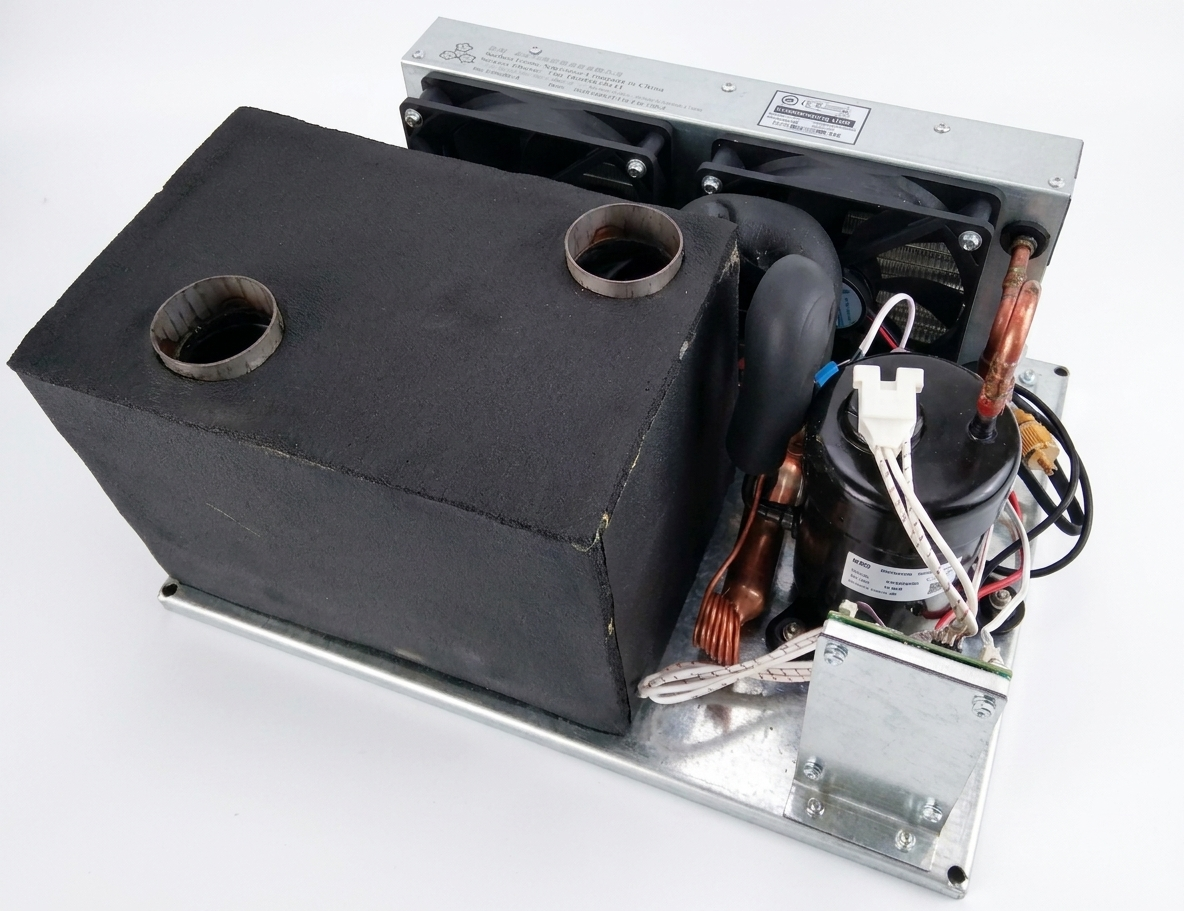
What Makes a Portable 12V Air Conditioner Different from Standard AC
A household window unit plugs into 120V or 220V mains and draws power from an essentially unlimited grid. A portable 12v air conditioner draws from a finite battery or a vehicle alternator. That single difference changes everything: the compressor technology, the refrigerant charge strategy, the fan design, and—most importantly—how long you can actually run it before the battery dies.
True 12V portable units use BLDC (brushless DC) compressors that run directly on DC power without an inverter stage. This matters because every AC-to-DC or DC-to-AC conversion wastes roughly 10–15 percent of your energy as heat. A native 12V BLDC system skips that loss entirely, which translates directly into longer runtime on the same battery.
There is a second, less obvious advantage. BLDC compressors allow variable-speed operation. Instead of cycling on and off at full power like a traditional compressor, they modulate speed to match the actual cooling demand. When the space reaches near-target temperature, the compressor slows down and current draw drops. This is not a small effect—it can extend real-world runtime by 30 to 40 percent compared to a fixed-speed unit under the same conditions.
Runtime Calculation: The Math Nobody Shows You
Let us work through a real example using a 12V portable air conditioning unit rated at 450W cooling capacity with a working current of approximately 16 amps.
The formula is straightforward:
Runtime (hours) = Battery capacity (Ah) × Depth of discharge (%) ÷ Average current draw (A)
Here is where most guides fail: they use the maximum rated current as the constant draw. In reality, the compressor does not pull peak current continuously. During steady-state operation—after the initial cool-down surge—average current typically drops to 60–75 percent of the rated maximum, depending on ambient temperature, insulation quality, and target temperature differential.
Let us calculate with a common 100Ah lithium battery (LiFePO4) at 80 percent depth of discharge:
Conservative estimate (full-load assumption): 100Ah × 0.80 ÷ 16A = 5.0 hours
Realistic estimate (65% average load after cool-down): 100Ah × 0.80 ÷ 10.4A = 7.7 hours
That gap between 5 and nearly 8 hours is not marketing spin. It is physics. A well-insulated tent or vehicle cabin reaches the set temperature within 15 to 20 minutes, and the variable-speed compressor dials back significantly. If you are cooling a small pet enclosure or a single sleeping pod, the average draw drops even further.
Now scale it up. A 200Ah lithium battery bank—common in van conversions and overlanding rigs—gives you:
Conservative: 200Ah × 0.80 ÷ 16A = 10 hours
Realistic: 200Ah × 0.80 ÷ 10.4A = 15.4 hours
That is an entire overnight cooling session on a single charge, even in summer heat. Pair it with a 200W solar panel and you can offset 30–50 percent of daytime draw, pushing effective runtime well past 20 hours in favorable conditions.
One more variable worth noting: ambient temperature directly affects compressor workload. At 30°C (86°F) outside, the compressor cycles at moderate effort. At 40°C (104°F), it works significantly harder and stays at higher speeds for longer, pushing average draw closer to the full 16A rating. If you camp in extreme heat, plan your battery capacity for the conservative number, not the optimistic one.
Cooling Capacity: What 450 Watts Actually Feels Like
Cooling capacity rated in watts (or BTU) tells you how much heat the unit can remove per hour. A 450W cooling capacity is approximately 1,535 BTU/h. To put that in context:
A standard four-person camping tent (roughly 60–80 square feet of floor space) with fabric walls gains approximately 800–1,200 BTU/h of heat through the walls and ceiling in direct afternoon sun. A 450W unit can offset that gain and still pull the interior temperature 5–8°C (9–14°F) below ambient in a well-shaded setup, or 3–5°C in direct sun.
In a vehicle cabin with closed windows, the math improves dramatically. Car bodies have far better insulation than tent fabric, and the volume is smaller. Expect a temperature drop of 8–12°C below ambient within 20 minutes, with the compressor then throttling back to maintenance mode.
For enclosed pet spaces—kennels, crates, or small animal transport boxes—the cooling effect is even more pronounced because the volume is minimal. A 450W unit is genuinely oversized for a single pet enclosure, which means the compressor runs at very low speed and draws minimal current. Runtime on a modest 50Ah battery can exceed 8 hours in this scenario.
It is worth emphasizing that these temperature differentials assume you are managing heat gain. Direct sunlight on an unshaded tent can overpower even a capable cooling system, not because the unit lacks capacity but because the fabric offers almost zero insulation. The practical solution is shade—a tarp, tree cover, or positioning the tent on the north side of a structure—combined with reflective ground sheets that reduce radiant heat from below.
Four Scenarios Where 12V Portable AC Actually Makes Sense
Scenario 1: Camping and Overlanding
Summer camping without cooling is a test of endurance, not enjoyment. A 12V portable unit weighing around 11 lbs can be packed alongside standard camping gear without a weight penalty that matters. Set up the unit with the condenser facing outside the tent vestibule, route a short flexible duct for exhaust heat, and direct cooled air into the sleeping area. With a 100Ah battery and solar top-up during the day, you get comfortable sleep temperatures all night.
Scenario 2: Vehicle Rest and Midday Breaks
Long-haul drivers, delivery workers, and anyone who naps in their vehicle during lunch knows the problem: running the engine for AC wastes fuel and is often prohibited in urban areas due to idle restrictions. A 12V unit connected to an auxiliary battery cools the cabin silently without engine operation. The 5-hour conservative runtime is more than enough for a 2-hour rest, and you can recharge the battery while driving.
Scenario 3: Pet Climate Control
Transporting animals in warm weather is a genuine safety concern. Veterinary guidelines recommend keeping transport enclosures below 26°C (79°F) for most breeds. A compact 12V system mounted to a crate or kennel maintains safe temperatures for hours on a small battery. Because the compressor runs at minimal speed in this low-load scenario, noise levels stay below 45 dB—quieter than a household refrigerator.
Scenario 4: Emergency and Off-Grid Backup
Power outages during heat waves are dangerous, especially for elderly residents and people with medical conditions. A 12V portable air conditioner paired with a deep-cycle battery provides targeted cooling for a single room or sleeping area when the grid fails. It is not whole-house AC—it is survival cooling, and it works.
Battery Selection: Matching Power to Purpose
Not all 12V batteries are equal, and choosing the wrong type is the fastest way to get disappointing runtime.
LiFePO4 (Lithium Iron Phosphate): The best match for portable AC applications. Flat voltage curve means consistent compressor performance from full to empty. Safe 80–90 percent depth of discharge. Weighs roughly half as much as lead-acid for the same capacity. Higher upfront cost, but 2,000+ cycle lifespan makes the per-hour cost lower over time.
Lead-acid and AGM batteries work but impose penalties. Usable capacity drops to 50 percent depth of discharge to preserve battery health, effectively halving your runtime compared to lithium. Voltage sag under sustained 16A draw also causes the compressor controller to reduce speed or shut down prematurely.
For most users, a 100Ah LiFePO4 battery in the 25–30 lb range is the sweet spot: enough runtime for a full night of camping AC, portable enough to carry, and rechargeable from solar, vehicle alternator, or shore power.
Why the RIGID Micro DC Aircon Fits This Use Case
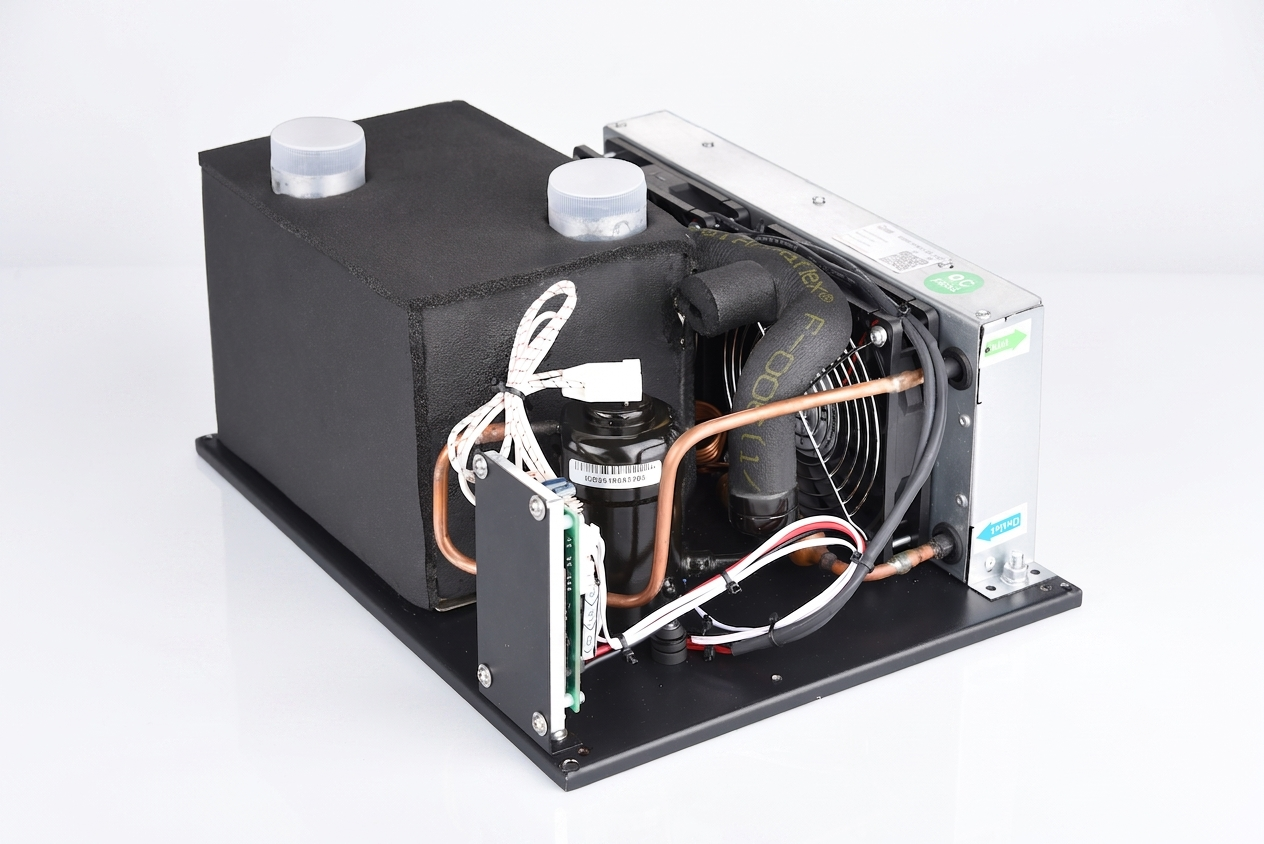
The RIGID Micro DC Aircon line is built specifically for the scenarios described above. The DV1910E-AC model operates natively on 12V DC with a 450W cooling capacity, driven by a miniature BLDC inverter compressor. At approximately 5 kg (11 lbs), it is one of the lightest true-compressor air conditioning modules available—not a swamp cooler, not a thermoelectric device, but a genuine vapor-compression refrigeration system.
Several design details matter for practical deployment. The system ships pre-charged with refrigerant and oil, eliminating field charging. The driver board accepts potentiometer speed control, 0–5V analog, PWM, and TTL communication, which means you can integrate it with thermostats, microcontrollers, or simple manual knobs. Condensate drainage is built in with a dedicated port. And the airflow output of 27.8 CFM is calibrated for small enclosed spaces—enough to circulate cooled air through a tent or cabin without the noise and power draw of an oversized blower.
For applications requiring more cooling capacity, the line extends to 24V models at 700W and 900W, but for battery-powered portability on standard 12V systems, the DV1910E-AC hits the practical limit of what a single leisure battery can sustain for meaningful duration.
Installation Tips for Maximum Runtime
Getting the most hours out of your battery is not just about the battery and compressor. These field-tested practices make a measurable difference:
Insulate your space first. A reflective windshield shade in a vehicle, or a reflective tarp over a tent, can reduce solar heat gain by 40 percent. That means the compressor works less and runtime extends proportionally.
Ensure proper condenser airflow. The condenser side of the unit rejects heat to the outside environment. Restricting that airflow forces the compressor to work harder and draw more current. In a tent setup, position the condenser outside the tent fabric with at least 6 inches of clearance on all sides.
Use a thermostat to prevent overcooling. Setting the target temperature to a comfortable 24–25°C (75–77°F) instead of the lowest possible setting keeps the compressor in its efficient low-speed range for the majority of the runtime cycle.
Wire gauge matters for 12V systems. At 16 amps, voltage drop over long wire runs is significant. Use 10 AWG or heavier wire for runs over 6 feet, and keep connections tight. A 0.5V drop at 12V represents a 4 percent power loss—energy that comes directly out of your runtime.
Realistic Expectations
A portable 12V air conditioner is not a replacement for a 14,000 BTU window unit. It will not cool a full-sized RV to 68°F in the Arizona desert at noon. What it will do is create a comfortable microclimate in a defined space—a tent, a vehicle cabin, a pet enclosure, a small room—using power that you can carry in a backpack-sized battery.
The math is honest: 100Ah of lithium gives you 5–8 hours of real cooling. Two hundred amp-hours gets you through the night. Add solar and the system becomes nearly indefinite in moderate climates. These are not theoretical numbers; they are the result of straightforward electrical calculations that anyone can verify with a clamp meter and a stopwatch.
If your use case fits within these parameters, a 12V portable AC system is one of the most practical off-grid comfort upgrades available. If it does not fit, no amount of marketing will change the physics. Know the math, match the scenario, and the system delivers exactly what the numbers promise.
The key takeaway is this: a portable 12v air conditioner works when you pair the right expectations with the right setup. Calculate your battery needs before you buy, manage heat gain in your space, and choose a true BLDC compressor system over thermoelectric gimmicks. The technology has matured to the point where genuine, compressor-driven cooling on 12 volts is reliable—but only if you respect the electrical realities that govern it. Do the math first, and the comfort follows.