
Field Snapshot: 07:00 Hours. The “Leak” Report.
The call comes in early. A fleet manager or a remote site operator is on the line, and they are not happy. A newly integrated cooling system—commissioned just yesterday—has apparently failed overnight. The report is consistent and alarming: “The unit is leaking fluid all over the floor.”
Immediate panic sets in regarding refrigerant lines. Did a flare crack? Was a fitting undertorqued? But upon arrival at the site or vehicle, the fluid isn’t oily, and it doesn’t smell like PAG oil. It’s water. A lot of it. The carpet in the sleeper cab is soaked, or the bottom of the electronics enclosure is pooling. The cooling unit is still running, still cooling, but the environment is a mess.
This is not a refrigerant failure. This is a failure of portable DC AC condensate management. It is one of the most overlooked aspects of integrating compact DC air conditioners into mobile and off-grid environments. We spend weeks calculating heat loads, battery bank sizing, and airflow paths, but often treat the condensate drain as an afterthought—until it floods the cabin.
In this field note, we break down the mechanics of condensate generation in DC systems, the specific challenges of mobile/vibrating environments, and the integration decisions that keep the water outside where it belongs.
The Physics Behind Portable DC AC Condensate Management
To solve the problem, we must first respect the volume of water involved. When we design for portable DC AC condensate management, we are managing the byproduct of latent cooling. An air conditioner doesn’t just lower temperature (sensible cooling); it dehumidifies. As air passes over the evaporator coil, moisture condenses on the cold fins once the surface temperature drops below the dew point.
In a stationary, grid-tied building, this is trivial. You have a fixed building envelope and gravity. In a portable or mobile DC application—like a truck cab, a marine cabin, or a solar-powered telecom shelter—the variables change drastically. The relative humidity can swing wildly. A unit operating in an arid desert environment might produce almost no water. The same unit, moved to a coastal region or operating during a rainy season, can generate a surprising volume of condensate every hour.
If the integration plan assumes “minimal water,” the system will fail when humidity spikes. The collection pan fills up, the drain line cannot keep up (or is airlocked), and the water overflows the internal gutter. This overflow follows the path of least resistance, which is usually down the inside of the casing and onto the floor. Understanding that water generation is a variable, not a constant, is the first step in robust integration.
Gravity Drainage: The Default Path and Its Pitfalls
The simplest method for removing water is gravity. It consumes no power—a critical factor for battery-dependent DC systems—and has no moving parts to fail. However, in the context of portable and vehicle-mounted systems, gravity is rarely as simple as “downhill.”
The Negative Pressure Problem
A common failure mode we see in field deployments involves the drain line routing relative to the blower fan. In many compact DC air conditioners, the evaporator coil is located on the suction side of the blower. This creates a negative pressure zone inside the drain pan area relative to the ambient air outside the drain hose.
If the drain line is routed straight out without a trap, the negative pressure can suck air up the drain line. This rushing air prevents the water from flowing down. The water is held in the pan by the air pressure until the pan overflows. This is why a “P-trap” or proper water seal is often discussed in building HVAC, but it is frequently omitted in tight mobile integrations due to lack of vertical space.
If you cannot fit a standard trap, you must ensure the drain outlet is positioned or designed to mitigate this back-pressure, or select a unit where the drain pan is positively pressurized (blow-through design), though draw-through is more common for efficiency.
The “Slosh” Factor
Gravity drains rely on a static slope. In a vehicle or portable setup, the unit moves. A truck parked on a steep incline, a boat rocking in the waves, or an off-road vehicle traversing uneven terrain changes the effective gravity vector. A drain pan that drains perfectly on level ground might pool water in a back corner when the vehicle is parked nose-up.
If the drain port is located on only one side of the pan, and the vehicle tilts away from that port, the water accumulates. Eventually, it rises high enough to spill over the edge of the pan before it reaches the drain. High-quality mobile integrations often require dual drain ports (one on each side) or a deep enough pan design to accommodate significant tilt without breaching the edge.
Active Removal: When Gravity Isn’t Enough
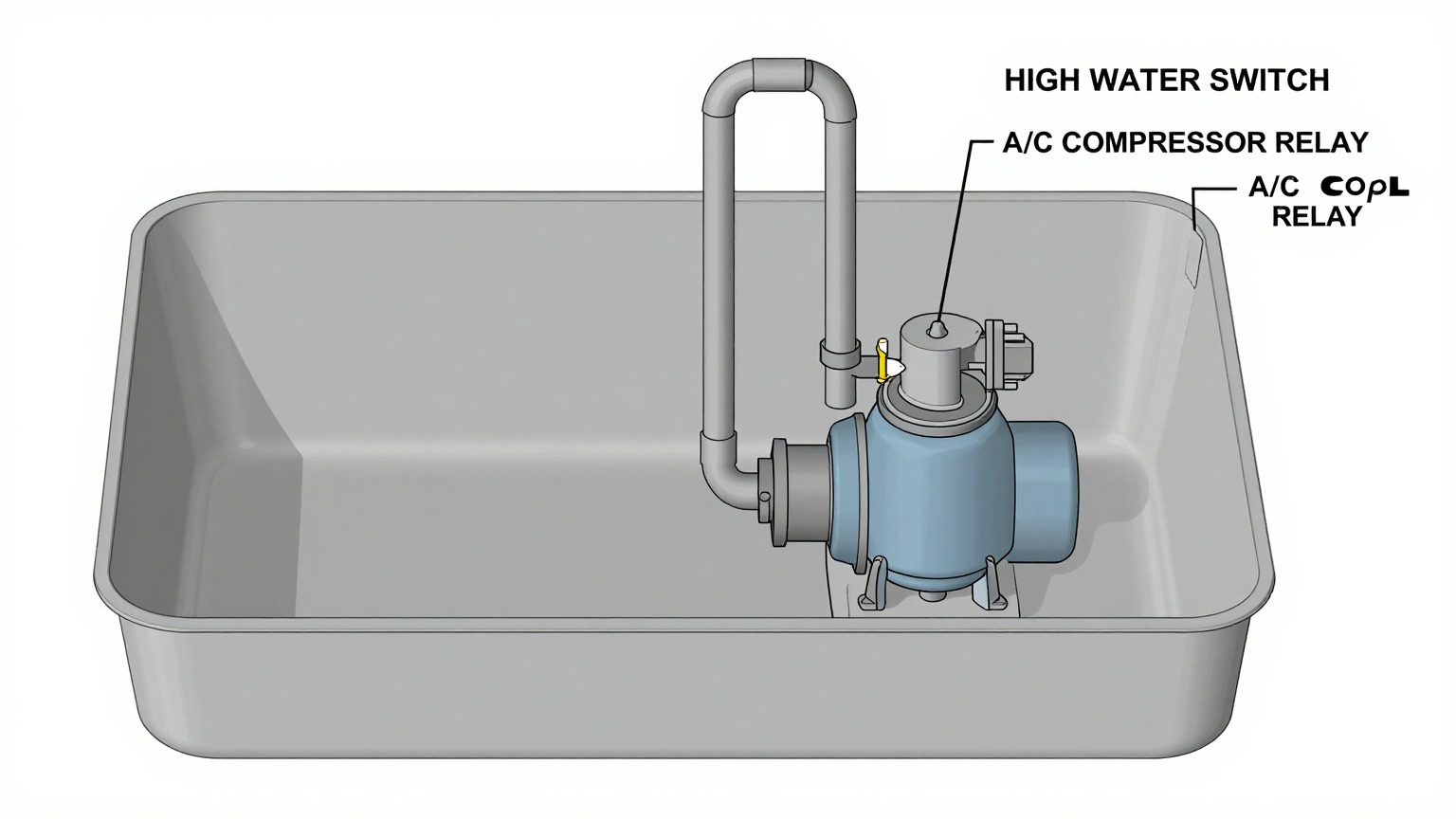
When the installation geometry prevents a continuous downward slope—for example, if the portable DC air conditioner is mounted low in a cabinet and the discharge must go up through a floor or wall—active condensate removal becomes necessary. This typically involves a condensate pump.
Pump Selection Constraints
Adding a pump introduces a new failure point and a new power load. For DC systems running on battery banks, every watt counts. While condensate pumps generally draw low current, they are an additional parasitic load. More importantly, they introduce complexity.
Diaphragm vs. Centrifugal: Diaphragm pumps are often preferred for their ability to run dry and self-prime, which is useful in mobile applications where the water flow is intermittent. Centrifugal pumps are quieter but can suffer if they lose their prime or if the float switch sticks.
Float Switch Hysteresis: The activation mechanism is critical. Mechanical float switches can get stuck due to algae growth or vibration. In mobile applications, the sloshing of water in the reservoir can cause the pump to cycle rapidly (short-cycling), leading to premature burnout. Electronic or sensor-based water level detection is often more reliable in high-vibration environments as it lacks moving parts.
The Overflow Safety Loop
If you choose to use a pump, you must plan for its failure. A robust integration includes a safety interlock. Many condensate pumps have a high-water alarm switch. This switch should be wired to interrupt the compressor signal (or the main power relay) of the cooling unit. If the pump fails or the line clogs, the A/C shuts down before the water overflows. Without this interlock, the A/C will continue to produce water that the broken pump cannot remove, guaranteeing a flood.
Evaporative Solutions: The “No-Drain” Myth
We often hear requests for “evaporative” units that require no drain line at all. The theory is that the condensate can be splashed onto the hot condenser coil, where it boils off and is exhausted with the hot air. This is common in residential window units (using a “slinger ring” on the fan).
Why This Fails in DC Applications
While this technology exists, relying on it for portable DC AC condensate management is risky for two reasons:
- Humidity Overload: In extremely high humidity, the rate of condensation often exceeds the rate of evaporation. The system produces water faster than the hot coil can boil it off. Once the basin fills, it overflows. If your integration relies 100% on evaporation and has no backup overflow drain, you are vulnerable to weather changes.
- Corrosion Risks: Spraying water onto the condenser coil increases the thermal efficiency slightly, but it also accelerates corrosion, especially if the environment has salt air or industrial contaminants. For long-term reliability in fleet assets, keeping the coils dry is often preferred over the minor efficiency gain of evaporative cooling.
Consequently, even if a unit claims to be evaporative, a professional integrator will always plumb the backup drain line. It is better to have a dry drain line than a wet floor.
Routing and Material Selection for Mobile Rigs
The physical tubing used for the drain line is another common point of failure. In a rush to finish an upfit, installers might grab whatever clear vinyl tubing is available. This often leads to problems down the road.
The Kink Risk
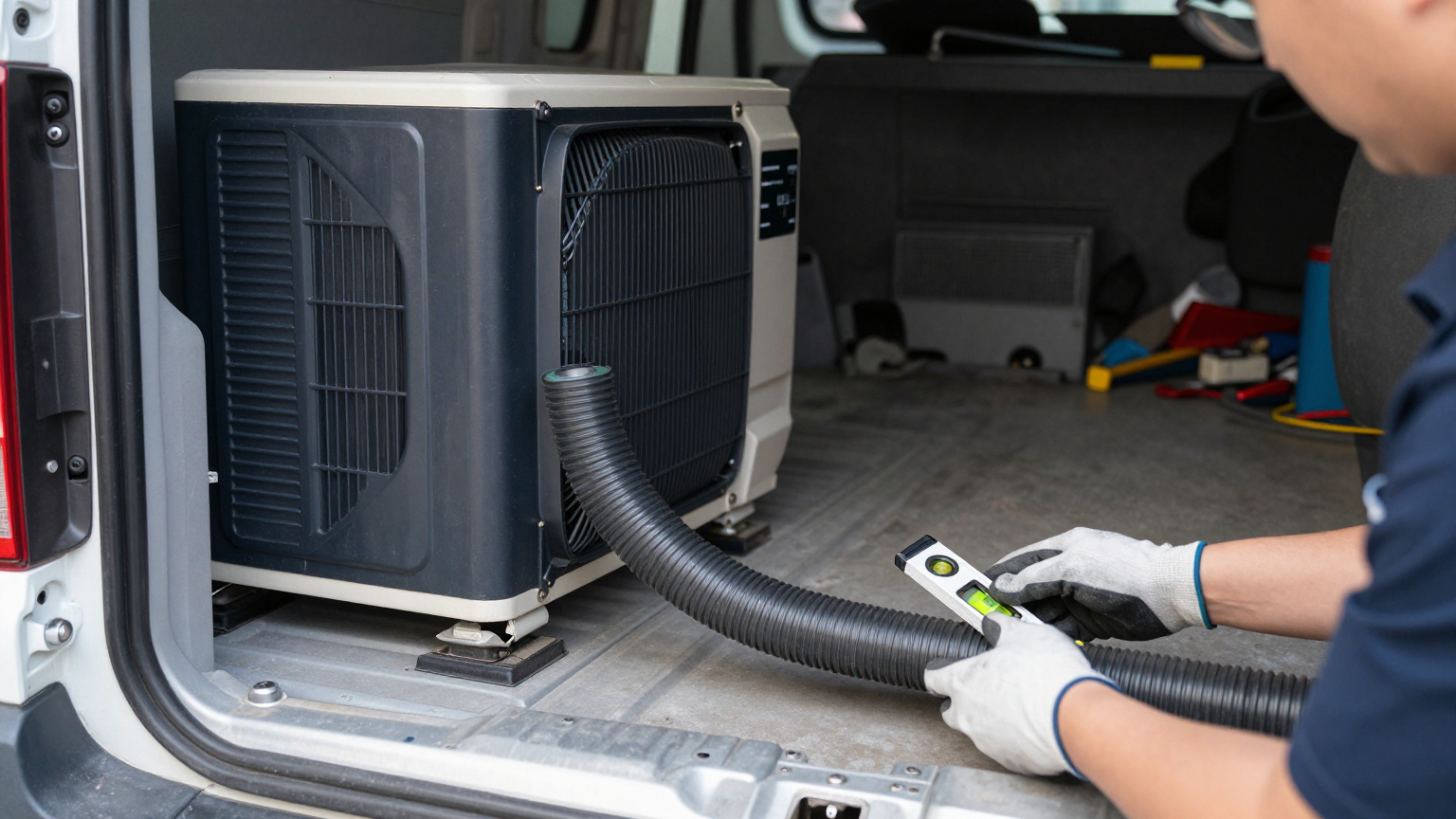
Soft vinyl tubing creates kinks easily, especially when routed through tight bulkheads or around sharp corners in a vehicle chassis. A kink acts as a dam. The water backs up, fills the pan, and floods the unit. For professional integration, we recommend reinforced tubing or rigid piping where possible, or careful routing with proper strain relief to prevent kinks from forming over time as the tubing softens with heat.
Algae and Bio-Slime
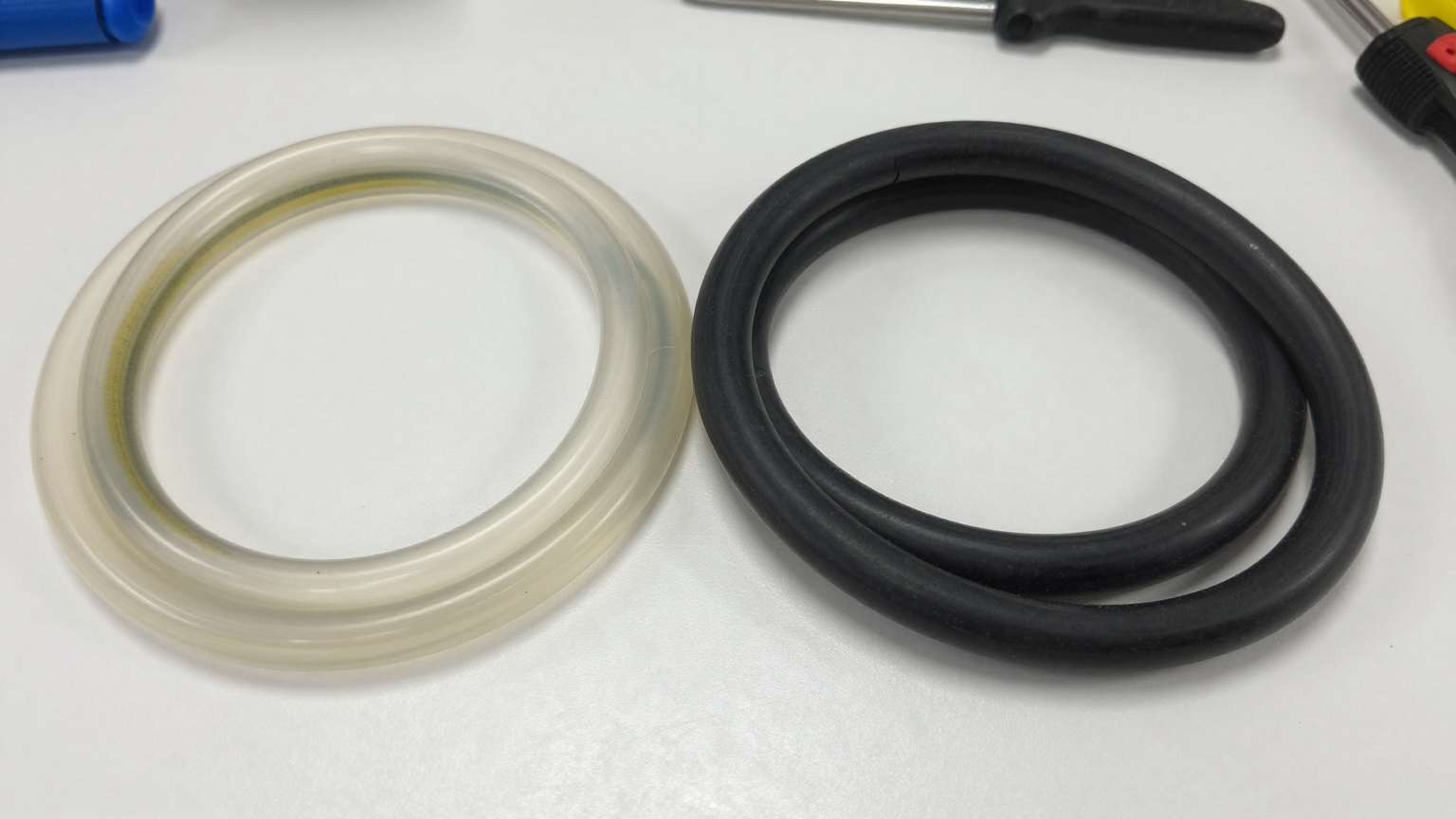
Condensate is not sterile distilled water; it collects dust, pollen, and organic matter from the evaporator coil. This nutrient-rich soup, combined with light exposure in clear tubing, promotes algae growth. Over time, a “bio-slime” forms that can block the tube completely.
Best Practice: Use opaque (black) tubing to block light and inhibit algae growth. If clear tubing is necessary for inspection, ensure it is accessible for cleaning. Additionally, avoid horizontal runs where water can stagnate. Maintain a continuous slope to keep the velocity of the water high enough to scour the line.
Integration Logic: A Decision Matrix
When planning your deployment, use this logic flow to determine the correct condensate strategy. Do not guess; assess the constraints of the specific vehicle or enclosure.
Scenario A: Stationary Enclosure (Solar/Telecom)
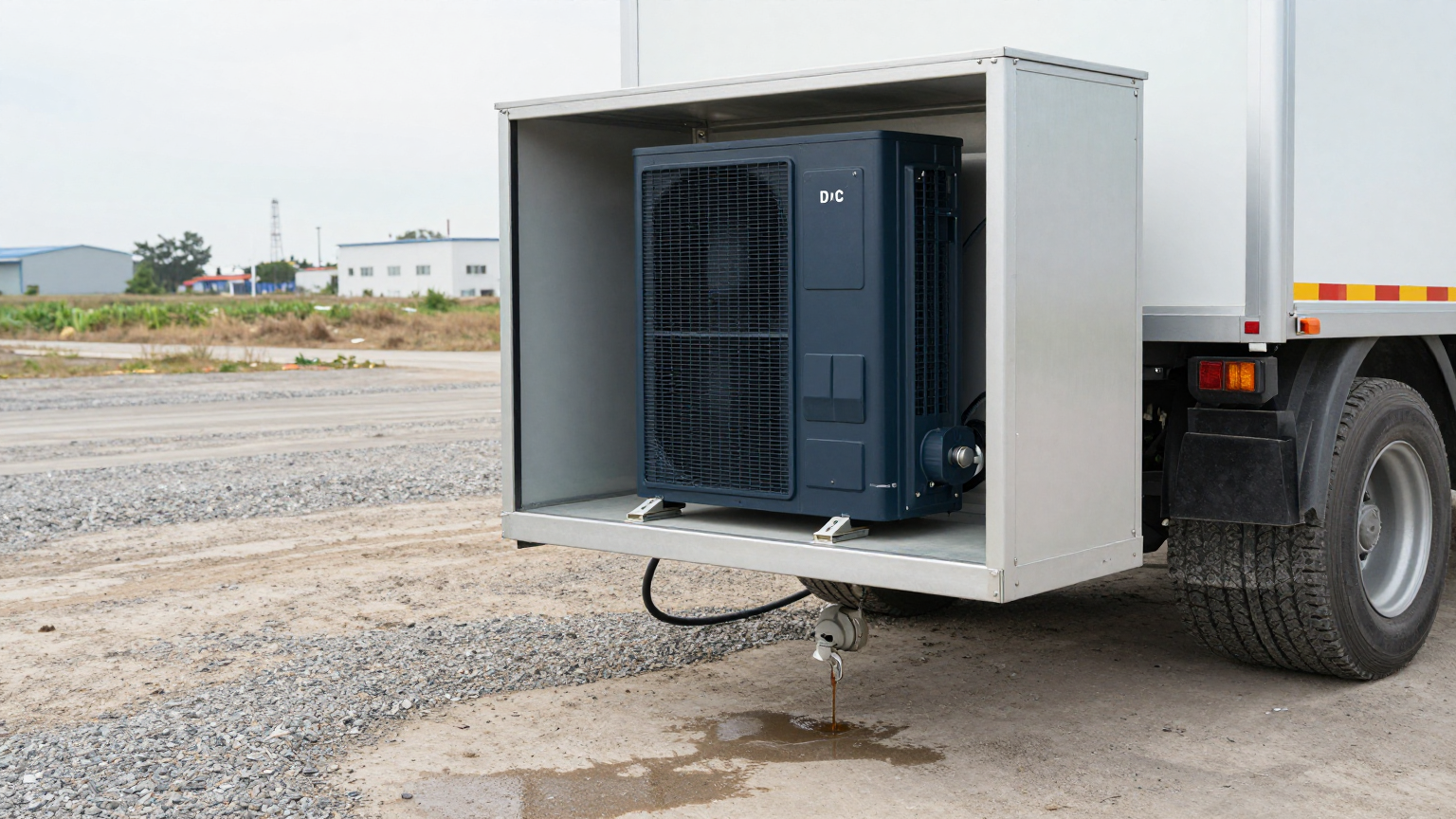
If the unit is fixed and level, gravity is the superior choice. It is fail-safe and uses no power. Ensure the drain line has a trap if the unit creates negative pressure, and route it outside the shelter. Use insect screens on the outlet to prevent mud daubers or spiders from clogging the line from the outside.
Scenario B: Mobile Vehicle (Truck/Van/Marine)
Gravity is still preferred, but you must account for tilt.
Check: Can the unit drain even if parked on a slope?
Decision: If yes, use gravity with dual drain ports if available. If no (e.g., the unit is at floor level), you must use a pump.
Pump Requirement: If using a pump, you must wire the high-water safety switch to the A/C controls. No exceptions.
Scenario C: High Vibration/Off-Road
Secure every connection. A friction-fit hose will shake loose. Use hose clamps on all drain connections. Avoid rigid PVC piping that can crack under torsion; use flexible reinforced hose. Ensure the drain pan inside the unit is designed with baffles or deep sides to prevent splashing during movement.
Troubleshooting Field Failures
When you encounter the “wet floor” scenario, follow this triage path to identify the root cause. Do not assume the unit is broken; usually, the integration is at fault.
- Check the Slope: Is the drain line running uphill at any point? Even a slight rise can cause an airlock.
- Check the End of the Line: Is the outlet submerged? If the drain hose terminates in a bucket or a puddle, it cannot drain. The outlet must be in free air.
- Inspect for Double Traps: If the hose sags between two support points, it creates a “double trap.” Air gets trapped between the two water pockets, stopping flow. The line must be supported continuously.
- Blow Out the Line: Algae or debris often form a plug. A quick blast of compressed air (gently) from the outlet side up can clear it, but this is a temporary fix. If it clogs once, it will clog again unless the routing or tubing type is improved.
Frequently Asked Questions
Q: Can I just let the water drain into the bilge or a false floor?
A: This is generally a bad idea. Accumulating moisture in hidden spaces promotes rust and mold. Always route condensate to the exterior of the vehicle or enclosure.
Q: Do I need to insulate the drain line?
A: In humid environments, yes. The drain water is cold (near the coil temperature). If the drain line runs through a hot, humid space, the outside of the drain hose can sweat, creating a secondary drip. Insulating the first few feet of the drain line is a common precaution.
Q: How often should I clean the drain pan?
A: We recommend inspecting it seasonally. If the environment is dusty (construction sites, off-road), mud can accumulate in the pan and block the port. A simple flush with water usually clears it.
Q: Can I use condensate tablets in a DC unit?
A: Yes, pan treatment tablets can help prevent algae growth. However, ensure they are secured so they don’t slide over and block the drain hole themselves—a common irony in mobile applications.
Q: What if the unit is leaking from the front, not the drain?
A: This usually indicates the unit is tilted forward (away from the drain) or the drain is completely blocked, causing the pan to overflow the front weir. Check the level of the installation.
Q: Is the water safe to drink?
A: Absolutely not. It contains heavy metals from the coil, dust, bacteria, and potentially mold. It is gray water and should be handled accordingly.
Conclusion
Water is the inevitable byproduct of cooling. In a portable DC air conditioner integration, managing that water is just as important as managing the power budget. A soaked floor is not just a nuisance; it is a failure of the system design that damages customer confidence and equipment.
By respecting the physics of condensation, choosing the right drainage method for your specific mobility constraints, and using quality materials that resist kinking and biological growth, you can ensure your cooling system remains dry and reliable. The goal is a system that cools without leaving a trace.
Integration Support
If your deployment involves complex geometry, extreme tilt angles, or unique environmental constraints, we can review your drainage strategy. We can help align your configuration with best practices for condensate management in mobile DC applications to prevent field failures before they happen.