The Boondocking Dilemma: Cool Sleep vs. Generator Noise
For the growing community of van lifers, Class B owners, and teardrop trailer enthusiasts, the appeal of boondocking (dry camping without hookups) is freedom. No campground fees, no neighbors three feet away, no check-out times. But this freedom comes with a thermal penalty: no shore power means no easy way to run your roof-mounted air conditioner.
The traditional solution is a gas generator. But generators are loud (60-75 dB), heavy, require fuel logistics, produce carbon monoxide, and are banned in many of the most desirable camping locations—National Parks, BLM dispersed sites, and National Forest land. Running one at 2 AM to cool your sleeping berth is a guaranteed way to anger every camper within 200 meters.
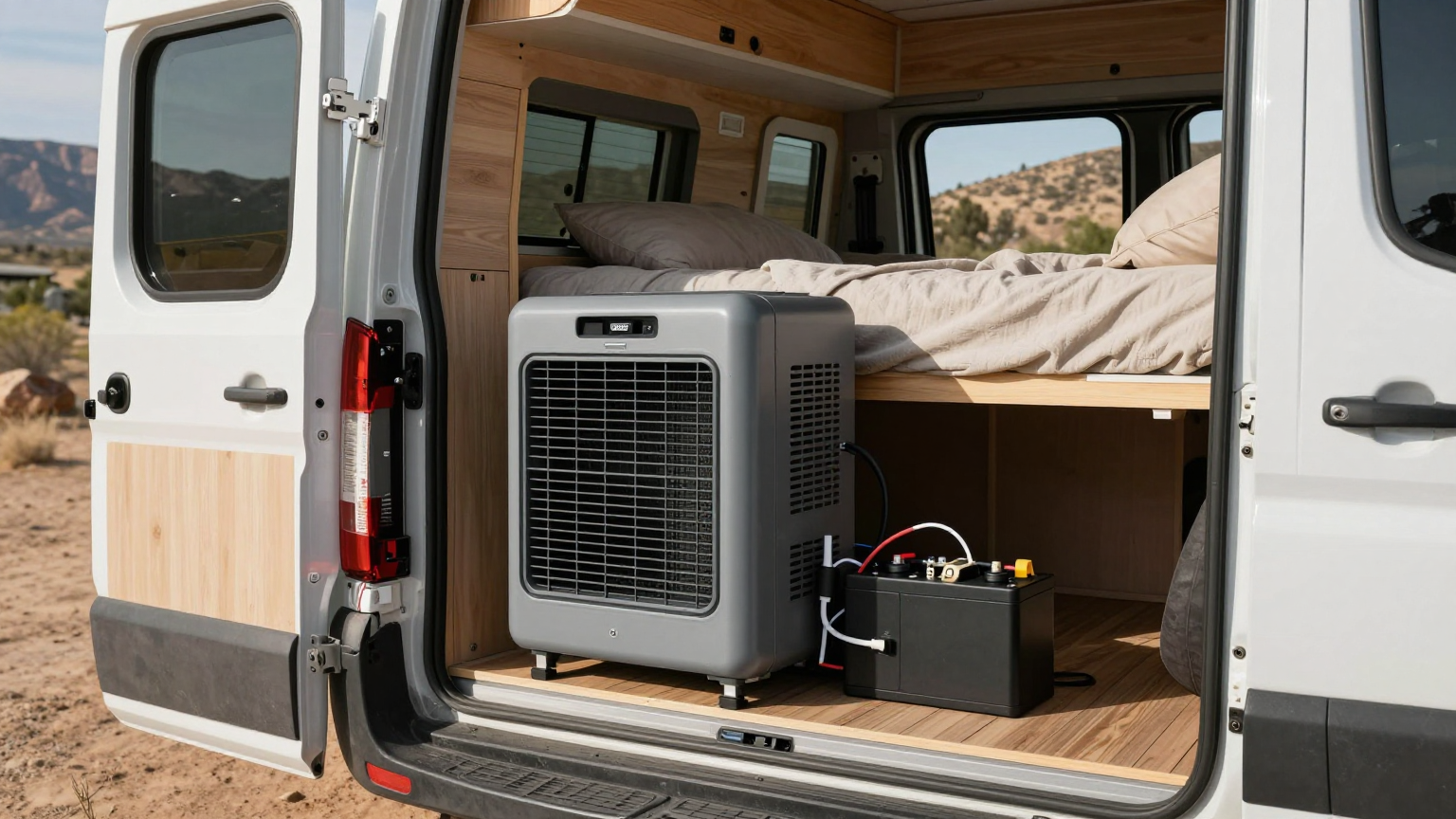
A portable rv air conditioner that runs directly off your existing DC battery bank changes the equation entirely. No generator. No inverter. No noise. Just cool, dry air all night long.
Why Roof AC Units Fail at Boondocking
Standard RV roof air conditioners (Dometic Brisk, Coleman Mach) are designed for shore power or generator operation. They draw 12-15 Amps at 120V AC—that’s 1,400 to 1,800 Watts of continuous power. Let’s do the math on why this is impractical for battery operation:
- Battery Requirement: To run a 1,500W roof AC for 8 hours, you need 12,000Wh (12kWh) of battery capacity. A typical van build has 200-400Ah of lithium at 12V, which is only 2,400-4,800Wh. Your roof AC would drain your entire battery bank in 2-3 hours.
- Inverter Loss: You also need a 2,000W+ pure sine wave inverter to convert DC to AC. This inverter itself consumes 50-100W just idling, and loses another 10-15% in conversion efficiency.
- Cooling the Entire Volume: Roof ACs are designed to cool the entire RV interior—kitchen, bathroom, cab. When you’re sleeping, you only need to cool the sleeping zone (roughly 30% of the total volume).
The result: roof ACs are massively oversized and power-hungry for the actual nighttime cooling task. It’s like using a fire hose to water a houseplant.
The Zone Cooling Strategy
The RigidChill approach is fundamentally different. Instead of conditioning the entire RV, you cool only the sleeping zone—the area where you actually need comfort. This is typically the rear bed area in a Class B van, the overhead bunk in a cab-over, or the mattress area in a teardrop trailer.
The Engineering Advantage
By reducing the target volume from 15-20 cubic meters (full RV) to 3-5 cubic meters (sleeping zone), you reduce the required cooling capacity by 70-80%. The RigidChill LC2810E delivers 2,300-2,800 BTU—perfectly matched to this smaller volume. The result:
- Power Draw: Only 100-250W (compared to 1,500W for a roof unit).
- Battery Runtime: A standard 200Ah/12V lithium bank (2,400Wh) can power the RigidChill unit for 10-16 hours in Eco Mode. That’s a full night plus morning, with battery to spare for lights and phone charging.
- No Inverter Needed: The unit runs natively on 24V DC. Use a simple 12V-to-24V boost converter (or wire directly to a 24V battery system). Zero inverter losses.
Installation in Different RV Types
The beauty of a portable unit is that it requires zero permanent modification to your vehicle. No roof holes, no wiring harnesses, no voided warranties.
Class B / Converted Van (Sprinter, Transit, ProMaster)
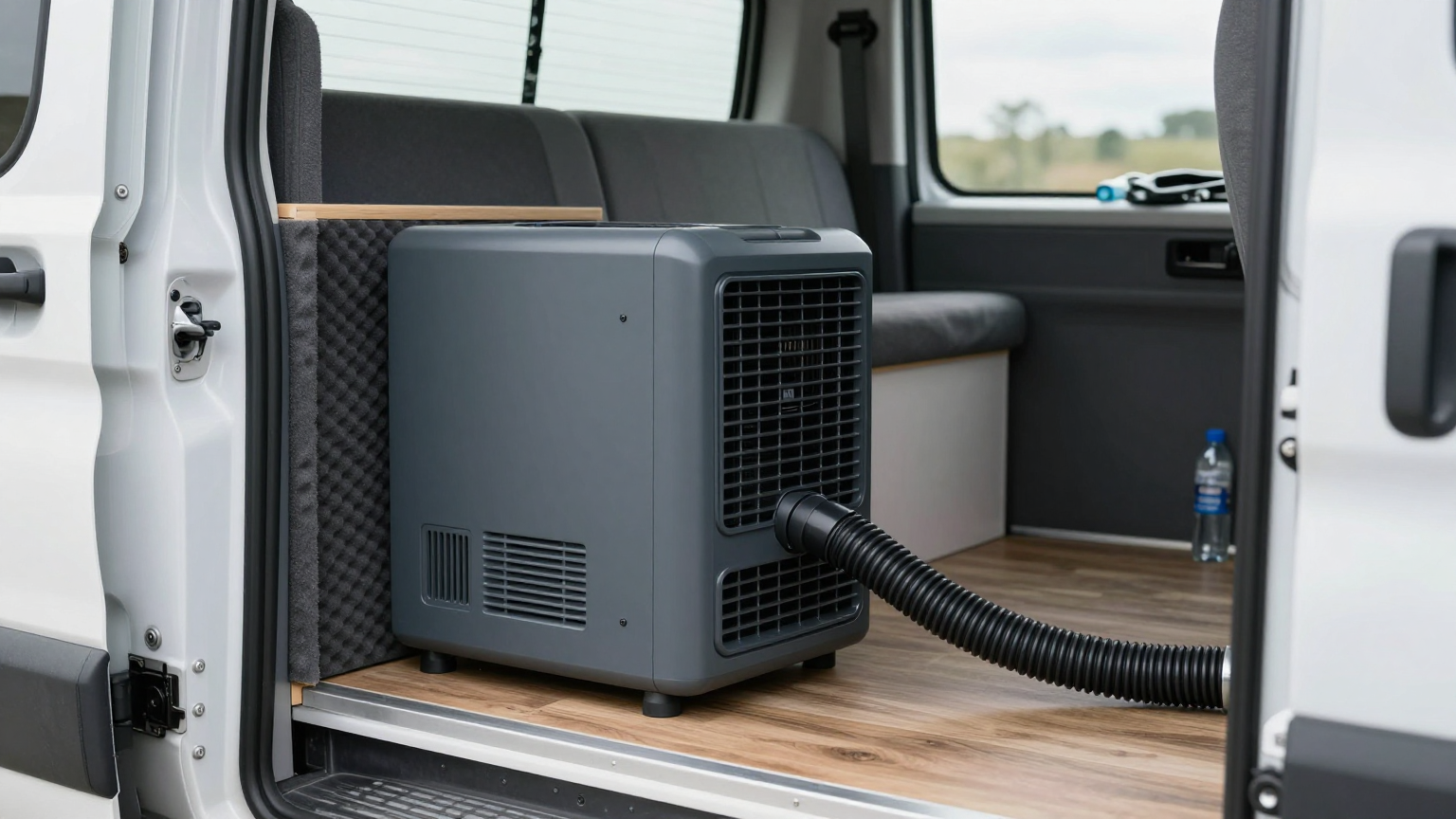
Place the RigidChill unit on the floor near the sliding door or in the galley area. Run the 4-inch exhaust hose out through a cracked sliding door (with a foam seal panel) or through a dedicated port in the van wall. Direct the cold air outlet toward the rear bed platform. Many builders install a small shelf or bracket to keep the unit secure during transit.
Teardrop / Small Trailer
Teardrop trailers have extremely small interior volumes (often under 3 cubic meters), making them ideal for the RigidChill’s capacity. Place the unit in the rear hatch galley area with the exhaust venting out the hatch. The cold air fills the sleeping cabin in minutes. Some owners mount the unit externally in a weatherproof box, ducting cold air in through a small port.
Class C / Cab-Over
For larger RVs where you want to cool just the cab-over sleeping loft, place the unit on the dinette below and duct the cold air up into the bunk using the flexible hose adapter. The hot air naturally falls down and away from the sleeping area, creating an efficient thermal stratification.
The RigidChill Hardware Advantage
Not all portable ACs are created equal. Most consumer “portable air conditioners” sold online are designed for apartments—they run on 110V AC, weigh 25-35 kg, and have reciprocating compressors that vibrate heavily and fail quickly in mobile environments. Here is what makes the RigidChill LC Series purpose-built for RV and van life:
1. Miniature BLDC Rotary Compressor
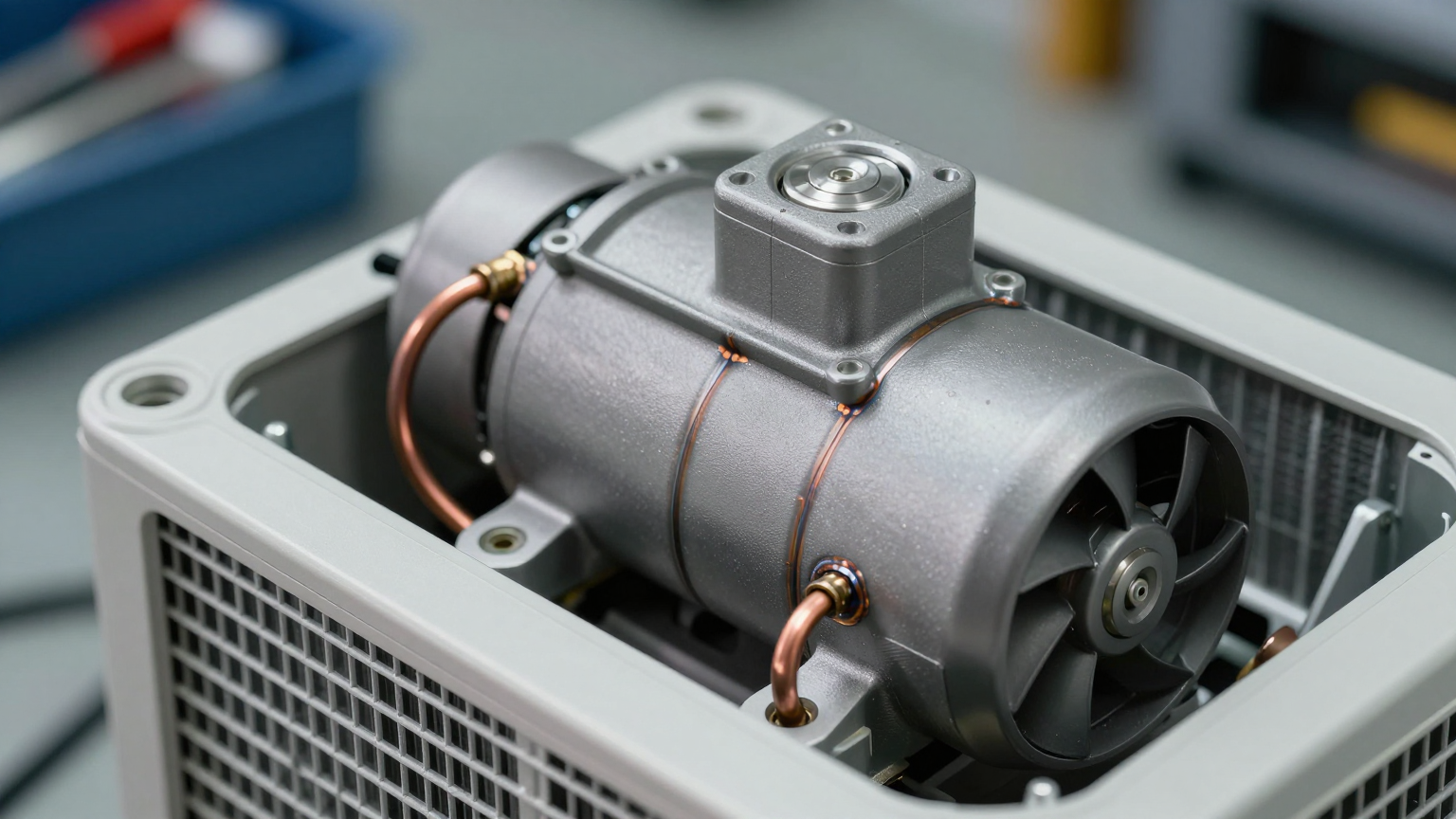
The heart of the unit is a brushless DC rotary compressor. Unlike reciprocating (piston) compressors found in household units, the rotary design has inherently lower vibration and is resistant to the constant motion, tilting, and road shock of vehicle travel. It won’t lose refrigerant charge from a bumpy forest road.
2. Variable Speed Operation
The compressor doesn’t just cycle on/off. It continuously adjusts its speed (RPM) to match the exact cooling demand. When the cabin is hot, it runs at full power. As the temperature approaches your set point, it gradually slows down, consuming less power and producing less noise. This “inverter” technology is the same principle used in high-end residential mini-splits, miniaturized for mobile use.
3. Dehumidification
Humidity is the hidden enemy of comfortable sleep. Even at 24°C, high humidity (above 60% RH) makes the air feel clammy and disrupts sleep. The RigidChill’s vapor compression cycle naturally removes moisture from the air as it passes over the cold evaporator coil. The condensate drains out through a small hose. The result is cool, dry air—critical for comfort in humid coastal or lakeside camping environments.
4. Compact Footprint
At roughly 18″ x 9″ x 11″ (460 x 230 x 280mm), the unit fits in spaces that would be impossible for a household portable AC. It can slide under a bench seat, sit on a galley counter, or be mounted in a custom bracket. Every cubic centimeter matters in a van build.
Power System Integration
Most van builds and RV upgrades already include a lithium battery bank (Battle Born, Renogy, Victron). The RigidChill unit integrates directly into this existing infrastructure.
Wiring Options
- 12V System (Most Common): Use a DC-DC boost converter (12V to 24V) rated for at least 15A output. Wire it to a dedicated circuit on your distribution panel with an appropriate fuse.
- 24V System: Connect directly. No converter needed. This is the most efficient option and is increasingly common in larger van builds and sailboats.
- Portable Power Station: For renters or those who don’t want to modify their electrical system, simply plug into the DC output of an EcoFlow, Jackery, or Bluetti unit.
Solar Replenishment
A 200-400W rooftop solar array can replenish most or all of the energy consumed by the AC during the previous night. In summer (long days, high solar yield), you can achieve a near-perpetual cooling cycle: solar charges the battery during the day while you explore, and the AC runs off the battery at night while you sleep. True energy independence.
Noise: The Stealth Camping Factor
For stealth campers (urban van dwellers who park in residential areas or Walmart lots), noise is a critical concern. Any sound that draws attention to your vehicle is a problem.
The RigidChill LC2810E operates at 42-48 dB in Eco Mode—comparable to a quiet conversation or a library. From outside the vehicle, with the doors and windows closed (except the small exhaust port), it is virtually inaudible. Compare this to a generator at 65-75 dB, which can be heard from 50 meters away.
This silent operation also means you won’t disturb your travel partner sleeping two feet away. The gentle airflow acts as a white noise machine, masking outside sounds like traffic or wildlife.
Real-World Runtime Data
Here are actual runtime figures reported by RigidChill customers across different battery configurations and ambient conditions:
- 200Ah/12V LiFePO4 + 12V-24V Converter: 11-14 hours at 30°C ambient (Eco Mode). Sufficient for a full summer night in the American Southwest.
- 100Ah/24V LiFePO4 (Direct): 12-16 hours at 28°C ambient. The most efficient configuration due to zero conversion losses.
- EcoFlow Delta 2 Max (2kWh): 10-12 hours via DC output at 32°C ambient. Ideal for weekend warriors who don’t have a permanent battery installation.
Integration Support
Every van build is different. Whether you’re converting a Sprinter, outfitting a teardrop, or upgrading a vintage Airstream, the RigidChill engineering team can help you determine the optimal unit placement, exhaust routing, and electrical integration for your specific layout.
We provide wiring diagrams, recommended fuse ratings, and DC-DC converter specifications for all common 12V and 24V battery architectures.
View the RigidChill Portable AC models and installation guides.