
How a Pour Point Bath Works Under ASTM D97
Pour point is the lowest temperature at which an oil still flows under prescribed conditions. The manual method most laboratories know is ASTM D97; ISO 3016 and IP 15 are related methods, so check which one your specification cites. It is simple in principle: a sample in a glass test jar sits inside a metal jacket, the jacket sits in a cold bath, and the operator tilts the jar at every 3 °C step to see whether the surface still moves.
The pour point bath is where most of the equipment decisions sit. D97 does not cool a sample steadily in one bath. It moves the jar through a series of baths at fixed temperatures as the sample cools. That schedule decides which bath temperatures you need, and therefore what a refrigerated chiller has to hold.
This guide walks through the schedule, shows which baths a recirculating chiller rated to −40 °C can cover, and explains how to size and connect one. Always work from the current edition of the standard (ASTM lists D97-17b, reapproved 2022); the figures below follow the published transfer schedule and are for orientation.
The Bath Temperature Schedule
In the manual D97 procedure, the specimen is first brought to a starting temperature, then observed at each multiple of 3 °C. When it has cooled to certain temperatures and still flows, the jar is moved to the next colder bath.
| When the specimen reaches | Move the jar to a bath at |
|---|---|
| +27 °C | 0 °C |
| +9 °C | −18 °C |
| −6 °C | −33 °C |
| −24 °C | −51 °C |
| −42 °C | −69 °C |
As soon as the specimen does not flow when tilted, the jar is held horizontal for 5 seconds. If there is still no movement, the pour point is reported as 3 °C above that reading. The published ASTM D97 procedure also gives separate pre-treatment for specimens expected to have pour points above or below −33 °C, including a 24 °C water bath in one path and a 6 °C water bath in the other.
The jacket is specified as a watertight, flat-bottomed metal cylinder about 115 mm deep with an inside diameter of roughly 44 to 46 mm. It keeps the jar from touching the bath liquid directly and slows the cooling rate, which is part of why the result is repeatable.
Which Baths a −40 °C Chiller Can Hold
A recirculating chiller rated to −40 °C can in principle hold the first three baths in the schedule. The last two are beyond its range.
| Bath | Within a 0 to −40 °C range? | What it means |
|---|---|---|
| 0 °C | Yes | Easy duty; condensation on cold surfaces is the main nuisance |
| −18 °C | Yes | Moderate duty; coolant choice starts to matter |
| −33 °C | Only 7 K above the coolant limit | Workable only if capacity and heat transfer margin at this temperature are confirmed |
| −51 °C | No | Needs a colder refrigeration stage, a cascade bath or a freezing mixture |
| −69 °C | No | Same |
The −33 °C bath is the tight one. If the bath is cooled through a coil, the coolant must be colder than the bath for heat to flow, and a −40 °C coolant limit leaves only 7 K for that under load. Circulating coolant directly through the bath body, or a coil with generous surface, makes it workable; either way it should be confirmed on the real bath rather than assumed.
With 0, −18 and −33 °C baths held, a laboratory can resolve pour points down to about −21 °C. The reasoning follows the D97 transfer schedule: the jar stays in the −33 °C bath while the specimen cools from −6 °C to −24 °C. If it stops flowing at or before the −24 °C reading, the pour point is reported at −21 °C or higher. If it still flows at −24 °C, the method sends it to the −51 °C bath.
That covers many lubricants, hydraulic oils and crude oils with moderate wax content. Samples such as low-temperature hydraulic fluids, arctic-grade fuels or synthetic oils with very low pour points will need the colder baths or a different method.
If most of your samples fall in that range, a three-bath refrigerated setup can handle the routine work, with the occasional very low pour point sample run on a colder apparatus. If a large share of samples need the −51 °C bath, a single-stage −40 °C chiller is the wrong core for the pour point bath, and a colder system should be specified from the start.
Refrigerated Bath vs Freezing Mixtures vs Automatic Analyzers
D97 allows bath temperatures to be reached by refrigeration or by suitable freezing mixtures. Laboratories typically choose among three setups.
| Setup | Strengths | Limits |
|---|---|---|
| Freezing mixtures (ice and salt, dry ice and solvent) | Low equipment cost; reaches the coldest baths | Consumables, handling, drifting temperature, solvent vapor |
| Refrigerated baths fed by recirculating chillers | Stable temperature, no consumables, repeatable | One temperature per chiller loop; range limit of each chiller |
| Automatic analyzers (for example ASTM D5949) | Less operator time; no external chiller bath needed | Different method; results must be reported against the method used |
The practical point for chillers is that each bath is a separate temperature. One recirculating chiller holds one set point, so a manual setup either uses one chiller per bath, or a multi-well apparatus with its own built-in refrigeration for each well.
Sizing the Chiller for a Pour Point Bath
A recirculating chiller rated to −40 °C still delivers far less capacity at −33 °C than at its nominal rating point, so size from the heat load at the bath temperature. The example below uses assumed values for illustration.
| Heat source | Assumption | Load at −33 °C bath |
|---|---|---|
| Bath heat leak | Insulated bath, 1.2 W/K, room at 23 °C (56 K difference) | About 67 W |
| Jars entering from warmer bath | Four jars, glass and sample about 5 kJ each, removed over about 10 minutes | About 30 W while loading |
| Hoses and fittings | 2 m of insulated supply and return hose | About 15 W |
| Lid openings and tilting | Frequent removal every 3 °C step | About 10 W |
| Total | Roughly 120 W |
 A load of this size is modest, but the chiller’s capacity at −33 °C is what matters. Ask for capacity data at the bath temperature, not only the headline rating, and allow margin for a warm laboratory.
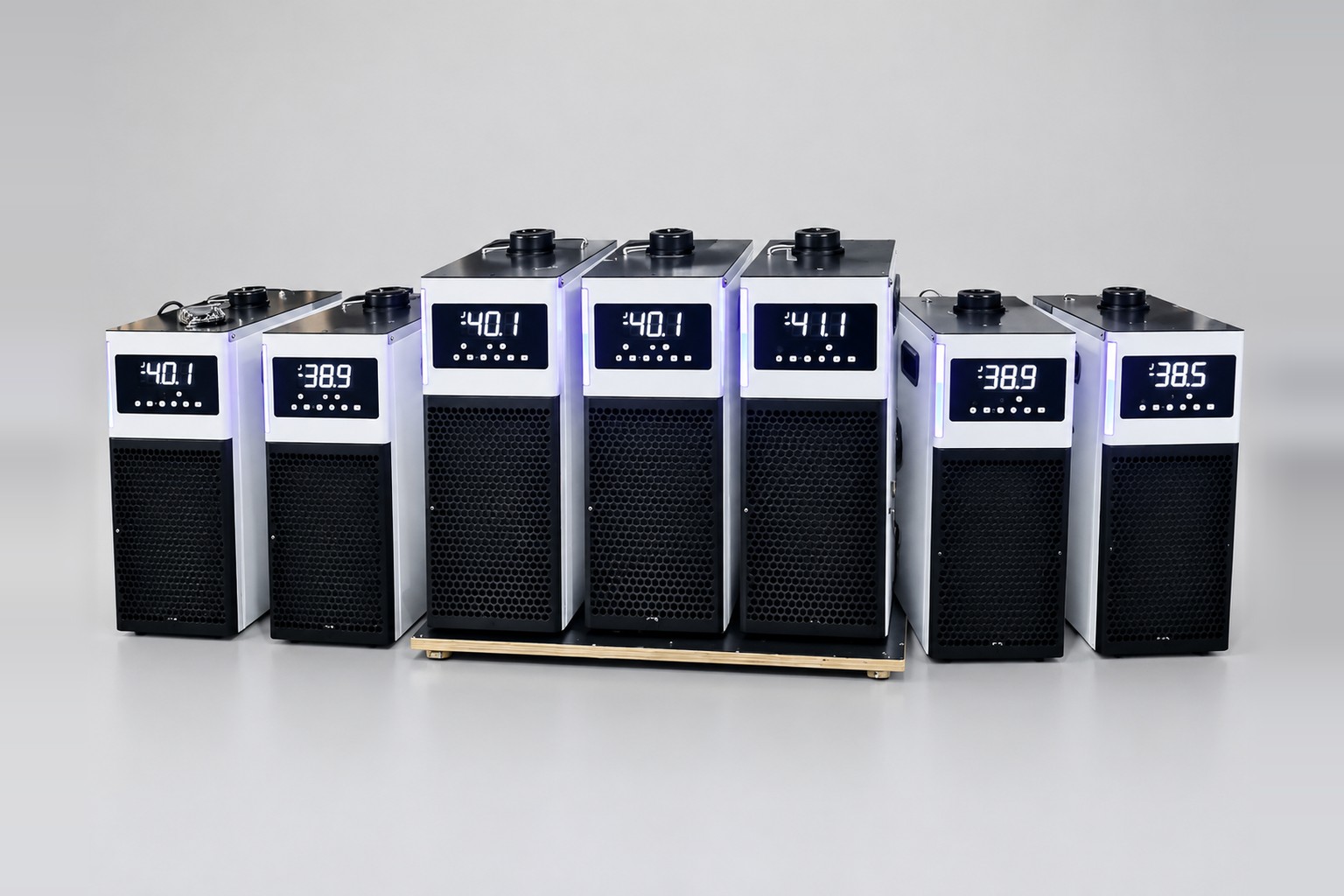
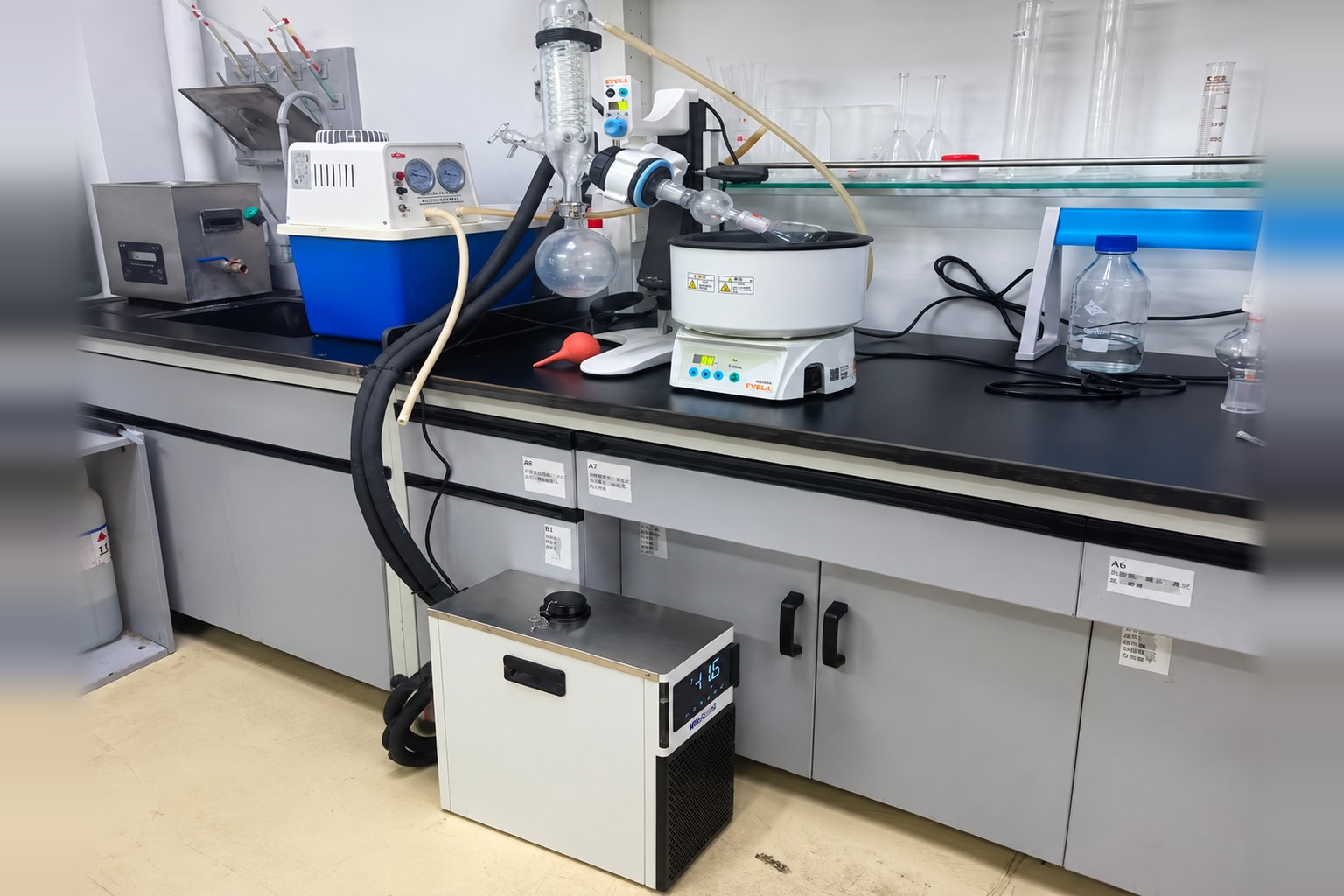
RIGID’s MiniCool countertop recirculating chiller is listed with cooling capacities of 450, 800 and 850 W and a temperature range of 0 to −40 °C, which spans the 0, −18 and −33 °C baths. It is listed with temperature stability of ±0.1 °C (test conditions not stated), quick-connect or threaded ports, and a 200 × 430 × 450 mm footprint. Capacity at −33 °C is not listed, so confirm it for your bath before ordering.
Recovery time matters as much as steady capacity. Each jar moved in from a warmer bath adds a pulse of heat, and during that pulse the bath temperature rises slightly. A chiller with generous capacity at −33 °C pulls it back quickly, which keeps the bath steady while the next 3 °C observation comes due.
Coolant and Frost at −33 °C
At −33 °C, coolant choice and moisture control become part of the method’s reliability.
- Coolant must stay fluid with margin below the coldest set point. Water-glycol mixtures thicken sharply as they approach their limit, which cuts flow and heat transfer. Our lab chiller coolant selection guide compares the common options.
- The bath liquid and the chiller loop do not have to be the same fluid if the bath uses an internal coil, which can simplify maintenance.
- Frost on the jacket rim and jar makes observation harder. D97 itself notes wiping condensed moisture from the jar with a cloth moistened in alcohol before tilting.
- Insulate hoses and exposed fittings so that condensate does not drip onto benches or electrical connections.
- Keep the bath covered between readings to reduce moisture ingress, which otherwise dilutes hygroscopic coolants over time.
Connecting a Recirculating Chiller to a Jacketed Bath
A recirculating chiller rated to −40 °C typically feeds the bath in one of two ways: through a coil immersed in the bath liquid, or by circulating coolant directly through the bath vessel’s jacket or body. The coil approach keeps the bath fluid separate and makes it easier to change bath liquids; direct circulation gives faster response.
- Keep hose runs short and fully insulated; every meter adds heat load and pressure drop.
- Use fittings rated for the coolant and the lowest temperature. Quick-connect ports make it easier to move a chiller between baths, provided the couplings seal reliably when cold.
- Place the bath temperature probe in the bath liquid near the jackets, not at the chiller outlet, and verify it with a calibrated thermometer.
- Check bath level after cool-down, since most coolants contract as they get colder.
- Leave clearance around the chiller’s air intake and exhaust so condenser heat does not warm the bath area.
Before the first test of the day, allow time for the bath, jackets and hoses to reach a stable temperature, then confirm the reading with a reference thermometer. A bath that has just reached set point at the sensor may still have warm jackets.
For a broader view of what a −40 °C circulator is used for in the laboratory, see our overview of low-temperature circulator applications.
Cloud Point and Other Low-Temperature Tests on the Same Setup
Cloud point, the temperature at which wax crystals first make a clear sample hazy, is often run on the same kind of jacket-and-bath apparatus as pour point, which is why suppliers sell combined cloud and pour point baths. Check the cloud point method’s own bath requirements before sharing equipment, because step sizes and observation rules differ.
Other low-temperature petroleum and lubricant tests use cold baths too, including low-temperature viscosity measurements. Those methods usually demand tighter temperature control than pour point, which changes how the chiller and bath should be chosen; our guide to the low-temperature viscosity test bath covers that case.
Common Mistakes
 Most pour point bath problems come from a handful of recurring errors.
- Choosing a chiller by nominal capacity without checking capacity at −33 °C.
- Expecting one chiller to hold several bath temperatures at once.
- Reporting pour points below about −21 °C from a setup that has no −51 °C bath.
- Controlling on the chiller’s internal sensor rather than measuring the bath itself.
- Using a coolant that becomes too viscous near the coldest set point.
- Leaving hoses uninsulated, which adds load and drips condensate.
If you are setting up or replacing a pour point bath, tell us the bath temperatures you need, bath volume and insulation, number of jackets, laboratory ambient range and available bench space, and our engineers will check whether a compact chiller fits. Send your pour point bath details to our engineering team.
Frequently Asked Questions
What bath temperatures does ASTM D97 use?
The manual procedure moves the test jar through baths at 0, −18, −33, −51 and −69 °C, depending on how cold the specimen gets before it stops flowing. The transfer points are when the specimen reaches +27, +9, −6, −24 and −42 °C respectively. Check the current edition of the standard for full details.
Can a −40 °C chiller run a complete pour point bath setup?
It can in principle cover the 0 and −18 °C baths, and the −33 °C bath if capacity and coolant temperature margin at that temperature are confirmed. With all three held, a laboratory can resolve pour points down to about −21 °C. Samples that still flow at −24 °C need the −51 °C bath, which is beyond a −40 °C chiller’s range.
How much cooling capacity does a pour point bath need?
It depends on bath size, insulation, hose length and how many jars are loaded, but a small insulated bath at −33 °C can have a load in the region of 100 to 150 W. The chiller’s capacity must be checked at the bath temperature, where it is much lower than at the nominal rating point.
Can one chiller serve all the pour point baths?
Not at the same time. Each bath runs at a different temperature and a recirculating chiller holds one set point. Laboratories either use one chiller per bath or an apparatus with built-in refrigeration for each well.
Is a refrigerated bath better than dry ice for pour point testing?
For the baths it can reach, a refrigerated bath removes consumables and holds temperature more steadily. Freezing mixtures remain useful for the coldest baths that a single-stage chiller cannot reach.
Why does frost matter in a pour point bath?
Frost and condensation obscure the sample surface, which makes the flow observation harder, and moisture entering the bath gradually dilutes some coolants. Covering the bath, insulating hoses and wiping the jar as the method describes all help.