
Precision Thermal Management Starts with Knowing Both Extremes
Most thermal failures in the field trace back to a single oversight: the engineer sized the system for peak cooling and ignored the cold end of the operating envelope. A battery pack that runs fine at 30 degrees ambient shuts down at minus five. A medical cooler that holds vaccines at two to eight degrees during summer transport loses control when the cargo bay drops below freezing on a winter night flight. An outdoor electronics cabinet that survives July in Arizona fails in January because condensation forms on cold circuit boards before the resistive heater catches up.
Precision thermal management means controlling temperature in both directions, not just removing heat. It means the system can warm a cold-soaked lithium pack to safe charging temperature at dawn, cool an overheating laser resonator at midday, and hold a 3D printer chamber within a narrow band while ambient swings wildly outside. The tool that makes this possible at compact scale is the DC vapor-compression heat pump: one compressor, one refrigerant circuit, one controller, two directions.
This article reviews how heat pump technology applies across the six core scenarios where bidirectional thermal control separates reliable deployments from field failures. If your application touches any of these domains, the decision framework here will help you evaluate whether a cool-and-heat module belongs in your next design.
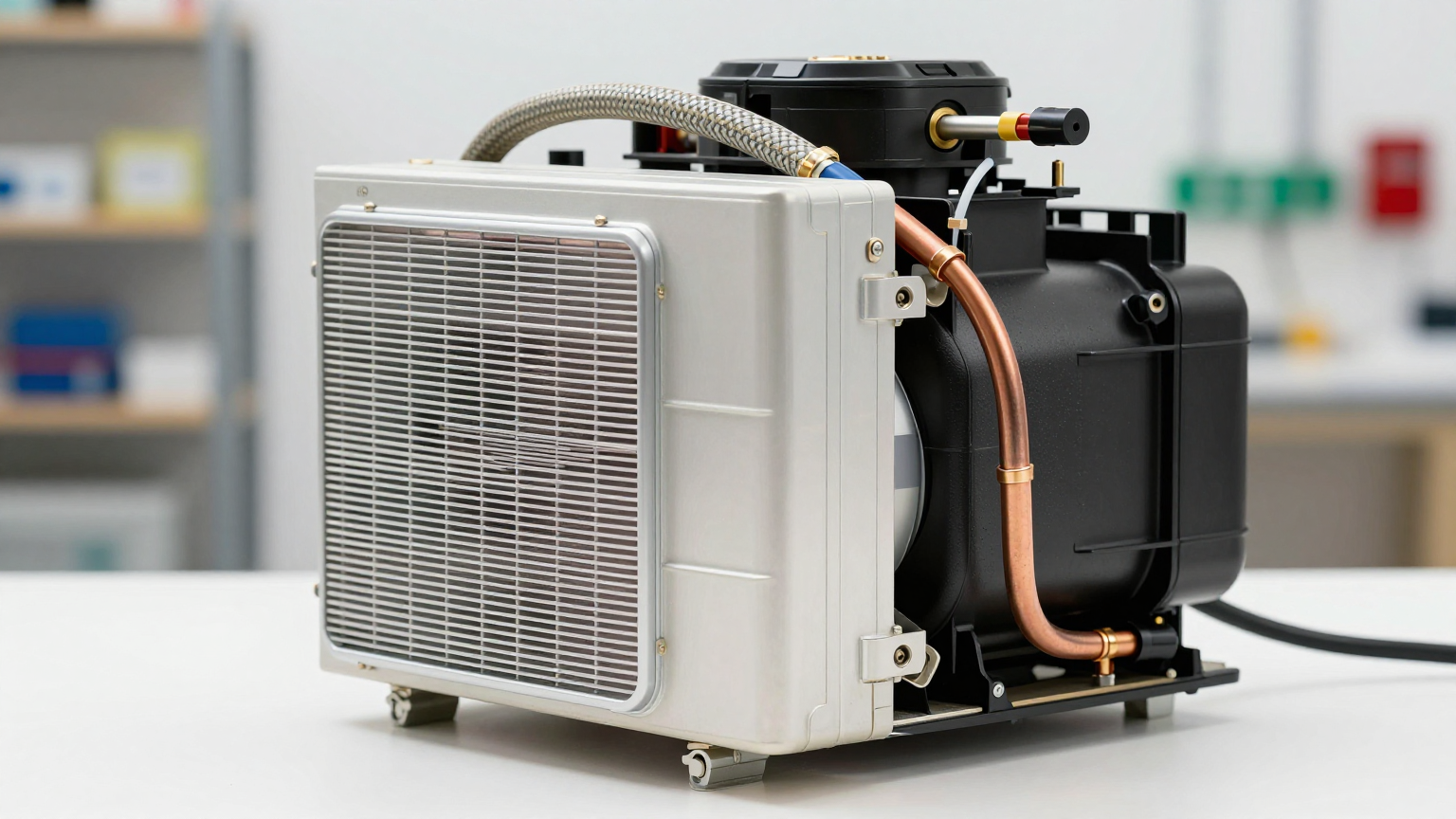
How a DC Heat Pump Delivers Bidirectional Control
A conventional cool-only system moves heat in one direction: indoor to outdoor. Add a four-way reversing valve and the refrigerant flow inverts. The indoor coil switches from evaporator to condenser, pumping heat into the controlled space instead of out. The compressor, expansion device, and charge remain the same. The mechanical addition is minimal, but the capability gain is substantial.
For DC-powered applications, the brushless DC compressor is the enabling component. It runs directly from battery voltage without an inverter stage, starts softly without inrush current spikes, and modulates speed to match the load. When the controller senses that the target zone has dropped below setpoint, it commands the reversing valve and the same compressor begins heating. The coefficient of performance in heating mode typically exceeds that of a resistive heater by a factor of two to three, depending on the temperature differential. That efficiency gap matters enormously in battery-powered and solar-powered systems where every watt-hour counts.
The practical result: one module, one wiring harness, one control loop, and full-range thermal authority from well below freezing to well above typical summer ambient. No separate heater. No second thermostat. No mode-switching relay that an operator has to remember to flip when the seasons change.
Battery Packs: Cold-Start Heating Prevents Lithium Plating
Lithium-ion cells are arguably the highest-stakes application for bidirectional thermal control. Charging below freezing causes lithium metal to deposit on the anode surface instead of intercalating into the graphite lattice. This plating is irreversible. It reduces capacity, increases internal resistance, and in severe cases creates dendrites that can puncture the separator and trigger thermal runaway.
A battery thermal management system (BTMS) built around a heat pump can warm the pack from a cold-soaked state to safe charging temperature before the BMS enables current flow. The same module then switches to cooling mode during fast charging or high-discharge operation when cell temperatures climb. This bidirectional authority is especially critical for energy storage systems deployed outdoors, electric construction equipment that sits idle overnight in cold climates, and EV charging stations at high altitude where overnight lows routinely cross the freezing threshold.
The alternative, a PTC heater for warming plus a separate chiller for cooling, works but consumes significantly more energy during the heating phase and requires twice the integration effort. For systems where the battery bank also powers the thermal management hardware, the heat pump’s superior heating efficiency directly translates to more usable energy for the primary load.
Medical Transport: Holding a Narrow Band Through Ambient Extremes
Blood products, vaccines, and certain pharmaceuticals require transport within a tightly defined temperature window. The challenge is that the transport environment itself is uncontrolled: a cargo van in summer, an aircraft hold in winter, a motorcycle courier in a tropical monsoon. The thermal system must reject heat when the vehicle interior climbs and add heat when it drops, all while maintaining the payload within its specified range.
A cool-only portable medical cooler handles the summer scenario but fails in winter unless the operator pre-warms the unit or stores it in a heated space before loading. A heat pump cooling system eliminates that dependency. The controller monitors the payload temperature and the ambient sensor, switching modes automatically. The operator loads the cargo and forgets about thermal management entirely, which is exactly the level of simplicity that field logistics demands.
For cold chain compliance, the continuous data log from a bidirectional system also simplifies audit trails. Instead of gaps where the cooler was off and a separate heater was on (or worse, where neither was running during a mode transition), the log shows uninterrupted control authority from pickup to delivery.
Laser Systems: Warm-Up Acceleration and Run-Time Stability
Fiber and CO2 lasers need their resonator and optics at a stable temperature before the beam reaches specification. In a cold workshop, warm-up can take thirty minutes or more. A heat pump accelerates this by actively warming the coolant loop until the resonator reaches its operating window, then seamlessly transitions to cooling once the laser begins generating waste heat.
The payoff is faster first-cut time and tighter wavelength stability during the transition from warm-up to full-power operation. For production environments where the laser runs one or two shifts and sits idle overnight, the daily warm-up penalty adds up. A bidirectional thermal module that cuts warm-up time effectively adds productive capacity without changing the laser itself.
This same logic applies to any precision optical or photonic system where thermal settling time affects output quality: semiconductor inspection tools, medical imaging lasers, and scientific instruments deployed in field containers.
Outdoor Cabinets: Surviving the Full Ambient Envelope
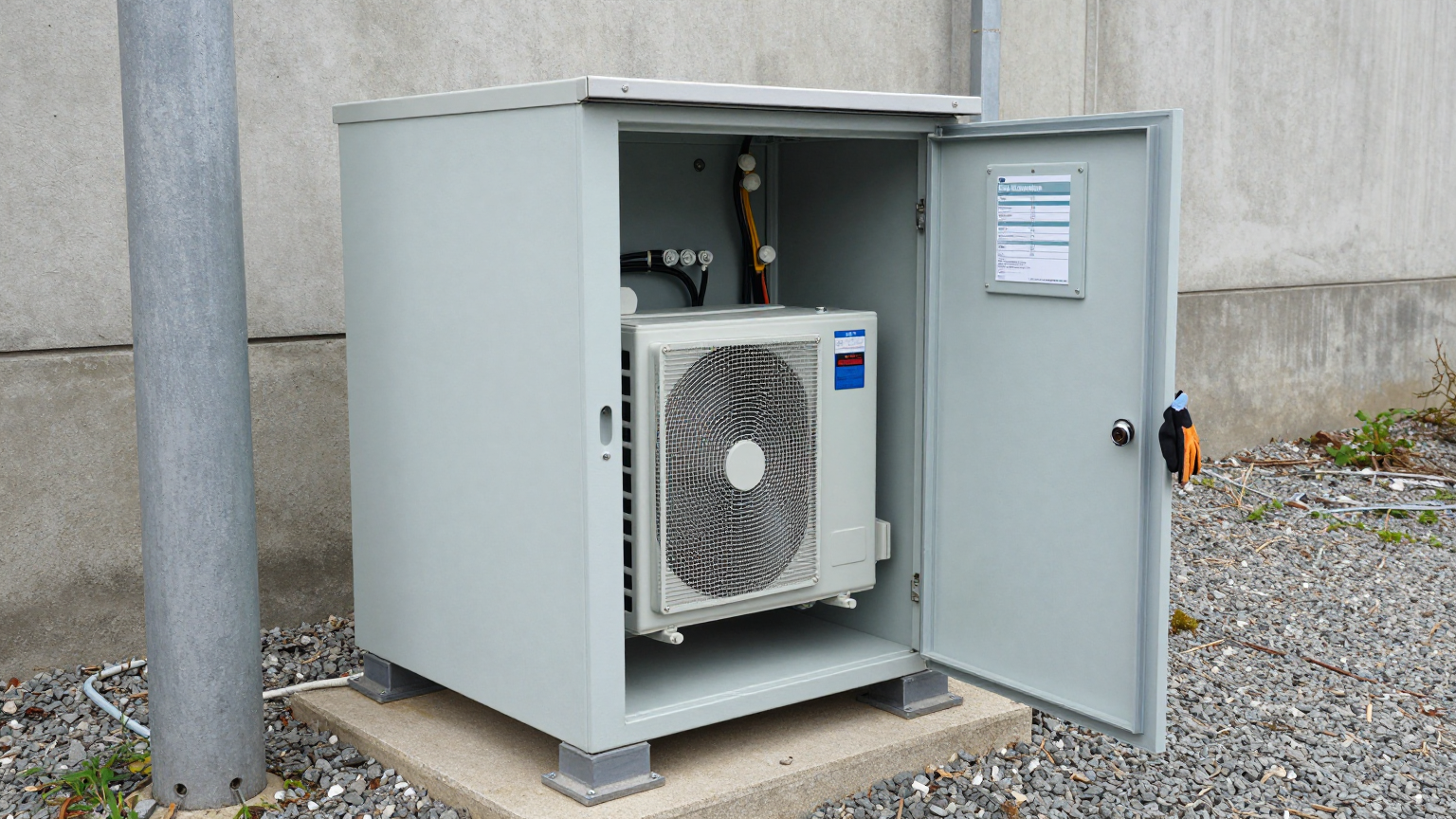
Telecom shelters, power distribution cabinets, and remote monitoring enclosures face the complete ambient spectrum. The traditional approach layers a compressor-based cooler for summer with a thermostatically controlled heater for winter, plus a ventilation fan for mild conditions. Three subsystems, three failure modes, three maintenance schedules.
A single heat pump module consolidates this into one unit. The controller reads internal and external temperature sensors and selects the appropriate mode automatically. The reduction in component count directly improves mean time between failures, which matters enormously for unattended sites where a truck roll for repair costs more than the equipment itself.
Condensation management is the integration detail that separates successful cabinet deployments from problematic ones. When the heat pump switches from cooling to heating, residual moisture on the cold evaporator coil can drip onto electronics below. Proper drain routing, a brief fan-only drying cycle before mode switch, and coil placement above a drip tray prevent this.
Additive Manufacturing: Chamber Control for Warp-Free Prints
Engineering-grade 3D printers using ABS, polycarbonate, and nylon require elevated chamber temperatures to prevent warping. The chamber must reach target temperature before printing and hold steady throughout builds lasting hours or days. Meanwhile, stepper motors and electronics inside need cooling to avoid overheating.
A heat pump addresses both needs. During pre-heat, it warms the chamber rapidly. Once the print starts and the heated bed plus extruder add thermal energy, the system transitions to cooling mode to prevent overshoot. A single heat pump with one PID loop eliminates the oscillation that occurs when separate heaters and coolers fight over the same thermal zone, delivering tighter temperature stability and fewer failed builds.
Portable Environmental Chambers: Lab Conditions Off-Grid
Field researchers and calibration technicians sometimes need a controlled thermal environment far from a laboratory. Soil sample incubation, adhesive cure testing, material aging studies, and sensor calibration all require holding a specimen at a defined temperature. The specimen may need to be above or below ambient depending on the protocol.
A portable environmental chamber built around a DC heat pump can maintain setpoints both above and below ambient, powered from a vehicle battery or portable solar array. The heat pump efficiency advantage over resistive heating extends battery runtime for above-ambient tests, while its cooling capability handles below-ambient protocols that a simple heater cannot address at all.
Decision Framework: Cool-Only vs. Cool-and-Heat
| Decision Factor | Cool-Only Sufficient | Heat Pump Recommended |
|---|---|---|
| Ambient range | Always above load minimum | Crosses both setpoint boundaries |
| Power source | Grid or large generator | Battery, solar, or limited DC bus |
| Enclosure volume | Room for separate heater and cooler | Tight packaging, single module preferred |
| Operator presence | Attended, can switch modes manually | Unattended or remote, autonomous switching needed |
| Heating duty cycle | Rare or brief | Daily or seasonal, significant energy draw |
| Compliance requirements | Wide tolerance band | Narrow band with audit trail needed |
The table above is a starting point. In practice, the decision often comes down to two questions: does the load ever need active heating, and is the heating demand frequent enough that a resistive element wastes unacceptable energy? If both answers are yes, the heat pump path is typically the more robust and economical choice over the system lifetime.
Integration Pitfalls That Derail First Prototypes
Selecting a heat pump module is the easy part. Integrating it without creating new problems requires attention to several details that are easy to overlook on paper but painful to fix after the first field deployment.
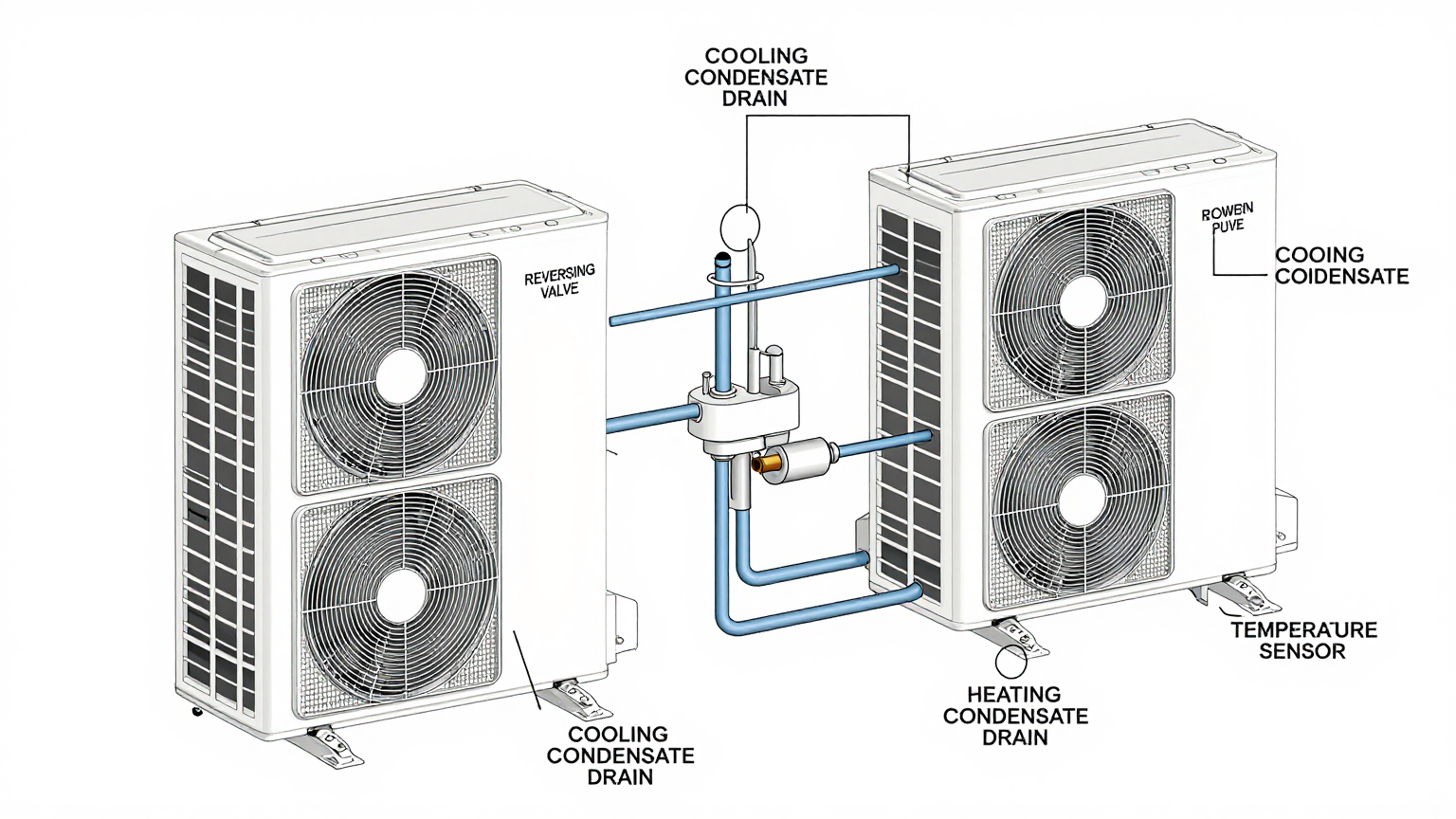
Defrost logic. When heating in cold ambient, the outdoor coil (now acting as evaporator) can frost over, reducing airflow and heat transfer. The controller needs a defrost cycle that temporarily reverses back to cooling mode to melt the ice, then returns to heating. Without this, heating capacity degrades progressively until the system cannot maintain setpoint.
Reversing valve timing. The four-way valve should not switch under full compressor load. A brief compressor pause before switching protects the valve from pressure differential damage and prevents refrigerant slugging. Most DC compressor controllers support a programmable delay, but it must be configured explicitly.
Condensate routing in both modes. In cooling mode, condensate forms on the indoor coil. In heating mode, it forms on the outdoor coil. Both drain paths must be designed and tested. Field failures from blocked or missing drains in the less-obvious mode are common.
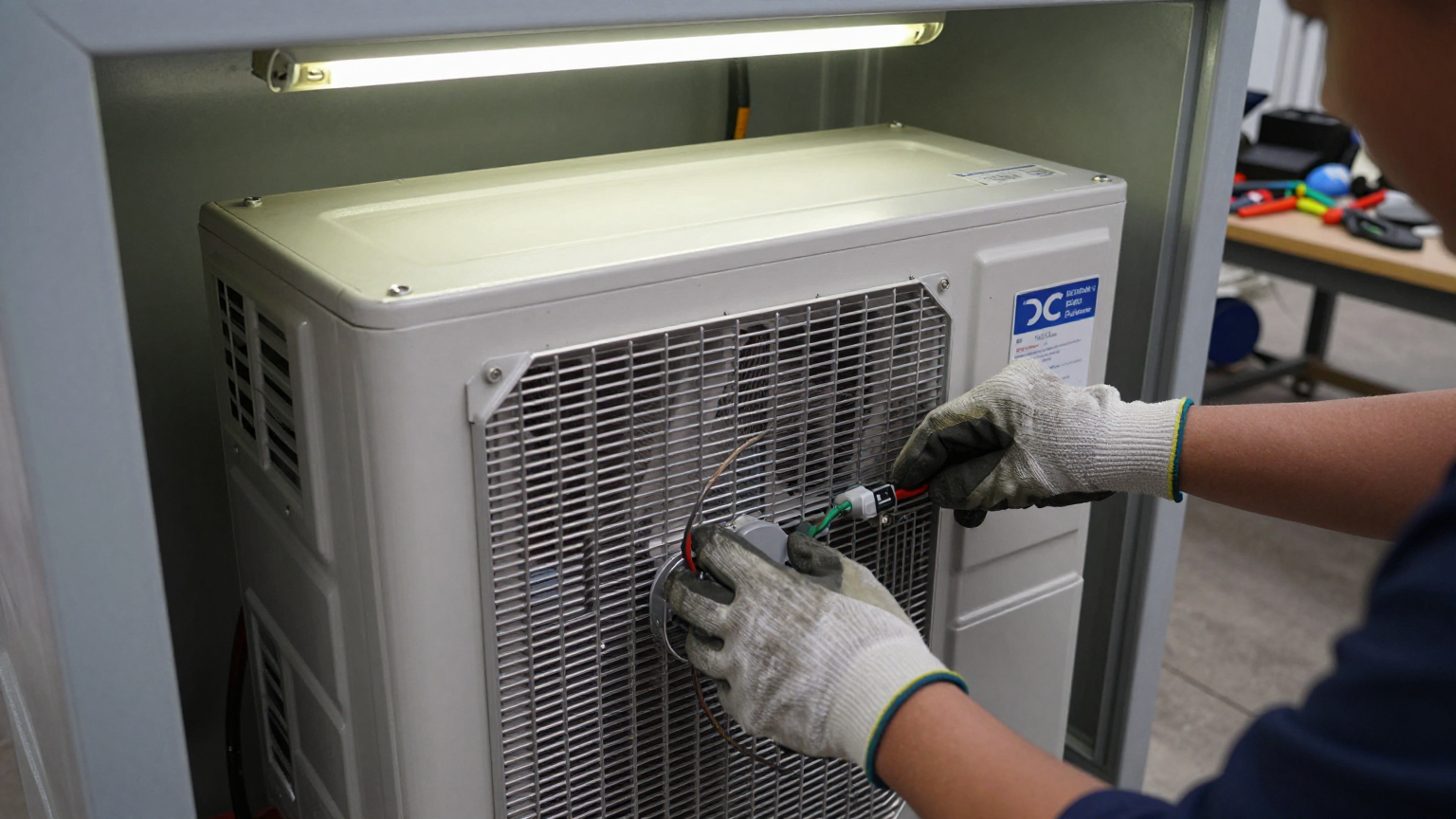
Sensor placement. A single temperature sensor at the air return gives adequate control for many applications, but high-value loads like battery packs and medical payloads benefit from multiple sensors with averaging or worst-case logic. The controller should act on the sensor that represents the most vulnerable point in the thermal zone, not the most convenient mounting location.
Frequently Asked Questions
Does a heat pump use more power than a cool-only unit?
In cooling mode, power consumption is essentially identical. The reversing valve and its solenoid add negligible draw. In heating mode, the heat pump uses significantly less power than a resistive heater for the same thermal output, typically delivering two to three watts of heating per watt of electrical input.
Can I retrofit a cool-only system to add heating?
In theory, adding a reversing valve to an existing refrigerant circuit is possible. In practice, the outdoor coil, expansion device, and control logic all need modification. It is generally more cost-effective to specify a heat pump module from the start than to retrofit one later.
What refrigerants work for bidirectional DC heat pumps?
R134a and R290 are the most common choices in compact DC systems. R134a offers broad compatibility and well-understood performance curves. R290 (propane) provides higher efficiency and lower global warming potential but requires compliance with flammability standards in the enclosure design.
How does the system handle the transition between heating and cooling?
The controller monitors the temperature differential between the setpoint and the measured value. When the measured temperature crosses a mode-switch threshold (typically set with a deadband to prevent short-cycling), the controller pauses the compressor briefly, actuates the reversing valve, and restarts. The entire transition takes a few seconds and is transparent to the load.
What is the minimum ambient temperature for heat pump operation?
This depends on the refrigerant and compressor design. Most compact DC heat pumps using R134a operate effectively down to approximately minus fifteen to minus twenty degrees C ambient in heating mode. Below that, the evaporator pressure drops to a point where the compressor cannot maintain adequate mass flow. For extreme cold applications, supplemental resistive heating or a low-temperature refrigerant blend may be needed.
Is precision thermal management possible with a single module?
Yes, provided the module is properly sized and the control loop is tuned for the application. Single-module systems routinely hold setpoints within plus or minus one to two degrees C in well-insulated enclosures. For tighter tolerances, liquid-loop heat pumps with thermal mass buffering offer sub-degree stability.
Choosing the Right Module for Your Application
The scenarios above span a wide range of cooling capacities, voltage inputs, and form factors, but they share a common requirement: reliable bidirectional thermal control from a compact, DC-powered platform. Whether you are designing a battery thermal management system that must prevent lithium plating at dawn and manage fast-charge heat at noon, or a portable field chamber that holds specimens above or below ambient on solar power, the underlying technology is the same vapor-compression heat pump cycle packaged for embedded integration.
RIGID’s Micro DC Aircon Cool and Heat series is designed for exactly these applications: compact modules with integrated reversing valves, brushless DC compressors, and configurable controllers that handle mode switching, defrost, and fault protection autonomously.
If your thermal envelope, power budget, or packaging constraints differ from the scenarios discussed here, the engineering team can review your specific requirements and align on a configuration path. Precision thermal management is rarely one-size-fits-all, but the building blocks are well proven.