
Why R1234yf Appears on the Options List
Laboratory buyers usually meet two refrigerants. R134a is the familiar one: non-flammable, widely serviced, and squarely inside the phase-down schedules. R290 is propane: negligible global warming potential, outside the HFC quota system, and flammable enough to bring charge limits and installation rules with it.
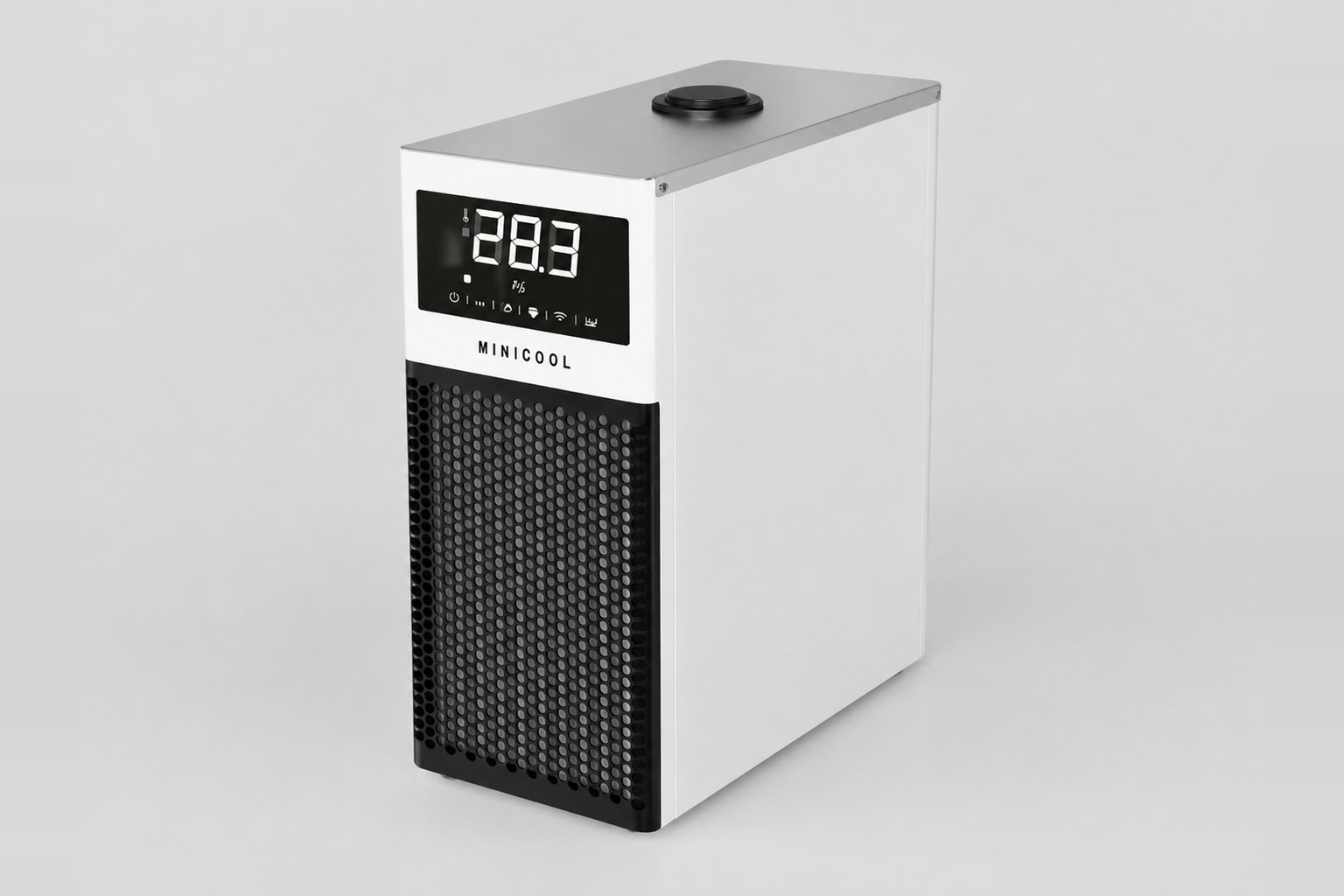
RIGID’s MiniCool countertop recirculating chiller series page lists a third option alongside those two: R1234yf, with a temperature range of 0 to −40 °C, capacities of 450, 800 and 850 W and stability of ±0.1 °C (test conditions not stated).
R1234yf is the middle path, and it is the least familiar of the three in laboratory work. This article covers what it changes and when it is worth specifying.
What It Is
R1234yf is a hydrofluoroolefin, an HFO rather than an HFC. The chemistry matters for two reasons: the molecule breaks down quickly in the atmosphere, which is why its global warming potential is so low, and it is mildly flammable, which is why it carries a different safety classification from R134a.
 The comparison below uses published figures for the refrigerants themselves, not for any particular machine.
| R134a | R1234yf | R290 | |
|---|---|---|---|
| Family | HFC | HFO | Hydrocarbon |
| Global warming potential | Roughly 1,300 | Less than 1 | Very low |
| Safety class | A1, non-flammable | A2L, mildly flammable | A3, flammable |
| Inside the HFC phase-down | Yes | No | No |
| Reported capacity against R134a | Reference | About 6% lower | Different system design |
| Reported efficiency against R134a | Reference | About 4% lower | Different system design |
| Pressure envelope | Reference | Within about 5% of R134a | Different |
The last row is the reason the automotive industry moved to R1234yf so quickly: the operating pressures are close enough to R134a that system architecture barely changes. That similarity is also why it appears as a drop-in-style option on compact equipment.
What the Low GWP Actually Buys
A refrigerant with a GWP below 1 sits outside the pressure that is squeezing R134a supply.
- It is not an HFC, so it is not consuming quota or allowances as those schedules tighten.
- Equipment restrictions written around GWP thresholds, such as the 150 limits appearing in several categories, do not bite in the same way.
- Corporate sustainability reporting treats it very differently from a 1,300 GWP charge.
For a machine that will still be in service in eight or ten years, that is the practical argument: the refrigerant inside it stays ordinary rather than becoming scarce and expensive.
What A2L Requires
Mildly flammable is not the same as non-flammable, and it is not the same as propane either. A2L sits between the two, and the consequences are mostly about installation and service rather than daily operation.
- Charge limits and room size can apply depending on the equipment category and the standard in force at the site.
- Service technicians need the right certification and recovery equipment for an A2L charge.
- Leak detection requirements may apply to the installation, particularly in small or unventilated rooms.
- Transport rules differ from a non-flammable charge, which matters for air freight.
None of this is exotic; it is standard practice in automotive air conditioning, where R1234yf has been the default for years. It is simply less familiar inside laboratories, where A1 refrigerants have been the norm.
The Capacity Penalty in Context
Published comparisons put R1234yf at roughly 6% lower capacity and 4% lower efficiency than R134a in equivalent systems. Two things are worth saying about those numbers.
First, they are refrigerant-level figures. What matters on a bench is the capacity of the specific machine at your set point and ambient, which the supplier has to state; a few percent at the refrigerant level can be absorbed or amplified by system design.
Second, a few percent is small next to the effects the same article series has already covered: a warm room, a fouled condenser or a loop with too little flow will cost far more than the refrigerant choice does.
Do not choose a refrigerant to gain 6% of capacity; choose the capacity you need and then choose the refrigerant for supply, safety and site rules.
Choosing Between the Three
| Situation | Reasonable choice |
|---|---|
| Non-flammable charge is a site requirement | R134a, accepting the supply outlook |
| Lowest GWP and a site that already handles hydrocarbons | R290, with its charge limits |
| Low GWP wanted but a hydrocarbon is not acceptable | R1234yf |
| Frequent air freight of the equipment | Compare all three against the current transport rules |
| Long service life in a regulated market | Avoid the high-GWP option if the category faces a threshold |
Our R290 buying guide for laboratory chillers covers the hydrocarbon route in detail, and charge limits for R290 explains how the flammable-charge rules work in practice.
What to Confirm Before Specifying
 Specifying it is a decision that touches purchasing, facilities and service, so collect these answers first.
- Which capacities are available with R1234yf, since an option list is not a per-model guarantee.
- Capacity and input power at your set point with that refrigerant, in writing.
- Charge mass, which decides transport treatment and any room-size rules.
- Who will service the unit locally, and whether they are equipped for A2L.
- Whether your site standards or insurer treat A2L differently from A1.
- Lead time, since less common options are not always stocked.
Servicing and the Long View
- Recovery equipment and gauges have to be rated for the refrigerant; mixing service kit across classes is not acceptable practice.
- Reclaimed R1234yf is a smaller market than reclaimed R134a today, which is a supply consideration in the opposite direction.
- Oil compatibility is part of the system design, not a field choice; do not treat any refrigerant as a drop-in for an existing charge.
- Label the machine clearly. The next technician should not have to guess what is inside it.
Reading a GWP Number Properly
Global warming potential is not a single fixed value. It is calculated over a time horizon, normally 100 years, and the published figures have been revised between successive scientific assessment reports. Regulations reference a specific report, so two correct-looking numbers for the same refrigerant can differ.
- State the source alongside the figure whenever it appears in a specification or a tender response.
- When a regulation sets a threshold such as 150, check which assessment basis that threshold is written against.
- For refrigerants with a GWP far below any threshold, the distinction rarely changes a decision; for borderline blends it can.
This is a documentation habit rather than an engineering one, and it prevents an avoidable argument at the point where a buyer, an auditor or a customs officer compares two numbers.
Where the Three Options Land in Practice
Refrigerant choice tends to be settled by the site rather than by thermodynamics, and three patterns cover most laboratory decisions.
- Shared or rented buildings often have blanket rules about flammable refrigerants written before A2L classifications existed. Where those rules cannot be changed quickly, R134a remains the path of least resistance, and the supply outlook becomes a budgeting question for the service years.
- Institutions with their own facilities engineering usually already handle hydrocarbons somewhere on site, which makes R290 straightforward and gives the lowest GWP with no quota exposure.
- Sites that want a low-GWP charge without a hydrocarbon conversation are where R1234yf earns its place, and that is a common position for a laboratory inside a larger industrial building.
The same logic applies to export equipment. A machine built for one market may be installed in another, and the refrigerant that was uncontroversial at the factory can meet different rules at the destination.
Documentation That Should Travel With the Machine
Whichever option is chosen, four facts belong in the equipment file rather than in an email thread.
- Refrigerant type and charge mass, as built.
- Safety classification and what it implies for the room it sits in.
- Service requirements, including the recovery equipment class needed.
- Capacity and input power at the working set point, as quoted for that refrigerant.
That file is what makes a service call, a transport booking or a compliance question a five-minute job years later.
End of Life and Recovery
Every refrigerant in this comparison has to be recovered rather than vented when the machine is retired, and the class decides who can do it and with what equipment.
- Recovery cylinders and machines are rated by refrigerant class, so an A2L charge cannot be pulled into equipment intended for A1 service.
- Small sealed units are easy to overlook at disposal because they look like ordinary laboratory equipment rather than refrigeration plant.
- Budget the recovery when a replacement is planned, not when the old unit is already on a pallet.
Keeping the charge mass in the equipment file makes this straightforward: the recovery contractor knows what to expect before arriving, and the disposal record matches what left the building.
Common Mistakes
- Reading an options list as confirmation that every capacity is available with every refrigerant.
- Treating A2L as equivalent to non-flammable because the risk is lower than propane.
- Assuming R1234yf can be charged into a machine designed for R134a.
- Choosing on the few-percent capacity difference rather than on supply and site rules.
- Forgetting that the transport rules follow the refrigerant, not the machine.
- Quoting a GWP number without saying which assessment report it comes from.
If you are specifying a chiller for a site with rules about flammable refrigerants, or for a market where GWP thresholds are approaching, send us the capacity, set point and destination and we will confirm which refrigerant options apply. Ask which refrigerant suits your site.
Frequently Asked Questions
Is R1234yf better than R134a?
It is better on global warming potential by a very large margin and it sits outside the HFC phase-down. It is slightly behind on reported capacity and efficiency, and it is mildly flammable, so the answer depends on which of those matters at your site.
How flammable is an A2L refrigerant?
Less than a hydrocarbon such as R290 and more than a non-flammable A1 such as R134a. In practice that means charge limits, installation requirements and service certification rather than a prohibition.
Will it cool as well as R134a?
Published comparisons show roughly 6% lower capacity and 4% lower efficiency at the refrigerant level. What matters for selection is the machine’s stated capacity at your set point and ambient, which should be requested per model and refrigerant.
Can I convert an existing chiller to R1234yf?
No. Refrigerant choice is part of the system design, including oil, controls and safety features, so it has to be specified with the order rather than changed in the field.
Does R1234yf avoid the phase-down entirely?
It is not an HFC, so it is not inside the HFC quota and allowance schedules. Equipment rules are written by category and threshold, so confirm the category that applies to your machine and market.
Is it harder to get serviced?
It is standard in automotive service and less common in laboratory service. Check that your local service provider has the right recovery equipment and certification before committing.
References
- National Refrigerants, R1234yf product data — HFO classification, A2L designation and application context.
- Royal Refrigerants, R-1234yf vs R-134a — reported capacity and efficiency differences and the similar pressure envelope.