
Review the Chiller Calibration Certificate Before Accepting Its Scope
A chiller calibration certificate supports the measurement object, temperature points, method, and conditions actually recorded on it. Start by identifying whether the work covered the controller indication, liquid at the outlet, or a separate application location. Check the reported results and uncertainty against your own requirement. A calibrated display does not automatically establish supply-temperature accuracy throughout an external loop, and neither result establishes the temperature of a sample inside an instrument.
For a laboratory purchasing a RIGID MiniCool, the useful question is what temperature evidence must accompany the selected configuration. Define the required result before requesting the certificate. This guide concerns document acceptance by procurement and quality teams. It does not describe RIGID as a calibration laboratory or promise that a particular calibration service is included with a chiller order.
Name the Object That Was Actually Calibrated
Find the instrument description, serial identity, sensor or channel identity where relevant, and configuration recorded by the provider. A certificate for a separate reference thermometer is not automatically a certificate for the chiller controller that was compared with it. Likewise, a service report listing the chiller serial number may include several observations without calibrating every temperature channel. Ask for a clear explanation when the document’s identification leaves that distinction unresolved.
Trace the identity into the delivered equipment. Replacement controllers, sensor changes, and software settings can disconnect a valid earlier measurement from the present configuration. A certificate belonging to an earlier unit of the same model cannot establish the delivered unit’s result. Retain the document identifier with the receiving record, and mark any accessories or channels excluded from the work rather than assuming the model name covers everything in the shipment.
Separate Controller Indication, Supply Liquid, and Sample Temperature
A controller comparison concerns the reading produced by a particular measurement chain. A supply-liquid measurement adds a physical location, circulation condition, and operating state. A sample measurement adds the instrument accessory, thermal link, and the experimental setup. These are related questions, but their evidence is not interchangeable. Write the acceptance location explicitly before interpreting an error value on the page.
For chiller calibration certificate review, identify the measured quantity alongside the place and conditions. If the required result concerns liquid entering an instrument, a probe in the reservoir may leave the hose and distribution effects outside the evidence. If the result concerns a sample, even a verified instrument inlet may leave sample settling unresolved. The supplier can then quote the correct verification scope instead of issuing a document that answers a different question.
Check Which Temperature Points Were Covered
Read the actual points, their units, and the reported results rather than only the advertised operating range of the equipment. Work at one temperature does not by itself demonstrate performance across a complete negative-temperature program. Select points according to the application and the provider’s supported method. Avoid adding a universal point count that has no relationship to your use or quality requirement.
Keep interpolation and extrapolation visible in the review. If a document includes a correction or a conversion curve, establish where its use is supported and how it is applied. A temperature point outside the certificate’s recorded scope needs separate evidence. The operating range is not the calibrated range. For an instrument that will be used only at particular conditions, a clearly limited scope can be appropriate; an unexplained claim of complete coverage cannot.
Read the Conditions Behind Each Result
Look for the circulating liquid, its formulation where relevant, flow arrangement, applied load, stabilization criterion, ambient conditions, and the measurement location. Their importance depends on the method and the claimed result. A controller calibrated by electrical simulation and a chiller compared with a reference in liquid involve different conditions. Neither approach should be rejected solely because it is different; ask whether it answers the specified acceptance question.
When an important condition is missing, request clarification before converting the reported number into a system capability. A supply measurement in an unloaded setup does not demonstrate performance under every laboratory heat load. Keep the missing condition attached to the specific claim it affects. This avoids demanding irrelevant details while also preventing a short service document from becoming an unsupported guarantee of the final instrument’s temperature behavior.
Separate Uncertainty From the Acceptance Limit
Measurement uncertainty describes the result’s stated uncertainty under its measurement basis. The acceptance limit expresses what the application or purchasing specification allows. They are different entries in a chiller calibration certificate review. Check the uncertainty units, coverage information, and any explanations the provider supplies. Do not treat the display resolution as the uncertainty of the comparison or as a substitute for the measured error.
If a pass or fail statement is needed, agree how the reported result and uncertainty will be considered against the limit. A result close to a tolerance boundary deserves an explicit decision basis rather than a hidden rounding choice. An uncertainty value is not a pass decision. The quality owner should define the required acceptance approach with the calibration provider before ordering, so the returned document can be assessed consistently without retroactively changing the specification.
Understand What Traceability Does and Does Not Establish
NIST’s policy describes measurement traceability through a documented calibration chain to a reference, with uncertainty contributions. The organization reporting its own result is responsible for establishing that connection. A reference to NIST on a supplier document therefore needs an intelligible measurement basis; it does not make NIST the certifier of the whole cooling system or the customer’s experimental method.
Ask the provider for the traceability information appropriate to the reported result. Keep it distinct from whether the result is fit for your required temperature, location, and uncertainty. A traceable measurement can still have a scope or uncertainty unsuitable for a particular application. Conversely, a brochure describing excellent stability is not a traceability record. The purchasing task is to obtain evidence for the needed measurement, rather than collect a recognizable institutional name.
Verify Any Accreditation Claim at the Relevant Scope
If the order requires work within an accredited laboratory scope, obtain the provider’s relevant scope information and confirm that the proposed service is included. A company-wide statement or a logo on a document is not enough to resolve the specific temperature work requested. Keep this as a procurement requirement rather than assuming every laboratory chiller needs the same accreditation route.
A chiller calibration certificate should identify what service was supplied and whether its conformity statements meet the agreed requirements. Do not infer RIGID’s calibration-service capability from another laboratory’s service listing. Where a third-party provider performs the work, record that provider and the handoff arrangement. The cooler manufacturer, measurement provider, and equipment user can have separate responsibilities, and the order should preserve those responsibilities instead of merging their claims.
Distinguish the As-Found Result From an Adjustment
An initial comparison records the equipment condition when it arrived for the work. An adjustment changes that condition, and a subsequent comparison can record the result afterward. Establish which stage each number represents and whether an adjustment was made. A final acceptable reading does not erase the original observation when the laboratory needs it to assess measurements made before service.
Ask for the relevant before-and-after information when it belongs to the agreed scope. Also identify any settings the user must maintain after the work, including applied corrections or channel assignments. A changed setting changes the evidence configuration. If the certificate’s result depends on a correction that is never entered into the operational readout, the document and the actual measurement are answering different conditions even though both identify the same chiller.
Keep MiniCool Product Claims at Their Published Scope
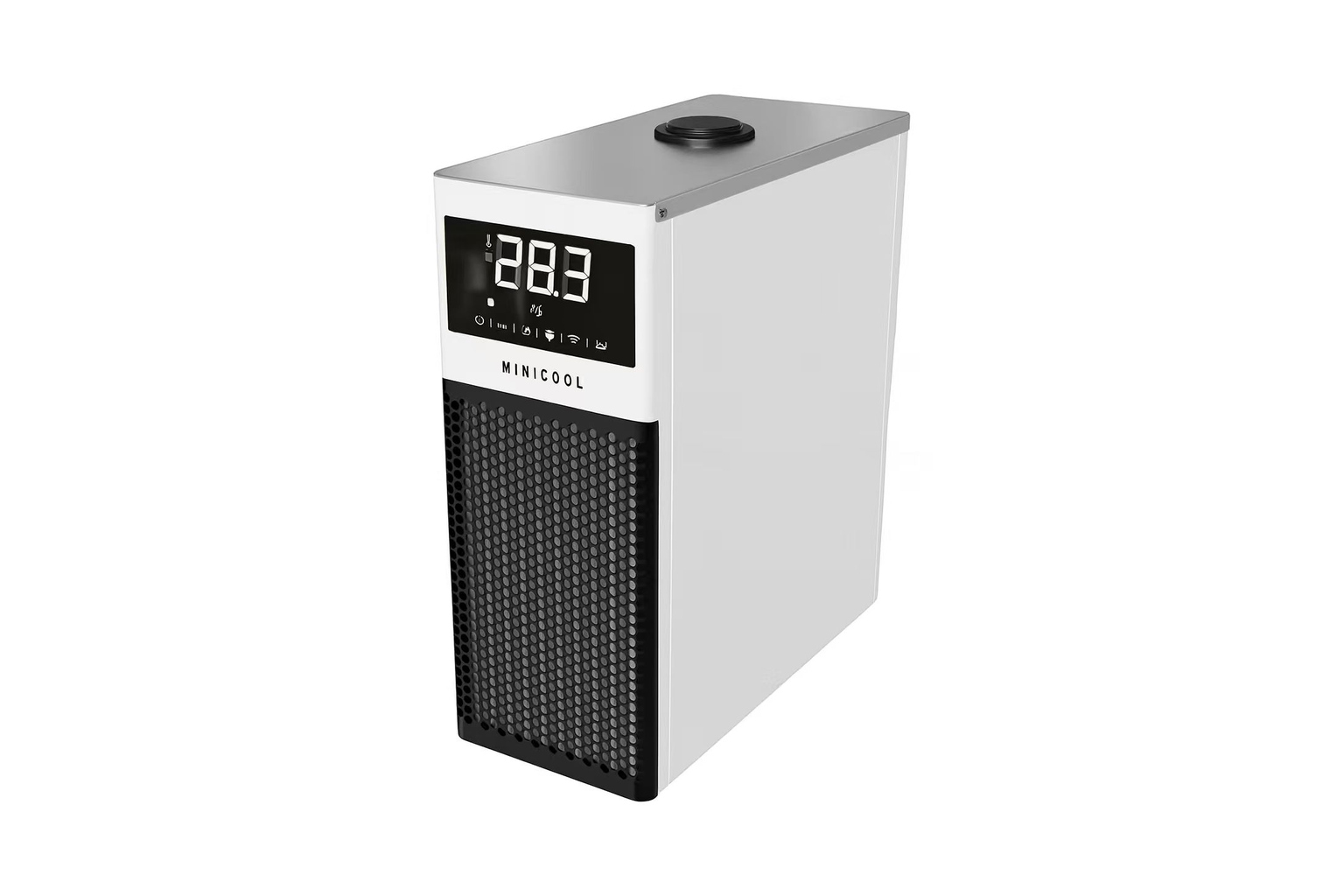
The RIGID MiniCool laboratory chiller series is published for −40°C to 0°C operation. The reviewed public stability claim does not provide the complete test conditions needed to assign a measurement uncertainty at the instrument or sample. A temperature range and a stability figure are useful product information, but they are not a unit-specific calibration result.
Request confirmation of certificate availability and scope for the actual order. Public information does not establish an included accredited service, a particular number of points, or full-range supply accuracy. In chiller calibration certificate review, keep those unknowns in the quotation until they are resolved. The goal is an appropriate document for the selected negative-temperature application, without turning an advertised product characteristic into a metrology guarantee that the evidence does not support.
Use a Document Acceptance Worksheet
The worksheet below separates identification, results, and application relevance. Assign unresolved items to the responsible provider and decide which prevent acceptance of the requested scope. It is not a demand for every available test; it organizes the evidence that the order actually requires. A document can be complete for a controller comparison while remaining insufficient for an instrument-inlet acceptance.
| Review item | Evidence to locate | Question before acceptance |
|---|---|---|
| Identity | Unit, sensor or channel, document ID | Does it describe the delivered configuration? |
| Quantity | Indication, supply liquid, or application location | Is this the required measured result? |
| Coverage | Temperature points and valid correction scope | Are the intended uses covered? |
| Conditions | Method, location, liquid and operating state | Can the result be interpreted for this duty? |
| Uncertainty | Reported uncertainty and its basis | Does it support the acceptance requirement? |
| Decision | Agreed limit and any conformity statement | Is the acceptance basis explicit? |
Preserve the provider’s complete document rather than transferring only a rounded error into a receiving spreadsheet. Record any clarification alongside the original. If the evidence is limited, accept only the scope demonstrated or request additional work. This creates a reviewable decision without forcing an otherwise valid document to claim performance at a location or condition that was never measured.
Keep Certificate Review Separate From Installation Verification
The existing chiller-loop temperature measurement guide addresses sensor choice and installation effects. A certificate review should use that distinction without becoming another wiring or probe-placement tutorial. The document can describe an accepted measurement chain while the final hose arrangement, accessory, and sample still need their own operational checks.
For a chiller calibration certificate inquiry, send RIGID the required measurement and document scope. Include the selected unit, operating points, acceptance location, load conditions, required uncertainty evidence, and any provider qualification requirement. Ask for the evidence you will actually use. Identify which application checks remain with the laboratory so a quote for controller work is not mistaken for acceptance of the complete experiment.
Frequently Asked Questions
Does a chiller calibration certificate prove sample temperature accuracy?
Only if its scope actually covers that sample measurement under the relevant conditions. Controller indication and circulating-supply measurements do not automatically establish the temperature inside an instrument vessel.
Does a traceability statement certify the complete cooling system?
No. It concerns the reported measurement result and its reference chain. Check the object, method, uncertainty, and application relevance separately; do not infer whole-system approval from an institutional reference.
Is a stability specification the same as calibration uncertainty?
No. Stability concerns behavior over time under a stated test basis. Calibration uncertainty belongs to a defined measurement result. A display resolution or unqualified stability claim cannot replace that evidence.
Must every certificate cover the entire operating range?
Not necessarily. Define the intended use and required scope with the provider. What matters is that any acceptance claim remains within supported points and conditions, with limitations made explicit.
Are calibration certificates included with every MiniCool order?
That supply scope is not established by the public information reviewed here. Confirm availability, provider, measured object, points, and reporting requirements for the actual order before purchasing.