
Robot Cooling System DC: Why Autonomous Enclosures Need Micro Air Conditioning
Autonomous robots are getting smarter, faster, and more capable every year. Warehouse AGVs navigate complex floor plans with centimeter precision. Outdoor delivery robots handle last-mile logistics in summer heat. Security patrol robots operate around the clock in parking structures and industrial campuses. But there is a problem that grows alongside their capabilities: heat.
Every watt of compute power, every motor driver pulse, every LiDAR spin generates thermal energy inside a sealed enclosure. And unlike a desktop computer or server rack, a robot cannot simply vent hot air into a climate-controlled room. The enclosure must stay sealed to maintain its IP65 or IP67 rating against dust, rain, and debris. The result is a thermal trap that can throttle processors, degrade batteries, and shorten component lifespans.
This article examines the thermal challenge facing autonomous robot designers and explains how a dedicated robot cooling system dc architecture — specifically micro DC air conditioning — solves the problem without compromising mobility, power budget, or environmental protection.
The Thermal Reality Inside Robot Enclosures
To understand why active cooling matters, consider the heat sources packed into a typical medium-sized autonomous robot:
- Compute modules (NVIDIA Jetson, industrial PCs): 15–75W continuous. During active perception and path planning, these processors run near peak load for extended periods.
- Motor drivers and power electronics: 50–200W. H-bridge drivers, DC-DC converters, and regenerative braking circuits all produce significant waste heat.
- LiDAR, cameras, and sensors: 10–30W. Spinning LiDAR units and thermal cameras add steady-state heat.
- Battery charging and discharging losses: Variable, but lithium cells operating at high C-rates generate internal heat that compounds the enclosure temperature.
Total thermal load in a typical autonomous robot ranges from 100W to 400W, concentrated in an enclosure volume of just 20 to 50 liters. For context, that is equivalent to a 200–800 W/m³ heat density — comparable to a densely packed server chassis, but without any of the airflow infrastructure that data centers provide.
Without active cooling, internal temperatures in a sealed robot enclosure can exceed 70°C within 30 minutes of full-load operation on a 35°C summer day. At those temperatures, compute modules throttle aggressively, battery cycle life drops by 50% or more, and electrolytic capacitors in power electronics approach their rated limits.
Why Passive Cooling Falls Short
Robotics engineers often attempt passive thermal management first. Heat sinks, thermal pads, and conductive chassis panels can move heat from components to the enclosure walls. But passive approaches face fundamental limits in sealed robot enclosures:
- No forced airflow: Internal fans can redistribute heat but cannot remove it from a sealed system. They simply equalize the temperature inside the enclosure.
- Limited surface area: Robot chassis are designed for structural integrity and sensor mounting, not heat dissipation. Available surface area for passive radiation is typically insufficient for loads above 50W.
- Ambient temperature floor: Passive cooling can only bring internal temperatures down to ambient. For outdoor robots operating in 40°C environments, that floor is already above the safe operating range for many electronics.
- Solar loading: Outdoor robots absorb solar radiation on their top surfaces, adding 100–300W of additional thermal input depending on color and surface area.
The conclusion is straightforward: any sealed robot enclosure generating more than 50–80W of internal heat in warm environments needs active cooling that can pump heat from inside the enclosure to the outside air — against the temperature gradient if necessary.
Micro DC Air Conditioning: Purpose-Built for Robotic Platforms
Traditional air conditioning is designed for buildings and vehicles — heavy, AC-powered, and oversized for robotic applications. Micro DC air conditioning takes the same vapor-compression refrigeration cycle and packages it for mobile, battery-powered platforms.
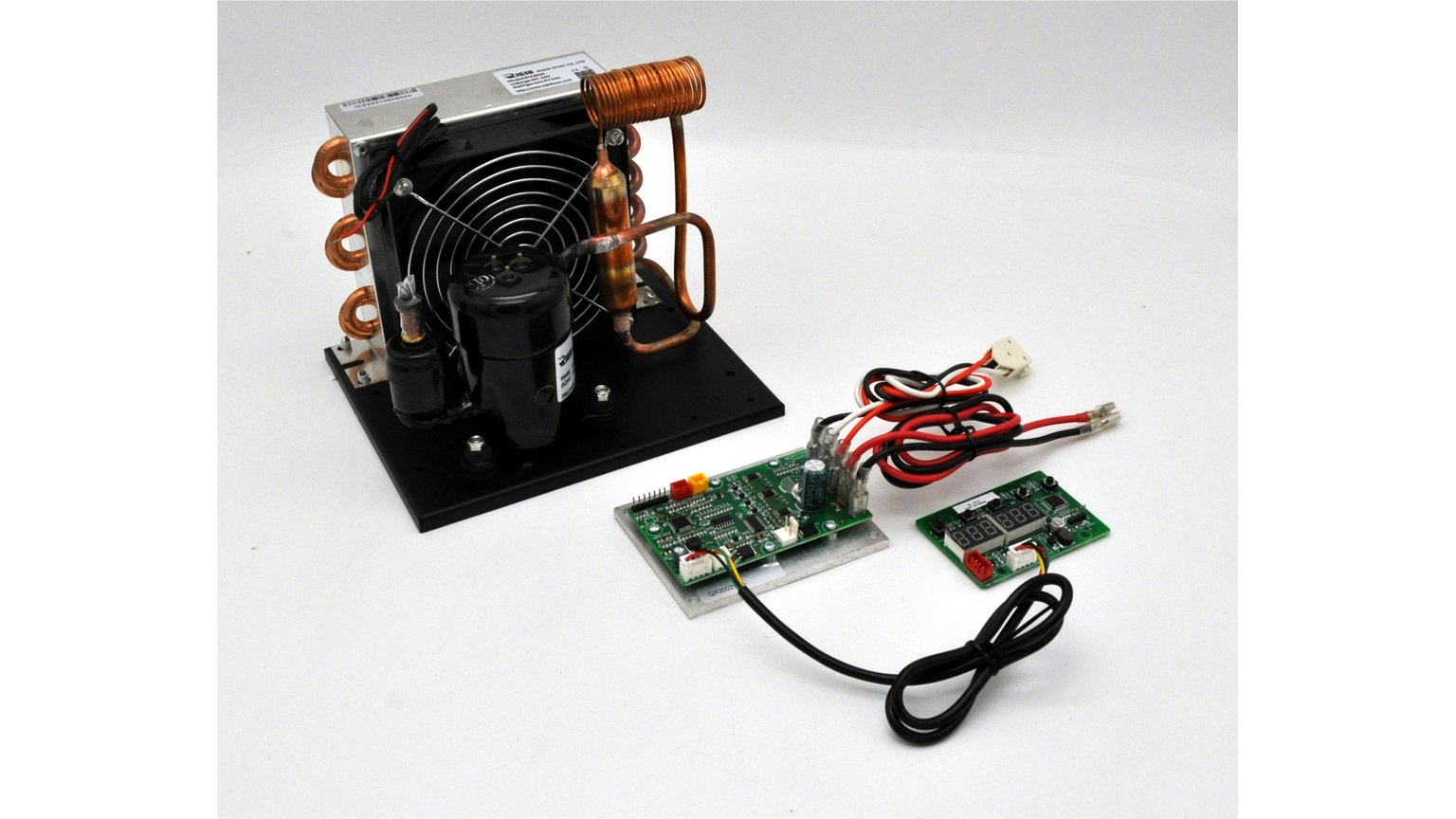 The core advantages of a micro DC aircon system for autonomous robots include:
DC Native Operation
Robots run on DC battery buses — typically 24V or 48V. A micro DC air conditioner connects directly to this bus without requiring an inverter. This eliminates conversion losses, reduces component count, and simplifies the power architecture. The compressor, fans, and control electronics all operate natively at the robot’s bus voltage.
Sub-Ambient Cooling Capability
Unlike thermoelectric (Peltier) coolers that struggle to achieve more than 10–15°C below ambient at reasonable efficiency, a vapor-compression micro aircon can maintain enclosure temperatures 20–30°C below ambient. This means electronics stay at 25°C even when the robot operates in 45°C outdoor heat.
Weight and Form Factor
A complete micro DC aircon unit weighs approximately 5 kg. For medium and large autonomous robots in the 50–500 kg class, this represents 1–10% of total system mass — well within acceptable limits. The compact form factor allows integration within the robot chassis rather than as an external appendage.
Sealed System Integrity
The refrigeration cycle moves heat through sealed copper tubing and heat exchangers. The only penetrations through the enclosure wall are the refrigerant lines and condensate drain — all easily sealed to maintain IP65/IP67 ratings. The robot’s environmental protection remains intact.
Variable Speed Operation
Modern BLDC compressors in micro DC aircon units support variable speed control. When the robot is idle (low compute load, motors off), the compressor runs at minimum speed, drawing minimal current. When the robot enters active navigation with full sensor fusion and path planning, the compressor ramps up to match the increased thermal load. This dynamic response optimizes battery life.
Product Specifications: DV1920E-AC and DV2820E-AC
RIGID HVAC offers two micro DC aircon models specifically suited for autonomous robot applications:
DV1920E-AC
- Operating voltage: 24V DC
- Cooling capacity: 450W
- Maximum current draw: 8A
- Target application: Lighter robots with moderate heat loads (100–200W internal generation)
DV2820E-AC
- Operating voltage: 24V DC
- Cooling capacity: 700W
- Maximum current draw: 8A
- Target application: Compute-heavy robots with high thermal loads (200–400W internal generation)
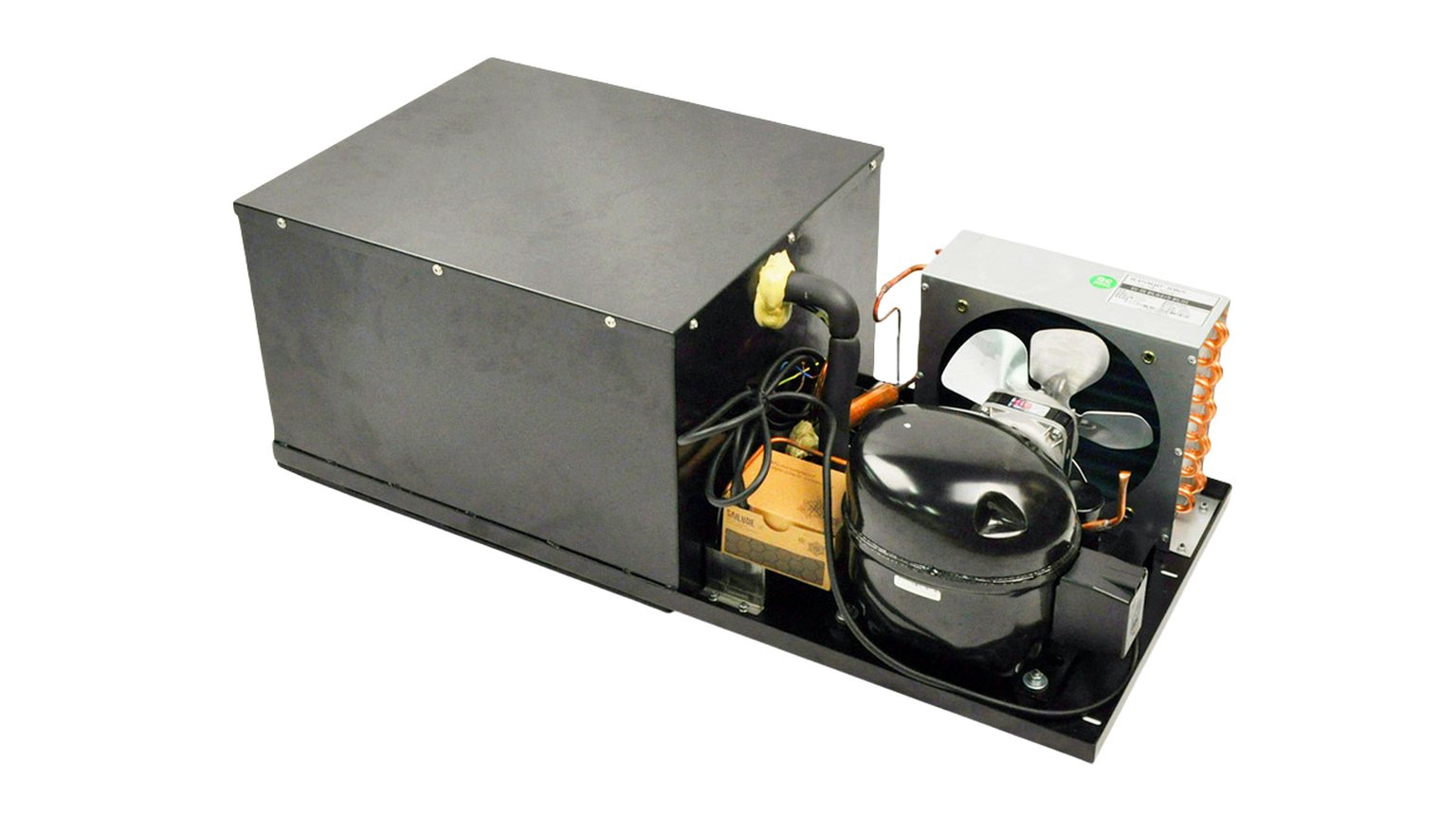
Both units weigh approximately 5 kg and feature compact dimensions designed to fit within standard robot chassis volumes. The Micro DC Aircon product line provides detailed specifications and configuration options for integration engineers.
Design Considerations for Robot Integration
Integrating a micro DC aircon into an autonomous robot requires attention to several engineering factors that differ from stationary cooling applications:
Vibration Tolerance
Robots experience continuous vibration from drive motors, wheel contact with uneven surfaces, and mechanical actuators. The BLDC rotary compressor used in micro DC aircon units handles vibration well — the rotary mechanism has no reciprocating parts that could be damaged by external shock loads. However, mounting should include vibration isolation pads, and refrigerant lines need flexible sections to prevent fatigue cracking at connection points.
Orientation Sensitivity
Autonomous robots operating on ramps, loading docks, or uneven terrain may tilt significantly from horizontal. The compressor in these micro DC units tolerates operation at up to 30° from horizontal without oil circulation issues. For robots that may experience greater tilt angles (such as agricultural robots on hillsides), additional oil management provisions may be needed.
Power Budget Management
Cooling competes directly with drive motors and compute for battery capacity. At maximum load, the DV2820E-AC draws 8A at 24V — approximately 192W. On a robot with a 2 kWh battery pack, this represents roughly 10% of total energy budget during continuous operation. Variable speed control is essential: during low-load periods, actual power draw drops to 40–60W, extending operational runtime significantly.
Condensate Management
When cooling air below its dew point, moisture condenses on the evaporator. Indoor warehouse robots in climate-controlled environments produce minimal condensate. Outdoor robots in humid tropical or subtropical environments may generate significant condensate that needs routing to a collection reservoir or controlled drip point that does not compromise the robot’s IP rating or leave water trails that could indicate the robot’s patrol pattern.
Airflow Architecture
Inside the sealed enclosure, a small circulation fan moves air across the evaporator and distributes cooled air to hot components. The condenser (heat rejection side) mounts on the exterior of the enclosure with its own fan drawing ambient air. Condenser placement should avoid areas where the robot’s body panels might block airflow or where exhaust heat could be recirculated.
Application Scenarios
Warehouse AGVs and AMRs
Indoor warehouse robots operate in environments ranging from climate-controlled distribution centers (20–25°C) to non-conditioned warehouses that can reach 45°C in summer. The DV1920E-AC with 450W cooling capacity handles most warehouse AGV thermal loads, where compute requirements are moderate and motor duty cycles include frequent idle periods during loading and unloading.
Outdoor Delivery Robots
Last-mile delivery robots face the full spectrum of outdoor thermal challenges: direct solar radiation, high ambient temperatures, and sustained compute loads for navigation in complex urban environments. The DV2820E-AC with 700W capacity provides adequate margin for these demanding conditions, maintaining safe electronics temperatures even during extended delivery routes in summer heat.
Inspection and Security Patrol Robots
These robots often operate continuously for 8–12 hour shifts, with consistent sensor and compute loads for surveillance, anomaly detection, and reporting. The steady-state nature of their thermal load makes them well-suited to variable-speed DC cooling — the compressor finds an efficient operating point and maintains it for extended periods.
Agricultural Robots
Field robots for crop monitoring, spraying, and harvesting operate in direct sunlight with high ambient temperatures and often carry significant compute hardware for machine vision and autonomous navigation. Their larger chassis (often 200–500 kg) easily accommodates the 5 kg weight of a micro DC aircon unit, and their substantial battery packs (5–10 kWh) provide ample energy budget for cooling.
Application Boundaries: Where Micro DC Aircon Does Not Fit
Honest engineering requires acknowledging limitations. Micro DC air conditioning is not appropriate for every robotic platform:
- Micro drones and small UAVs: At 5 kg, a micro aircon unit would represent 25–100% of the total vehicle mass. Drones rely on propeller wash for convective cooling and must use lightweight passive thermal management.
- Small indoor robots under 20 kg: Desktop-sized robots, small educational platforms, and lightweight indoor assistants generate insufficient heat to justify active cooling and cannot accommodate the weight or volume.
- Sub-zero environment robots: Robots operating in cold storage facilities (-20°C) or arctic conditions need heating, not cooling. Their challenge is keeping batteries warm enough to function, not removing excess heat.
The sweet spot for micro DC aircon is medium to large autonomous robots (50–500 kg total mass) operating in environments above 15°C with internal heat generation exceeding 100W in sealed enclosures.
Integration Workflow for Robotics Engineers
For engineers evaluating micro DC aircon for their robot platform, the integration process typically follows these steps:
- Thermal audit: Measure or calculate total internal heat generation under worst-case operating conditions. Include all electronics, motors (conducted heat), and solar loading if applicable.
- Capacity selection: Choose a cooling unit with capacity exceeding the thermal load by at least 20% margin. The DV1920E-AC (450W) suits loads up to 350W; the DV2820E-AC (700W) handles loads up to 550W with margin.
- Mechanical integration: Identify mounting location within the chassis. The condenser needs external airflow access; the evaporator needs internal air circulation. Refrigerant line routing must avoid sharp bends and vibration stress points.
- Electrical integration: Connect to the 24V bus through appropriate fusing and switching. Integrate the compressor speed control signal with the robot’s thermal management controller for dynamic load matching.
- Condensate planning: Design the condensate path based on operating environment humidity levels. Indoor robots may need only a small reservoir; outdoor robots need active drainage or evaporation strategies.
- Testing and validation: Run thermal soak tests at maximum ambient temperature with full compute and motor load. Verify that internal temperatures remain within component specifications with adequate margin.
The Battery Life Equation
A common concern among robotics engineers is the impact of active cooling on battery life. The math is straightforward but often more favorable than expected:
Consider a 200 kg delivery robot with a 48V, 40Ah battery pack (1.92 kWh). Drive motors consume an average of 300W during transit. Compute and sensors draw 120W continuously. Without cooling, the robot has approximately 4.5 hours of operational runtime.
Adding a DV1920E-AC running at average 60% capacity adds approximately 115W to the power budget. This reduces runtime to approximately 3.6 hours — a 20% reduction. However, without cooling, compute throttling reduces navigation efficiency by 15–25%, and the robot must return to base more frequently for thermal recovery periods. The net operational throughput with cooling often exceeds the uncooled scenario.
Furthermore, maintaining battery temperatures below 35°C (enabled by active cooling) extends battery cycle life by 40–60% compared to batteries regularly exposed to 45–55°C internal enclosure temperatures. Over a 3-year robot deployment, this translates to avoiding one or two battery pack replacements — a significant cost saving that far exceeds the energy cost of running the cooling system.
Future Trends: Smarter Thermal Management for Smarter Robots
As autonomous robots become more capable, their thermal management needs will evolve:
- Higher compute loads: Next-generation perception systems using transformer models and real-time 3D mapping will push compute power — and heat generation — higher.
- Predictive cooling: Integration with the robot’s mission planner allows pre-cooling before entering high-load scenarios (approaching a complex intersection, entering a warm building).
- Waste heat recovery: In cold environments, rejected heat from the cooling cycle can be directed to battery warming, improving cold-weather performance.
- Modular thermal architectures: Standardized cooling modules that robot manufacturers can specify like any other subsystem, with plug-and-play mechanical and electrical interfaces.
Request an Engineering Assessment
Every robot platform has unique thermal characteristics determined by its compute architecture, operating environment, duty cycle, and mechanical design. A proper cooling solution requires understanding these specifics rather than applying a one-size-fits-all approach.
If you are designing an autonomous robot with sealed enclosure thermal challenges, contact the RIGID HVAC engineering team for a thermal assessment. Provide your enclosure volume, estimated heat load, operating ambient temperature range, available power budget, and weight constraints. The team will recommend the appropriate micro DC aircon configuration and provide integration guidance specific to your platform.